Showing posts with label Mauritius. Show all posts

Tuesday, 12 September 2023

Zorotypus komatsui: A new species of Ground Louse from Cameroon.

Ground Lice, Zoraptera, are small (less than 3 mm) Insects typically found under bark. They are one of the smallest orders of Insects, with only 46 described species, although this may be a severe underestimation of their true diversity, as they are both easily overlooked and morphologically conservative. Ground Lice have a fossil record dating back to the Palaeozoic, with the last common ancestor of all living species thought to have lived about 270 million years ago. They are mostly wingless, and were once thought to be so throughout their life-cycle (the name Zoraptera means 'pure wingless') but winged forms are produced at some times of year, helping them colonise new areas.

In a paper published in the journal ZooKeys on 1 September 2023, Yoko Matsumura of the Department of Ecology and Systematics at Hokkaido UniversityMunetoshi Maruyama of the Kyushu University Museum, Nelson Ntonifor of the Department of Agronomic and Applied Molecular Sciences at the University of Buea, and Rolf Beutel of the Entomology Group at Friedrich-Schiller-Universität Jena, describe a new species of Ground Louse from Cameroon.

The new species is described from a single wingless male specimen discovered under a 30 cm long rock half embedded in soil close to the village of Nyasoso in Southwest Region, Cameroon, by Takashi Komatsu and Munetoshi Maruyama. A subsequent search of the surrounding forest yielded no further specimens. It is placed in the genus Zorotypus, and given the specific name komatsui; no explanation is given for this name, but it presumably honours Takashi Komatsu. The single known specimen of Zorotypus komatsui is a wingless male, 2.42 mm in length, with a head 0.47 mm long and 0.50 mm wide. It is light brown in colour, lacking any markings, even eye spots. 

Digitalmicroscopic images of the holotype of Zorotypus komatsui (ventral view) (A) habitus, (B) head and prothorax, (C) hindleg and abdomen. Matsumura et al. (2023).

Matsumura et al. also report the presence of Zorotypus vinsoni, a species previously known only from Mauritius, on Madagascar. This is the second species found to be present on both islands, following Zorotypus delamarei, which was discovered initially on Madagascar and subsequently on Mauritius. Mauritius was formed by volcanic activity about 8.9 million years ago, and probably largely resurfaced by another volcanic episode about 1 million years ago. This being the case, it is likely that both species of Zorotypus found on Mauritius have colonised the island from Madagascar in the recent past.

See also...

Follow Sciency Thoughts on Facebook.

Follow Sciency Thoughts on Twitter.


Thursday, 27 August 2020

Eighteen Melon-headed Whales found dead on Mauritian beaches following scuttling of Japan-owned cargo ship.

A total of eighteen Melon-headed Whales, Peponocephala electra, have been found dead on beaches in Mauritius over the past 24 hours, with about a dozen further Animals in visible distress close to the shore. The deaths widely thought to be linked to the sinking of the MV Wakashio, a Japan-owned, Panama-registered cargo ship which became stranded on a reef off the island on 25 July 2020. The ship began leaking fuel oil shortly after becoming stranded, with all attempts at refloating it failing. It eventually broke up during an attempt to drag it off the reef on 15 August, with the stern section sinking and the bow remaining afloat. The bow section was eventually scuttled (deliberately sunk) on 24 August. Since the initial stranding oil slicks and dead Fish, Turtles, and invertebrates have washed up on many of Mauritius' pristine beaches, reefs, wetlands, and mangroves, but this is the first reported death of Cetaceans following the event, and concerns have been raised that the deaths may have been linked to the decision to scuttle the vessel.

The scuttling of the bow section of the MV Wakashio off the coast of Mauritius on 25 July 2020. Mobilisation Nationale Wakashio.

At the time of the stranding the MV Wakashio is believed to have been carrying around 3.8 million litres of a heavy fuel oil blend, VLSFO, over a million litres of which may have escaped into the environment. The specific impacts of VLSFO on marine life are unclear, although oil is potentially harmful to marine life in a variety of ways. Most obviously it can coat the outside of organisms, causing damage to external structures such as the feathers of Birds and fur of Mammals, as well as smothering many marine invertebrates and plants. It also contains a variety of chemicals which can be directly toxic upset the hormonal balance of many animals. Oil also impedes the feeding of marine organisms, coating both food and feeding organs, but provides an excellent food source for Bacteria, which can lead to Eutrophication events - dramatic increases in Bacteria numbers, which then use all the oxygen in the water, leading other organisms to asphyxiate.

 
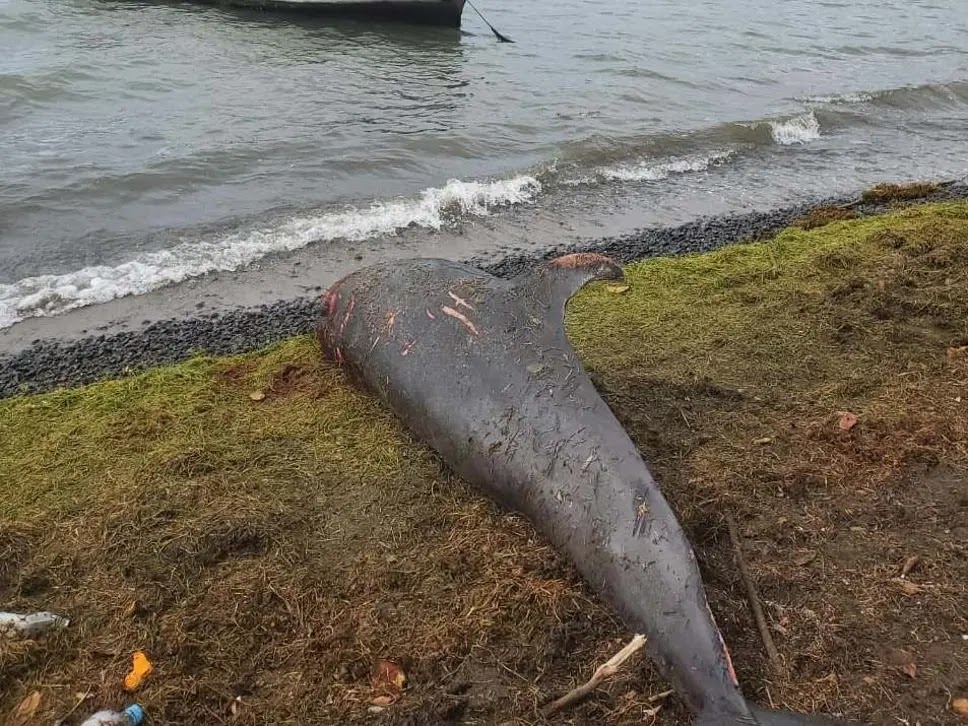
The body of a Melon-headed Whales, Peponocephala electra, on a beach at Grand Sable, Mauritius. Reuters.

The government of Mauritius has been widely accused of failing to respond the the incident with sufficient urgency, with decisions about the handling of the ship and spill being largely left to the ship's owners, Nagashiki Shipping, who are accused of not putting the interests of ordinary Mauritians first, and clean-up efforts onshore being led by a community group, Mobilisation Nationale Wakashio, which formed in response to the incident. Many people in Mauritius suspect the government may be willing to let the size of the incident be downplayed in order to protect the country's tourism industry.

 
Oil-booms made by local volunteers, which are being used to contain an oil spill off Mauritius. Mobilisation Nationale Wakashio.

Melon-headed Whales, Peponocephala electra, are considered to be of Least Concern under the terms of the International Union for the Conservation of Nature's Red List of Threatened Species, being widely distributed in the Indian and Pacific Oceans. In Mauritius they are widely known by the alternative name 'Electra Dolphins', and are one of several types of Dolphin that form a popular tourist attraction in the area (along with Bottlenose Dolphins, Tursiops truncatus, Spinner Dolphins, Stenella longirostris, and other species). These small Cetaceans are easily seen from the shore in many areas of Mauritius, and are tolerant of people swimming in the water with them. Melon-headed Whales, are highly social, living in groups of up to 500 individuals, freely mixing with other species, and having even been recorded adopting and looking after orphaned cubs of other types of Dolphins. This makes the species excellent for tourists wishing to interact with Dolphins, but also makes the particularly vulnerable to mass-death incidents and strandings, when large numbers of individuals encounter the same problem at the same time.

 
A dead Melon-headed Whale, Peponocephala electra, on a beach in Mauritius. Nitin Jeeha/BBC.

See also...


Follow Sciency Thoughts on Facebook.


Friday, 7 August 2020

Mauritian beaches threatened by oil from stricken ship.

Several beaches in Mauritius have been closed to the public after oil was found to be leaking from a ship stranded on a reef off the coast of the island nation. The Panama-registered container-ship MV Wakashio ran aground off the coast of Pointe d'Esny, a Ramsar Convention-registered Wetlands of International Importance, on Sunday 25 July 2020. The crew of the vessel was evacuated successfully, but attempts to pump out the 200 tonnes of diesel and 3800 tonnes of bunker fuel aboard the ship it have failed, and oil has now been found to be leaking from the vessel, prompting local authorities to close off beaches in the Blue Bay, Pointe d'Esny and Mahebourg areas. There are also concerns that if the ship cannot eventually be refloated that it might break up, leading to a much worse environmental crisis.

The MV Wakashio caught on a reef off the coast of Pointe d'Esny, Mauritius. Dev Ramkhelawon/L'Express Maurice/AFP/Getty Images.

Oil spills are potentially harmful to marine life in a variety of ways. Most obviously it can coat the outside of organisms, causing damage to external structures such as the feathers of Birds and fur of Mammals, as well as smothering many marine invertebrates and plants. It also contains a variety of chemicals which can be directly toxic upset the hormonal balance of many animals. Oil also impedes the feeding of marine organisms, coating both food and feeding organs, but provides an excellent food source for Bacteria, which can lead to Eutrophication events - dramatic increases in Bacteria numbers, which then use all the oxygen in the water, leading other organisms to asphyxiate.

The location of Pointe d'Esny on the southeast coast of Mauritius. Google Maps.

See also...


Follow Sciency Thoughts on Facebook.

Saturday, 4 February 2017

Understanding the origins of the Giant Tortoises of the southwest Indian Ocean.

Giant Tortoises were once numerous on both continental and island landmasses, though most of the continental species became extinct in the Late Pleistocene and most of the island species in the Holocene, all of which extinctions have been linked to a single cause, the spread of Modern Humans around the globe. Today only two species of Giant Turtle remain, Chelonoidis nigra in the Galapagos and Aldabrachelys gigantean on Aldabra Island, a small coral atoll in the Indian Ocean, about 400 km north of Madagascar and about 600 km west of the east coast of Africa. The southwest Indian Ocean was formerly somewhat of a hotspot for Giant Tortoise diversity, with at least two species on Madagascar, plus two species on Mauritius, two species on Rodrigues and one on La Réunion.

An Aldabra Giant Tortoise, Aldabrachelys gigantean. Wikipedia.

How the Tortoises got to these islands is somewhat of a mystery; the ancestors of the Giant Tortoises of Madagascar presumably reached there while Madagascar was still attached to the Gondwanan supercontinent in the Cretaceous, or floating there from Africa in the Eocene or earlier, when prevalent currents in the southwest Indian Ocean ran from Africa towards Madagascar (Giant Tortoises seldom voluntarily swim, but float well and can survive long periods at sea, so Tortoises swept out to sea by, for example, flood events, have a reasonable chance of surviving till they reach a new landmass). However from the end of the Eocene onwards, prevalent currents in the southern Indian Ocean have all flowed east-to-west, making it highly unlikely that a Tortoise could drift from island to island in this direction without swimming hundreds of kilometres against the current. This makes the presence of Tortoises on smaller Indian Ocean islands hard to understand, as all of these islands have appeared since the end of the Eocene; Mauritius having first appeared about 8.9 million years ago, La Réunion about 2.2 million years ago and Rodrigues about 1.5 million years ago, while Aldabra, with a highest point only eight meters above sea level, has emerged from and been covered by the sea several times during the past million years, and is thought to have been continuously exposed only for the last 80 000 years.

In a paper published in the Journal of Biogeography on 11 March 2016, Lucienne Wilmé of the School of Agronomy at the University of Antananarivo, and the Missouri Botanical Garden's Madagascar Research & Conservation Program, Patrick Waeber of Forest Management and Development at the Swiss Federal Institute of Technology Zurich, and Joerg Ganzhorn of Animal Ecology and Conservation at Hamburg University, discuss the possibility that Giant Tortoises may have reached the islands of the southwest Indian Ocean not by drifting on ocean currents, but by active movement by Humans.

The earliest Humans arrived on Madagascar about 4000 years ago. These were fairly advanced, already having metal tools, and are thought to have come from Southeast Asia, with subsequent waves of arrivals from Arabia, Africa and eventually Europe. People from Southeast Asia began making ocean-crossing journeys about 45 000 years ago, hopping from island-to-island to reach remote parts of the Indian and Pacific Oceans, as well as the continent of Australia, and possibly South America.

During this process they introduced many animals and plants to the islands they visited, such as Pacific Rat, Rattus exulans, Chicken, Gallus gallus, Sweet Potato, Ipomea batatas, Taro, Colocasia sp., and Banana, Musa sp.. Giant Tortoises have been considered to be excellent eating by most cultures that have encountered them (most species being wiped out by encounters with hungry European sailors in the eighteenth and nineteenth centuries). It is not, therefore, an outlandish idea that early navigators might, having encountered Giant Tortoises on Madagascar, have moved small populations to other islands in the Indian Ocean as a potential food source, either for colonists living permanently on the islands or for other sailors visiting the islands (European sailors introduced Sheep and Goats to many small islands for similar reasons).

Giant land tortoises, geology, oceanography, archaeology of the south-western Indian Ocean, and distance between islands and ocean surface currents prevailing since the closure of the Tethys Ocean. (SdM = Saya de Malha; N = Nazareth; StB = St Brandon; LGM = Last Glacial Maximum). Wilmé et al. (2016).

Wilmé et al. note that no ancient archaeological sites have been found on the Mascarine Islands (Mauritius, Rodrigues and La Réunion), which would seem to present a problem to this theory. However they note that sealevels have varied considerably over the past few thousand years, which has a particularly strong effect on small islands, so that it is quite possible ancient coastal settlements around these islands may have been covered by rising seas.

More problematically, the Tortoises of the southwest Indian Ocean are considered to have belonged to eight different species, which seems unlikely if they were all transplanted from Madagascar (where only two species are known). Wilmé et al. do not dispute the current accepted taxonomy of these species, however they do observe that species isolated on small islands are known to evolve rapidly, and that Tortoises, which produce particularly large clutches of young, are potentially more prone to this effect than slower breeding groups such as Birds or Mammals.

See also...

http://sciencythoughts.blogspot.co.uk/2016/10/mendozachelys-wichmanni-new-species-of.htmlhttp://sciencythoughts.blogspot.co.uk/2016/10/paiutemys-tibert-new-species-of.html
http://sciencythoughts.blogspot.co.uk/2015/12/xiaochelys-ningchengensis-sinemydid.htmlhttp://sciencythoughts.blogspot.co.uk/2015/11/turtle-remains-from-late-miocene-to.html
http://sciencythoughts.blogspot.co.uk/2015/10/turtle-eggs-from-late-cretaceous-of.htmlhttp://sciencythoughts.blogspot.co.uk/2015/10/pappochelys-rosinae-proto-turtle-from.html
Follow Sciency Thoughts on Facebook.

Thursday, 24 September 2015

Stick Insects of the Mascarene Islands.

The Mascarene Islands, Mauritius, Réunion and Rodrigues, lie in the western Indian Ocean, to the east of Madagascar and to the south of the Seychelles. They form part of a chain of biodiversity hotspots across the eastern Indian Ocean, where many islands and island groups have developed unique faunas and floras seen nowhere else. However, while Madagascar and the Seychelles are continental fragments left over from the breakup of Gondwana and started as islands with some unique fauna, the Mascarene Islands are of volcanic origin, formed by hotspot volcanism in a similar way to Hawaii or the Canary Islands, and all of the flora and fauna there must have reached the islands since they first rose above the waves, about 8-10 million years ago in the case of Mauritius, the oldest and largest of the islands.

Much of the fauna of the Mascarenes, shows a close affinity with that of Madagascar, the largest landmass in the southeast Indian Ocean and only 700 km from Mauritius. Mascarene Groups such as Day Geckos, Slit Eared Skinks, Giant Tortoises, Land Snails and Orb Spiders have all been shown to have originated from Madagascar. Other animals have been shown to be of Indo-Pacific origin, having apparently descended from animals that crossed the 5600 km of open-ocean from Australia or 7000 km from New Guinea. This group includes the famous but extinct Dodos and Solitaires, Skinks of the genus Leilopisma and Geckos of the genus Nactus.

The Stick Insects, Phasmatodea, of the Mascarenes present a unique problem to biogeographers, as they include members of four different subfamilies and one species of uncertain origin, apparently implying repeated colonization of the islands by members of different Stick Insects from different areas. Given the remoteness of the Mascarene Islands, this would be implausible for a group of flying, wide-ranging Insects, and is highly unlikely for Stick Insects, which have only very weak flying abilities, being able to slow their descent when falling from a tree, but not to make long, trans-oceanic migrations.

In a paper published in the journal BMC Evolutionary Biology on 16 September 2015, Sven Bradler of the Johann-Friedrich-Blumenbach-Institute of Zoology andAnthropology at the Georg-August-University Göttingen, Nicolas Cliquennois of the Collège français in Antsirabe, Madagascar and Thomas Buckley of Landcare Research, the School of BiologicalSciences at The University of Auckland and the Allan Wilson Centre, describe the results of a genetic study of the origin of Mascarene Stick Insects, which included data from 120 species of Stick Insects from around the globe, including seven species from Mauritius and three from Réunion (the single described Stick Insect species from Rodrigues, Xenomaches incommodus, is thought to be extinct, and no material was available for inclusion in the study).

Mascarene stick insects. (a) Couple of Apterograeffea reunionensis (Platycraninae) from Réunion. (b) Male of Epicharmus marchali (Xeroderinae) from Mauritius. (c) Female of Rhaphiderus spiniger (Tropidoderinae) from Réunion. Bradler et al. (2015).

Bradler et al. found that, contrary to expectations, all of the Mascarene Stick Insects belonged to a single lineage within the Lanceocercata, an Australasian group, having split from their closest Australian relatives about 27.15 million years ago, and with all the Mascarene Island Stick Insects having shared a last common ancestor that lived about 22.03 million years ago. The group has subsequently diversified into a number of forms that closely resemble members of other groups through convergent evolution, i.e. evolving the same traits to deal with similar ecological problems. For example, the Mascarene genus Apterograeffea has been considered to be a member of the Platycraninae (Coconut Stick Insects), closely resembling members of this group due to also having greatly enlarged cheeks, which support extra muscles which support the mandibles when chewing on tough foliage, while the Mauritian Epicharmus has been assigned to the Xeroderinae, resembling several members of this group with which it shares the habit of living on tree bark.

Chronogram of the sampled stick insect specimens with taxa distributed across the Indian Ocean highlighted in tones of red. Numbers at nodes indicate bootstrap values (left) and clade posterior probabilities (right); grey bars show 95 % highest probability density. Circled numbers refer to fossil calibration points: (1) Renphasma, (2) Eophasma, (3) fossil Malacomorpha, (4) fossil Clonistria. Abbreviations: Pl, Pliocene; Qu, Quaternary. Bradler et al. (2015).

This timescale is slightly problematic for the colonisation of the Mascarene Islands, as it requires the Stick Insects to have separated from their Australian relatives and begun diversifying into newly available niches considerably before the origin of the islands.

However, the Mascarene islands are of volcanic origin, the latest in a chain of islands formed by the movement of a volcanic hotspot, the Réunion Hot Spot, moving southwards across the Indian Ocean. Volcanic hot spots are formed where deep plumes of hot magma rising up from the Earth's interior intersect with the tectonic plates on the surface of the planet. Since these plumes originate deep within the mantle, their movement at the surface is independent of the movement of the tectonic plates. This means that while the currant Mascarene Islands, Mauritius, Réunion and Rodrigues, are quite young, a chain of previous islands, now sunken beneath the seas, extends northwards from them along the line of the volcanic hotspot.

Bradler et al. reason that the Mascarene Island Stick Insects could have originally colonised one of these sunken islands, most probably Siant Brandon, which lies 385 km to the northeast of Mauritius and which first emerged from the sea about 31 million years ago, or Nazareth Bank, slightly to the north of Saint Brandon, which first emerged about 35 million years ago, and subsequently colonised the current Mascarene Islands from these now sunken 'stepping stones', possibly via the smaller uprisings of Baissac Bank and Soudan Bank.

Dispersal scenario of Mascarene stick insects superimposed on a map of the Indian Ocean. (a) Current map of the Indian Ocean. (b) Enlarged view of Mascarene plateau. Red arrows indicate postulated colonisation events: The ancestral Mascarene stick insect arrived on currently submerged islands located to the North of Mauritius followed by a radiation and at least three (maximal six) independent dispersals to Mauritius and another three dispersals to Réunion, most likely facilitated by ocean currents. Bradler et al. (2015).

See also...
http://sciencythoughts.blogspot.co.uk/2015/05/eruptions-on-piton-de-la-fournaise.htmlEruptions on Piton de la Fournaise.
The Observatoire Volcanologique du Piton de la Fournaise reported a sharp rise in sulphur dioxide emissions from Piton de la Fournaise, a shield volcano which forms much of the eastern part of Réunion...
http://sciencythoughts.blogspot.co.uk/2015/05/syzygium-pyneei-new-species-of-myrtle.html


Syzygium pyneei: A new species of Myrtle from Mauritius. 
The genus Syzygium is the largest within the Myrtle family, Myrtaceae, with over 1200 described species from across the tropical and subtropical regions of the Old World, including fifteen previously described species from Mauritius.


http://sciencythoughts.blogspot.co.uk/2015/02/eruptions-on-piton-de-la-fournaise.htmlEruptions on Piton de la Fournaise, Réunion Island.                                          On Wednesday 4 February 2014 the Observatoire Volcanologique du Piton de la Fournaise recorded 180 Earthquakes between 4.00 and 9.00 am, on Piton de la Fournaise, a shield volcano which forms much...
Follow Sciency Thoughts on Facebook.

Thursday, 21 May 2015

Syzygium pyneei: A new species of Myrtle from Mauritius.


The genus Syzygium is the largest within the Myrtle family, Myrtaceae, with over 1200 described species from across the tropical and subtropical regions of the Old World, including fifteen previously described species from Mauritius.

In a paper published in the journal PhytoKeys on 5 February 2015, James Byng of the School of Biological Sciences at the University of Aberdeen and the Herbarium of the Royal Botanic Gardens at Kew, Vincent Florens of the Department of Biosciences at the University of Mauritius and Cláudia Baider of The Mauritius Herbarium at the Ministry ofAgro-Industry and Food Security of Mauritius, describe a new species of Syzygium from Mondrain Reserve on the island of Mauritius.

The new species is named Syzygium pyneei, in honour of Kersley Pynee, a prominent Mauritian botanist who first noticed the species. Only two specimens are known, both growing on a ridge in the Mondrain Reserve at a height of about 520 m. The specimens were observed to flower in November 2006, reportedly for the first time in about 20 years. A few fruits were observed on the ground in January 2006, but no seedlings observed. The species is distinguished by its flowers, which are relatively large (over 2 cm), pinkish green in colour and grow directly from the trunk of the plant.

Sole recorded flowering event of Syzygium pyneei. Kersley Pynee in Byng et al. (2015).

Syzygium pyneeiis a large shrub reaching 3.5 m in height, with grey or creamy pink bark and waxy oval leaves, 10-15 cm in length and 4.5-9 cm in width. It produces fruit 20 mm in length containing one or two seeds, these being globular if one seed is present or half-moon shaped when there are two.

Syzygium pyneei (A) and (B) bark (C) close-up of branchlet (D) lower leaf surface (E) upper leaf surface. James Byng in Byng et al. (2015).

The Mondrain Reserve is a private reserve which has been fenced to keep out invasive alien Deer and cleared on invasive plants. The area surrounding the reserve has a similar habitat, but is dominated by alien species notably Psidium cattleianum (Peruvian Guavas), a highly invasive species known to be highly detrimental to other Mauritian native plants. A search of this forest revealed no further specimens of Syzygiumpyneei, suggesting that it has been excluded by competition with non-native species. Since only two plants are currently known the species is classified as Critically Endangered under the terms of the International Union for the Conservation of Nature’s Red Listof Threatened Species.

See also…

Ants are often highly adaptable animals, and many species have proven to be highly invasive pests, able to reach new homes by hitching a ride on cargo moved by Humans, and often proceeding modify the...
 
Guavas, Psidium guajava, are fruit bearing trees in the Myrtle Family, Myrtaceae, closely related to Eucalyptus. They are native to Mexico, Central America and the Caribbean Islands, but have been introduced to many countries as a commercial fruit crop, the largest producers being Mexico, India and Brazil. Like...
http://sciencythoughts.blogspot.co.uk/2014/10/the-conservation-status-of-madagascan.htmlThe conservation status of Madagascan Palms.
Madagascar is considered to be one of the world’s biodiversity hotspots. The island has an area of 592 750 km2 and is located in the southern Indian Ocean, giving it a tropical climate with a diverse range of...

Follow Sciency Thoughts on Facebook.