Showing posts with label Marine Mammals. Show all posts

Friday, 10 January 2025

Cochimicetus convexus: A new species of Eomysticetid Whale from the Late Oligocene of Baja California Sur, Mexico.

Baleen Whales, Mysticetes, are the largest Animals alive today, and, as far as we can tell, the largest Animals ever to have lived. They are able to achieve this huge size by a unique feeding mechanism; using a system of keratinaceous baleen plates  to filter food items (such as Crustaceans of small Fish) from the water. The largest Baleen Whales are lunge feeders, capable of engulfing whole shoals of prey-items, then  trapping them on the baleen plates as the accompanying water is pushed out through. The earliest Mysticetes appeared in the Late Eocene, though these were still Toothed Whales, little different from the ancestors of today's Odontocetes. The first true Baleen Whales were the Eomysticetids, a group which appeared in the Early Oligocene. Eomysticetids had baleen plates similar to those of modern Baleen Whales, but appear to have lacked the ability to lunge-feed in the same way, and were not capable of reaching the same sizes.

In a paper published in the journal Palaeontologica  Electronica in January 2025, Cielo Cedillo-Avila and Gerardo González-Barba of the Museo de Historia Natural at the Universidad Autónoma de Baja California Sur,  and Azucena Solis-Añorve, also of the  Museo de Historia Natural, and of Posgrado of Ciencias Marinas and Costeras at the Universidad Autónoma de Baja California Sur, describe a new species of Eomysticetid Whale from the Late Oligocene San Gregorio Formation of Baja California Sur.

The new species is described from a single specimen comprisng a partially complete skull with a length of 147 cm, along with both mandibles and tympanic bulla. It is named Cochimicetus convexus, where 'Cochimicetus' refers to the indigenous Cochimi people, a nomadic group who once inhabited the northern part of Baja California Sur, and 'convexus' refers to the convex shape of the anterior tip of the tympanic bulla, which tends to be pointed in other Eomysticetid Whales.

Dorsal view of the holotype of Cochimicetus convexus. (A) Image showing the identified structures. (B) photography with scale 10 cm. Cedillo-Avila et al. (2025).

Cochimicetus convexus is the fourth species of Eomysticetid Whale from the Oligocene of Baja California Sur, demonstrating the importance of the area for our understanding of the early evolution of the Mysticetes. 

See also...

Monday, 1 April 2024

Fucaia humilis: A Mysticete Whale from the Latest Eocene of Washington State.

Modern Mysticete Whales are noteworthy for the presence of a keratinous baleen, which they use as a filter feeding device, having lost all conventional dentition. The earliest members of the group, which retained teeth, first appeared in the Late Eocene, with the group undergoing a significant diversification event in the Oligocene. To date, only two species of Mysticete Whales are known from the Eocene, both from the Southern Hemisphere (one from Peru and one from Antarctica). This has led to the hypothesis that the Mysticetes are of Southern Hemisphere origin, and that the Oligocene radiation within the group is likely to have been driven by the End Eocene opening of a seaway between Antarctica and South America, and the subsequent formation of the Antarctic Circumpolar Current, which in turn led to a Southern Ocean with superabundant and highly-concentrated nutrients, an environment which could have favoured the evolution of the baleen filter-feeding system. 

In a paper published in the journal Current Biology on 28 March 2024, Cheng-Hsiu Tsai of the Department of Life Science and Institute of Ecology and Evolutionary Biology at the National Taiwan University, and the Department of Geology at the Japanese National Museum of Nature and Science, James Goedert of the Burke Museum of Natural History and Culture at the University of Washington, and  Robert Boessenecker, formerly of the Charleston Center for Paleontology*, describe a third species of Eocene Mysticete Whale, from the Lincoln Creek Formation of Washington State, the first known Mysticete Whale from the Eocene of the Northern Hemisphere.

The new species is placed in the genus Fucaia, which contains two previously described species from the Oligocene of the northwest coast of North America, and given the specific name humilis, meaning 'humble', in reference to the apparent minor role of Mysticete Whales in Eocene ecosystems. The new species is described from a single specimen (UWBM  109363), comprising posterior portion of a skull with right periotic and bulla attached, partial mandible, and the hyoid apparatus.

Geological column and species of Fucaia.  (A) Geological occurrences of Fucaia spp. in Washington State, USA. (B) Dorsal view of Fucaia goedertorum (NTUM-VP 240224, cast of the holotype); (C) dorsal view of Fucaia humilis (UWBM 109363); (D) ventral view of Fucaia goedertorum (NTUM-VP 240224, cast of the holotype); (E) and ventral view of Fucaia humilis (UWBM 109363). Tsai et al. (2024).

The precise location that the specimen was collected from is not given, but is described as being a site on the Middle Fork of the Satsop River, Mason County, dated to 34.5 million years before the present, which is 600 000 years before the Eocene/Oligocene boundary.

(A) The stratigraphic and geological interpretations of the Fucaia humilis discovery site, and (B) field photo, August 2023. Tsai et al. (2024).

Based upon the size of the specimen, the living Whale is estimated to have been between 286 and 206 cm in length, which is fairly typical for small Aetiocetid Whales (the group of toothed Mysticete Whales to which the genus Fucaia belongs).

The discovery of Fucaia humilis in deposits dated to the Latest Eocene of North America has serious implications for our understanding of the evolution of Mysticete Whales. Both previously described Eocene Mysticete Whales came from the Southern Hemisphere, which led palaeontologists to the conclusion that the group came from that part of the world, and that the subsequent Oligocene radiation of Mysticete Whales was driven by events there, notably the formation of the Antarctic Circumpolar Current.

Phylogenetic relationships of Fucaia humilis. Tsai et al. (2024).

The presence of a member of the genus Fucaia, which has been found nowhere else, on the Pacific Northwest of North America in the Latest Eocene suggests a presence of Aetiocetid Whales in this region for around 10 million years, whereas the occurrence of toothed Mysticete Whales in other parts of the world appears to have been somewhat sporadic, with Whales only present some of the time, gaps in the record, and a high turnover of genera, implying unstable environments intermittently colonised by Whales. Notably, the appearance of Fucaia humilis appears to coincide with the development of a Kelp forest ecosystem in this area, something which persists to this day. Kelp forests provide a stable, nutrient rich environment, which was apparently favourable to small Aetiocetid Whales. 


*Robert Boessenecker was arrested on 14 March 2024 along with his wife, the former museum collection manager at the Mace Brown Natural History Museum, accused of stealing fossils with a value of US$8634 from the collection of the Mace Brown Museum when both were employed there.

See also...

Tuesday, 15 August 2023

Monitoring Cetaceans in the Azores.

Gathering data on the numbers and movements of far-ranging ocean Animals such as Cetaceans is notoriously difficult, which is unfortunate, as such Animals are considered to be key indicators of the condition of marine ecosystems, with current concerns about the long-term health of the marine environment making such data particularly crucial. The Marine StrategyFramework Directive requires European Union member states with coasts to monitor the biodiversity of their territorial waters in order to maintain the marine environment. However, this does not include dedicated Cetacean surveys, due to the complexity and expense of maintaining such programs. This leaves Cetacean surveys largely in the hands of citizen scientists and commercial organizations.

The highly charismatic nature of Whales and Dolphins makes them ideal for citizen science projects, with the public often keen to take a role in their conservation. Whale watching tours have become popular tourist activities in many parts of the world in recent decades, providing both a tool for educating the public about marine ecology and an excellent opportunity for scientific programs studying Whales to piggyback onto the commercial activity. Such programs have proven particularly good for gathering long-term data on Whales within areas where tours are carried out. Whale-watching tours are therefore a cost-effective tool for monitoring Whale populations, particularly in areas where funding is limited or unavailable. Successful examples include the ORCA Survey Network operating in UK waters, the Fixed Line Transect Mediterranean monitoring Network, which works from European Atlantic and Mediterranean ferries, the CETUS project, which operates from cargo boats out of Macaronesia (the Azores, Madeira, the Canaries, and the Cape Verde islands) and mainland Portugal, and the Kakila database, which gathers data from Whale watching tours in the Caribbean. Data gathered from such sources has led to numerous publications on the distribution, movements, and habitat preferences of Cetaceans.

The Azores Islands are located in the North Atlantic Ocean at 36-41° North and 24-32° West. The archipelago is composed of nine volcanic islands organised into three groups separated by deep waters (i.e. deeper than 2000 m): the Western (Flores and Corvo), Central (Faial, Pico, Graciosa and Terceira) and Eastern groups (São Miguel and Santa Maria). The archipelago presents a well-defined oceanographic seasonality: March is usually the coldest month (average sea surface temperature 15°C), while the highest temperatures are generally reached in September (average sea surface temperature 25°C). The spring bloom is noticeable each year by the increase in chlorophyll concentrations, which drastically drop to oligotrophic conditions during summer. 

The people of the Azores have been linked to Cetaceans since the islands were first colonised in the fifteenth century, when early settlers are known to have harvested Whales stranded on beaches or found dead at sea. In the mid eighteenth century, whalers from North America began to visit the islands in pursuit of Sperm Whales, Physeter macrocephalus, often recruiting local people as crew for their vessels. The Azoreans learned the techniques used by the Americans, and adapted them to their own needs, replacing spotters mounted high upon ships with spotters at high points on land, and using these to guide small boats towards sited Whales in the same way. 

Over time the oil for which Sperm Whales was hunted was replaced by oil from other sources, making Whaling less profitable, and the practice began to die out in the 1960s. In 1982, Portugal ratified the Moratorium of theInternational Whaling Commission, and in 1986 Whaling was officially banned in all Portuguese territories, including the Azores, where the last two Sperm Wales were killed in 1987. 

The whaling industry provided the first accurate data on Whales collected in the Azores, with whalers collecting data on changes in the distribution of Whales over time, the first accurate descriptions of the Animals, and even the first records of their eating giant Cephalopods. In 1987 the government of the Azores, with support from the European Union, invited the International Fund for Animal Welfare to carry out a feasibility study on the potential for developing a Whale-watching industry in the Islands. The first tours were carried out from Pico Island in 1989, and rapidly became popular with tourists. Some the earliest recruits to the new business were former lookouts from the Whaling industry, and they were soon followed by former whalers, who worked as skippers on the new boats, brining with them their expertise in the ecology and behaviour of the Whales. In 1993 Whale-watching tours also began from São Miguel Island, with tours later starting from Faial and Terciera islands.

To date, 28 species of Whales and Dolphins have been observed around the Azores, making the islands one of the most popular Whale-watching destinations in the world. From the outset, the Whale-watching industry in the Azores was built on an ecotourism model, with regulations developed through collaboration between the tour operators, the scientific community, and the government of the Azores. The first Bienal das Baleias conference was held in Lajes do Pico in October 1998, with the various groups involved seeking to come to a consensus on further developing an ecologically friendly industry. As a consequence of this, legislation was introduced in 1999, which required the mandatory collecting of data on Whales by the tour boats, although this proved to be highly impractical, and was quickly dropped, although all parties involved agreed that a system of gathering this data was needed, both to develop the Whale-watching industry and to further the study and conservation of the Whales. 

The MONICET project grew out of a discussion at the 2006 Bienal das Baleias conference, with a scientific consortium working with three Whale-watching companies to develop a methodology for collecting data in a scientifically usable manner, and a remit to develop a database to store this data, all funded by a grant from the Azores government. 

In a paper published in the Biodiversity Data Journal on 8 August 2023, Laura González García of the  Institute of Marine Sciences at the University of the Azores, Marc Fernández of the Marine and Environmental Sciences Centre of the Agência Regional para o Desenvolvimento da Investigação Tecnologia e Inovação, and José Azevedo, also of the Institute of Marine Sciences at the University of the Azores, describe the methodology used by the MONICET project, the data gathered by that project so far, and ways in which this data might be used by researchers outside the Azores. 

González García et al. describe eleven years of MONICET data, collected between 2009 and 2020, and provided by 11 of the 23 Whale watching companies active in the Azore, operating out of four of the nine volcanic islands which make up the Azores (Azores Experiences and Peter Whale Watch from Faial Island; Aqua  Açores and Espaço Talassa from Pico Island; Futurismo Azores Adventures, Picos de Aventura, Terra Azul, Terra do Pico and Sea Colors from São Miguel Island and Atlantiangra, Ocean Emotion and Picos de Aventura from Terceira Island). Not every company reported data every year; participitation in the project is voluntary, and data will always be accepted from any company wishing to participate. In the first year of the project only three companies reported data, while the greatest number was reached in 2019, when nine companies reported.

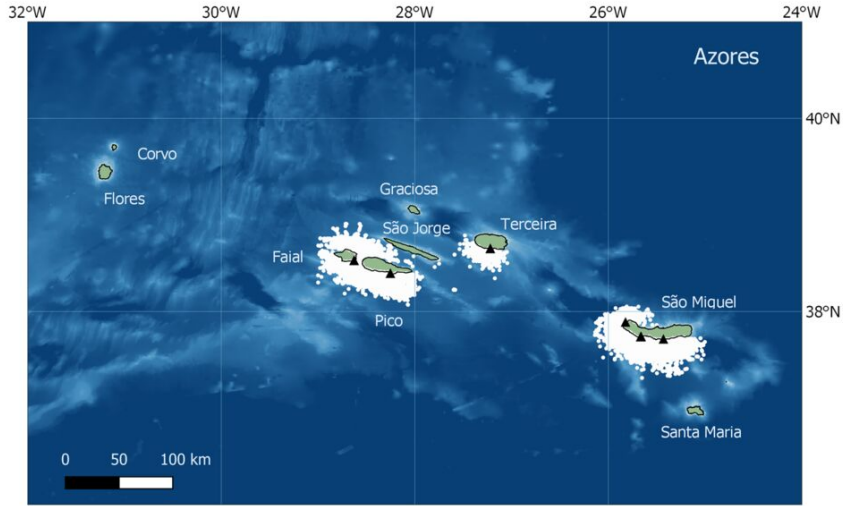
The Azores Archipelago, with the locations (white dots) of all the sightings recorded between 2009 and 2020 in the MONICET database. Base ports of contributing companies are indicated by black triangles. González García et al. (2023).

MONICET uses a collaborative platform to collect and disseminate data on Cetacean sightings and movements, as well as photo images used for Whale identification. The data is collected on a voluntary basis, and is available to all interested persons, including the general public. 

Whale-watching tours in the Azores typically last 2.5-3 hours, with most companies operating two tours per day, although some run three per day in the peak of the tourist season. Tours operate from São Miguel Island year-round, but from the other islands is more seasonal, typically running from May to September. In all cases, Whales are first spotted from land, with experienced spotters guiding boats to the Cetaceans. This typically results in at least one Whale encounter per trip, with boats moving to the Whales then slowing down for periods of observation. 

The data used by MONICET is typically gathered by trained guides on board the boats (often trained biologists), who record the times at which the boats leave and return to their home ports, the location of the boats throughout their voyage (recorded with a GPS system), and the time, location, and species of any Whales encountered, as well as the number of Whales, their approximate age (adults, juveniles or calves), and behaviour, as well as other data about weather, sea conditions etc. Guides are provided with annual training on data collection by MONICET.

Tourists encountering a group of Cetaceans on a Whale-watching tour in the Azores. Futurismo Azores Adventures.

During the period recorded in González García et al.'s data, 37 000 sightings were recorded of 22 Cetacean and three Turtle species, including Minke Whale, Balaenoptera acutorostrata, Sei Whale, Balaenoptera borealis, Bryde's Whale, Balaenoptera edeni, Blue Whale, Balaenoptera musculus, Fin Whale, Balaenoptera physalus, Humpback Whale, Megaptera novaeangliae, Common Dolphin, Delphinus delphis, Short-finned Pilot Whale, Globicephala macrorhynchus, Long-finned Pilot Whale, Globicephala melas, Risso's Dolphin, Grampus griseus, Killer Whale, Orcinus orca, False Killer Whale, Pseudorca crassidens, Striped Dolphin, Stenella coeruleoalba, Atlantic Spotted Dolphin, Stenella frontalis, Bottlenose Dolphin, Tursiops truncatus, Pygmy Sperm Whale, Kogia breviceps, Sperm Whale, Physeter macrocephalus, North Atlantic Bottlenose Whale, Hyperoodon ampullatus, Sowerby's Beaked Whale, Mesoplodon bidens, Blainville's Beaked Whale, Mesoplodon densirostris, True's Beaked Whale, Mesoplodon mirus, and Cuvier's Beaked Whale, Ziphius cavirostris, as well as Loggerhead Turtle, Caretta caretta, Green Turtle, Chelonia mydas, and Leatherback Turtle, Dermochelys coriacea.

One problem noted by González García et al. is that the MONICET data tends to reflect the commercial preferences of the tourist industry. Thus spotters will guide boats towards more appealing Cetaceans, such as families of Sperm Whales or active pods of Dolphins, over Beaked or diving Whales which spend little time at the surface. The data set is presumed to be good, given the training and experience of the guides, but some caution needs to be applied to sightings of more elusive Whales, as these are less often seen, and spend less time at the surface where they can be identified. 

Some types of Whale will alter their behaviour in response to the presence of boats; this is particularly true of Dolphins, which tend to break off other activities in order to investigate Human visitors. For this reason, the activity of Whales is recorded when the boats first arrive, although there is a danger that the Whales may already have been affected by the presence of earlier boats.

Whales active at the surface are more attractive to tour boats than deep diving Whales. Azores Experiences.

See also...


Follow Sciency Thoughts on Facebook.

Follow Sciency Thoughts on Twitter.


Saturday, 5 August 2023

Perucetus colossus: A Basilosauridae Whale from the Eocene of Peru, which may have had a mass exceding that of the modern Blue Whale.

The fossil record of the Cetacea gives us one of the most remarkable examples of an evolutionary transition in a group of organisms, from small, Mouse Deer-like, and entirely terrestrial, Artiodactyls to the largest Animals ever to have lived in out oceans. The early marine Whales developed specialisms for life in the water during one of the Earth's most extreme greenhouse phases, quickly growing in body size, and by the end of the Eocene becoming extremely elongate as well. However, the extreme gigantism seen in modern Whales is a apparently a relatively recent development which appeared in Baleen Whales in the cooling oceans of the Late Cainozoic. One of these, the extant Blue Whale, Balaenoptera musculus, is currently considered to be the heaviest Animal ever to have lived on Earth. This trend in developing large body-size as a development to active pelagic swimming is not unique in Cetaceans, among Tetrapods it can be observed in several clades of Mesozoic Marine Reptiles, such as the Ichthyosaurs.

As Animals make the transition from living in a terrestrial one to living in a marine one, buoyancy control becomes a key aspect of their biology. In Vertebrates, bone is the densest tissue, and large amounts of this tissue are present in the bodies of most Vertebrates. This has resulted in a variety of specialist bone-adaptations appearing in Tetrapods that have returned to an aquatic lifestyle. In Animals with a slow-moving, shallow-diving lifestyle, such as Sirenians, this typically manifests as an increase in bone mass. This increase has been observed in the earliest Whales, and is seen in many Basilosaurids (an extinct Cetacean family which was the most numerous and widespread Whale group in the Eocene). The reverse situation is seen in more active, pelagic swimming marine Tetrapods, including all modern Whales, with bone mass becoming severely reduced, and other tissues taking on a greater role in providing structural support to the body. The Basilosaurids were a unique group, growing to lengths of up to 20 m and having a much higher relative bone mass than modern Whales, although, this has not until now been shown to be close to that of the extant Sirenians.

In a paper published in the journal Nature on 2 August 2023, Giovanni Bianucci of the Dipartimento di Scienze della Terra at the Università di Pisa, Olivier Lambert of the Direction Opérationnelle Terre et Histoire de la Vie at the Institut Royal des Sciences Naturelles de Belgique, Mario Urbina of the Departamento de Paleontología de Vertebrados at the Museo de Historia Natural of the Universidad Nacional Mayor de San Marcos, Marco Merella and Alberto Collareta, also of the Dipartimento di Scienze della Terra at the Università di Pisa, Rebecca Bennion, also of the Direction Opérationnelle Terre et Histoire de la Vie at the Institut Royal des Sciences Naturelles de Belgique, and of the Evolution & Diversity Dynamics Lab at the Universite de Liege, Rodolfo Salas-Gismondi, also of the Departamento de Paleontología de Vertebrados at the Museo de Historia Natural of the Universidad Nacional Mayor de San Marcos and of the Facultad de Ciencias y Filosofía and Centro de Investigación para el Desarrollo Integral y Sostenible at the Universitad Peruana Cayetano Heredia Lima, Aldo Benites-Palomino, again of the Departamento de Paleontología de Vertebrados at the Museo de Historia Natural-Universidad Nacional Mayor de San Marcos, and of the Department of Paleontology at the University of Zurich, Klaas Post of the Natuurhistorisch Museum Rotterdam, Christian de Muizon of the Département Origines et Évolution at the Muséum National d’Histoire Naturelle, Giulia Bosio of the Dipartimento di Scienze dell’Ambiente e della Terra at the Università degli Studi diMilano-Bicocca, Claudio Di Celma of the School of Science and Technology at the University of Camerino, Elisa Malinverno, also of the Dipartimento di Scienze dell’Ambiente e della Terra at the Università degli Studi di Milano-Bicocca, Pietro Paolo Pierantoni, also of the School of Science and Technology at the University of Camerino, Igor Maria Villa of the Institut für Geologie at the Universität Bern, and  Eli Amson of the Staatliches Museum für Naturkunde Stuttgart, describe a new species of Basilosaurid Whale from the Late Eocene Paracas Formation of Peru, which combines a gigantic size with the highest degree of bone mass increase ever seen in a Whale, which was potentially heavier than the living Blue Whale.

The new species is described from a single specimen, MUSM 3248, which was recovered from the upper part of the Yumaque Member of the Paracas Formation exposed in the Ica valley a few kilometres south of the Zamaca locality, and is now housed in the collection of the Museo de Historia Natural of the Universidad Nacional Mayor de San Marcos. This was five metres below a tephra layer radioisotope dated to 36.8 million years ago. Based upon this, and biostratigraphic data from the silts of the Yumaque Member, the specimen is estimated to be between 39.8 and 37.84 million years old, making it Bartonian, or Middle Eocene in age. The species is named Perucetus colossus, where 'Perucetus' means 'Peru Whale' and 'colossus' means gigantic.

Location and stratigraphic position of Perucetus colossus MUSM 3248. (a) Map showing the position of the Coastal Batholith and major trench-parallel structural highs along the coast of Peru. (b) Stratigraphic column of the Cainozoic succession exposed in the East Pisco Basin. (c) Measured stratigraphic section of the type locality of Perucetus colossus, indicating the stratigraphic height of the holotype MUSM 3248, the dated tephra layer, and the identified bioevents. Bianucci et al. (2023).

The specimen comprises a partial skeleton including 13 vertebrae (two tentatively referred to the last thoracics and the others to the anterior lumbars), four ribs and right innominate lacking the distal portion of the ilium. It is believed to have been nearing skeletal maturity when it died. 

Perucetus colossus differs from all other known Cetaceans in the extremely pachyosteosclerotic (thick and dense) nature of the bones of its post-cranial skeleton. Pachyosteosclerosis has been reported in Cetaceans before, and is a defining feature of the Basilosaurid Subfamily Pachycetinae, but never to the extent seen in Perucetus colossus. 

Partial skeleton of the Perucetus colossus MUSM 3248 holotype. (a) Schematic body and skeletal reconstruction reporting the preserved bones (red). (b), (c) Right rib in anterior (b) and lateral (c) views. (d)–(f) Right innominate in medial (d), dorsal (e) and lateral (f) views. (g)–(i) Last preserved lumbar vertebra in anterior (g), left lateral (h) and dorsal (i) views. (j)–(l) Articulated sequence of the 13 collected vertebrae in dorsal (j), ventral (k) and right lateral (l) views. Scale bars, 50 cm (b), (c) and (g)–(l) and 10 cm (d)–(f). All of the images were generated from 3D surface models. Bianucci et al. (2023).

Although heavily modified by the presence of additional dense bone material, the transverse processes of the vertebrae are sufficiently similar to those of other Basinosaurids for Biannucci et al. to be confident about their placement as the two thoracic and the first eleven lumbar vertebrae. About half the vertebrae are missing their centrum epiphyses, a sign that these bones were not fused at the time of death. In a terrestrial Mammal, this would be taken as a sign of immaturity, but in Whales this condition frequently persists into adult life, and is therefore considered to be of no significance for determining the age of the specimen. 

One of the vertebrae of Perucetus colossus being moved during the recovery of the specimen. Universitad Peruana Cayetano Heredia Lima.

The best preserved rib displays a simple proximal end without distinct tuberculum and capitulum and a weak overall curvature in anterior or posterior view, which is consistent with a placement in the posterior region of the rib cage. Since pachyosteosclerosis of the ribs tends to develop in the foremost ribs first, this is consistent with the entire rib cage being pachyosteosclerotic.

Specimen MUSM 3248, shows no signs of having been pathological in any way (pathological pachyosteosclerosis tends to produce highly variable bone density distribution), but rather appears to have been a healthy specimen of a species with a highly pachyosteosclerotic skeleton. The apophyses of the vertebrae are distinctive in having a 'bloated' appearance, unlike that of any other Mammal, whereas in all other Cetaceans, including the largest Balaenopterids and Balaenids, the vertebral apophyses tend to be relatively thin.

Pachyostosis in the Perucetus colossus MUSM 3248 holotype. (a)–(c) Skeleton (a) preserved bones in dark grey, life reconstruction (b), and 3D models of a rib (c) and lumbar vertebra (d) of Perucetus colossus. (e)–(j) Skeletons (e), (h), posterior rib (f), (i) and last lumbar vertebra (g), (j) of the Wexford Blue Whale, Balaenoptera musculus; (e)–(g) and another Basilosaurid, Cynthiacetus peruvianus (h)–(j). Scale bars, 50 cm for isolated bones in (c), (d), (f), (g), (i) and (j) and 2 m for the skeletons and reconstruction in (a), (b), (e) and (h). The dagger symbols (†) indicate extinct species. Bianucci et al. (2023).

The ribs which were found were also highly pachyosteosclerotic, leading Bianucci et al. to conclude that this state would have applied to the whole skeleton. If this was the case, then the volume of the entire skeleton would have been 2.9-4.1 m², and would have weighed 5.3 to 7.6 tonnes, which is 2.0–2.9 times as much as that of a 25 m long Blue Whale.

The total range of skeletal masses found in Tetrapods varys between about 26 mg in the Dwarf Chameleon Brookesia nana, and an estimated 9.9 tonnes in the giant Titanosaur, Argentinosaurus huinculensis. Modern Cetaceans have relatively light skeletons, compared to the rest of their tissues, perhaps making up 2.2-5.1% of their entire body mass, while that of terrestrial Mammals varies between 4 and 10%. The skeletons of Sirenians, aquatic Mammals with a lifestyle similar to that presumed for pachyosteosclerotic Basilosaurs such as Perucetus colossus. tend to have skeleton-mass-to-body-mass ratios similar to that of terrestrial Mammals. 

Estimating the body mass of extinct Animals such as Basilosaurs is complicated, and in the case of Perucetus colossus is made more challenging by the extreme skeletal morphology. It is likely that the heavy skeleton would have been counterbalanced by a large volume of buoyant blubber, which would have had a strong impact on the overall density and mass of the soft tissue of the living Whale. If it is assumed that Perucetus colossus has a skeleton-mass-to-body-mass ratio similar to that of modern Sirenians, then the living Animal would have had a total mass of about 85 tonnes, but if the ratio was comparable to that of living Whales, then it would have been between about 180 and 340 tonnes. Adult Blue Whales typically have a total body mass of about 130-150 tonnes, so it is possible that Perucetus colossus was more massive than a Blue Whale.

Scaling of the skeletal mass across Amniotes’ body mass range. Regressions based on extant terrestrial Mammals (grey line) and extant Cetaceans (blue line). The estimated values for extreme terrestrial Amniotes, Sirenians (either measured or estimated) as well as the results of the estimations for Perucetus colossus are also shown. Each data point corresponds to a distinct species (specific mean for the largest extant cetaceans, Balaenoptera musculus and Physeter macrocephalus), except for extant sirenians (represented by two species). The horizontal and vertical bars indicate the maximum and minimum estimates (some are too small to be visible). Scales are logarithmic. Human height, 1.8 m (scale for larger silhouettes); penny diameter, 2 cm. Bianucci et al. (2023).

Among Tetrapods, high levels of pachyosteosclerosis are only known in fully aquatic species capable of bearing young in the water. The morphology of Perucetus colossus makes it highly unlikely that it was ever able to pull itself onto land for any reason, and therefore it is presumed to have given birth at sea. Its presumed morphology and high level of pachyosteosclerosis make it likely that it lived in shallow waters, such as those inhabited by living Manatees, although the large mass of the Animal may have made it more resilient to wave actions, something which has also been proposed for the more recently extinct t Steller’s Sea Cow, Hydrodamalis gigas. Coastal habitats have previously been proposed for Basilosaurids, based upon their skeletal anatomies and stable isotope data.

 
Reconstruction of Perucetus colossus in its coastal habitat. Because portions of the skeleton are unknown, several aspects of the reconstruction are tentative: the overall proportions of the axial postcranium are based on a close relative Cynthiacetus peruvianus, which was scaled-up and dilated according to the elements recovered for Perucetus colossus; the skull and limbs were only scaled-up; the tail fluke and forelimb use (bottom-walking) are based on the Manatee, Trichechus, sp, the extant Marine Mammal with the closest degree of pachyosteosclerosis in the postcranial skeleton; the hind limb of Perucetus colossus was not recovered, but the anatomy of its innominate indicates the presence of a reduced, articulated leg. The associated Sawfish, Pristis sp., was recovered from the same unit in the East Pisco Basin, the Yumaque Member of the Paracas Formation. Alberto Gennari in Bianucci et al. (2023).

Although Perucetus colossus is known only from a single fragmentary skeleton, lacking a head or any teeth (which would be needed to make any assumption about its diet or feeding habits), some conclusions can be made about the way in which it lived. The vertebrae of Perucetus colossus have elongated centra, something also found in other Basilosaurids, as well as in living Manatees, Trichechus spp., where it is associated with swimming by means of axial undulation. Interestingly, another living Sirenian, the Dugong, Dugong dugon, which lives in more open waters and swims in a similar way to living Whales, by oscillation of a lunate tail, lacks such elongate centra. 

A previous study examined motion in another Basilosaurid, Cynthiacetus peruvianus, providing a methodology to analyse the movement of Perucetus colossus. Doing this showed that dorsal and lateral flexation was extremely limited in Perucetus colossus, but that its capacity for ventral flexation was actually higher than in Cynthiacetus peruvianus, suggesting that swimming was driven entirely by downward strokes of the posterior part of the body. Such a form of motion has also been proposed for early Whales Antaecetus and Pachycetus, and would have been particularly useful for pushing the Animal away from the seafloor suddenly; in the smaller Whales it has been suggested that this might have indicated they were Ambush predators, but this seems unlikely for an Animal as large as Perucetus colossus; instead a strong upward swimming capacity might have been needed to help it breath. 

Estimates of the osteological range of motion. Extension and flexion of the preserved portion of vertebral column of Perucetus colossus holotype (MUSM 3248) is compared with an equivalent vertebral column portion of Cynthiacetus peruvianus holotype (MNHN.F.PRU10) using the respective 3D models. Intervertebral spaces were reconstructed based on the Common Dolphin, Delphinus delphis. Scale bar is 50 cm. Bianucci et al. (2023).

The large size and undulatory motion of early Whales such as Perucetus colossus and Basilosaurus spp., is similar to that seen in the large Ichthyosaurs of the Early Triassic. In these Marine Reptiles it has been suggested that their large size might have helped to compensate for the high energetic cost of undulatory locomotion. It has also been observed that the earliest members of several Mesozoic Marine Reptile groups shared a small size (less than 1 m), pachyosteosclerotic skeleton, and serpentiform body adapted for undulatory motion, suggesting that all these Animals were the subjects of similar selective pressures, associated with shallow diving in a coastal environment. Having adopted such a lifestyle, all would then have been under further selective pressure to grow in size, allowing longer and deeper dives.

While the absence of a skull makes it impossible to accurately reconstruct the feeding habits of Perucetus colossus, its large size and a body apparently adapted to slow swimming and diving in near-shore environments, do make some speculation possible. Such a large Animal must have required very large quantities of food, and therefore that food must have been fairly abundant. Perucetus colossus has been observed to share a number of features with extant Sirenians, a group which feeds almost exclusively on Seagrass and Macroalgae, but no other Cetacean has ever been recorded to follow a herbivorous lifestyle, so this seems a little unlikely. An alternative might be sessile or sedentary benthic Animals such as Crustaceans, demersal Fish, and Molluscs. Such organisms could be harvested with a sucking and/or filter feeding technique, similar to that used by the living Grey Whale, Eschrichtius robustus, or possibly to have fed on sunken carrion, in a way similar to many large, bottom-dwelling Sharks.

The discovery of Perucetus colossus extends the range of known skeletal phenotypes for Vertebrates, and our understanding of the maximum achievable body mass for a healthy Animal. It further shows that masses close to or exceeding 100 tonnes are not a recent phenomenon in Cetaceans, as has previously been assumed, but had also been achieved by the second half of the Eocene; a time during which the maximum size was also achieved by several other Mammal groups. While the remains of the only known specimen of Perucetus colossus are fragmentary, preventing a full reconstruction of the living Animal and its lifestyle, it appears to have been adapted for a slow-swimming, most likely coastal, benthic habit, showing that a fully pelagic lifestyle is not necesarily a prerequisite for achieving large size in Cetaceans. It further expands the known ecological niche of the Basilosaurids, but supports the hypothesis that this group was essentially restricted to coastal environments, which are known to have been highly productive during the Eocene.

See also...


Follow Sciency Thoughts on Facebook.

Follow Sciency Thoughts on Twitter.


Saturday, 12 February 2022

Hydrodamalis gigas: Applying genomics to the extinct Steller’s Sea Cow.

The Steller’s Sea Cow, Hydrodamalis gigas, was first described by German naturalist and explorer Georg Wilhelm Steller in 1741, and became extinct 27 years later, presumably as a result of Human activities. As a Sirenian reaching over 10 m in length and weighed in excess of 10 metric tons and living in the subarctic waters around the Commander Islands, of the Russian Far East, Steller’s Sea Cow was a very unusual Animal (all other known Sirenian species are tropical or subtropical in distribution, and the largest reach about 4 m in length and weigh at most 1.5 tons). As with many other extinct Animals, understanding the biology of the Steller’s Sea Cow, has been difficult.

In a paper published in the journal Science Advances on 4 February 2022, a team of scientists led by Diana Le Duc of the Institute of Human Genetics at the University Medical Center Leipzig, and the Department of Evolutionary Genetics at the Max Planck Institute for Evolutionary Anthropology, Akhil Velluva, also of the the Department of Evolutionary Genetics at the Max Planck Institute for Evolutionary Anthropology, and of the Rudolf Schönheimer Institute of Biochemistry at the University of Leipzig, and Molly Cassatt-Johnstone of the Department of Ecology and Evolutionary Biology at the University of California, Santa Cruz, present the results of a study which attempts to understand the biology of the Steller’s Sea Cow by analysing genetic material from its bones.


Sirenian distribution according to the International Union for Conservation of Nature Red List. Le Duc et al. (2022).

Le Duc et al. extracted DNA from the bones of 12 Sea Cows from Bering Island, as well as two well preserved museum specimens (SNMB N51667 from the Braunschweig Natural History Museum and SC16.JK045 from the collection of the Kamchatka Branch of the Pacific Geographical Institute). Analysis of the mitochondrial DNA (mDNA) of the Bering Island bones confirmed that these were from different individuals, radiocarbon dated to 2205 to 1155 before the present. They were able to generate a comparative dataset consisting of 4877 orthologous genes, which was compared to previously published genomes of the Dugong, Dugong dugon, and Florida Manatee, Trichechus manatus latirostris. 

It was found that two of the genes which code for arachidonate lipoxygenases were inactivated via premature stop codons in all the Steller’s Sea Cow individuals. In Humans, inactivation of either of these genes leads to a disease called congenital ichthyosis, in which the patient develops hyperkeratotic, dry, thickened, scaling skin. This is interesting, as Steller’s Sea Cows are described as having had skin resembling 'the bark of an old oak tree'. Since these genes were inactivated in all of the individuals examined, Le Duc et al. calculate that this trait was either fixed, or close to being fixed in the population, suggesting that it conveyed an evolutionary advantage to the Steller’s Sea Cow. Examination of the same genes in other Sirenians, Seals, Sea Otters, and Polar Bears found that they were still active, although they were inactive in Cetaceans (Whales and Dolphins). Cetaceans do not show scaly or bark-like skin, but they do shed their skin at a very high rate compared to other Mammals, which may make these genes irrelevant to them. The shedding of skin by Cetaceans is facilitated by the loss of functional genes for desmosomes (specialised adhesive protein complexes) in the upper skin layers. These genes were found to be functional in the Steller’s Sea Cows, which would account for their 'bark-like' skin. 

 
Left: Steller’s Sea Cow drawing according to Steller’s description from 1741. Right: Image of a patient with ichthyosis; detail depicts scaling and hyperkeratosis. Le Duc et al. (2022).

The loss of arachidonate lipoxygenase genes in Cetaceans has been suggested as an adaptation to a life spent completely in a marine environment, along with the hair-loss seen in Cetaceans and Sirenians. However, the functioning arachidonate lipoxygenase genes seen in other, extant, Sirenians implies that moving to a marine environment is not enough, in itself, to make the loss of these genes advantageous, while the convergent loss of these genes in Cetaceans and Steller’s Sea Cow suggests that is does convey an advantage of some sort, and presumably one which applies to both Cetaceans and the Steller’s Sea Cow, but not to other Sirenian species. 

The one notable difference in the habitat of the Steller’s Sea Cow and other Sirenians is the much colder waters that this species lived in, and while Cetaceans are found in all marine environments, many species do spend at least part of their lives in cold waters, and it is not unreasonable to postulate that the last common ancestor of all modern species might have lived in a cold climate.

Another gene that was found to be inactivated in both the Steller’s Sea Cow and Cetaceans, but not extant Sirenians or other Marine Mammals was NPFFR2, which encodes for neuropeptide FF receptor-2, which is linked to thermogenesis. Mice in which this gene is inactivated are known to show increased fat accumulation, and lose the ability to generate heat through the activation of brown adipose tissue. It is thought that brown adipose tissue thermogenesis is less important in larger Animals, which conserve heat better due to their lower body volume to surface area ratio. Steller’s Sea Cow and Cetaceans also show inactivation of the UCP1 gene, which has been linked to the regulation of thermogenesis by brown adipose tissue. In combination, this strongly suggests that both the Steller’s Sea Cow and Cetaceans have sacrificed brown adipose tissue thermogenesis in return for larger size and a greater development of fatty tissues, as an adaptation to living in cold climates.

A larger size and greater fat accumulation capacity also enables Animals to endure longer periods of fasting, which may also have been important for the Steller’s Sea Cow. The species is thought to have subsisted almost entirely upon Dragon Kelp, Eularia fistulosa, a species found throughout the North Pacific from May to September, but absent for the rest of the year. The Pleistocene fossil record of Steller’s Sea Cows suggests that they were once found from Japan to the Baja Peninsula in Mexico, a distribution which suggests the ability to disperse over long distances, and in particular making crossings between oceanic islands. Such crossings would involve being away from the species food source, and could conceivably have been made outside of the Kelp season by non-feeding Sea Cows.

Georg Wilhelm Steller described a population of about 1000 Sea Cows living around Bering Island during the winter of 1741–1742. If this is a typical population size, and the species once inhabited other Kelp forests around the North Pacific, then there may once have been as many as 200 000 individuals living across the west coast of North America, Kamchatka, and the Kurile Islands. 

Le Duc et al. used the pairwise sequentially Markovian coalescent (a method which uses the genome sequence of a single individual to estimate demographic history covering a time span of thousands of generations) to estimate long-term population trends in the Steller’s Sea Cow. From this they estimate that the species had been in decline for around half a million years, possibly with some population stability during the Eemian Interglacial, between 130 000 and 80 000 years ago. This would suggest that, while Humans were probably the final push that drove the species to extinction, the population encountered by early European explorers in the Commander Islands was already a relict of a fast-declining species.

See also...


Online courses in Palaeontology. 

Follow Sciency Thoughts on Facebook.

Follow Sciency Thoughts on Twitter.