Showing posts with label Toothed Whales. Show all posts

Saturday, 23 March 2024

Pebanista yacuruna: A new species of South Asian River Dolphin from the Miocene of Peru.

Toothed Whales, Odontocetes, are known to have colonised freshwater systems multiple times during the Neogene, resulting in four distinct lineages of 'River Dolphins' in different geographical areas, the Iniidae, Lipotidae, Platanistidae, and Pontoporiidae. The Lipotidae had a single species which persisted into modern times, Yangtze River Dolphin, Lipotes vexillifer, but which is thought to have become extinct in the late twentieth century due to Human activities. The Platanistidae comprises two species of completely freshwater-dwelling Dolphins from South Asia, Platanista minor from the Indus River system, and Platanista gangetica from the Ganges River and associated waterways. The Iniidae comprises a single genus of River Dolphins from South America, Inia, as well as a number of fossil species in four extinct genera. The single known species of Pontoporiidae, the La Plata River Dolphin, Pontoporia blainvillei, is also found in South America, but is not an obligate freshwater dweller, also venturing into coastal waters.

The two species of Platanista are among the most highly specialised Cetaceans, with large enlarged, thin and pneumatic supraorbital crests enclosing their melons (fatty organs used in echolocation), and eyes reduced to the point where they are almost blind; an evolutionary adaptation to living in sediment laden waters. A number of fossil Dolphins have been assigned to the Platanistidae, but all are from marine sediments, leaving no clear indicator as to when the group moved into freshwater systems. The South American Iniidae present a similar situation, with most known fossil species coming from marine deposits, although one freshwater species, Ischyrorhynchus vanbenedeni, has been described from the Late Miocene of Argentina.

In a paper published in the journal Science Advances on 20 March 2024, Aldo Benites-Palomino of the Department of Paleontology at the University of Zurich, and the Departamento de Paleontología de Vertebrados at the Museo de Historia Natural of the Universidad nacional Mayor de San MarcosGabriel Aguirre-Fernández, also of the Department of Paleontology at the University of Zurich, Patrice Baby of Geosciences-Environnements Toulouse at the Université de ToulouseDiana Ochoa of the Centro de Investigación para el Desarrollo integral y Sostenible at the Universidad Peruana Cayetano Heredia, and the Departmento de Geología at the Universidad de Salamanca, Ali Altamirano, also of the Departamento de Paleontología de Vertebrados at the Museo de historia natural of the Universidad nacional Mayor de San Marcos, John Flynn of the Division of Paleontology at the American Museum of Natural History, the Department of Earth & Environmental Sciences at Columbia University, and the Graduate Programs in Biology and Earth and Environmental Sciences at the City University of New YorkMarcelo Sánchez-Villagra, again of the Department of Paleontology at the University of Zurich, Julia Tejada, again of the Departamento de Paleontología de Vertebrados at the Museo de Historia Natural of the Universidad nacional Mayor de San Marcos, the Division of Paleontology at the American Museum of Natural History, and of the Division of Geological and Planetary Sciences at the California Institute of TechnologyChristian de Muizon of the Departement Origines et Evolution at the Muséum Nation-al d’Histoire Naturelle, and Rodolfo Salas-Gismondi, once again of the Departamento de Paleontología de Vertebrados at the Museo de Historia Natural of the Universidad nacional Mayor de San Marcos, the Centro de Investigación para el Desarrollo integral y Sostenible at the Universidad Peruana Cayetano Heredia, and the Division of Paleontology at the American Museum of Natural History, describe a new species of  Platanistid Dolphin from the Early to Middle Miocene Pebas Formation of Peruvian Amazonia.

The new species is named Pebanista yacuruna, where 'Pebanista' is a combination of Pebas, after the formation from which the fossil came, and Platanista, the only living genus of Platanistid Dolphin, and 'yacuruna' is a mythical water creature from the folklore of the Kichua peoples of the Peruvian Amazon. The new species is described from a single partial skull, comprising the posterior part of the rostrum, the facial region including part of the right supraorbital crest, the temporal and occipital regions.

Pebanista yacuruna, MUSM 4017. holotype skull in dorsal (A) and (B), ventral (C) and (D), left lateral (E) and (F), and anterodorsal views (F) and (G). Benites-Palomino et al. (2024).

The skull has a preserved length of 698 mm and an estimated width of 281 mm. The sutures of the skull are well fused, indicating that it was an adult at the time of death. The vertex of the skull is deviated leftwards, the premaxillae in the rostrum and facial areas is asymmetric, the braincase is anteroposteriorly shorter than wide; and the palatines lack contact and project dorsolaterally, all of which are diagnostic of the Platanistidae. Based upon the width of the skull, the living Dolphin is estimated to have been between 281 cm and 247 cm in length. Although Pebanista yacuruna undoubtedly occupied an inland, freshwater environment, it is similar in size to marine members of the group, considerably larger than living Platanista spp., and recent River Dolphins in general.

Size comparison between 'River Dolphins' and marine Platanistoids and River Dolphins. White silhouettes indicate the minimum body length calculated or recorded; gray body outlines indicate the largest size recorded or estimated in: (A) Macrosqualodephis ukupachai, (B) Zarhachis flagellator, (C) Pontoporia blainvillei, (D) Pebanista yacuruna, (E) Inia geoffrensis, (F) Platanista gangetica, and (G) Lipotex vexillifer. (H) Artistic reconstruction of Pebanista yacuruna. Jaime Bran in Benites-Palomino et al. (2024).

All known living members of the Platanistidae are restricted to the river systems of South Asia. Fossil Platanistid Dolphins are fairly common in the Oligocene and Miocene, when they appear to have had a global distribution and to have occupied a range of ecological niches, but all previously described fossils of the group are considered to have been marine. The group reached peak diversity in the Early Miocene, declining in numbers and diversity after this time, following the emergence of f other toothed Cetacean groups such as Delphinoids, Beaked Whales, and Physeteroids around the time of the Middle Miocene Climatic Optimum. 

The Early Miocene was a time of global cooling, as well as increased subsidence in the Andean-Amazonian foreland basin system, with most of the modern west Amazon rainforest area in Colombia, Peru, and Brazil covered by a continental-scale fresh water to brackish water foreland system (the Pebas System) parallel to the Andes. During the Early Miocene there were at least two large scale marine influxes from the Caribbean Sea into this basin. This wetland ecosystem reached its maximum extent during the Middle Miocene Climatic Optimum, as a complex arrangement of terrestrial and aquatic environments rich in nutrients and prey types, inhabited by a wide range of Fish, Turtles, Crocodylians (Caimans and Gharials), and mammals (Marsupials, Sloths, Rodents, Primates, and Ungulates), among others. This resource rich ecosystem appears to have favoured large sizes in predators such as Pebanista yacuruna and Gharials, a group of Crocodilians which also have marine ancestry, but which today are restricted to South Asia.

See also...

Monday, 18 April 2022

Orcaella brevirostris: Irrawaddy River Dolphin extinct in Laos, less than 90 surviving in Cambodia.

The Irrawaddy River Dolphin, Orcaella brevirostris, is now officially extinct in Laos after the last surviving member of the species inhabiting a trans-border pool shared with Cambodia, died in February this year. The Dolphin, a male identified as ID#35, was found on a shore of the Chheuteal Pool in Stung Treng Province, Cambodia, having apparently died of injuries sustained when he became entangled in fishing nets on the Laos side of the pool. Irrawaddy River Dolphins are (or were) officially protected in both Laos and Cambodia, with a ban on gill nets, which are notoriously dangerous to small Cetaceans, in environments where they are found. However, while this rule was enforced on the Cambodian side of the border, where there are patrols by river guards and a public education program, part of Chheuteal Pool lies within Laos, where the rules were not enforced, and where Cambodian river guards are unable to operate.

 
ID#35, the last Irrawaddy River Dolphin living in the Chheuteal Pool spanning the border between Laos and Cambodia, found dead in February 2022. Phnom Penh Post.

In 1993 there were 17 Irrawaddy River Dolphins living in Chheuteal Pool, by 2009 this number had fallen to seven, by 2012 there were only six, in 2018 three Dolphins were recorded, and since 2021 ID#35 had been on his own. The Dolphin had been visibly unwell since becoming entangled in fishing gear in January, and was about half of his normal bodyweight when he died. Officials from the Cambodian Fisheries Administration and WWF Cambodia had considered moving him to a site lower in the Mekong Valley in Cambodia, where there is another population, but concluded that they lacked the expertise to do so. 

 
An Irrawaddy River Dolphin, Orcaella brevirostris, in a deep-water pool in Cambodia. Lor Kimsan/WWF Cambodia.

The Mekong Valley population in Cambodia is now thought to comprise only 89 individual Dolphins, with few other populations, in the Irrawaddy River in Myanmar, the Mahakam River in Indonesian Borneo, in Chilika Lagoon in India, in Malampaya Sound in the Philippines, and on the Trat coast in Thailand, each now thought to be less than 100 individuals, although a much larger population is present in the Sundarbans Mangrove Forest of Bangladesh, possibly numbering as many as 6000 individuals. The species is currently classified as Endangered under the terms of the International Union for the Conservation of Nature's Red List of Threatened Species

See also...


Follow Sciency Thoughts on Facebook.

Follow Sciency Thoughts on Twitter


Friday, 25 December 2020

Sperm Whales stranded on Yorkshire coast all reported to have died.

A pod of ten young Sperm Whales, Physeter macrocephalus, which stranded on the coast of East Yorkshire between Tunstall and Withernsea have all died, according to British Divers Marine Life Rescue. The Whales were first spotted by a member of the public at about 8.30 am, who reported them to the Maritime and Coastguard Agency, who in turn contacted British Divers Marine Life Rescue. It was not considered possible to mount any form of rescue operation for the Whales, due to their large size (Sperm Whales can reach about 20 m in length, and weigh up to 80 tonnes) and the rough seas in the area. Sperm Whales seldom live for long if they strand on the shore, and initial inspections of the Yorkshire Whales suggested that they appear to have been malnourished before stranding. Reports of additional Whale strandings at Spurn Point have not been substantiated.

 
A Sperm Whale, Physeter macrocephalus, stranded on the coast of East Yorkshire on 24 December 2020. British Divers Marine Life Rescue.

Sperm Whales are the largest species of Toothed Whales, reaching about 20.5 m in length. The species is currently considered to be Vulnerable under the terms of the International Union for the Conservation of Nature's Red List of Threatened Species, with a population that probably measures somewhere in the hundreds of thousands. The species is thought to have had a population of over a million around the beginning of the nineteenth century, but to have fallen to about 29 000 by 1880. The population rose again in the early twentieth century, as targeting of the species by Whalers declined, then fell from 1946 to 1980 as hunting of Sperm Whales increased again. Since 1985 the species has been protected by a moratorium on the taking of Whales agreed by the International Whaling Commission, and although a few Sperm Whales have been taken by the Japanese Whaling fleet since this time, the main threat to these animals is thought to come from Fishing nets, in which they can become entangled and drown, and plastics, which they can ingest, filling up their stomachs and preventing them from taking their normal food (mostly Squid). 

See also...


Follow Sciency Thoughts on Facebook.

Follow Sciency Thoughts on Twitter.


Tuesday, 24 November 2020

Sperm Whale sighted on sand bar off Norfolk coast.

A dead Sperm Whale, Physeter macrocephalus, has been sighted on a sand bar in the Wash (an inlet of the North Sea separating the English counties of Norfolk and Lincolnshire). The Whale, which is about 1.6 km off the Norfolk coast, was first spotted on Monday 23 November 2020, by staff at the RSPB's Snettisham Reserve, but could not be located later the same day by a team from the Huntstanton Coastguard. However, it was spotted again on Tuesday 24 November, having apparently moved further to the west. The cause of the Animal's death is unclear, but it is thought to be a young male.

 
A Stranded Sperm Whale, Physeter macrocephalus, on a sand bar in the Wash this week. Les Bunyan Wildlife Photography.

Sperm Whales are the largest species of Toothed Whales, reaching about 20.5 m in length. The species is currently considered to be Vulnerable under the terms of the International Union for the Conservation of Nature's Red List of Threatened Species, with a population that probably measures somewhere in the hundreds of thousands. The species is thought to have had a population of over a million around the beginning of the nineteenth century, but to have fallen to about 29 000 by 1880. The population rose again in the early twentieth century, as targeting of the species by Whalers declined, then fell from 1946 to 1980 as hunting of Sperm Whales increased again. Since 1985 the species has been protected by a moratorium on the taking of Whales agreed by the International Whaling Commission, and although a few Sperm Whales have been taken by the Japanese Whaling fleet since this time, the main threat to these animals is thought to come from Fishing nets, in which they can become entangled and drown, and plastics, which they can ingest, filling up their stomachs and preventing them from taking their normal food (mostly Squid). 

See also...


Follow Sciency Thoughts on Facebook.

Follow Sciency Thoughts on Twitter.


Thursday, 5 November 2020

About 120 Short-finned Pilot Whales returned to the sea following mass stranding in Sri Lanka.

About 120 Short-finned Pilot Whales, Globicephala macrorhynchus, have been returned to the sea, following a mass stranding event. The Whales began to wash up on a beach near Panadura, on the southwest coast about 25 km to the south of the capital, Colombia, on Monday 2 November 2020. Volunteers from the local community, joined by members of the country's Navy and Coast Guard, immediately began work to return the Whales to the sea, with most of the Animals thought to have been returned safely, although at least four have known to have died.

 
A Short-finned Pilot Whale, Globicephala macrorhynchus, that died following a mass stranding event in Sri Lanka on 4 November 2020, one of four Whales known to have died as a result of the incident. Lakruwan Wanniarachchi/AFP/Getty Images.

Short-finned Pilot Whales, Globicephala macrorhynchus, are considered to be of Least Concern under the terms of the International Union for the Conservation of Nature's Red List of Threatened Species, with a global population of over 700 000 individuals, split into four distinctive populations, two in the Pacific and one each in the Indian and Atlantic oceans. They typically live in pods of eight to ten individuals, but sometimes assemble into larger groups, sometimes with many hundreds of individuals congregating at the same location. However, this behaviour can make these Whales vulnerable to mass strandings, if large gatherings become spooked or disorientated by some event. The actual causes of such strandings are unclear, with a variety of causes having been suggested, including naval sonar, soar activity, and anomalies in the Earth's geomagnetic field.

See also...


Follow Sciency Thoughts on Facebook.

Follow Sciency Thoughts on Twitter.
 

Thursday, 27 August 2020

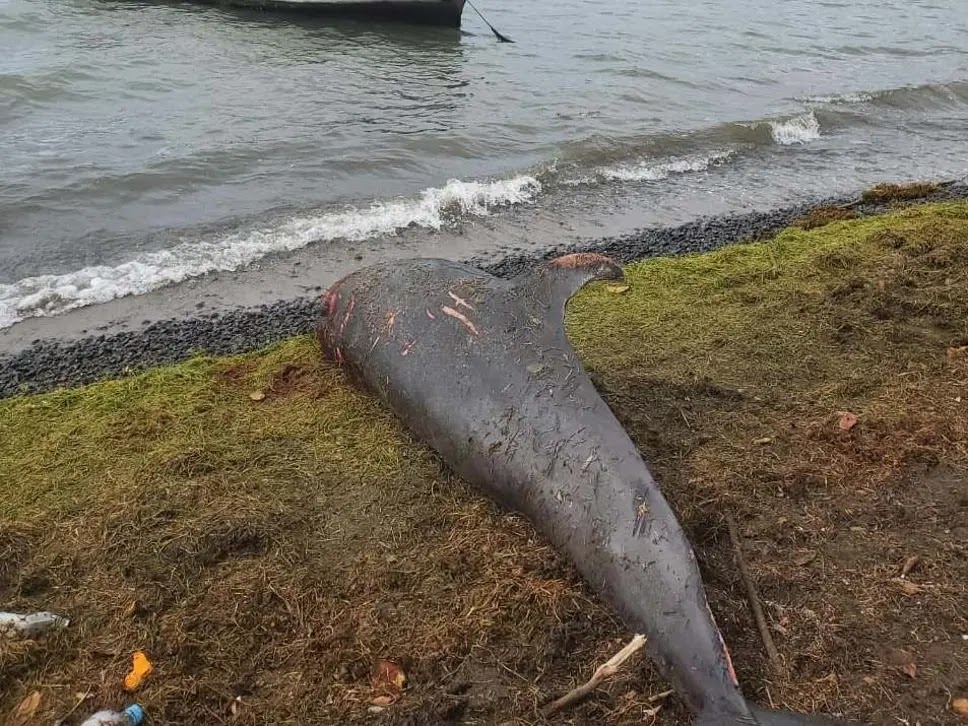
Eighteen Melon-headed Whales found dead on Mauritian beaches following scuttling of Japan-owned cargo ship.

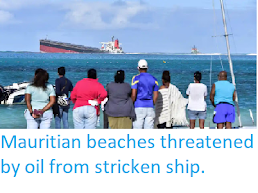
A total of eighteen Melon-headed Whales, Peponocephala electra, have been found dead on beaches in Mauritius over the past 24 hours, with about a dozen further Animals in visible distress close to the shore. The deaths widely thought to be linked to the sinking of the MV Wakashio, a Japan-owned, Panama-registered cargo ship which became stranded on a reef off the island on 25 July 2020. The ship began leaking fuel oil shortly after becoming stranded, with all attempts at refloating it failing. It eventually broke up during an attempt to drag it off the reef on 15 August, with the stern section sinking and the bow remaining afloat. The bow section was eventually scuttled (deliberately sunk) on 24 August. Since the initial stranding oil slicks and dead Fish, Turtles, and invertebrates have washed up on many of Mauritius' pristine beaches, reefs, wetlands, and mangroves, but this is the first reported death of Cetaceans following the event, and concerns have been raised that the deaths may have been linked to the decision to scuttle the vessel.

The scuttling of the bow section of the MV Wakashio off the coast of Mauritius on 25 July 2020. Mobilisation Nationale Wakashio.

At the time of the stranding the MV Wakashio is believed to have been carrying around 3.8 million litres of a heavy fuel oil blend, VLSFO, over a million litres of which may have escaped into the environment. The specific impacts of VLSFO on marine life are unclear, although oil is potentially harmful to marine life in a variety of ways. Most obviously it can coat the outside of organisms, causing damage to external structures such as the feathers of Birds and fur of Mammals, as well as smothering many marine invertebrates and plants. It also contains a variety of chemicals which can be directly toxic upset the hormonal balance of many animals. Oil also impedes the feeding of marine organisms, coating both food and feeding organs, but provides an excellent food source for Bacteria, which can lead to Eutrophication events - dramatic increases in Bacteria numbers, which then use all the oxygen in the water, leading other organisms to asphyxiate.

 
The body of a Melon-headed Whales, Peponocephala electra, on a beach at Grand Sable, Mauritius. Reuters.

The government of Mauritius has been widely accused of failing to respond the the incident with sufficient urgency, with decisions about the handling of the ship and spill being largely left to the ship's owners, Nagashiki Shipping, who are accused of not putting the interests of ordinary Mauritians first, and clean-up efforts onshore being led by a community group, Mobilisation Nationale Wakashio, which formed in response to the incident. Many people in Mauritius suspect the government may be willing to let the size of the incident be downplayed in order to protect the country's tourism industry.

 
Oil-booms made by local volunteers, which are being used to contain an oil spill off Mauritius. Mobilisation Nationale Wakashio.

Melon-headed Whales, Peponocephala electra, are considered to be of Least Concern under the terms of the International Union for the Conservation of Nature's Red List of Threatened Species, being widely distributed in the Indian and Pacific Oceans. In Mauritius they are widely known by the alternative name 'Electra Dolphins', and are one of several types of Dolphin that form a popular tourist attraction in the area (along with Bottlenose Dolphins, Tursiops truncatus, Spinner Dolphins, Stenella longirostris, and other species). These small Cetaceans are easily seen from the shore in many areas of Mauritius, and are tolerant of people swimming in the water with them. Melon-headed Whales, are highly social, living in groups of up to 500 individuals, freely mixing with other species, and having even been recorded adopting and looking after orphaned cubs of other types of Dolphins. This makes the species excellent for tourists wishing to interact with Dolphins, but also makes the particularly vulnerable to mass-death incidents and strandings, when large numbers of individuals encounter the same problem at the same time.

 
A dead Melon-headed Whale, Peponocephala electra, on a beach in Mauritius. Nitin Jeeha/BBC.

See also...


Follow Sciency Thoughts on Facebook.


Friday, 3 January 2020

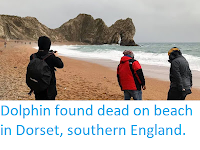
Dolphin found dead on beach in Dorset, southern England.

The Lulworth Coastgaurd has reported a Dolphin stranding at Durdle Door on the coast of Dorset, southern England. The animal was reported on the morning of Friday 2 January 2020, causing the Coastgaurd to investigate, as Cetacean strandings fall within their remit. Upon arrival they found the animal was a Short-beaked Common Dolphin, Delphinus delphis, a species common in waters around the UK, which had died before being discovered. The death is not regarded as suspicious, Common Dolphins are quite commonly found on beaches in Europe and other areas, simply because they are abundant. The Coastgaurds took measurements and photographed the Dolphin, data that will be shared with the Natural History Museum and the UK Cetacean Strandings Investigation Programme, who both maintain databases of Cetacean strandings around the UK.

A Short-beaked Common Dolphin found on the beach at Durdle Door in Dorset, England, on 3 January 2020. Lulworth Coastguard.

Short-beaked Common Dolphins are abundant in temperate and warm temperate waters around the world, and to some extent in the tropics. They are not considered to be endangered globally, though some populations are protected as they are considered locally vulnerable, notably those in the the North Sea, Baltic Sea, Mediterranean, Black Sea and eastern tropical Pacific, which are all protected under the terms of the Convention on the Conservation of Migratory Species of Wild Animals.

See also...

https://sciencythoughts.blogspot.com/2019/09/grampus-griseus-rissos-dolphins-in.htmlhttps://sciencythoughts.blogspot.com/2019/09/phocoena-sinus-vaquita-porpoise-in.html
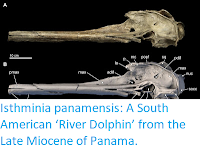
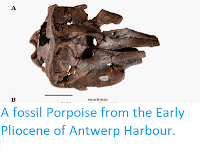
https://sciencythoughts.blogspot.com/2015/09/isthminia-panamensis-south-american.htmlhttps://sciencythoughts.blogspot.com/2015/01/a-fossil-porpoise-from-early-pliocene.html
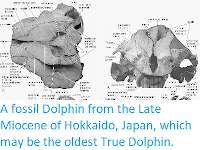
https://sciencythoughts.blogspot.com/2014/10/a-fossil-dolphin-from-late-miocene-of.htmlhttps://sciencythoughts.blogspot.com/2014/10/a-new-species-of-dolphin-from-early.html
Follow Sciency Thoughts on Facebook.