Showing posts with label Medusazoa. Show all posts

Tuesday, 19 April 2022

Warnings issued to bathers after Compass Jellyfish spotted in the Dardanelles Strait.

Authorities in western Turkey have issued a warning to bathers after Compass Jellyfish, Chrysaora sp. (probably Chrysaora hysoscella), were spotted in the Dardanelles Strait close to the port of Çanakkale. The Jellyfish, which can deliver a sting comparable to that of a Bee, are not normally seen in the Dardanelles Strait, and people there may be unfamiliar with them. While individually the stings of these Jellyfish are comparatively mild, their tentacles can grow to a meter and a half in length, which often stick to their victims delivering multiple stings, and the stings will remain active when the Jellyfish have died, or the tentacles have become detached. If people are stung by these Jellyfish the recommendation is that the sting is treated with vinegar as quickly as possible - and not fresh water, which will make the sting worse.

 
A Compass Jellyfish, Chrysaora hysoscella, at the Acquario di Genova in Italy. Francesco Crippa/Flickr/Wikimedia Commons.

Compass Jellyfish are native to the southern Mediterranean, but rising temperatures associated with global warming, combined with increased nutrient runoff, have enabled to spread northwards in the summer months, through the Dardanelles Strait into the Sea of Marmara and the Black Sea. There are concerns that a further temperature rises could lead to permanent populations becoming established in these areas, changing the ecology of these regions and damaging fisheries in the area.

 
A Compass Jellyfish, Chrysaora sp., on a beach near Çanakkale in western Turkey on Monday 18 April 2022. DHA Photo.

Jellyfish, although often large, are entirely planktonic in nature, meaning that they simply drift in the water column, and are unable to swim against currents, so that storms or other events that cause temporary changes in current flow can deposit large numbers on shorelines. Jellyfish numbers are determined largely by nutrient availability, as nutrient levels determine the amount of phytoplankton (single-celled Algae) in the water column, and this in turn controls the numbers of smaller zooplankton (small planktonic Animals), which are the main source of food for Jellyfish.

See also...


Follow Sciency Thoughts on Facebook. 

Follow Sciency Thoughts on Twitter.  


Tuesday, 22 March 2022

Atolla reynoldsi: A new species of deepwater Jellyfish from Monterey Bay, California.

Jellyfish of the genus Atolla have been recorded in every ocean basin, and encountered on almost all deep-sea expeditions. They are clearly an important part of deep marine ecosystems, although their ecological role is poorly understood. There are currently ten described species of Atolla, although some of these species are poorly documented and have descriptions which make them hard to differentiate, making the genus in need of a full taxonomic revision.

In a paper published in the journal Animals on 16 March 2022, George Matsumoto, Lynne Christianson, Bruce Robison, Steven Haddock, and Shannon Johnson of the Monterey Bay Aquarium Research Institute describe a new species of Atolla from Monterey Bay, California.

The Monterey Bay area has been extensively surveyed by Remote Operated Vehicles over the past two decades, and, as with other areas, numerous examples of Atolla have been observed. Notably, a number of specimens lacking the long trailing tentacles typical for the genus have been seen, which prompted Matsumoto et al. to collect specimens for morphological and genetic analysis. These collections revealed the presence of three genetically distinct species of tentacle-less Atolla within the Bay, one of which was also clearly morphologically distinct from all other Atolla species in ways other than the absence of tentacles, and is described as a new species, while the other two, referred to by Matsumoto et al. as Atolla sp A and Atolla sp B, show morphological overlap with other described species, and are not described as new species, pending a full review of the genus using genetic information.

The new species is named Atolla reynoldsi, in honour of Jeff Reynolds, who is considered to have been the first volunteer at the Monterey Bay Aquarium, after standing guard over a beached whale on Del Monte Beach overnight so that the Aquarium could retrieve it and prepare it for eventual overhead display. The species is described from ten specimens collected between April 2006 and June 2021 in Monterey Bay at depths between 1013 m and 3189 m.

 
Atolla reynoldsi in situ, 8.5 cm in diameter showing four narrow bases at the centre of the Medusa that expand into a vase-like shape before ending with a shallow indentation. Matsumoto et al. (2022).

Atolla reynoldsi has between 26 and 39 small tentacles around its rim, and a similar number of rhopalia (eyespots). It is flattish in shape, with a slight rounded dome at its centre. The pedalia (tentacle bases) each have nine lateral ridges, some of which have spikey projections. The gut of Atolla reynoldsi has what Matsumoto et al. describe as a distinctive 'Greek-cross' morphology, not seen in other members of the genus. The gonads are oval when immature but become large and horseshoe-shaped when mature.

See also...


Follow Sciency Thoughts on Facebook.

Follow Sciency Thoughts on Twitter


Thursday, 4 March 2021

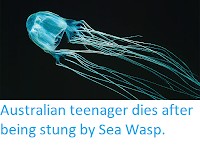
Australian teenager dies after being stung by Sea Wasp.

A seventeen-year-old Australian boy has died after being stung by a Sea Wasp, Chironex fleckeri, a form of Box Jellyfish. The boy, who has not been named, was stung while swimming of the coast of Patterson Point, near Bamaga on the western Cape York Peninsula, Queensland, on Monday 22 March 2021. He was airlifted to the Intensive Care Unit at Townsville Hospital by the Royal Flying Doctor's Service, but died a week after the incident on Monday 1 March. This is the first recorded death from a Jellyfish sting in Australia since 2006, when another swimmer died after being stung by a Sea Wasp near Bamaga.

 
A Sea Wasp, Chironex fleckeri. Kelvin Aitken/VWPics/AP.

Sea Wasps, Chironex fleckeri, endemic to shallow coastal waters and which has a particularly potent sting, with an adult of the species producing enough venom to kill adult Humans, which makes them a common cause of fatalities from Southeast Asia to Australia. Box Jellyfish are particularly dangerous as they do not simply drift passively as other Jellyfish do, but possess well developed eyes, muscular and nervous systems, allowing them to actively hunt small prey, and sometimes (probably inadvertently) attack Humans.

See also...


Follow Sciency Thoughts on Facebook.

Follow Sciency Thoughts on Twitter.