Showing posts with label Cnidaria. Show all posts

Tuesday, 25 April 2023

Tripedalia maipoensis: A new species of Box Jellyfish from Hong Kong.

Box Jellyfish, Cubozoa, are a small group of Medusozoans noted for their approximately cube-shaped bells and the extreme toxicity of their venom. The group is divided into two monophyletic orders, the Carybdeida which have a single tentacle emerging from each pedalium (tentacle stalk) and Chirodropida, which have multiple tentacles emerging from each pedalium. The Tripedaliidae are a small group of Carybdeid Box Jellyfish, divided into two genera, the Copula, which have a single pedalium at each corner of their box, and the Tripedalia, which posses two or three. The genius Tripedalia is currently divided into two species, Tripedalia binata, with two pedalia at each bell corner, and Tripedalia cystophora, with three. Both species are found in estuarine Mangroves, though Tripedalia cystophora apparently has a wide distribution, having been reported from the United States, Mexico, Singapore, India, and Japan, while Tripedalia binata has only been reported from Australia and Thailand.

Box Jellyfish are common in the coastal waters of China, but have not been extensively studied, with only three species of Carybdeids reported to date.

In a paper published in the journal Zoological Studies on 20 March 2023, Yanan Sun of the Department of Biology at Hong Kong Baptist University, Justin Hon Yin Tsui and Rachel Ting Huen Wong of the Faculty of Biology, Medicine and Health at the University of Manchester, Ringo Nga Ching Cheung and Murphy Kam Pui Ng of the Ocean Park Corporation, Carmen Or of  WWF-Hong Kong, and Jian-Wen Qiu, also of the Department of Biology at Hong Kong Baptist University, describe a new species of Tripedalia from intertidal Shrimp ponds within the Mangroves of the Mai Po Nature Reserve in Hong Kong.

The new species is given the name Tripedalia maipoensis, where 'maipoensis' means 'from Mai Po', in reference to the Mai Po Nature Reserve. This species has three pedalia per bell corner, with each pedalium having one tentacle, and a velarium  (flap of tissue at the base of the bell) with forked canals.

Morphological characteristics and phylogenetic position of Tripedalia maipoensis (A)–(B) holotype (TMBC030991), female, living specimen, lateral view showing the gross morphology (A), and oblique top view showing gastric phacellus (B); (C) Rhopalial niche, preserved specimen, paratype (TMBC030992); (D) Rhopalium, showing six eyes and a statolith; (E) Upside down view of the bell showing the velarial canals, preserved specimen, paratype (TMBC030992), male; (F) details of the velarial canals, preserved specimen, holotype (TMBC030991), female; (G) oblique top view, showing nematocyst warts and gastric phacellus, living specimen, paratype TMBC030992; (H) manubrium, preserved, paratype (TMBC030997); (I) Nematocyst batteries from tentacle, paratype (TMBC030997). Scale bars: (A), (B) 1 cm; (C), (F), (H) 1 mm; (D) 0.3 mm; (E), (G) 5 mm; (I) 10 µm. Abbreviations: cs, crystalline statolith; g, gonad; gp, gastric phacellae; le, lower lens eye; nw, nematocyst wart; pe, pit eye; rn, rhopalial niche; se, slit eye; ue, upper lens eye; vc, velarial canal. Sun et al. (2023).

The bell of Tripedalia maipoensis is transparent, and roughly cube-shaped, with rounded corners and a slightly arched roof. This has a scattering of nematocysts (stinging cells) of different sizes, Two gonads are present at each of the lower corners of the bell, and halfway between the corners is a ropalial niche, covered by two flaps, from which can emerge a rhopalium (sensory structure), bearing six eyes (two lateral pit eyes, two lateral slit eyes, a smaller upper lens eye, and a larger lower lens eye) as well as a large crystalline statolith (weighted organ used to tell up from down). The adults reach about 12.5 mm in bell height.

Tripedalia maipoensis has only been found within the Mai Po Nature Reserve on Hong Kong, though Sun et al. suspect it is highly likely to be found in other areas of the Pearl River Estuary, to which the ponds in which was found are connected. It was found in water channels flanked by Common Reed, Phragmites australis, or Mangroves of mainly Kandelia obovata mixed with the Golden Leather Fern, Acrostichum aureum. It has been observed between April and June every year since it was first noticed. 

See also...

Follow Sciency Thoughts on Facebook.

Follow Sciency Thoughts on Twitter


Monday, 10 April 2023

Thousands of By-the-wind Sailors wash up on Californian beaches.

Beachgoers in California are reporting thousands of By-the-wind Sailors, Velella velella, small colonial Hydrozoans distantly related to the Portuguese Man o' War, Physalia physalis, washed up on the beaches between Dana Point in Orange County and Point Reyes National Seashore, to the north of San Francisco. Mass strandings of By-the-wind Sailors are not unusual in spring and summer in California, particularly when there are strong onshore winds, as has been the case recently. It has been suggested that such mass strandings may be an early warning of a developing El Niño weather system over the Pacific, something predicted for this year.

A mass stranding of By-the-wind Sailors, Velella velella, on a beach at the Point Reyes National Seashore. Point Reyes National Seashore.

While these brightly coloured and superficially Jellyfish-like animals can be alarming, they are considerably less dangerous than the Portuguese Man o' War, as their toxin is not particularly harmful to Humans, though it is worth avoiding handling them, as they can cause itching and some people may have an allergy to the sting.

Like the Portuguese Man o' War, By-the-wind-sailors are colonial Siphonophores only distantly related to true Jellyfish, Scyphozoa, though commonly referred to as such. Their bodies are made up of thousands of individual zooids, each with their own sting, tentacles and digestive system. New zooids are formed by budding from other members of the colony, but remain attached to these to form a single colony. These animals are anchored to the sea surface by a highly modified zooid which forms an air sack, filled with a mixture of carbon monoxide defused from the zooid and nitrogen, oxygen and argon from the atmosphere, which are brought into the sack through osmosis. 

The anatomy of the By-the-wind-sailor, Velella velellaTBR's Muscles.

However they are rather smaller, with colonies seldom exceeding 7 cm in length, and differ somewhat in their reproductive cycle, with alternative generations of sexual colonies, which may be male or female and reproduce sexually, budding off asexual stages medusae, which are about a mm across, and produce eggs which can go on to form new colonies.

See also...


Follow Sciency Thoughts on Facebook.

Follow Sciency Thoughts on Twitter.


Thursday, 29 December 2022

Four children hospitalised by Irukandji Jellyfish stings off K'gari (Fraser) Island, Queensland.

Four children have been airlifted to hospitals in Queensland after being stung by Irukandji Jellyfish at beached on K'gari (Fraser) Island in a two day period. The first incident happened at about 10.30 am on Tuesday 27 December 2022, when a girl described as being of 'primary school age' was stung on the chest while swimming in a creek near Wathumba Beach. She was airlifted to the Hervey Bay Hospital in Pialba, on the mainland, and is described as being in a stable condition. The second incident happened at 2.40 pm the same day, when two girls aged five and seven were stung while swimming at Wathumba Beach. Again, both victims were airlifted to Hervey Bay Hospital, and are in a stable condition. The final incident happened the following day, when a young boy was stung, again in a creek near Wathumba Beach, and flown to Hervey Bay Hospital. 

The Irukandji Jellyfish is a form of Box Jellyfish, Cubozoa, found along the northern coast of Australia, which has both a particularly potent sting and a very small size, making it particularly dangerous to swimmers. The Jellyfish are typically about 5 mm across, though they can reach as much as 30 mm, with tentacles between 5 and 50 mm in length. The sting of these Jellyfish is particularly potent, and can cause muscle aches, back pain, nausea, headaches, chest and abdominal pains, sweating, high blood pressure, difficulty breathing, and in extreme cases death.

An Irukandji Jellyfish, Carukia barnesiABC.

Irukandji Jellyfish are found in the waters to the north of Australia all year round, and move south during the southern summer, making them a threat to bathers along the north Australian coast. The Jellyfish move further south in warmer years, and there are concerns that rising sea temperatures associated with global warming may lead to them moving further south in the future.

See also...


Follow Sciency Thoughts on Facebook.

Follow Sciency Thoughts on Twitter.


Tuesday, 19 April 2022

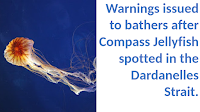
Warnings issued to bathers after Compass Jellyfish spotted in the Dardanelles Strait.

Authorities in western Turkey have issued a warning to bathers after Compass Jellyfish, Chrysaora sp. (probably Chrysaora hysoscella), were spotted in the Dardanelles Strait close to the port of Çanakkale. The Jellyfish, which can deliver a sting comparable to that of a Bee, are not normally seen in the Dardanelles Strait, and people there may be unfamiliar with them. While individually the stings of these Jellyfish are comparatively mild, their tentacles can grow to a meter and a half in length, which often stick to their victims delivering multiple stings, and the stings will remain active when the Jellyfish have died, or the tentacles have become detached. If people are stung by these Jellyfish the recommendation is that the sting is treated with vinegar as quickly as possible - and not fresh water, which will make the sting worse.

 
A Compass Jellyfish, Chrysaora hysoscella, at the Acquario di Genova in Italy. Francesco Crippa/Flickr/Wikimedia Commons.

Compass Jellyfish are native to the southern Mediterranean, but rising temperatures associated with global warming, combined with increased nutrient runoff, have enabled to spread northwards in the summer months, through the Dardanelles Strait into the Sea of Marmara and the Black Sea. There are concerns that a further temperature rises could lead to permanent populations becoming established in these areas, changing the ecology of these regions and damaging fisheries in the area.

 
A Compass Jellyfish, Chrysaora sp., on a beach near Çanakkale in western Turkey on Monday 18 April 2022. DHA Photo.

Jellyfish, although often large, are entirely planktonic in nature, meaning that they simply drift in the water column, and are unable to swim against currents, so that storms or other events that cause temporary changes in current flow can deposit large numbers on shorelines. Jellyfish numbers are determined largely by nutrient availability, as nutrient levels determine the amount of phytoplankton (single-celled Algae) in the water column, and this in turn controls the numbers of smaller zooplankton (small planktonic Animals), which are the main source of food for Jellyfish.

See also...


Follow Sciency Thoughts on Facebook. 

Follow Sciency Thoughts on Twitter.  


Tuesday, 22 March 2022

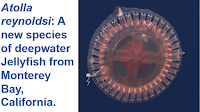
Atolla reynoldsi: A new species of deepwater Jellyfish from Monterey Bay, California.

Jellyfish of the genus Atolla have been recorded in every ocean basin, and encountered on almost all deep-sea expeditions. They are clearly an important part of deep marine ecosystems, although their ecological role is poorly understood. There are currently ten described species of Atolla, although some of these species are poorly documented and have descriptions which make them hard to differentiate, making the genus in need of a full taxonomic revision.

In a paper published in the journal Animals on 16 March 2022, George Matsumoto, Lynne Christianson, Bruce Robison, Steven Haddock, and Shannon Johnson of the Monterey Bay Aquarium Research Institute describe a new species of Atolla from Monterey Bay, California.

The Monterey Bay area has been extensively surveyed by Remote Operated Vehicles over the past two decades, and, as with other areas, numerous examples of Atolla have been observed. Notably, a number of specimens lacking the long trailing tentacles typical for the genus have been seen, which prompted Matsumoto et al. to collect specimens for morphological and genetic analysis. These collections revealed the presence of three genetically distinct species of tentacle-less Atolla within the Bay, one of which was also clearly morphologically distinct from all other Atolla species in ways other than the absence of tentacles, and is described as a new species, while the other two, referred to by Matsumoto et al. as Atolla sp A and Atolla sp B, show morphological overlap with other described species, and are not described as new species, pending a full review of the genus using genetic information.

The new species is named Atolla reynoldsi, in honour of Jeff Reynolds, who is considered to have been the first volunteer at the Monterey Bay Aquarium, after standing guard over a beached whale on Del Monte Beach overnight so that the Aquarium could retrieve it and prepare it for eventual overhead display. The species is described from ten specimens collected between April 2006 and June 2021 in Monterey Bay at depths between 1013 m and 3189 m.

 
Atolla reynoldsi in situ, 8.5 cm in diameter showing four narrow bases at the centre of the Medusa that expand into a vase-like shape before ending with a shallow indentation. Matsumoto et al. (2022).

Atolla reynoldsi has between 26 and 39 small tentacles around its rim, and a similar number of rhopalia (eyespots). It is flattish in shape, with a slight rounded dome at its centre. The pedalia (tentacle bases) each have nine lateral ridges, some of which have spikey projections. The gut of Atolla reynoldsi has what Matsumoto et al. describe as a distinctive 'Greek-cross' morphology, not seen in other members of the genus. The gonads are oval when immature but become large and horseshoe-shaped when mature.

See also...


Follow Sciency Thoughts on Facebook.

Follow Sciency Thoughts on Twitter


Wednesday, 23 September 2020

Inverness woman hospitalised by Jellyfish sting in Scotland.

A woman has been treated in Raigmore Hospital in Inverness after being stung by a Lion's Mane Jellyfish, Cyanea capillata, while swimming off Whiteness Beach near Ardersier on the Moray Firth on Saturday 19 September 2020. Libby Bligh, 50, of Kinmylies, in Inverness, encountered the metre-long Jellyfish while coming out of the water following a swimming trip with a friend. She complained of a severe burning sensation, and began to feel unwell on the drive back to Inverness, prompting her friend to take her to the hospital. By the time they arrived she had developed breathing problems, and was diagnosed with anaphylactic shock. Ms Bligh was treated at the hospital then kept under observation for a further 24 hours before being released.

 
Libby Bligh, 50, of Kinmylies, in Inverness, treated for anaphylactic shock at a Scottish hospital after being stung by a Lion's Mane Jellyfish. Daily Record.

The Lion's Mane Jellyfish is the largest known species of Jellyfish, reaching over 2 m in diameter and with tentacles that can be more than 30 m in length. They are exclusively found in cooler temperate waters around the North Atlantic, North Pacific, Arctic Ocean and Baltic Sea. They are pelagic, able to swim against currents under their own energy, rather than drifting as many Jellyfish do, and spend most of their lives in open water, but they move into coastal waters towards the end of their annual life-cycle, when the (sexual) medusae produce eggs, which in turn hatch into a polyp which attaches to the seafloor in shallow waters, from which new medusae bud off asexually.

 
A Lion's Mane Jellyfish, Cyanea capillata, in Gullmarn Fjord, Sweden. W Carter/Wikimedia Commons.

See also...


Follow Sciency Thoughts on Facebook.

Follow Sciency Thoughts on Twitter