Showing posts with label Midlothian. Show all posts

Tuesday, 13 October 2020

Whale dies after stranding on Edinburgh beach.

A Whale has died after stranding on a beach in Edinburgh, Scotland. The Whale, identified as a young Sowerby’s Beaked Whale, Mesoplodon bidens, was found on a beach near the mouth of Brunstane Burn on the afternoon of Tuesday 13 October 2020, while still alive, but died shortly thereafter, despite attempts by volunteers from the Scottish Society for the Protection of Animals and British Divers Marine Life Rescue to refloat it. 

 
A Young Sowerby’s Beaked Whale, Mesoplodon bidens, stranded on an Edinburgh beach on 13 October 2020.

Sowerby's Beaked Whales are found throughout the North Atlantic and North Sea, although they are reclusive Animals which tend to avoid boats and other Human objects, making them rarely seen. As such their population structure is not really known, and they are classified as Data Deficient under the terms of the International Union for the Conservation of Nature's Red List of Threatened Species. This is the third stranding of a member of the species recorded in the UK this year, with British Divers Marine Life Rescue recording two strandings in August, one in Suffolk and one in Hampshire, which implies a reasonably healthy population in UK waters (although individual strandings are sad, the fact that strandings are occurring implies that Whales are present. Sowerby's Beaked Whales are protected by the Agreement on the Conservation of Small Cetaceans of the Baltic, North East Atlantic, Irish and North Seas, the Agreement on the Conservation of Cetaceans in the Black Sea, Mediterranean Sea and Contiguous Atlantic Area, and the Memorandum of Understanding Concerning the Conservation of the Manatee and Small Cetaceans of Western Africa and Macaronesia. Historically the species was sometimes targeted by Norwegian Whalers, but this has not been the case in recent history; though these Whales are thought to be at risk from entanglement in fishing gear.

See also...


Follow Sciency Thoughts on Facebook.

Follow Sciency Thoughts on Twitter.


Friday, 5 December 2014

Magnitude 2.0 Earthquake in Midlothian, Scotland.

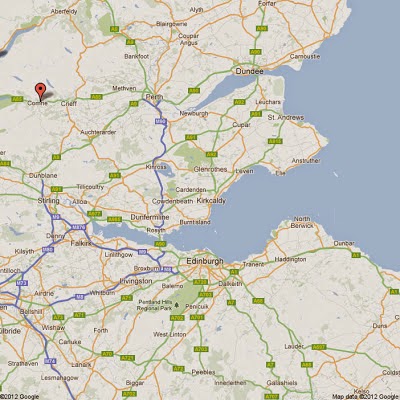
The British Geological Survey recorded a Magnitude 2.0 Earthquake at a depth of 6 km in southwest Midlothian, Scotland, about 10 knm to the south of Edinburgh, slightly before 10.00 pm GMT on Wednesday 3 December 2014. This is a small event, and there is no danger of any damage or injuries, but a number of people have reported feeling it in the town of Penicuik.

 The approximate location of the 3 December 2014 Midlothian Earthquake. Google Maps.

Earthquakes become more common as you travel north and west in Great Britain, with the west coast of Scotland being the most quake-prone part of the island and the northwest of Wales being more prone  to quakes than the rest of Wales or most of England.
The precise cause of Earthquakes in the UK can be hard to determine; the country is not close to any obvious single cause of such activity such as a plate margin, but is subject to tectonic pressures from several different sources, with most quakes probably being the result of the interplay between these forces.
Britain is being pushed to the east by the expansion of the Atlantic Ocean and to the north by the impact of Africa into Europe from the south. It is also affected by lesser areas of tectonic spreading beneath the North Sea, Rhine Valley and Bay of Biscay. Finally the country is subject to glacial rebound; until about 10 000 years ago much of the north of the country was covered by a thick layer of glacial ice (this is believed to have been thickest on the west coast of Scotland), pushing the rocks of the British lithosphere down into the underlying mantle. This ice is now gone, and the rocks are springing (slowly) back into their original position, causing the occasional Earthquake in the process. 
(Top) Simplified diagram showing principle of glacial rebound. Wikipedia. (Bottom) Map showing the rate of glacial rebound in various parts of the UK. Note that some parts of England and Wales show negative values, these areas are being pushed down slightly by uplift in Scotland, as the entire landmass is quite rigid and acts a bit like a see-saw. Climate North East.
Witness accounts of Earthquakes can help geologists to understand these events, and the structures that cause them. If you felt this quake, or were in the area but did not (which is also useful information) then you can report it to the British Geological Survey here.
See also...

http://sciencythoughts.blogspot.co.uk/2012/09/two-earthquakes-in-perthshire-in-two.html Two Earthquakes in Perthshire in two days.   On Friday 21 September 2012, a few seconds before 10.30 am British Summertime (a few seconds before 9.30 am GMT) the British Geological Survey recorded a Magnitude 1.4 Earthquake 2 km beneath the village of Comrie in west Perthshire, Scotland. Less than a day later, slightly before 8.40 am British Summertime (slightly before 7.40 am GMT) on Saturday 22 September, a second Earthquake, with a magnitude of...
 Follow Sciency Thoughts on Facebook.