Showing posts with label Mors Island. Show all posts

Saturday, 28 October 2017

Tasbacka danica: Pigment preservation in an Early Eocene Sea Turtle.

The Early Eocene Fur Formation of Denmark is noted for its excellently preserved plant and animal fossils, with its Birds and Turtles being particularly noteworthy. The Turtles include specimen MHM-K2 an exceptionally well preserved juvenile Sea Turtle, discovered in 2008 by Henrik Madsen of the Moclay Museum in a limestone concretion from the Ejerslev Mo-clay pit on the Isle of Mors, and described as Tasbacka danica. This specimen comprises an almost complete, articulated Turtle-skeleton in dorsal view, along with what appear to be vestiges of preserved soft tissue.

In a paper published in the journal Scientific Reports on 17 October 2017, a team of scientists led by Johan Lindgren of the Department of Geology at Lund University describe the results of a study of MHM-K2 in which a number of ultrastructural and biomolecular methods were used to examine the soft tissues of the specimen, and discuss the conclusions which result from these studies.

Photograph of MHM-K2. Fo, fontanelle (the light colour is a result of sediment infill); Hyo, hyoplastron; Hyp, hypoplastron; Ne, neural; Nu, nuchal; Pe, peripheral; Py, pygal. Arrowheads indicate neural nodes. Lindgren et al. (2017).

Lindgren et al. first examined the dark film surrounding the skeleton, which is distinct from the surrounding sediments and thought to be the remnants of a soft tissue layer, using field emission gun scanning electron microscopy, which showed this layer to be made up of sub-spherical to elongate microbodies, which are held in places in a fine-grained matrix presumed to be a precipitate, and in other places within a three-dimensional sheet-like matrix with a frothy texture. An elemental analysis using energy-dispersive X-ray microspectroscopy showed that both the microbodies and the sheet-like matrix were enriched in carbon, strongly suggesting an organic origin, and further examination of this matrix and the bodies in it reveals the film to be about 15 μm thick, with the microbodies held in a fibrous mesh that keeps them separate, rather than being stacked or overlapping.

Ultrastructure of MHM-K2 soft tissues. (a) FEG-SEM micrograph of demineralised tissue showing microbodies and adhering matrix. (b) At higher magnification, the microbodies possess a rough surface texture and scattered pits (arrowheads). (c) FEG-SEM micrograph of untreated soft tissue depicting microbodies embedded in a mineral precipitate (black star) and sheet-like matter (white star). (d) Microbodies (arrowheads) in a sheet-like substrate. (e) TEM micrograph of electron-dense microbodies and fibrous matrix (black arrowheads) after demineralisation. White star indicates epoxy resin, whereas black star marks an artificial rupture. Lindgren et al. (2017). 

Next Lindgren et al. attempted to look for traces of the protein keratin in the film. In modern Turtles the bony shell is covered by a layer of epidermal tissue (skin) containing both α- and β-keratins. Α-keratins are also found in the integuments of Mammals, including Humans, and can be synthesised by some micro-organisms, making cross-contamination an issue, however β-keratins are only found in modern Reptiles and Birds (where they are the major component of feathers), making cross-contamination from another source much less likely. To this end Lindgren et al. developed antibodies to β-keratin that had green fluorescence proteins bound to their antigen sites, which were then tested on both the bony shield of MHM-K2 and that of a modern Green Sea Turtle, Chelonia mydas. The antigens bound to both the test subjects, producing a visible pattern of fluorescence, and while this was less marked in the fossil material the two shells showed distribution of the proteins in a similar pattern, strongly supporting the idea that the antibodies had bound to preserved Eocene proteins rather than modern contaminants.

 
Immunoreactivity of fossil and extant Turtle tissues. Immunohistochemical staining results for MHM-K2, (a) and (b), and Chelonia mydas, (c) and (d) carapace scute and muscle tissue to antibodies raised against Gallus domesticus (Chicken) feathers (anti-Gallus fth). Lindgren et al. (2017).

Lindgren et al. then repeated the same procedure for haemoglobin (using antibodies to both the American Alligator, Alligator mississippiensis, and Ostrich, Struthio camelus, versions of the protein), and the muscle-fibre protein tropomyosin, again using antibodies to the Chicken version of the protein. Both of these proteins were found to be present in the same distribution in MHM-K2 as in Chelonia mydas, though at lower levels (this would be expected, since not all of the proteins would be likely to be preserved).

Finally Lindgren et al. used time-of-flight secondary ion mass spectrometric analyses to examine the specimen. This method uses a a pulsed ion beam to remove molecules from the very outermost surface of the sample, molecules which are then accelerated into the flight tube of a mass spectrometer, where their mass is determined by measuring the exact time at which they reach the detector. This produced readings consistent with the iron-containing porphyrin units of haemoglobin molecules, the pigment protein eumelanin, and a number of indeterminate amino acids.

Modern Sea Turtle hatchlings are commonly very dark in colour, at least on their dorsal (upper) surfaces. This initially seems counter-productive, as these Turtles typically have to cross some distance of light-coloured sand between leaving the nest and reaching the sea, a period during which they suffer a very high mortality rate due to predation. However, this period only lasts a few minutes, after which the young turtles enter the sea, where they are still vulnerable to predation and where a dark dorsal surface provides a useful camouflage pattern in the several years it takes them to reach maturity. The presence of the dark-coloured eumelanin protein in MHM-K2 suggests that this held true for Eocene Turtles as  much as it does for modern ones.

Finally Lindgren et al. note that the presence of haemoglobin in the specimen may shed some light on the preservation of fossils in the Mors Formation. These fossils are thought to have been formed from animals which were quickly buried on the sea flood by a layer of clay-rich sediment, sealing them off from the actions of the outside environment. However, this is not in itself enough to explain the highly detailed preservation seen in these fossils, as buried organic matter is still prone to decomposition by anaerobic Bacteria. Lindgren et al. suggest that the presence of oxygen-rich haemoglobin (toxic to most anaerobic Bacteria) permeating the tissues of these animals may have inhibited decomposition, enabling the formation of the detailed fossils found in the Mors Formation today.

See also...

http://sciencythoughts.blogspot.co.uk/2016/10/mendozachelys-wichmanni-new-species-of.htmlhttp://sciencythoughts.blogspot.co.uk/2016/10/paiutemys-tibert-new-species-of.html
http://sciencythoughts.blogspot.co.uk/2016/10/septencoracias-morsensis-roller-from.htmlhttp://sciencythoughts.blogspot.co.uk/2015/12/xiaochelys-ningchengensis-sinemydid.html
http://sciencythoughts.blogspot.co.uk/2015/11/turtle-remains-from-late-miocene-to.htmlhttp://sciencythoughts.blogspot.co.uk/2015/10/turtle-eggs-from-late-cretaceous-of.html
Follow Sciency Thoughts on Facebook.

Sunday, 2 October 2016

Septencoracias morsensis: A Roller from the Early Eocene of Denmark.

Rollers, Coracii, are large-headed, large-beaked insectivorous Birds related to Kingfishers, Bee-eaters, Hoopoes and Hornbills. They are restricted to the Old World today, with a but two species found the tropics or subtropics, but appear to have been more widely distributed in the past. Like many living Bird-groups, they appear to have arisen shortly after the End Cretaceous extinction (before which Avian faunas were dominated by the extinct Toothed Birds), though precisely where and when is unclear due to a lack of good Bird-producing sites from the Palaeocene. Fossil Rollers have been described from the Early Eocene Messel Shale and Green River Formation of Wyoming, as well as the Late Eocene Quercy deposits of France, and fragmentary remains not described to species level from the Early Eocene of Condé-en-Brie, also in France.

In a paper published in the journal Scientific Reports on 27 September 2016, Estelle Bourdon of The Natural History Museum of Denmark and Section of Biosystematics at the University of Copenhagen, Anette Kristoffersen of the Department of Geosciences and Natural ResourceManagement at the University of Copenhagen and Niels Bonde, also of The Natural History Museum of Denmark and Section of Biosystematics at the University of Copenhagen, as well as the Fur Museum (MuserumSalling), describe a new species of Roller from the Early Eocene Fur Formation of Klovbakker Quarry on the Island of Mors, off northwestern Jutland.

The Fur Formation is a marine diatomite, i.e. a sedimentary rock formed from the tests (shells) of planktonic Diatoms; such diatomites can form in both marine and lake deposits, but only far enough from the shore that the Diatom tests are able to build up without significant input of sediments from terrestrial environments. These deposits are noted for the production of numerous Insects and Vertebrates, the later including Fish, Turtles and Birds. Importantly the Fur Formation also included numerous layers of volcanic ash, allowing very precise radiometric dating of the deposits.

The new Bird is named Septencoracias morsensis, where 'Septencoracias' means 'Northern Roller' and 'morsensis' means 'from Mors'. It is described from a single, largely-intact, three-dimensionally preserved specimen, which also has preserved stomach contents. The living Bird would have been about 25 cm in length, towards the minimum end of the size range seen in living Rollers.

Septencoracias morsensis. (a) Photograph of whole specimen. (b) 3D white light scanning of the whole specimen. (c) Interpretative drawing with damaged areas of the skull, fish remains and soft tissues represented in dark grey. Abbreviations: al1–2, phalanges of alular digit; ap, narial opening; at, atlas; ax, axis; c, cervical vertebrae; ca, carpometacarpus; cd1–7, caudal vertebrae; co, vertebral costae; cp, costal process; cr, cranium; d, damage in the skull area; dm, phalanx of minor digit; dM1, proximal phalanx of major digit; dM2, distal phalanx of major digit; ec, ectethmoid; f, femur; fi, fish remains; ft, foramina intertransversaria; fv, fish vertebra; h, humerus; if, ilioischiadic foramen; is, ischium; md, mandibula; me, mesethmoid; mx, maxilla; mI, metatarsal I; pa, palatine; pb, pubis; po, postacetabular wing of ilium; pr, preacetabular wing of ilium; pt, pterygoid; pu, uncinate process; py, pygostyle; ra, radius; rd, radial carpal bone; sc, scapula; st, soft tissues; sy, synsacrum; ta, tarsometatarsus; tb, tibiotarsus; u, ulna; ul, ulnar carpal bone; I1–2, phalanges of pedal digit I; II1–3, phalanges of pedal digit II; III1–4, phalanges of pedal digit III; IV1–5, phalanges of pedal digit IV. The ‘r’ and ‘l’ prefixes indicate right and left, respectively. Estelle Bourdon in Bourdon et al. (2016).

The specimen was found directly above an ash layer dated to 54.04 million years ago, making it about 54 million years old. This makes it the oldest known Roller, and places it directly after the Early Eocene Thermal Maximum, a time when tropical climates could be found as far north as Denmark. Since other fossil Rollers found in northerly locations in Europe and America also come from warm Eocene deposits, it is likely that the preference for hot climates seen in modern Rollers arose early in the history of the group.

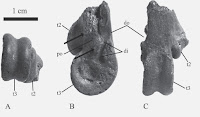
 Septencoracias morsensis. (a) Skull in left lateral view. (b) Right foot in medial view. (c) Left foot in dorsal view. (d) Right humerus in cranial view. (e) Right carpometacarpus in ventral view. Bourdon et al. (2016).

The stomach contents of Septencoracias morsensis comprise the skeletons of at least two Argentinoid Fish. These Fish reached about 10 cm in size, and are very abundant in the Mors Formation, apparently having been a food source for many of the other animals found there. The consumption of Fish is outside the behaviour of modern Rollers, and may suggest some unrollerlike habits for Septencoracias morsensis. However this does not necessarily mean the Bird was capable of hunting Fish like a Kingfisher; most Birds will scavenge opportunistically when the opertunity arises, and the consumption of Fish may have been an example of such behaviour in a Roller with more conventional habits.

 Life reconstruction of Septencoracias morsensis. Salient diagnostic features of the new fossil relative to other rollers include the larger skull and the small, ovoid and dorsally positioned narial openings. Septencoracias is represented with a brownish and bluish plumage, because brownish and/or bluish feathers occur in all species of Rollers and most species of Ground-rollers, and are probably primitive within the Coracii. Estelle Bourdon in Bourdon et al. (2016).

See also...

http://sciencythoughts.blogspot.co.uk/2014/06/phorusrhacid-terror-birds-from-middle.htmlPhorusrhacid ‘Terror Birds’ from the Middle Eocene of Western Europe.                        The Phorusrhacid ‘Terror Birds’ were large, carnivorous flightless Birds that appear to have held the role of top terrestrial predators in South America throughout much of the Cenozoic. They are known to have colonized parts of North America, during...
http://sciencythoughts.blogspot.co.uk/2014/06/a-flower-visiting-bird-from-middle.htmlA flower-visiting Bird from the Middle Eocene Messel Shale of Germany.                          Several groups of modern Birds are known to feed by visiting flowers to collect nectar, and in the process serve as pollinators for the plants. Most notable are...
http://sciencythoughts.blogspot.co.uk/2014/05/fossil-romainvilliine-geese-from-late.htmlFossil Romainvilliine Geese from the Late Eocene of Xinjiang Province, China.            The Romainvilliines are an extinct group of large Waterfowl known from Late Eocene and Early Oligocene of France, Belgium and England. They... 
Follow Sciency Thoughts on Facebook.