Showing posts with label Bush Cricket. Show all posts

Friday, 4 July 2025

Eupholidoptera stelae: A new species of Bush Cricket from Cyprus.

Bush Crickets of the genus Eupholidoptera are found around the Mediterranean Basin from southern France to Turkey and the Levant. There are currently 55 known species, mostly with very limited distributions. The maximum diversity in the genus has been recorded from Greece (26 species) and Turkey (21 species). The cryptic habits of these Crickets, which are almost entirely nocturnal and mostly live in dense thorn-scrub, means that new species are still being discovered fairly regularly. The standard method of sampling Orthopterans, capture by hand, is difficult with cryptic groups such as Eupholidoptera, but members of the genus have been captured in baited pit traps set for Spiders and Beetles, which offers an alternative way to study the group.

In a paper published in the journal Zootaxa on 26 June 2025, Luc Willemse of the Naturalis Biodiversity Center, Christodoulos Makris of Lemesós on Cyprus, and Baudewijn Odé of Plasmolen in the Netherlands, describe a new species of Eupholidoptera from the Troodos Massif.of Cyprus.

The new species is named Eupholidoptera stelae in honour of Stela Makris, the daughter of Christodoulos Makris. It is described from a series of specimens obtained from baited traps and 'wine ropes' (ropes made from absorbent material which has been soaked in a mixture of vinagar and sugar and draped over shrubs and bushes - a method used primarily to capture Moths) in the Cedar and maquis forests of the Troodos Massif of Cyprus.

Eupholidoptera stelae field images. (1) Female Cedar Valley 07/09/2021 on a ‘wine rope’; (2) female Kannoures 23/08/2019; (3) male Kannoures 21/09/2019; (4) male Kannoures 21/09/2019. Christodoulos Makris in Willemse et al. (2025).

Female specimens are, on average, slightly larger than males, measuring between 17.4 and 21.4 mm, compared to between 16.2 and 19.5 mm in males. They are maroon in colour, alternated with some yellowish and blackish parts, a shade of green is visible on the legs. In females the proximal edge of the last abdominal tergite is black.

Eupholidoptera stelae is found at altitudes of 525 m–1515 m in the central and south-western part of the Troodos Massif of Cyprus, a landscape dominated by open Pine and Oak forests. The area of available habitat appears to be over 1000 km², and while it has only been detected in an area of about 24 km², it is difficult to detect and could be more widespread. This area receives a high number of tourist visits, but falls mostly within a series of national reserves, and is largely protected from development. For this reason, Willemse et al. do not believe that Eupholidoptera stelae needs to be included on the International Union for the Conservation of Nature's Red List of Threatened Species.

Habitats of Eupholidoptera stelae. (250 The central and south-western part of Troodos Massif. (26) Open Black Pine, Pinus nigra, forest with an undergrowth of Golden Oak, Quercus alnifolia, Grecian Whitebeam, Sorbus graeca and Holy Bramble, Rubus sanctus, in the Kannoures area of the Troodos Mountains,  (27)  Cedar  forest  with  the  endemics Cyprus Cedar, Cedrus  brevifolia,  and Golden Oak, Quercus  alnifolia,  in the Tripilos  area  of  Pafos  Forest,  (28) Shrubs including the endemic Golden Oak,  Quercus alnifolia, in Turkish Pine, Pinus brutia, forest. Christodoulos Makris in Willemse et al. (2025).


See also...
Wednesday, 15 October 2014

Three new species of Katydid from China.


Katydids of the genus Xizicus and its close relatives are found across eastern Asia, though the taxonomy of the group is currently somewhat confused, in part due to publications being published in different languages without translation. New species are being described within the group every year, with different authors using slightly different classifications. Several subgenera have been created within the genus, some of which have been promoted to full genus status, others being synonymized (a taxa described separately by two different authors is correctly called by the first name used, the second description becoming a junior synonym of the first; junior synonyms are not used subsequently, but are recorded so that taxonomists encountering them know what they refer to).

In a paper published in the journal Zootaxa on 16 September 2014, Hanqiang Wang and Jun Jing of the School of Life Science at East China NormalUniversity in Shanghai, Xianwei Liu of the Shanghai Entomological Museum of the Chinese Academy of Sciences and Kai Li, also of the School of Life Science at East China Normal University, revise the genus Xizicus, raising the number of subgenera within the genus from two (Xizicus and Paraxizicus) to four (Xizicus, Paraxizicus, Zangxizicus and Haploxizicus), and three new species are described.

The first new species described is placed in the subgenus Xizicus (Paraxizicus) and given the specific name fallax, meaning ‘similar’ due to its similarity to Xizicus (Paraxizicus) biprocerus. Xizicus (Paraxizicus) fallax is a yellowish Katydid with dark lines along its body, with females slightly larger than males. It is found in Guangxi and Jiangxi Provinces, China.

Xizicus (Paraxizicus) fallax (top) male and (bottom) female.Wang et al. (2014).

The second new species is placed in the new subgenus Xizicus (Zangxizicus), which derives from a combination of the genus name (Xizicus) and ‘Xizang’, the Chinese name for Tibet, and given the specific name quadrifascipes, meaning ‘four-stripes’, referring to markings on the hind femora. This species is described from a single male specimen from Motuo County in Xizang, at an altitude of 1060 m, which is yellow and brown in colour.

Xizicus (Zangxizicus) quadrifascipes, male specimen.Wang et al. (2014).

The third new species is also placed in the subgenus Xizicus (Zangxizicus), and given the specific name tibeticus, which derives from Tibet. This species is described from a single male from Chayu in Xizang, found at an altitude of 1900 m, and a single female from Motuo, at an altitude of 1100 m. Xizicus (Zangxizicus) tibeticus is a yellowish brown Katydid, the male slightly smaller than the female.

Xizicus (Zangxizicus) tibeticus(top) male and (bottom) female.Wang et al. (2014).

The second new subgenus erected is named Xizicus (Haploxizicus), in reference to the male anatomy (expand). This subgenus is erected to include five previously described species from China, previously placed in different taxa.

See also…

Katydids (or Bush Crickets) are members of the Cricket and Grasshopper Order, Orthoptera, noted for their exceptionally long antennae and the way in which they...

Bush Crickets, or Katydids, are large Insects in the Order Tettigoniidae, related to Grasshoppers and True Crickets. The are distributed widely around the globe, but reach their maximum diversity in the tropics and in temperate North America. The males of each species attract their mates with a distinctive call, made by...

Reconstructing the sounds made by ancient organisms is not something that palaeontologists can normally attempt. There are some fairly well published studies on Hadrosaurs, which suggest that if they had chosen to...


Follow Sciency Thoughts on Facebook.

Thursday, 8 November 2012

Four new species of Katydid from Singapore and Malaysia.

Katydids (or Bush Crickets) are members of the Cricket and Grasshopper Order, Orthoptera, noted for their exceptionally long antennae and the way in which they produce their 'song' by rubbing stridulatory files on their wings together, something which fossil Katydid's from the Jurassic were already doing this. Katydids are found throughout the world, though they are most abundant in the tropics and North America.

In a paper published in The Raffles Bulletin of Zoology on 29 February 2012, Sigfrid Ingrisch of the Alexander Koenig Zoological Research Museum and Ming Kai Tan of the Department of Biological Sciences at the National University of Singapore describe four new species of Katydid from Singapore and Malaysia, based upon previously undescribed specimens from museums and recently collected material.

The first new species described is placed in the previously described genus Nahlaksia, and given the specific name bidadari, named after the exhumed Bidadari cemetery, a multi-faith burial ground in use from 1901 till 1973, which was redeveloped in 2001-6. The species is described on the basis of specimens collected at the Mandai Reservoir in 1967, as well as more recent material from both Singapore and Malaysia.

Nahlaksia bidadari is an 18-22 mm ochre or brown Katydid, sometimes with green spots. The males are slightly larger than the females. The recent specimens were collected living on dead branches of felled trees and climbers.

Nahlaksia bidadari (Top) adult male, (Bottom) nymph. Ingrisch & Tan (2012).

Nahlaksia bidadari nymph hiding within hollow twig. Ingrisch & Tan (2012).

The second new species described is placed in the genus Oxylakis, and given the specific name singaporensis, meaning 'coming from Singapore'. The description is based upon two specimens, a 15 mm male collected at the Tenga airbase in 1958 and a 22 mm female collected at an unspecified location in Singapore in 1901. The male has an exceptionally dense stridulatory file, suggesting that it's call would be quite distinctive.

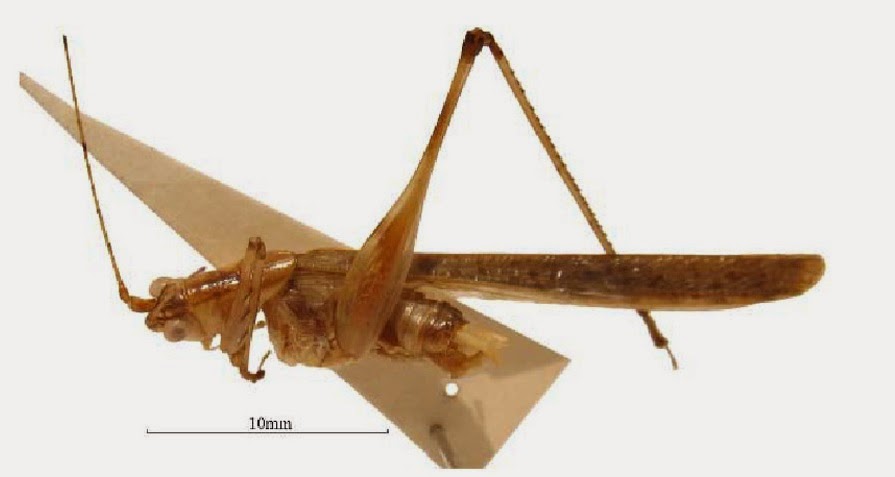
Oxylakis singaporensis, male specimen. Scale bar is 10 mm. Ingrisch & Tan (2012).

The remaining two species are both placed in the genus Jambiliara. The first of these species is named Jambiliara selita, Selita being the locality in Singapore where the earliest of the specimens used in describing the species was found, in 1871. The species is described from this as well as a specimen collected in 1901, and more recent specimens from Singapore, as well as an undated specimen from a collection made in Malaysia. Jambiliara selita is a brown and black Insect, similar to other species in the same genus, but with a distinctive stridulatory file.

Jambiliara selita, male (top) and female (bottom). Scale bars are 10 mm. Ingrisch & Tan (2012).

The second species of Jambiliara described is Jambiliara angula, described from a single male specimen that landed on a jungle path in front of a collector in Malaysia in 1956. It is a 27 mm brown and yellow Katydid.

Jambiliara angula, male. Scale bar 10 mm. Ingrisch & Tan (2012).

See also New species of Bush Cricket from the Eastern Carpathian MountainsAn early Cricket from southeast India and What Jurassic Katydids did.

Follow Sciency Thoughts on Facebook.

Sunday, 28 October 2012

New species of Bush Cricket from the Eastern Carpathian Mountains.

Bush Crickets, or Katydids, are large Insects in the Order Tettigoniidae, related to Grasshoppers and True Crickets. The are distributed widely around the globe, but reach their maximum diversity in the tropics and in temperate North America. The males of each species attract their mates with a distinctive call, made by rubbing stridulatory files on the back of their wings together, something they have apparently been doing since at least the Jurassic.

In a paper published in the journal Zootaxa on 18 October 2012, Gergely Szövényi of the Department of Systematic Zoology & Ecology at Eötvös Loránd University, Gellért Puskás of the Department of Zoology at the Hungarian Natural History Museum and Kerill Márk Orci of the Ecology Research Group of the Hungarian Academy of Sciences, Eötvös Loránd University and the Hungarian Natural History Museum, describe a new species of Bush Cricket from the ancient Caliman Caldera of the Eastern Carpathian Mountains in northern Romania.

The location of the Caliman Caldera. Google Maps.

The interior of the Caliman Caldera at (left) 1400 m and (right) 1600 m. Szövényi et al. (2012).

The new species is placed in the previously described genus Isophya, and given the specific name nagyi, in honour of Barnabás Nagy of the Plant Protection Institute of Hungarian Academy of Sciences, a leading expert on the Orthoptera (Crickets and Grasshoppers etc.) in Hungary.

The species is essentially similar to other species in the genera, a green Bush Cricket averaging 24 mm in length, and was identified on the basis of the male song, which is distinctive and indicates reproductive isolation. This is not simply a cultural difference, as in the songs of Whales or Primates, the song of a male Bush Cricket is preset by the physical structure of its stridulatory file.

Two colour variations of Isophya nagyi. Szövényi et al. (2012).

The stridulatory files of (A) Isophya nagyi, (B) Isophya camptoxypha, (C) Isophya ciucasi, (D) Isophya posthumoidalis, (E) Isophya sicula. (H) detail of the center part of the stridulatory file of Isophya nagyiSzövényi et al. (2012).


Follow Sciency Thoughts on Facebook.