Showing posts with label Palpa District. Show all posts

Sunday, 15 September 2019

Seven killed in landslides in Nepal.

Seven people have died in two landslides in Nepal this week. Six members of the same family died when their house was swept away when a road collapsed onto it in the village of Cherlabang in Rolpa District on Thursday 12 September 2019. They have been identified as Jaya Budha, 38, his wife Muljyoti Budha, 36, and their two daughters, Bewasti, 9, and Karishma, 2, as well as Shiva Kumari Budha, 28, and her son Asal, 4. Shiva Kumari Budha's husband is understood to be working overseas. The incident was caused by the collapse of a section of the Ghartigaun-Thawang Highway above the village. Residents of the village had been raising concerns about the construction of this highway for some time, claiming that contractors had carried out shoddy work in the absence of proper governmental supervision, and it is understood that Shiva Kumari Budha and her son had moved in with Muljyoti Budha's family out of concern that her own home might be vulnerable to such an event. 

The approximate location of the 12 September 2019 Cherlasbang landslide. Google Maps.

On Friday 13 September a rockfall on the Siddhartha Highway at Siddhababa in Palpa District, hit two vehicles, killing the driver of one, who has been identified as Kamal Pariyar of Gulmi District. Two people in the other vehicle escaped unhurt. 

The scene of a landslide in Palpa District, Nepal, that killed the driver of a car on Friday 13 September 2019. Mukti Neupane/MyRepublica.

The incidents have been blamed on torrential rainfall that has fallen across the area in the last few days. Landslides are common during the monsoon season in Nepal, which lasts from May to September, with  the highest rainfall occurring in July. Landslides are a common problem after severe weather events, as excess pore water pressure can overcome cohesion in soil and sediments, allowing them to flow like liquids. Approximately 90% of all landslides are caused by heavy rainfall.

Monsoons are tropical sea breezes triggered by heating of the land during the warmer part of the year (summer). Both the land and sea are warmed by the Sun, but the land has a lower ability to absorb heat, radiating it back so that the air above landmasses becomes significantly warmer than that over the sea, causing the air above the land to rise and drawing in water from over the sea; since this has also been warmed it carries a high evaporated water content, and brings with it heavy rainfall. In the tropical dry season the situation is reversed, as the air over the land cools more rapidly with the seasons, leading to warmer air over the sea, and thus breezes moving from the shore to the sea (where air is rising more rapidly) and a drying of the climate. This situation is particularly intense in South Asia, due to the presence of the Himalayas. High mountain ranges tend to force winds hitting them upwards, which amplifies the South Asian Summer Monsoon, with higher winds leading to more upward air movement, thus drawing in further air from the sea. 

Diagrammatic representation of wind and rainfall patterns in a tropical monsoon climate. Geosciences/University of Arizona.
 
See also...

https://sciencythoughts.blogspot.com/2019/09/assessing-how-wildlife-attacks-upon.htmlhttps://sciencythoughts.blogspot.com/2019/09/landslide-kills-three-in-jajarkot.html
https://sciencythoughts.blogspot.com/2019/04/magnitude-47-earthquake-in-kathmandu.htmlhttps://sciencythoughts.blogspot.com/2018/10/climbing-expedition-wiped-out-by.html
https://sciencythoughts.blogspot.com/2018/07/seventeen-dead-in-landslides-and-flash.htmlhttps://sciencythoughts.blogspot.com/2017/12/magnitude-49-earthquake-in-dolakha.html
Follow Sciency Thoughts on Facebook.

Sunday, 10 February 2019

Eleven known deaths as floods and landslides hit Peru and Chile.

At least eleven people have died as heavy rains hit southern Peru and northern Chile this week. Three people are know to have died and several more are still missing after two separate mudslides hit towns in the Arequipa Province of Peru, and another two when a similar incident hit a mine in Palpa District. Landslides are a common problem after severe weather events, as excess pore water pressure can overcome cohesion in soil and sediments, allowing them to flow like liquids. Approximately 90% of all landslides are caused by heavy rainfall. In Chile has cause a series of flash floods in the Atacama Desert, normally considered one of the driest places on Earth, destroying over a hundred homes and killing at least six people. Like many desert areas the Atacama, while generally arid, is prone to occasional severe flooding. This stems from two causes; firstly the arid climate prevents the development of a thick soil layer which would be expected in less dry areas, so that in much of the area (non-porous) bedrock is either exposed or close to the surface, and secondly the hot climate leads to heavy evaporation from nearby Pacific Ocean, so that if the wind changes direction and brings water-laden air to the area, it brings a lot of precipitation with it. This combination of heavy rainfall and low ground absorbency leads to large amounts of water at the surface, typically moving downhill at some speed. Dry channels or ravines through which these sudden floods are channelled, can be particularly dangerous at these times, particularly as they often appear to resemble natural pathways or even camp sites to people unfamiliar with the climate.

 A car trapped in mud following a flash flood at Chuquicamata in the Atacama Desert of northern Chile. Pedro Tapia/AFP.

This extreme weather has been linked to a developing El Niño wearther system over the Pacific Ocean. The El Niño is the warm phase of a long-term climatic oscillation affecting the southern Pacific, which can influence the climate around the world. The onset of El Niño conditions is marked by a sharp rise in temperature and pressure over the southern Indian Ocean, which then moves eastward over the southern Pacific. This pulls rainfall with it, leading to higher rainfall over the Pacific and lower rainfall over South Asia. This reduced rainfall during the already hot and dry summer leads to soaring temperatures in southern Asia, followed by a rise in rainfall that often causes flooding in the Americas and sometimes Africa. Worryingly climatic predictions for the next century suggest that global warming could lead to more frequent and severe El Niño conditions, extreme weather conditions a common occurrence.

 Movements of air masses and changes in precipitation in an El Niño weather system. Fiona Martin/NOAA.

See also...

https://sciencythoughts.blogspot.com/2019/01/magnitude-67-earthquake-off-coast-of.htmlhttps://sciencythoughts.blogspot.com/2018/11/magnitude-62-earthquake-in-iquique.html
https://sciencythoughts.blogspot.com/2018/10/warnings-issued-to-aviation-after.htmlhttps://sciencythoughts.blogspot.com/2018/05/magnitude-51-earthquake-in-petorca.html
https://sciencythoughts.blogspot.com/2018/01/eruptive-activity-on-volcan-arrau-peak.htmlhttps://sciencythoughts.blogspot.com/2018/01/magnitude-71-earthquake-off-coast-of.html
Follow Sciency Thoughts on Facebook.

Saturday, 8 August 2015

Landslide hits bus in Palpa District, Nepal, killing at least three.

Three people have been confirmed dead after a landslide hit a bus traveling from Palpa to Butwal on the Siddhartha Highway near Siddhababa on the afternoon of Saturday 8 August 2015, sweeping it into the Tinau River. Twenty six people were on the bus at the time of the incident, and it was initially feared that all had died, but around fifteen passengers have now been pulled from the wreckage alive, though there is little hope of finding any more survivors as the bus is now completely submerged in the river. The incident happened following 24 hours of heavy rain in the area, which reportedly weakened the hillslope above the road. Landslides are a common problem after severe weather events, as excess pore water pressure can overcome cohesion in soil and sediments, allowing them to flow like liquids. Approximately 90% of all landslides are caused by heavy rainfall.

Rescue workers recover the body of a victim following the 8 August 2015 Siddhababa landslide. DC Nepal.

Landslides are common during the monsoon season in Nepal, which lasts from May to September, with  the highest rainfall occurring in July, when the Palpa District typically receives around 230 mm of rain in the month. August is the second wettest month, typically receiving around 130 mm of rain.

The approximate location of the 8 August 2015 Siddhababa landslide. Google Maps.

Monsoons are tropical sea breezes triggered by heating of the land during the warmer part of the year (summer). Both the land and sea are warmed by the Sun, but the land has a lower ability to absorb heat, radiating it back so that the air above landmasses becomes significantly warmer than that over the sea, causing the air above the land to rise and drawing in water from over the sea; since this has also been warmed it carries a high evaporated water content, and brings with it heavy rainfall. In the tropical dry season the situation is reversed, as the air over the land cools more rapidly with the seasons, leading to warmer air over the sea, and thus breezes moving from the shore to the sea (where air is rising more rapidly) and a drying of the climate. This situation is particularly intense in South Asia, due to the presence of the Himalayas. High mountain ranges tend to force winds hitting them upwards, which amplifies the South Asian Summer Monsoon, with higher winds leading to more upward air movement, thus drawing in further air from the sea. 

Diagrammatic representation of wind and rainfall patterns in a tropical monsoon climate. Geosciences/University of Arizona.

See also...

One pupil has been confirmed dead and at least 13 more students and teachers have sustained injuries after a landslide struck a secondary school in the Chhorepatan area of Pokhara on Thursday 16...

Two doctors from India serving at the Lumbini Medical College are reported to have died after a landslide struck their car at Siddababa in Palpa District in southern Nepal on Wednesday 17 June 2015.  The two have been named as Tarun Deep Singh Kochar...

Over 4500 people have been confirmed dead after an Earthquake measured as a Magnitude 7.8 event at a depth of 15 km by the United States Geological Survey struck the Lamjung District of Nepal...


Follow Sciency Thoughts on Facebook.

Thursday, 18 June 2015

Landslide kills two Indian doctors in Nepal.

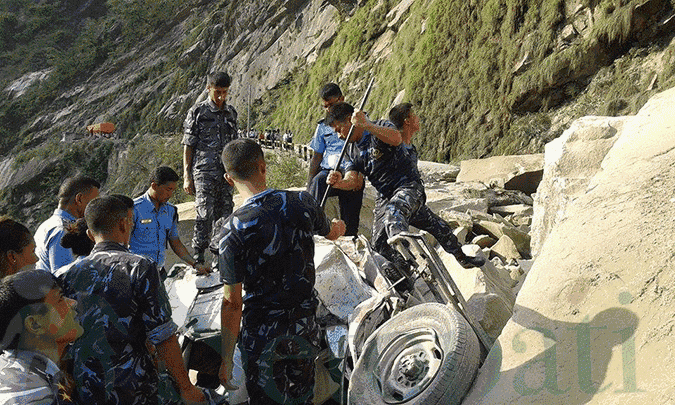
Two doctors from India serving at the Lumbini Medical College are reported to have died after a landslide struck their car at Siddababa in Palpa District in southern Nepal on Wednesday 17 June 2015.  The two have been named as Tarun Deep Singh Kochar an eye specialist and his wife Yasoda Kocher a gynecologist. Two other doctors from the college, Jamin Akhtar Mikrani and Prerit, are understood to have been injured in the event. The incident has been described as a dry landslide (most landslides are wet, caused by sediments becoming waterlogged after flooding or heavy rainfall), and linked to a small Earthquake, thought to have been an aftershock of the Magnitude 7.8 event which struck Nepal on 25 April 2015.

Rescue workers at the scene of the 17 June Palpa District landslide. Bhagwati Pandey/Setopati.

Nepal is located entirely within the Himalayas, a range of mountains formed by uplift associated with the collision between the Indian and Eurasian tectonic plates. The Indian Plate is moving northwards at a rate of 5 cm per year, causing it to impact into Eurasia, which is also moving northward, but only at a rate of 2 cm per year. When two tectonic plates collide in this way and one or both are oceanic then one will be subducted beneath the other (if one of the plates is continental then the other will be subducted), but if both plates are continental then subduction will not fully occur, but instead the plates will crumple, leading to folding and uplift (and quite a lot of Earthquakes). The collision of the Indian and Eurasian plates has lead to the formation of the Himalayan Mountains, the Tibetan Plateau, and the mountains of southwest China, Central Asia and the Hindu Kush.

The approximate location of the 17 June Palpa District landslide. Google Maps.

See also...

Over 4500 people have been confirmed dead after an Earthquake measured as a Magnitude 7.8 event at a depth of 15 km by the United States Geological Survey struck the Lamjung District of Nepal...


Eight people are known to have died and at least three more are missing after two landslides in Nepal on Monday 25 August 2014. The first incident happened at Baramchi in Sindhupalchowk District, where...


Eight people are known to have died and many more are missing following a massive landslide near Jure in the Sindhupalchowk District of Nepal on Saturday 2 August 2014. At least forty people were also injured in the incident, one of whom has been identified...


Follow Sciency Thoughts on Facebook.