Showing posts with label Parasitic Plants. Show all posts

Sunday, 23 June 2024

Thismia malayana: A new species of Parasitc Plant from Peninsula Malaysia.

Thismias, Thismia spp., are a curious group on Monocotyledonous Plants found in the evergreen forests of tropical and subtropical Asia, northern and eastern Australia to New Zealand, the north-central USA, Costa Rica and southern tropical America. They are Mycoheterotrophs, obtaining nutrition parasitically from the network of Mycorrhizal Fungi which exchange nutrients with the Plants of the forest, but contributing nothing themselves to the relationship. Thismias do not photosynthesize, enabling them to live on the darkest parts of the forest floor, and live most of their lives below ground, occasionally producing intricate, but often inconspicuous, flowers at most a few centimetres high, which are pollinated by Fungus Knats or similar small Insects.

In a paper published in the journal Phytotaxa on 31 May 2024, Mat Yunoh Siti-Munirah of the Forest Research Institute Malaysia, independent researchers Chin Hardy-Adrian, Sharipudin Mohamad-Shafiq, and Zainuddin Irwan-Syah, and Abd Halim Hamidi of the Negeri Sembilan Forestry Department, describe a new species of Thismia from Peninsula Malaysia.

The new species is named Thismia malayana, where 'malayana' is derived from 'Malaya' the old name for Peninsula Malaysia. The species is described from a specimen collected in the Kuala Pilah District of Negeri Sembilan State, Malaysia, on a trail leading to Gunung Angsi mountain, in February 2023.

Thismia malayana (A) flowering plant (A1) floral tube, inner surface (A2) annulus and stamen filaments, view from inside (B) inflorescence with anthetic flower and several young fruits (B1) style and stigma (B2) annulus, top view (C) flower, side view (D), (E) stamens, view from inside and from outside, (E1) stamen supraconnectives: one pair of club-shaped inwards-pointing, one pair of acute outwards-pointing, and one central appendage (F) stamen supraconnectives, apical view (G) stamen tube, view from below (H), (H1) fruit after dehiscence, top view, (H2) seeds I shoot base with roots. Siti-Munirah et al. (2024).

Thismia malayana exists as a vermiform root, light brown, unbranching and about 1 mm in diameter, which produces a light brown herbaceous Plant, reaching a maximum height of about 10 cm. This above-ground Plant comprises a stem about 6 cm long and 0.2 cm in diameter, from which grow 2-4 scale-like brown leaves, and 1-4 asymmetrical, tube-shaped flowers, up to about 7 mm long and 5 mm in width, brown-to-off-white in colour, with orange longitudinal ribs, and an opening surrounded by six triangular tepals. 

Thismia malayana with scales (the finest grade is 0.5 mm) (A) side view (B) top view (C) the size compared to the 20-sen coin (23.59 mm in diameter). Photos by Chin Hardy-Adrian from uncollected plants. Siti-Munirah et al. (2024).
 
Thismia malayana is known from only two localities, one in the Gunung Angsi Forest Reserve in Negeri Sembilan State, and the other in Tengku Hassanal Wildlife Reserve in Pahang State. In both locations it grows in moist, shady areas of Diptocarp forests, at elevations of 200-450 m above sealeavel, usually producing flowers and fruit between December and February (although flowering in June has also been observed). 

Habitat (in situ) of Thismia malayana in Ulu Bendul Recreational Park in Gunung Angsi Forest Reserve (A), (B) and the Tengku Hassanal Wildlife Reserve (C)–(E). (A) Thismia malayana at its habitat, which is located right next to the main trail to Gunung Angsi. (B) Mat Yunoh Siti-Munirah showing the habitat of Thismia malayana. (C) Path to Lata Bujang and Gunung Benom (D) The plants growing on rotten wood (E) Sharipudin Mohamad-Shafiq observing a Thismia malayana in its habitat. Photos by Mat Yunoh Siti-Munirah (A), (B) and Sharipudin Mohamad-Shafiq (C)–(E). Siti-Munirah et al. (2024).

Thismia malayana is known only from two locations, with less than 10 individual Plants observed. Both locations are in protected areas, although on is quite close to a forest trail, where it might be disturbed by visitors. The species is extremely cryptic in nature, making it likely that is exists in other areas and has not been discovered. For these reasons, Siti-Munirah et al. recommend that the species be classified as Vulnerable under the terms of the International Union for the Conservation of Nature's Red List of Threatened Species. 

See also...

Tuesday, 13 February 2024

Thonningia alba: A new species of Parasitic Plant from Madagascar.

The Balanophoraceae is a family of obligate root-parasitic plants (which is to say, Plants which tap into the root systems of other Plants for nutrients, and carry out little-or-no photosynthesis for themselves) in the order Santalales, which also includes Sandalwoods and Mistletoes. Six species of these plants, in five genera, are known from Africa, while three are found in Madagascar, Ditepalanthus malagasicus and Thonningia malagasica (sometimes known as Langsdorfa malagasica), which are endemic to the island, and  Balanophora abbreviata, which is also found in Southeast Asia.

In a paper published in the Kew Bulletin on 25 January 2024, Leandro Jorge Telles Cardoso and João Marcelo Alvarenga Braga of the Instituto de Pesquisas Jardim Botânico do Rio de Janeiro, describe a new species of Balanophoraceaen Parasitic Plant from the Masoala Peninsula of northeastern Madagascar.

Cardoso and Braga first came across this species as specimens in the collections of the Missouri Botanical Garden and Muséum National d'Histoire Naturelle, which were identified as belonging to Thonningia malagasica, but which appeared more similar to Thonningia sanguinea, a species known from West and Southern Africa, but never previously recorded in Madagascar. Closer examination of this material and comparison to specimens of all known species of Thonningia and Langsdorfa led Cardoso and Braga to conclude that the material did in fact represent a new species.

The new species is named Thonningia alba, where 'alba' means 'white' in reference to the colour of the flowers. Known specimens of the species have a single branch with 1-3 clusters of inflorescences. Leaves are reduced to a few 3-5 whorls of scales around the base of these inflorescences. Inflorescences can be male or female, and reach a maximum diameter of about 3 cm in diameter. Flowers are tubular, with male flowers reaching 12-16 mm in length, while female flowers are 9-12 mm long.

Thonningia alba. Male inflorescence, Masoala Peninsula, Madagascar, 15°41'43.55"S, 49°57'50.63"E, 270 m above sealevel, September 2018. Neek Helme in Cardoso & Braga (2024).

Thonningia alba has been found growing in tropical rainforests on the Masoala Peninsula at altitudes of between 110 and 650 m above sealevel, and appears to flower between July and November, with fruit being produced in November; although the limited number of observations of the species in the wild mean that this cannot be stated with absolute confidence. It is clearly parasitic in nature, but the identity of its host Plant is unclear. 

The Masoala Peninsula is considered to be a mega-diverse region of global biodiversity importance, and is covered by a mosaic of protected areas, the largest of which is the Masoala National Park, which includes large expanses of rainforests and coastal landscapes. Specimens of Thonningia alba were collected in 1986, 1993, and 1994, and the species was observed in the wild in September 2018. All observations were within the Masoala National Park, at two locations separated by about 16 km. While the park itself is a protected area, the surrounding area is home to a growing Human population, which is at least partially dependent on collecting wild resources from the area's forests. For this reason, Cardoso and Braga recommend that the species be treated as Endangered under the terms of the International Union for the Conservation of Nature’s Red List of Threatened Species.

See also...


Saturday, 13 August 2022

Cyne barcelonae: A new species of Showy Mistletoe from the Philippines.

Showy Mistletoes, Loranthaceae, are specialist members of the Sandlewood order, Santalales, which superficially resemble the Mistletoes of the northern temperate regions (to which they were formerly thought to be related), but with a distribution in the Southern Hemisphere and tropical regions, and more showy and brightly coloured flowers. Like the True Mistletoes, the Showy Mistletoes are hemiparasitic, which is to say they produce chlorophyll and photosynthesise for themselves, but obtain many of their nutrients by sinking their roots into the xylem of other Plants.

In a paper published in the journal Phytotaxa on 11 August 2022, Daniel Nickrent of the Plant Biology Section at Cornell University, and Mark Gregory Rule of the Department of Environmental Studies at Mindanao University and the Philippine Taxonomic Initiative describe a new species of Showy Mistletoe from Dinagat and Bucas Grande Island off the northeast coast of Mindanao. 

The new species is placed in the genus Cyne, which has previously been found in the Philippines, the Moluccas Islands, and New Guinea, and given the specific name barcelonae, in honour of the Filipina botanist Julie Fenete Barcelona, for her work on Pteridophytes and Rafflesia. 

Cyne barcelonae. (A) Habit of mistletoe parasitic on Myrsine sp. (B) A young haustorial connection to host branch. Arrow indicates a new vegetative shoot forming on the flank of the haustorium. Note that no epicortical roots are present. (C) Terminal portion of vegetative shoot showing two lateral and the central stems assuming a pseudo-whorled appearance. Note the connation of the leaf bases. (D) Non-connate leaves subtending to young shoots with connate leaves, still unopened. (E) Young inflorescence with one of the connate leaves removed. Although two pairs of triads can be discerned, their decussate nature is obscure. (F) Flowering shoots of plant photographed on Dinagat Island. Meljan Demetillo & Mark Gregory Rule in Nickrent & Rule (2022).

Cyne barcelonae produces a stem directly from its host without epicortical runners (visible external roots). This stem then typically divides to form two branches. The bark darkens to reddish brown as it ages, leaves are waxy and oval. The branch tips have two terminal leaves, each surrounding two triads of flowers. These flowers are green and tubular, with red tips. Fruits are a orange-brown in colour.

Cyne barcelonae. (A) Flowers at anthesis. Note the green corolla with a dilated base as well as stamens with filaments. (B) Fruits young and mature with persistent calyculus and style base. (C) Young fruit longitudinal section showing seed inside ovary wall. (D) Capitulum arising from corky periderm of receptacle. Note the bracts and bracteoles adpressed to calyculus/ovary. (E) Portion of inflorescence with two triads, one with calyculus/ovaries removed to show the laciniate bracts and bracteoles. (F) Corky periderm removed from receptacle. Nickrent & Rule (2022).

This Mistletoe has been observed growing on trees belonging to the genera Myrsine, Sterculia, and  Timonius, always on ultramafic soils within 20 m of a stream; other Mistletoes were observed in the same areas targeting the same host-trees. The species was found on two islands. Bucas Grande is part of the Siargao Islands Protected Landscape and Seascape, and in theory enjoys a high level of protection. However, the area where Cyne barcelonae was found growing as actually a fragment of remnant forest within a community-operated resort, and while their are regulations on Human activities here, firewood-collection and commercial tree cultivation do occur. Furthermore, the Plants were observed before the passage of Typhoon Rai through the area in December 2021, and has not been revisited by scientists since. Dinagat Island is currently considered to be severely threatened by mining, despite being recognised as an area of great importance for Plant biodiversity, with about half of the island's forests in areas which are currently covered by Mineral Production Sharing Agreements. Some protection may be offered by the Dinagat Island Conservation Program, which has recently been initiated by the provincial government, and which is intended to exclude areas of great biological significance from mineral extraction.

See also...


Follow Sciency Thoughts on Facebook.

Follow Sciency Thoughts on Twitter.


Tuesday, 30 November 2021

Cremastra saprophytica: A new species of semi-mycoheterotrophic Orchid from Gifu Prefecture, Japan.

Whilst Plants are primarily photosynthetic organisms, a lifestyle retained by the vast majority of species, a few, particularly those living in dark places, have lost this ability, and instead have become parasitic, obtaining nutrients from other organisms. The overwhelming majority of Parasitic Plants are mycoheterotrophs, Plants which parasitise the Mycorrhizal Fungi of other Plants, obtaining nutrients from the Fungi (including those nutrients the Fungi have themselves obtained from other Plants), but not providing the Fungi with anything in return. The evolution of such mycoheterotrophial systems is of great interest to botanists, making Plant groups in which this trait appears to be evolving a focus of study. One such group is the Orchid genus Cremastra, found in the dark understories of temperate forests in the Himalayas and East Asia. The genus Cremastra currently contains five species of Orchid, four of which are leafy, photosynthetic Plants, while the fifth, Cremastra aphylla, from Hokkaido Island, Japan, is a mycoheterotroph which lacks leaves and produces no chlorophyll.

In a paper published in the journal Phytotaxa on 30 November 2021, Kenji Suetsugu of the Department of Biology at Kobe University, describes a new species of Cremastra from Gifu Prefecture in central Honshu, Japan.

The new species is named Cremastra saprophytica, as it is associated with the saprotrophic Fungus Coprinellus disseminates, which obtains nutrients from decaying wood rather than mycorrhizal associations with Plants, apparently making the new species an indirect saprotroph via parasitism of this Fungus.

 
Cremastra saprophytica from the type locality. (A)–(C) Flowering plant. (D) Flower, dorsal view. (E) Flower, lateral view. (F) Flower, front view. Central arrow points to a small smooth callus of lip positioned at the base of midlobe, whereas the other arrows point to the inconspicuous lateral lobes. (G) Fruiting plants. (H) Fruiting body of Coprinellus disseminates, one of the associated fungi of Cremastra saprophytica. Suetsugu (2021).

Unlike Cremastra aphylla, Cremastra saprophytica does produce chlorophyll, although it lacks leaves, and the majority of its nutrition appears to be obtained mycoheterotrophicly. The Plants reach between 28 and 48 cm tall, and produce dark purple, tubular flowers in May and June, followed by green fruiting bodies between June and October. The flowers appear to be entirely self-pollenating, which is a common adaptation in forest understory plants, whose habitat contains few potential pollinators.

 
Cremastra aphylla from Hokkaido. (A) Flowering plant. (B) Flowers; central arrow points to a large verruculose callus of lip positioned at the base of midlobe, whereas the other arrows point to the conspicuous lateral lobes. (C) Close-up of the upper part of the lip and column, lateral view. (D) Close-up of the upper part of the lip, dorsal view. (E) Close-up of the upper part of column and anther cap (lateral and ventral views); arrow points to a large, folded viscidium attached to pollinia. Suetsugu (2021).

Cremastra saprophytica is currently known only from a single location, near the town of Ibigawa in Ibi County.  It can be difficult to determine the distribution or range of Parasitic Plants, as they tend o be small and inconspicuous, and are typically found in dark forest understories or other dimly lit places, producing flowers and fruiting bodies at certain times of year. However, the relatively large size and conspicuous flowers of Cremastra saprophytica make it unlikely that it could be very widespread and have remained overlooked.

See also...


Follow Sciency Thoughts on Facebook.

Follow Sciency Thoughts on Twitter. 


Saturday, 2 October 2021

Thismia sitimeriamiae: A new species of Parasitic Plant from Terengganu State, Peninsular Malaysia.

The Family Thismiaceae comprises 3-5 genera (two genera are sometimes separated out and placed within a family of their own) of Parasitic Monocotyledonous Plants within the Order Dioscoreales, which also includes Yams. These Plants parasitise the Mycorrhizal Fungi of other Plants, obtaining nutrients from the Fungi, but not providing the Fungi with anything in return. The genus Thismia currently contains 86 species, predominantly from tropical Asia and Australasia, although there are species known from the Americas and temperate Asia. However, the diversity of the group is not that well understood, as these Plants, which are non-photosynthetic, only protrude above the ground during their breeding season, when they produce flowers a few centimetres high. This means that many Thismia species are known only from a single specimen, and we have little idea how widespread they really are or how much variation there is within species. 

The Malaysian state of Terengganu appears to be somewhat of a biodiversity hotspot for Thismias, whith six species reported there to date; Thismia alba, Thismia aseroe, Thismia domei, Thismia javanica, Thismia latiffiana, and Thismia terengganuensis. This diversity appears to be linked to the primary rainforests of the state, which have been disappearing rapidly in recent decades, which raises interesting conservation questions for the genus, which is hard to raise in captivity or transplant to new locations, due to its dependence on (unknown) Fungal hosts.

In a paper published in the journal Phytokeys on 29 June 2021, Mat Yunoh Siti-Munirah of the Forest Research Institute Malaysia, Nikong Dome of DigitalDome Photography, and Chris Thorogood of the Department of Plant Sciences at the University of Oxford and the University of Oxford Botanic Garden, describe a new species of Thismia from the Hulu Nerus Forest Reserve in the State of Terengganu.

 
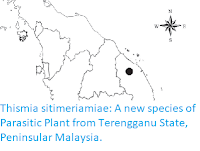
Hulu Nerus Forest Reserve (black circle), where the new species was discovered. Siti-Munirah Mat Yunoh et al. (2021).

The new species was discovered by Nikong Dome beside a mountain trail in the forest reserve in 2019, and is named Thismia sitimeriamiae, in honour of his mother, Siti Meriam, honour of her unparalleled support for his conservation activities and her help in maintaining his plant collections. The species was originally discovered at two locations beside the trail in December 2019, but a return visit in February 2020 found that one of these sites had been destroyed by Wild Boar activity, and only a single Plant was growing at the other. A follow up visit in December 2020 again found only a single Plant growing at this site, and was unable to locate any other sites where the species was growing.

 
Thismia sitimeriamiae. (A) The habitat in Gunung Sarut, in the State of Terengganu, Peninsula Malaysia. (B) The habit of flowering specimen. (C) A fruiting specimen (in situ). Siti-Munirah Mat Yunoh et al. (2021).

Thismia sitimeriamiae produces a single conical orange flower on an unbranching stem covered by residual, scale-like, non-photosynthetic white leaves arranged in a spiral pattern. The whole Plant stands about 2.2 cm heigh, and is easily overlooked in the forest leaf-litter. 

 
Illustration of Thismia sitimeriamiae. (A) Cross section of perianth showing pendulous stamens (above) and slender pistil (beneath). (B) Pistil. (C) Aerial view of flower showing mitre and portions of apical part of floral tube and outer tepals. (D) Fruit. (E) Stamen (showing outer side of connective). (F) Flower, lateral view. (G) Habit, showing inflorescence (flower) and roots. Siti-Munirah Mat Yunoh et al. (2021).

The new species is currently known only from a single location, in a lowland Dipterocarp forest, growing on moist soil in shade, at an elevation of 209 m above sealevel. Since it is known only from a single location, beside a popular tourist trail where there is a high chance of Human disturbance, and less than five specimens have ever been observed, Siti-Munirah Mat Yunoh et al. recommend that the species be treated as Critically Endangered under the terms of the International Union for the Conservation of Nature’s Red List of Threatened Species. 

 
Thismia sitimeriamiae. (A) Habit with roots. (B) Flower, view from below. (C) Aerial view of floral tube (mitre removed). (D) Flower, aerial view. (E) Mitre, lateral view. (F) Ovary and pistil, lateral view. (G) Flower, lateral view. (H) Mitre, lateral view. (I) Stellate trichomes on the outer surface of floral tube. Images not to scale. Siti-Munirah Mat Yunoh et al. (2021).

Thismias, like other non-photosynthetic Parasitic Plants, typically spend much of their time below ground, only emerging to flower, the timing of which can be unpredictable from a Human perspective. Nevertheless, Thismia sitimeriamiae, has only been observed at two localities, flowering and fruiting between December and February, and both of those sites have subsequently been disturbed by the actions of Wild Boars, the first between the initial discovery of the Plant in December 2019 and a follow-up visit to the site in 2020, the second was discovered also to have been destroyed during a visit to the site in June 2021. 

Plants which parasitise Fungi present an interesting challenge to conservationists, since their survival is linked to specific, and usually unknown, Fungal hosts, making them hard to cultivate. Nevertheless, botanic gardens have had some success with other Parasitic Plants, including the Australian Orchid, Rhizanthella gardneri, and Rafflesia in the Philippines, although both of these had known hosts, allowing the transplanting of Plants to new areas. Most members of the genus Thismia have been recorded only once, and the ecology of these Plants is poorly understood, which makes cultivating them unlikely in the near future. This being the case, conservation efforts should be directed at the preservation of their environment as much as possible.

See also...


Follow Sciency Thoughts on Facebook.

Follow Sciency Thoughts on Twitter. 


Thursday, 10 October 2019

Sapria myanmarensis: A new species of Parasitic Plant from Kachin State, Myanmar.

The genus Sapria currently contains three species of Parasitic Plants closely related to the Corpse Flowers, Rafflesia spp.. Like Corpse Flowers, all members of the genus Sapria are parasitic on vines of the genus Tetrastigma, with almost the entire body of the parasite reduced to a haustorium that grows within the tissue of the host. The only part of the parasite that extends outside the host is the flower (and later the fruiting bodies derived from this), though these flowers are exceptionally large and distinctive. The genus Sapria differs from  Rafflesia in the structure of its flowers; both genera have large floral chamber defined by a diaphragm. However similar floral chambers in Rafflesia and Sapria are constructed very differently. The diaphragm is derived from the petal whorl in Rafflesia, on the other hand, in Sapria it is derived from elaboration of a ring structure located between the perianth and the stamen whorl.

In a paper published in the journal Taiwania on 20 August 2019, Nobuyuki Tanaka of the Department of Botany at the Japanese National Museum of Nature and Science, Hidetoshi Nagamasu of the Kyoto University Museum, Shuichiro Tagane of the Kagoshima University Museum, and Mu Mu Aung, Aung Khaing Win, and Phyu Phyu Hnin, of the Forest Research Institute of the Myanmar Ministry of Natural Resources and Environmental Conservation,  describe a new species of Sapria from Kachin State, Myanmar.

The new species is named Sapria myanmarensis, meaning 'from Myanmar'. The plant lives entirely within the roots of Tetrastigma, until it flowers during the dry season (i.e. December till March), when it produces a pink bud that grows to 7 cm in diameter, which opens to produce a red flower with white warts, 10 cm in diameter.

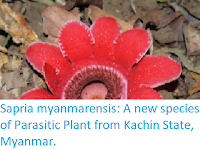
Sapria myanmarensis, female flower. Tanaka et al. (2019).

The plant was found growing in an evergreen forest in a hilly area of the Indawgyi Wildlife Sanctuary. Less than 50 plants were found in total, and Tanaka et al, recomend that the species be classified as Critically Endangered under the terms of the International Union for the Conservation of Nature’s Red List of Threatened Species. I

See also...

https://sciencythoughts.blogspot.com/2019/06/thismia-submucronata-new-species-of.htmlhttps://sciencythoughts.blogspot.com/2018/09/cassytha-filiformis-parasitic-plant.html
https://sciencythoughts.blogspot.com/2017/09/thismia-nigricoronata-new-species-of.htmlhttps://sciencythoughts.blogspot.com/2016/12/lecanorchis-tabugawaensis-new-species.html
https://sciencythoughts.blogspot.com/2016/02/rafflesia-consueloae-dwarf-corpse.htmlhttps://sciencythoughts.blogspot.com/2015/08/gastrodia-madagascariensis-not-so-new.html
Follow Sciency Thoughts on Facebook.

Wednesday, 26 June 2019

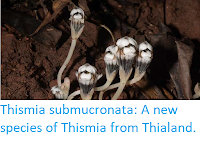
Thismia submucronata: A new species of Thismia from Thialand.

Thismias (Thismiaceae) are a small group of Parasitic Plants found throughout the tropics, with a few temperate species known from North America, Japan, New Zealand and Australia. They parasitise the Mycorrhizal Fungi with which all vascular plants have a relationship, but where other plants exchange sugars produced by photosynthesis for nutrients obtained from the soil by the Fungi, Thismias do not photosynthesise, instead taking both nutrients and sugars from the Fungi and giving nothing in return. In order to do this Thismias must target Fungi in relationships with other Plants (since Fungi do not produce sugars), preventing the Thismia from growing to any great size. Thismias are related to Bat Flowers and Arrowroots; they were formerly classified within the (also parasitic) Burmanniaceae, but it is now recognised that while the two groups are fairly closely related, both are more closely related to some non-parasitic plants than they are to each-other.

In a paper published in the journal Taiwania on 24 June 2019, Sahut Chantanaorrapint of the Department of Biology at Prince of Songkla University, Naiyana Tetsana of the Forest Herbarium of the Department of National Parks, Wildlife and Plant Conservation, Petch Tripetch of Muang, and Somran Suddee, also of the Forest Herbarium of the Department of National Parks, Wildlife and Plant Conservation, describe a new species of Thismia from the Phu Hin Rong Kla and Phu Suan Sai national parks in northern Thialand.

The new species is named Thismia submucronata, where 'submucronata' meaning 'short-tipped'. The plant is whitish (it does not produce chlorophyll) with white flowers with darker bases, and small, triangular, scale-like leaves. It reaches about 14 cm in height. The species was found growing in two different locations, in both places growing in leaf litter, under the shade of moist evergreen forest, near a waterfall or stream side. The plants were found at altitudes of between 1200 and 1300 m.

Thismia submucronata, plant in natural habitat. Sahut Chantanaorrapint in Chantanaorrapint et al. (2019).

See also...

https://sciencythoughts.blogspot.com/2018/09/cassytha-filiformis-parasitic-plant.htmlhttps://sciencythoughts.blogspot.com/2017/09/thismia-nigricoronata-new-species-of.html
https://sciencythoughts.blogspot.com/2016/12/lecanorchis-tabugawaensis-new-species.htmlhttps://sciencythoughts.blogspot.com/2016/02/rafflesia-consueloae-dwarf-corpse.html
https://sciencythoughts.blogspot.com/2015/08/gastrodia-madagascariensis-not-so-new.htmlhttps://sciencythoughts.blogspot.com/2015/06/balanophora-coralliformis-new-species.html
Follow Sciency Thoughts on Facebook.