Showing posts with label Pulmonate Gastropods. Show all posts

Tuesday, 26 July 2022

Barkeriella museensis: A new species of Systellommatophoran Slug from the tropical Afromontane greenhouse of the Science Museum of Trento, northern Italy.

Botanical gardens, Plant nurseries, and similar facilities are well known reserves of xenodiversity (diversity based upon introduced, non-local species). Such environments have been a route through which a wide range of Invertebrates, Micro-organisms, Fungi, and Plants are known to have spread from such centres into new environments, leading many countries to have introduced tight legislation around the importing of Plants and soil. In recent years taxonomists have described a number of new species from botanical gardens, including Fungi, Wasps, Gastrotrichs (four of the 800 species described within this group, or 0.5% of their total diversity), Arachnids, Insects, and Molluscs.

In a paper published in the Zoological Journal of the Linnean Society on 26 July 2022, Giuseppe Manganelli of the Dipartimento di Scienze Fisiche, della Terra e dell’Ambiente at the Università di Siena, Andrzej Lesicki of the Department of Cell Biology at the Adam Mickiewicz University in Poznan, Andrea Benocci of the Museo di Storia Naturale dell’Accademia dei Fisiocritici, Debora Barbato, also of the Dipartimento di Scienze Fisiche, della Terra e dell’Ambiente at the Università di Siena, Dannio Miserocchi of Ravenna, Joanna Pieńkowska, aslo of the Department of Cell Biology at the Adam Mickiewicz University in Poznan, and Folco Giusti, again of the Dipartimento di Scienze Fisiche, della Terra e dell’Ambiente at the Università di Siena, describe a new species of Slug from the tropical Afromontane greenhouse of the Science Museum of Trento, northern Italy.

The new species is described from a population found living in the greenhouse in January and May 2019, but which could not be refound in February 2022. During the intervening time the part of the greenhouse where the Slugs were found was restructured, and the entire greenhouse suffered an infestation with burrowing Suriname Cockroaches, Pycnoscelus surinamensis, and it is believed the population is now extinct. 

An initial examination of the Slugs quickly revealed that they had transverse ridges on the foot, indicating that they did not belong to the Order Stylommatophora, the most numerous and diverse group of Pulmonate Gastropods, but rather the less numerous Order Systellommatophora. Members of the Systellommatophora are all Slug-like forms lacking shells, and are exclusively hermaphroditic. They are considered to be a sister group to the Stylommatophora, with the two groups together forming the clade Geophila. 

The Order Systellommatophora comprises three families. The Onchidiidae are large, oval-to-round, predominantly semi-marine Slugs, with a single pair of tentacles, found throughout the coastal zones of the temperate, subtropical, and tropical oceans, but most diverse and abundant in the eastern Indian Ocean and tropical western Pacific. The Veronicellidae are medium-to-large sized, dorsoventrally flattened, elongate Slugs, with leathery backs and two pairs of tentacles, found throughout the tropics and subtropics, although favouring moist climates and most abundant and diverse in primary and secondary rainforests. The Rathouisiidae are small, slender, typically keeled, carnivorous Slugs, with two pairs of tentacles, found in Southeast Asia and Australasia. 

The new Slug is a small, slender species with four pairs of tentacles, which shares many features associated with the Rathouisiidae. However, the species also has a number of unique features which prevent it being placed into any currently described Rathouisiid genus, most notably the structure of the reproductive system, considered important in the classification of Gastropods, prompting Manganelli et al. to place it in a new genus.

The new species is named Barkeriella museensis, where 'Barkeriella' honours New Zealand Gary Barker for his work on  terrestrial Gastropods, and 'museensis' means 'coming from MUSE', where MUSE is an abbreviation commonly used for the Science Museum of Trento.
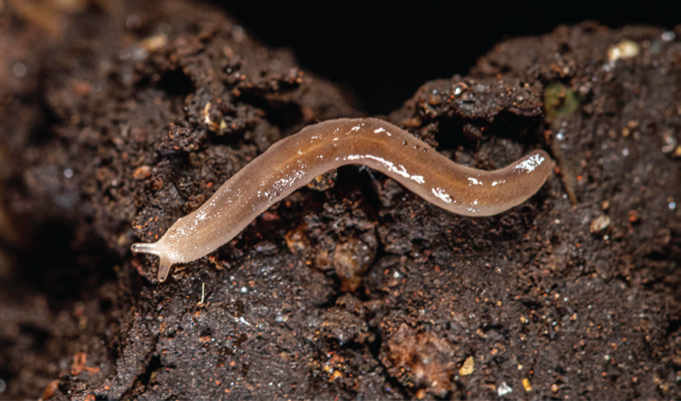
Live specimen of Barkeriella museensis from the tropical greenhouse of the Science Museum of Trento, Italy. Debora Barbato in Manganelli et al. (2022).

Barkeriella museensis is a small Slug, at most 20 mm in length and no more than 3 mm in width. It has a rounded body, whitish in colour with a grey band on each side, separated by a white line marking the trace of a keel. There are two pairs of tentacles, with the upper being longer and tending to have a pinkish hue. The foot is elongate.

The origin of Barkeriella museensis is unclear. The given the known range of the Rathouisiidae, it is unlikely that the species originates in the montane forests of Africa. However, the Afromontane greenhouse of the Science Museum of Trento is known to contain species of non-African origin, chosen for their close resemblance to African species which were not available, and the majority of Plants in the greenhouse were sourced from other collections or commercial dealers in Italy anyway.

There are currently four known genera of Rathouisiids (excluding Barkeriella), each with its own distribution. The genus Rathouisia, which gives its name to the group as a whole, is known from southeastern China, and possibly South Korea. The genus  Atopos is known from Southeast Asia, Indonesia, New Guinea, and northern Australia. The genus Granulilimax contains a single species from Japan, with another genus known, but never formally named or described, from the Ryukyu Islands.

Theoretically, if the relationship between Barkeriella and these other genera could be established, then it might be possible to estimate its point of origin. Unfortunately the GenBank database, an open access database of gene sequences containing data from more than 500 000 species of species of Animals and Plants, contains only a limited number of sequences from the genera Atopos and Granulilimax, and none from Rathouisia, despite this being the largest genus in the family. In order to remedy this Manganelli et al. uploaded sequences from key parts of the genomes of both Barkeriella museensis and Rathouisia sinensis. Unfortunately none of the sequences available were close enough to Barkeriella museensis to shed any light on its point of origin.

See also...

Follow Sciency Thoughts on Facebook.

Follow Sciency Thoughts on Twitter


Friday, 24 May 2019

Laocaia simovi: A new species of Semislug from Vietnam.

Semislugs are terrestrial Gastropods with much reduced shells. Unlike true Slugs they have not lost their shell completely, though they cannot withdraw into it, and it is often internal. Semislugs are not a single taxonomic group, occurring in a number of Pulmonate Gastropod families, with about two thirds of terrestrial 'Slugs' actually being Semislugs. The genus Laocaia currently comprises two species of Semislugs in the Family Helicarionidae (which contains both Semislugs and Snails) from Fansipan Mountain in northwest Vietnam.

In a paper published in the journal ZooKeys on 16 May 2019, Ivaylo Dedov of the Institute of Biodiversity and Ecosystem Research at the Bulgarian Academy of Sciences, Ulrich Schneppat of Malix in Switzerland, Manh Quang Vu of the Ho Chi Minh City University of Food Industry, and Nguyen Quoc Huy of the Vietnamese Institute of Ecology and Works Protection, describe a new species of Laocaia, which is also from Fansipan Mountain in northwest Vietnam.

The new species is named Laocaia simovi, where 'simovi' honours the biologist Nikolay Simov of the National Museum of Natural History in Sofia. The species is described from three adult and two juvenile specimens collected from a Bamboo forest at 2900 m above sealevel, just below the summit of the mountain. These are 21.12–26.40 mm in length, with a thin shell covering a non-coiled visceral hump, which sits in a v-shaped body groove. They are a light ochre-brown in colour, grey around the head, the rear part of the foot is dark red. The shell is located on top of the hump, slightly offset to the right, and is more mineralised to the rear.

Laocaia simovi, colouration of the body with the visceral hump and U-shaped dorsal groove. Dedov et al. (2019).

See also...

http://sciencythoughts.blogspot.com/2019/02/pleistocene-land-snails-from-sea-cliffs.htmlhttp://sciencythoughts.blogspot.com/2019/01/pseudamnicola-sumbasensis-new-species.html
http://sciencythoughts.blogspot.com/2019/01/molluscs-from-early-cambrian-shackleton.htmlhttp://sciencythoughts.blogspot.com/2018/12/platydoris-guarani-new-species-of.html
http://sciencythoughts.blogspot.com/2018/09/alionchis-jailoloensis-new-species-of.htmlhttp://sciencythoughts.blogspot.com/2018/08/rioting-in-hout-bay-cape-town-after.html
Follow Sciency Thoughts on Facebook.

Sunday, 2 September 2018

Alionchis jailoloensis: A new species of Onchidiid Slug from the Mangroves of Halmahera, eastern Indonesia.

Onchidiid Slugs are shell-less Gastropods found almost exclusively in Mangroves and intertidal zones (though two species are found at high altitudes in Montane Rianforests in Borneo and the Philippines). Remarkably, unlike all other marine Gastropods, they are air-breathing Pulmonates, closely related to terrestrial Slugs and Snails, and cannot survive below the low-tide line, as if they are not periodically exposed to the air they will drown. Onchidiids reach their maximum diversity in Southeast Asia and Indonesia, but are found around the world, reaching as far north as Scotland and Alaska.

In a paper published in the journal Raffles Bulletin of Zoology on 21 May 2018, Tricia Goulding of the Department of Biology at Pennsylvania State University, and the Bernice Pauahi Bishop Museum, Munawar Khalil of the Department of Marine Science at Universitas Malikussaleh, Shau Hwai Tan of the Marine Science Laboratory and Centre for Marine and Coastal Studies at Universiti Sains Malaysia, and Benoît Dayrat, also of the Department of Biology at Pennsylvania State University, describe a new species of Onchidiid Slug from Halmahera Island in Indonesia.

The new species is named Alionchis jailoloensis, where 'Alionchis' honours Ali, an assistant of Alfred Russel Wallace during his travels in the Malay Archipelago, originally hired as a cook, but who went on to make a significant contribution to the study of Ornithology in the region, and 'jailoloensis' means 'from Jailolo', a small port on Halmahera, near where the species was discovered, and the  former name of the entire island. Alionchis jailoloensis is flattened with thick eyestalks and additional eyes on its dorsal surface, it is muddy brown in colour and reaches about 65 mm in length. 

Live specimens, Alionchis jailoloensis, Indonesia, Halmahera. (A) Dorsal view, 63 mm long; (B) Dorsal view, 48 mm long; (C) Dorsal view, holotype, 43 mm long); (D) Dorsal view, 64 mm long; (E) Dorsal view (the arrow points to the pneumostome), same as (A); (F) Dorsal view, 51 mm long); (G) Dorsal view, 61 mm long; (H) Lateral view, 69 mm long; (I) Ventral view, 33 mm long; (J) Ventral view, 45 mm long. Goulding et al. (2018).

Alionchis jailoloensis was found living on mudflats between trees in open Mangrove Forest. It appears to be endemic to the island of Halmahera (i.e. not found anywhere else), which is unusual for a Onchidiid Slug, as most species have quite wide distributions.

See also...

https://sciencythoughts.blogspot.com/2018/08/rioting-in-hout-bay-cape-town-after.htmlhttps://sciencythoughts.blogspot.com/2018/01/acrotoma-likharevi-acrotoma.html
https://sciencythoughts.blogspot.com/2017/07/fluminicola-umpquaensis-fluminicola.htmlhttps://sciencythoughts.blogspot.com/2017/07/aenigmatoconcha-clivicola-new-species.html
https://sciencythoughts.blogspot.com/2016/12/dendronotus-arcticus-dendronotus.htmlhttps://sciencythoughts.blogspot.com/2016/09/sphendone-insolita-new-species-of.html
Follow Sciency Thoughts on Facebook.