Showing posts with label Scarabeidae. Show all posts

Thursday, 18 April 2019

Lophorrhinides muellerae: A new species of Flower Chafer from Tanzania.

Scarab Beetles, Scarabeidae, are a large and diverse group, containing about 30 000 known species from around the world. These Beetles are typically large and robust, and often with a metallic colouration. Many Scarab Beetles are excellent diggers, and many of these digging Scarabs share a habit of burying their eggs with a supply of dung to feed their young, gaining them the name Dung Beetles, though others lay their eggs on carrion, decaying plant matter, or in some cases living plants. Flower Chafers, Cetoniinae, are Scarab Beetles that feed as adults on the nectar and pollen of flowers. The larval habits of this group are variable, with some species predating the larvae of other Insects and others feeding on Bird Droppings - the later being particularly true of Southern African species. 

In a paper published in the journal ZooKeys on 26 March 2019, Renzo Perissinotto of the School of Environmental Sciences at Nelson Mandela University, Lynette Clennell of the Macau Anglican College, and Gerhard Beinhundner of Euerbach in Germany, describe a new species of Flower Chafer from the Southern Highlands of Tanzania.

The new species is named Lophorrhinides muellerae, where ‘Lophorrhinides’ means ‘similar to Lophorrhina’ a genus which it closely resembles and is thought to be closely related to, and ‘muellerae’ honours Ruth Müller of the Ditsong Museum of Natural History, who found the male specimen of the new species in the museum’s collection and realised it was probably a new species. The species is described from two specimens, the male from the collection of the Ditsong Museum, and a female from the private collection of Gerhard Beinhundner. The female closely resembles that of Lophorrhina donckieri, and was originally misidentified as such. The male, however, is quite unlike that of any member of the genus Lophorrhina, which tend to be strongly sexually dimorphic (i.e. the sexes are very different), and resembles the female quite strongly.

Male Lophorrhinides muellerae in dorsal view. Perissinotto et al. (2019). 

The male specimen is 17.9 mm in length and 9.8 mm in width, black and orange in colour with a dull lustre and covered in hairs. The female is slightly larger, at 18.0 mm long and 9.5 mm wide, and similar in colour but shiny and largely hairless. The two specimens are presumed to be the same species due to their similarity in appearance, though this has not been tested by genetic analysis, and the two specimens were collected in different places at different times; the female in the Rungwe Mountains in February 2006, and the male at Manow in ‘Deutsch Ost-Afrika’ at an unknown time (although the name Deutsch Ost-Afrika implies it was collected before 1914, as this German colony was lost during the First World War, becoming first British Tanganyika and then the Republic of Tanzania.

Female Lophorrhinides muellerae in dorsal view. Perissinotto et al. (2019).

See also...

https://sciencythoughts.blogspot.com/2019/02/callophylla-macrocephala-new-species-of.htmlhttps://sciencythoughts.blogspot.com/2018/12/drosera-albonotata-new-species-of-pygmy.html
https://sciencythoughts.blogspot.com/2018/11/glaresis-hespericula-new-species-of.htmlhttps://sciencythoughts.blogspot.com/2018/07/beauveria-majiangensis-new-species-of.html
https://sciencythoughts.blogspot.com/2018/06/macrocheles-kekensis-new-species-of.htmlhttps://sciencythoughts.blogspot.com/2017/10/eurypeza-aurora-new-species-of-scarab.html
Follow Sciency Thoughts on Facebook.

Thursday, 7 February 2019

Callophylla macrocephala: A new species of Flower Chafer from southern Tanzania.

Scarab Beetles, Scarabeidae, are a large and diverse group, containing about 30 000 known species from around the world. These Beetles are typically large and robust, and often with a metallic colouration. Many Scarab Beetles are excellent diggers, and many of these digging Scarabs share a habit of burying their eggs with a supply of dung to feed their young, gaining them the name Dung Beetles, though others lay their eggs on carrion, decaying plant matter, or in some cases living plants. Flower Chafers, Cetoniinae, are Scarab Beetles that feed as adults on the nectar and pollen of flowers. The larval habits of this group are variable, with some species predating the larvae of other Insects and others feeding on Bird Droppings - the later being particularly true of Southern African species. 

The genus Callophylla is currently known from only three species, and a very limited number of specimens. Callophylla costata was first described based upon a single male specimen from central Cameroon in 2016. A female collected from Mount Nimba in Guinea was assigned to the same species in 1954, then redescribed as a new species, Callophylla lamottei, in 2007, when the actual female of Callophylla costata was discovered. In 2015 a third species, Callophylla takanoi, was described based upon a male found in western Zambia during a survey undertaken to the region by the British Natural History Museum.

In a paper published in the journal ZooKeys on 23 January 2019, Renzo Perissinotto of the School of Environmental Sciences at Nelson Mandela University describes a new species of Callophylla, from a single male found in the collection of the Ditsong National Museum of Natural History in Pretoria, which was apparently collected by the German entomologist Paul Norbert Schürhoff in what is now southern Tanzania in the early twentieth century.

The new species is given the name Callophylla macrocephala, meaning ‘big head’ as its head, and in particular its clypeus (forepart of the head, resembling the face of a vertebrate), is notably larger and wider than other known members of the genus. The specimen is 12.8 mm long and 5.3 mm wide, and black in colour with ochre markings on its elytra (wing cases), and scattered, horseshoe-shaped perforations on its protonum (thorax).

Dorsal (A) and ventral (B) habitus of Callophylla macrocephala. Perissinotto (2019). 

The specimen is labelled as having come from the ‘Nakonde Hochland’ (Nakonde Highlands) area of Deutsch-Ostafrika, presumed to be the Lindi District of German Tanganyika (modern Zambia), which lies across the border from the town of Nakonde, in what was then the British colony of Northern Rhodesia and is now Zambia. The specimen does not appear to have been mentioned in any of Schürhoff’s numerous publications on Flower Chafers. 

Type localities of Callophylla macrocephala (blue circle) and Callophylla takanoi (red circle) in Central – East Africa. Perissinotto (2019).

Like other members of the genus Callophylla, Callophylla macrocephala lacks any form of mouthparts, and apparently cannot feed as an adult. Perissinotto suggests that this inability of adults of the genus to feed, combined with a distribution in highland regions, may explain the apparent rarity of the genus. Species confined to high altitudes are effectively living in islands cut off from other members of the same species by areas of uninhabitable lowland. This means that individual species tend to have very local distributions, and any population which somehow gets transplanted to a new ‘island’ is effectively cut off from the population from which it came, enabling new species to form easily. Where an insect has only a very short adult lifespan, then adults will only be seen for a few days at one time of year, making it unlikely that collection entomlogists will happen to wander through at the right moment.

See also...

https://sciencythoughts.blogspot.com/2018/11/glaresis-hespericula-new-species-of.htmlhttps://sciencythoughts.blogspot.com/2017/10/eurypeza-aurora-new-species-of-scarab.html
https://sciencythoughts.blogspot.com/2017/10/lamellothyrea-isimangalis-new-species.htmlhttps://sciencythoughts.blogspot.com/2017/09/pegylis-majori-new-species-of-scarab.html
https://sciencythoughts.blogspot.com/2017/07/electraesalopsis-beuteli-new-species-of.htmlhttps://sciencythoughts.blogspot.com/2016/08/ceratocaryum-argenteum-plant-producing.html
Follow Sciency Thoughts on Facebook.

Tuesday, 6 November 2018

Glaresis hespericula: A new species of Scarab Beetle from the Cape Verde Islands.

The Glaresidae are a family of small and rather uniform Scarab Beetles thought to be the sister group to all other Scarabs. They have a long fossil record, with seven known Mesozoic species in three separate genera. All modern members of the group are placed in a single genus, Glaresis, which currently contains 82 species, found on every major land-mass except Antarctica and Australia.

In a paper published in the journal ZooKeys on 23 October 2018, David Král and Lucie Hrůzová of the Department of Zoology at Charles University, describe a new species of Glaresis from Boa Vista Island in the Cape Verde group.

The species is named Glaresis hespericula, where ‘hespericula’ means a juvenile Hesperid. It is described from two specimens, one male and one female, collected from near Praia de Chavez. Both are robust, golden Beetles with a fine covering of short hairs. The male is 4.2 mm in length and the female 4.3 mm.

Glaresis hespericula, (1) male in dorsal view, (2) female in ventral view. Král & Hrůzová (2018) 

See also...

https://sciencythoughts.blogspot.com/2018/07/beauveria-majiangensis-new-species-of.htmlhttps://sciencythoughts.blogspot.com/2018/06/macrocheles-kekensis-new-species-of.html
https://sciencythoughts.blogspot.com/2017/10/eurypeza-aurora-new-species-of-scarab.htmlhttps://sciencythoughts.blogspot.com/2017/10/lamellothyrea-isimangalis-new-species.html
https://sciencythoughts.blogspot.com/2017/09/pegylis-majori-new-species-of-scarab.htmlhttps://sciencythoughts.blogspot.com/2017/07/electraesalopsis-beuteli-new-species-of.html
Follow Sciency Thoughts on Facebook.

Saturday, 21 October 2017

Eurypeza aurora: A new species of Scarab Beetle from Nairobi, Kenya.

Scarab Beetles, Scarabeidae, are a large and diverse group, containing about 30 000 known species from around the world. These Beetles are typically large and robust, and often with a metallic colouration. Many Scarab Beetles are excellent diggers, and many of these digging Scarabs share a habit of burying their eggs with a supply of dung to feed their young, gaining them the name Dung Beetles, though others lay their eggs on carrion, decaying plant matter, or in some cases living plants.

In a paper published in the journal Zootaxa on 18 October 2017 Ruchard Sehnal of the Department of Zoology and Fisheries, at the Czech University of Life Sciences Prague, describe a new species of Scarab from Kenya.

The new species is placed in the genus Eurypeza, which currently contains a single species from Somalia, and given the specific name aurora:, meaning Morning Star. The species is described from a single male specimen collected from the town of Salama in the Nairobi Metropolitan Region. It is an elongate Scarab, about 9.6 mm in length, with a reddish-brown head and black body, though this is covered in yellowish white hairs giving it a brownish appearance.

Eurypeza aurora, male in dorsal view. Scale bar is 1 mm. Sehnal (2017).

See also...

http://sciencythoughts.blogspot.co.uk/2017/10/lamellothyrea-isimangalis-new-species.htmlhttp://sciencythoughts.blogspot.co.uk/2017/09/pegylis-majori-new-species-of-scarab.html
http://sciencythoughts.blogspot.co.uk/2017/07/electraesalopsis-beuteli-new-species-of.htmlhttp://sciencythoughts.blogspot.co.uk/2016/08/ceratocaryum-argenteum-plant-producing.html
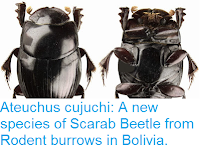
http://sciencythoughts.blogspot.co.uk/2016/04/onthophagus-clavijeroi-onthophagus.htmlhttp://sciencythoughts.blogspot.co.uk/2015/05/ateuchus-cujuchi-new-species-of-scarab.html
Follow Sciency Thoughts on Facebook.

Friday, 13 October 2017

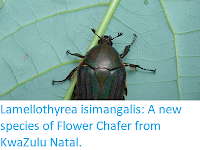
Lamellothyrea isimangalis: A new species of Flower Chafer from KwaZulu Natal.

Scarab Beetles, Scarabeidae, are a large and diverse group, containing about 30 000 known species from around the world. These Beetles are typically large and robust, and often with a metallic colouration. Many Scarab Beetles are excellent diggers, and many of these digging Scarabs share a habit of burying their eggs with a supply of dung to feed their young, gaining them the name Dung Beetles, though others lay their eggs on carrion, decaying plant matter, or in some cases living plants. Flower Chafers, Cetoniinae, are Scarab Beetles that feed as adults on the nectar and pollen of flowers. The larval habits of this group are variable, with some species predating the larvae of other Insects and others feeding on Bird Droppings - the later being particularly true of Southern African species. The genus Lamellothyrea was described by entomologist Jan Krikken from a single specimen from the Transvaal, in 1980. These Beetles have not subsequently been found in the Transvaal, though they are found in KwaZulu Natal Province, South Africa, and in the southern part of Mozambique. Recent studies of wild populations of Lamellothyrea have strongly indicated that the South African and Mozambican populations are in fact separate species.

In a paper published in the journal ZooKeys on 8 August 2017, Renzo Perissinotto of the School of Environmental Sciences at Nelson Mandela Metropolitan University, formally describes the KwaZulu Natal population of Lamellothyrea as a new species, having determined that the original Transvaal specimen having been determined to belong to the Mozambican species, so that this population retains the original species name (type species name), Lamellothyrea descarpentriesi.

The new species is named Lamellothyrea isimangalis, in reference to the the iSimangaliso Wetland Park, where most of the population is found. The females of this species are slightly larger than the males, at 21.2–21.8 mm, compared to 20.1–21.4 mm. The species is quite variable in colour, ranging from light brown to metallic purple to dark green. The larvae of this species are not known, but the adults were found on the flowers and fruits of the Dune Waterberry Tree, Sizygium cordatum,  from November to December and February to March, which coincides with peak rainfall in the area.

Lamellothyrea isimangaliso in its natural habitat at St Lucia Estuary. Lynette Clennell in Perissonotto (2017).

Lamellothyrea isimangalis was found prodominantly within the iSimangaliso Wetland Park, with a small population around Lake Nhlabane, roughly 10 km to the southeast of the park. The population outside that park is apparently vulnerable to coastal dune mining, though the majority of the population should be safe due to the high level of protection within the iSimangaliso Wetland Park.

Typical habitat of Lamellothyrea isimangaliso in the coastal forest on the Eastern Shores of Lake St Lucia. Nicola Carrasco in Perissonotto (2017).

See also...

http://sciencythoughts.blogspot.co.uk/2017/09/pegylis-majori-new-species-of-scarab.htmlhttp://sciencythoughts.blogspot.co.uk/2017/07/electraesalopsis-beuteli-new-species-of.html
http://sciencythoughts.blogspot.co.uk/2016/08/ceratocaryum-argenteum-plant-producing.htmlhttp://sciencythoughts.blogspot.co.uk/2016/04/onthophagus-clavijeroi-onthophagus.html
http://sciencythoughts.blogspot.co.uk/2015/05/ateuchus-cujuchi-new-species-of-scarab.htmlhttp://sciencythoughts.blogspot.co.uk/2014/09/a-new-species-of-scarab-beetle-from.html
Follow Sciency Thoughts on Facebook.

Sunday, 24 September 2017

Pegylis majori: A new species of Scarab Beetle from the Hamer Region of Ethiopia.

Scarab Beetles, Scarabeidae, are a large and diverse group, containing about 30 000 known species from around the world. These Beetles are typically large and robust, and often with a metallic colouration. Many Scarab Beetles are excellent diggers, and many of these digging Scarabs share a habit of burying their eggs with a supply of dung to feed their young, gaining them the name Dung Beetles, though others lay their eggs on carrion, decaying plant matter, or in some cases living plants. Members of the genus Pegylis are found across tropical Africa and have larvae which feed on the roots of plants.

In a paper published in the journal Zootaxa on 22 September 2017, Richard Sehnal of the Department of Zoology and Fisheries, at the Czech University of Life Sciences Prague, describes a new species of Pegylis from the Hamer Reion of Ethiopia.

The new species is named Pegylis majori, in honour of Vladimír Major, who collected the specimens from which the species is described. The species is described from eleven male and four female specimens, all collected from near the town of Turmi in the Hamer Region, at an altitude of about 950 m. The males range from 14.4 to 16.3 mm in length, the females from 18.0 to 18.5 mm, both sexes being a metallic black colour, given a russet hue by the presence of many small orange hairs. 

Pegylis majori, (A) male, and (B) female, both in dorsal view. Sehnal (2017).

See also...

http://sciencythoughts.blogspot.co.uk/2017/07/electraesalopsis-beuteli-new-species-of.htmlhttp://sciencythoughts.blogspot.co.uk/2016/08/ceratocaryum-argenteum-plant-producing.html
http://sciencythoughts.blogspot.co.uk/2016/04/onthophagus-clavijeroi-onthophagus.htmlhttp://sciencythoughts.blogspot.co.uk/2015/05/ateuchus-cujuchi-new-species-of-scarab.html
http://sciencythoughts.blogspot.co.uk/2014/09/a-new-species-of-scarab-beetle-from.htmlhttp://sciencythoughts.blogspot.co.uk/2014/08/a-new-species-of-scarab-beetle-from.html
Follow Sciency Thoughts on Facebook.