Showing posts with label Shasta County. Show all posts

Friday, 26 December 2025

Three dead as California hit by a series of storms over Christmas period.

Three people have died and many others have been affected by flooding as California has been hit by a series of storms over the Christmas period. A 74-year-old man from Redding, in Shasta County, died on the weekend of 20-21 December 2025, after his car became trapped in floodwaters, despite efforts by local police officers to rescue him. On Monday 22 December a woman in her 70s died after being swept into the sea by a large wave at MacKerricher State Park in Mendocino County. On Wednesday 24 December a 64-year-old man from San Diego was struck by a falling tree.

A car partially buried by a mudslide in San Bernadino County, California. CBS News.

Many areas have been affected by flooding, with some communities in San Bernadino County facing evacuation orders in order to keep them safe. Several flash floods have been reported in Los Angeles County, where 27 cm of rainfall was recorded on Wednesday 24 December, with a large landslip reported in Altadena, on a slope which had been stripped of vegetation by wildfires in January this year. Around 130 households were evacuated due to concerns about flooding and landslides in Los Angeles, mostly in the Pacific Palisades neighbourhood, which was also hit by wildfires in January. Windspeeds gusting in excess of 100 km per hour have been recorded in San Francisco, where waves more than 7 m high have been reported. More than 100 000 people have been left without power due to the storms, mostly in the central part of the state.

The storms have been driven by a phenomenon called an atmospheric river, in which a narrow band of saturated air carries large volumes of moisture for long distances. Such streams typically originate in tropical regions, and typically travel along the boundaries between diverging weather systems. As with other storm systems, once they pass over land they lose momentum, and can be forced upwards by hills or mountains, causing them to cool and deposit their moisture as precipitation, causing high rainfall and often flooding.

A diagrammatic representation of an atmospheric river. National Weather Service/National Atmospheric and Oceanic Organization/Wikimedia Commons.

Atmospheric rivers are a common phenomenon on the west coast of the United States, and a significant driver of local weather conditions. However, these systems are becoming both more common and more severe as a result of the warming climate, which has led to rising temperatures over the tropical Pacific, and subsequently higher levels of atmospheric moisture, combined with a tendency form storm systems and other weather events to form and move much more quickly, making it harder for meteorologists to make long term predictions about where and when such storms will hit.

See also...

Sunday, 5 August 2018

Wildfire kills seven in Shasta County, California.

Seven people have now been confirmed dead in a wildfire in Shasta County, California. The Carr Fire broke out on 23 July 2018, when sparks from the wheel rim of a trailer with a flat tyre dragging against a road ignited dry vegetation. The fire remained fairly small until 28 July, when rising winds began led to it growing and spreading rapidly, since when it has destroyed over a thousand homes, and claimed the lives of four residents of the area, two of them children, as well as two fire fighters and a utility worker attempting to restore power lines that had been earlier damaged by the fire.

Firefighters attempting to control the Carr Fire near Douglas City on 31 July 2018. Mark Ralston/AFP/Getty Images.

The Carr Fire is one of a series of wildfires burning in California at the moment, these have a variety of causes and have been fuelled by dry winds blowing from the mountains in the northeast of the state, but are essentially due to a prolonged drought in the state, which has been experiencing dry conditions since 2011, the longest such drought in the state's recorded history. This drought has killed vegetation, including thousands of trees, across much of central California, providing dry tinder to fuel the fires, despite high rainfall that caused flooding in parts of the state in the winter of 2016-7. The draught has been made worse by the diversion of water to suit Human purposes, such as agriculture, industry and leisure, which has taken water away from other ecosystems, resulting in the build-up of dead, dry vegetation that has produced fuel for the fires.

See also...

https://sciencythoughts.blogspot.com/2018/07/californian-man-killed-by-wildfire.htmlhttps://sciencythoughts.blogspot.com/2018/04/magnitude-53-earthquake-to-southwest-of.html
http://sciencythoughts.blogspot.co.uk/2018/03/magnitude-47-earthquake-off-coast-of.htmlhttp://sciencythoughts.blogspot.co.uk/2018/03/juvenile-gray-whale-washes-up-dead-on.html
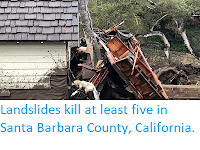
http://sciencythoughts.blogspot.co.uk/2018/01/beaches-in-monterey-county-california.htmlhttp://sciencythoughts.blogspot.co.uk/2018/01/landslides-kill-at-least-five-in-santa.html
Follow Sciency Thoughts on Facebook.

Friday, 14 August 2015

Adiantum shastense: A new species of Maidenhair Fern from California.


Maidenhair Ferns of the genus Adiantum are global in distribution, though most species are restricted to the tropics and subtropics.About 225 species (roughly 10% of the total number of described species in the genus) are found in temperate regions, though most of these are found only in Asia. Nine species of Adiantum are currently recognised from Canada and the United States, though four of these are essentially tropical species with the northernmost limit of their range in the southern US, one species is global in distribution and found on all continents except Antarctica, one is found in Asia as well as North America and one is thought to be introduced. However recent genetic studies of Maidenhair Fern populations suggest that many of these ‘species’ may in fact be clusters of cryptic morphospecies (plants which appear identical but which are genetically isolated from one-another), suggesting that the group may be larger and more complex than is currently understood.

In a paper published in the journal PhytoKeys on 21 July 2015, Layne Huiet of the Department of Biology at Duke University, Martin Lenz and Julie Nelson of the USDA Forest Service at Shasta-Trinity National Forest, Kathleen Pryer, also of the Department of Biology at Duke University and Alan Smith of the University Herbarium at the University of California, Berkeley, describe a new species of Maidenhair Fern from Shasta County in California.

The new species is named Adiantum shastense, where ‘shastense’ means ‘from Shasta’, the species having only been found to date around Lake Shasta in Shasta County, California, an area with a high number on endemic species (species not found elsewhere). It is essentially similar to Adiantum jordanii, a species wide-ranging in North America, being a rhizomatous Fern (Fern which can regrow each year from a creeping underground root) producing up to 10 fronds 30-60 cm in length. However it has a longer growing season than Adiantum jordanii, persisting later in the summer.

Fronds of Adiantum shastense growing in the wild. Huiet et al. (2015).

Adiantum shastense was first identified from herbarium specimens, some of which were collected over a hundred years ago, during a study into the globally distributed Adiantum capillus-veneris, in California; Adiantum shastense grows alongside Adiantum capillus-veneris in places, whereas Adiantum jordanii is generally intolerant of other Maidenhair species. DNA sequencing analysis of these herbarium specimens revealed that they were neither Adiantum capillus-veneris nor Adiantum jordanii, but a new and previously undescribed species apparently endemic to Shasta County. Subsequent investigations found it to be widespread within this area, growing on a variety of substrates, and in places forming the dominant understory plant. Since the species is currently known only from a limited area, Huiet et al. recommend that it be treated as having a California Rare Plant Rank of 4.3, though they note that unlike other endemic plants of the Shasta Lake area (but like other Maidenhair Ferns) Adiantum shastense is distributed via wind-blown spores, making it highly possible that it is also found at (as yet undiscovered) locations outside of this area.

See also…

Governor Laffan's Fern declared Extinct in the Wild.
The International Union for the Conservation of Nature published its annual update of its Red List of Threatened Species on Thursday 12 June 2014, marking the 50th year of the list's existence...


Three new species of Fern from the Middle Triassic of northern Italy.
Middle Triassic plant fossils have been collected from the Dolomites for at least a century and a half. These Triassic floras were dominated by Conifers, and were long thought to have lived in an arid...

Follow Sciency Thoughts on Facebook.