Showing posts with label Side-Necked Turtles. Show all posts

Tuesday, 4 October 2016

Paiutemys tibert: A new species of Bothremydid Turtle from the Late Cretaceous of Utah.

Bothremydids are an extinct group of Side-necked Turtles (i.e. Turtles  that could not withdraw their heads back into their shells, bt had to fold it sideways instead) that arose in the Early Cretaceous and persisted till the Eocene. The earliest members of the group are thought to have been Freshwater Turtles living in the Gondwanan interior, but members of the group evolved to colonize first brackish and then fully saline waters, enabling them to spread around the margins of the Atlantic. Bothremydids were an ecologically diverse group, producing a variety of forms, including species interpreted as adapted to specializing in feeding on Molluscs, others with a piscavorous (Fish-eating) diet, and more generalist forms.

In a paper published in the journal PeerJ on 26 September 2016, WalterJoyce of the Departement für Geowissenschaften at the Universität Freiburg, Tyler Lyson of the Department of Earth Sciences at the Denver Museum of Nature and Science and James Kirkland of the UtahGeological Survey describe a new species of Bothremydid Turtle from the Late Cretaceous Naturita Formation of MacFarlane Mine in southwest Utah.

The specimen was excavate in the early 1960s and has since resided unprepared in the collection of Zion National Park, prior to being rediscovered by James Kirkland and Don DeBlieux of the Utah Geological Survey and moved to the Natural History Museum of Utah. Since the time of its discovery the MacFarlane Mine site has been buried by a major landslide, and is no longer accessible, however the specimen was preserved in a block that also contained numerous Molluscs and other invertebrates, enabling a detailed diagnosis of both its stratigraphic and palaeoenvironmental context. These suggest that the Turtle was buried in a brackish water environment, such as an estuary or lagoon with freshwater input, and that it lived in the latest Cenomanian, i.e. about 94 million years ago.

The specimen is described as Paiutemys tibert, where 'Paiutemys' refers to the Southern Paiute people who inhabit the area where the specimen was found (-mys is a commonly used suffix for Turtles), and 'tibert' honours Neil Tibert, who established the stratigraphy (rock dating sequence) for the area where the specimen was found. The specimen is largely complete and undistorted, being s shell 16.5 cm in length, estimated to have been about 18 cm long in life.

Paiutemys tibert, Late Cretaceous (Cenomanian) of Utah, USA. Photographs and illustrations of shell in (A) dorsal and (B) ventral view. Abbreviations: Ab, abdominal scute; An, anal scute; co, costal; EG, extragular scute; ent, entoplastron; epi, epiplastron; Fe, femoral scute; Gu, gular scute; Hu, humeral scute; hyo, hyoplastron; hypo, hypoplastron; Ma, marginal scute; mes, mesoplastron; ne, neural; nu, nuchal; Pe, pectoral scute; per, peripheral; Pl, pleural scute; SP, supernumerary pleural scute; SN, supernumerary nuchal scute; spy, suprapygal; Ve, vertebral scute; xi, xiphiplastron. Joyce et al. (2016).

See also...

http://sciencythoughts.blogspot.co.uk/2015/12/xiaochelys-ningchengensis-sinemydid.htmlXiaochelys ningchengensis: A Sinemydid Turtle from the Jehol Biota.                 Sinemydid Turtles are a group of extinct Turtles known from the Middle Jurassic to the Early Cretaceous of Asia. They have traditionally been thought to be stem-group Cryptodires (i.e. more closely related to...
http://sciencythoughts.blogspot.co.uk/2015/11/turtle-remains-from-late-miocene-to.htmlTurtle remains from the Late Miocene to Early Pliocene Black Rock Sandstone of Victoria, Australia.                                          Australia has a diverse assemblage of Sea Turtles today, with six of the seven living Sea Turtle species found in Australian waters and one found nowhere else. The continent also has an extensive...
http://sciencythoughts.blogspot.co.uk/2015/10/turtle-eggs-from-late-cretaceous-of.htmlTurtle eggs from the Late Cretaceous of Madagascar.                                               Turtles are unique among living Amniotes (Vertebrates that can lay...
Follow Sciency Thoughts on Facebook.

Saturday, 2 June 2012

A new species of Giant Side-Necked Turtle from the Palaeocene of Columbia.

Side-Necked Turtles are freshwater Turtles restricted to the Southern Hemisphere. They get their name from their inability to withdraw their heads completely into their shells, which causes them to fold their necks sideways beneath the lip of their upper shells. The group is split into two sub-groups; the African Side-Necked Turtles (Pelomedusidae), found in Eastern and Southern Africa, Madagascar and Norther South America, and the Austro-South American Side-Necked Turtles (Chelidae), found in Australia, New Guinea, Indonesia and South America. 

In a paper in the June 2012 edition of the Journal of Systematic Palaeontology, a team of scientists led by Edwin Cadena of the Department of Marine, Earth and Atmospheric Sciences at North Carolina State University, the Florida Museum of Natural History at the University of Florida and the Smithsonian Tropical Research Institute describe a new species of Palaeocene African Side-Necked Turtle from the Cerrejón Coal Mine in Columbia.

Map showing the location of the Cerrejón Mine. Cadena et al. (2012).

The new species is named as Carbonemys cofrinii, Cofrin's Coal Turtle, in honor of the late David Cofrin, a Floridan philanthropist noted for his support for the arts, education, nature preservation and community development.

It is described from an isolated skull, 21 cm in length by 13 cm wide, from the 58-55 million year old, Upper Palaeocene Cerrejón Formation at the Cerrejón Mine.

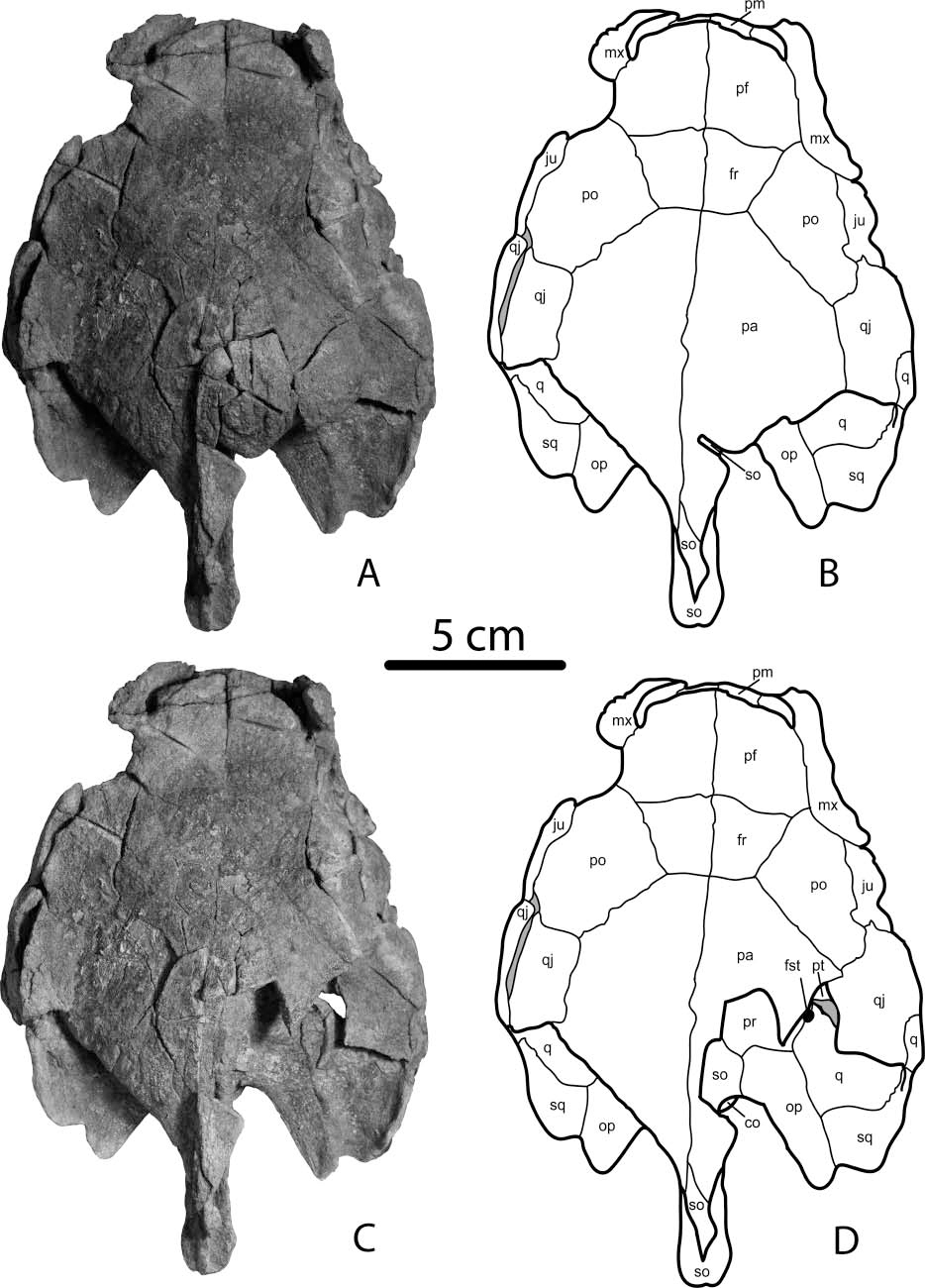
Carbonemys cofrinii. (A) Photograph of skull, complete dorsal view. (B) Interpretive drawing of (A). (C) Skull without a portion of the parietal, showing the bones at the roof of the otic chamber. (D) Interpretive drawing of (C). Abbreviations: fr, frontal; fst, foramen stapedio temporale; ju, jugal; mx, maxilla; op, opisthotic; pa, parietal; pf, prefrontal; po, postorbital; pr, prootic; q, quadrate; qj, quadratojugal; so, supraoccipital; sq, squamosal. Cadena et al. (2012).

Carbonemys cofrinii. (A) Photograph of skull, complete ventral view. (B) Interpretive drawing of (A). Abbreviations: bo, basioccipital; bs, basisphenoid; cm, condylus mandibularis; co, condylus occipitalis, ju, jugal; mx, maxilla; op, opisthotic; pa, parietal; pal, palatine; pm, premaxilla; pp, processus paroccipitalis; pr, prootic; pt, pterygoid; ptp, processus trochlearis pterygoidei; q, quadrate; qj, quadratojugal; so, supraoccipital; sq, squamosal. Cadena et al. (2012).

Cadena et al. also describe two further Side-Necked Turtle finds from the same deposits. The first of these, described as Taxon A, is the nearly complete shell of a Turtle, 173 cm in length. This is the right sort of size to be the same species as Carbonemys cofrinii, but it is clearly a different specimen, and Cadena et al. decided not to assign it to the species without direct evidence. Whatever the case there were clearly large (~2 m) Side-Necked Turtles living in Northern Columbia during the Late Palaeocene, comparable with the largest Side-Necked Turtle ever known, Stupendemys geographicus (shell length 1.8 m), from the Miocene Venezuala, and the largest known Palaeocene Turtle of any description.

Taxon A. (A) Photograph of carapace (upper shell), dorsal view. (B) Interpretive drawing of (A). (C) Photograph of plastron (lower shell), ventral view. (D) Interpretive drawing of (C). Cadena et al. (2012).

The second undescribed Side-Necked Turtle is a group of four shells, about 20 cm in length, which are not formally described as they lack skulls, considered the by Cadena et al. the most important feature for classification purposes. One of these shows sign of having been bitten by a crocodile.

Taxon B. (A) Photograph of carapace. (B) Interpretive drawing of (A). (C) Photograph of plastron. (D) Interpretive drawing of (C). (E) Photograph of carapace. (F) Interpretive drawing of (E). (G) Photograph of plastron. (H) Interpretive drawing of (G). (I) Photograph of partial shell in dorsal view. (J) Interpretive drawing of (I), plastral elements in dark grey. (K) Photograph of partial shell in ventral view. (L) Interpretive drawing of (K), plastral elements in dark grey. (M) Photograph of nearly complete shell in dorsal view. (N) Interpretive drawing of (M), black spots represent crocodile bite marks. (O) Photograph of nearly complete shell in ventral view. (P) Interpretive drawing of (O), black spots represent crocodile bite marks. (Q) Photograph of the smallest turtle from the Cerrejón Formation, nuchal and costal 1 in ventral view. (R) Interpretive drawing of (Q) nuchal and costal 1 in dorsal view. Abbreviations: abd, abdominal scale; axb, axillary buttress; axs, axillary scar; c, costal; ent, entoplastron; epi, epiplastron; fem, femoral; gu, gular; hum, humeral; hyo, hyoplastron; hyp, hypoplastron; ins, inguinal scar; int, intergular; iscs, ischial scar; m, marginal; mes, mesoplastron; n, nuchal; p, peripheral; pec, pectoral; pl, pleural; pubs, pubis scar; pyg, pygal; sp, suprapygal; v, vertebral; xip, xiphiplastron. Cadena et al. (2012).

See also A new fossil bird from the Palaeocene of Brazil and Reptiles on Sciency Thoughts YouTube.

Follow Sciency  Thoughts on Facebook.