Showing posts with label Social Spiders. Show all posts

Saturday, 12 January 2019

Brazilian municipality troubled by 'rain' of Spiders.

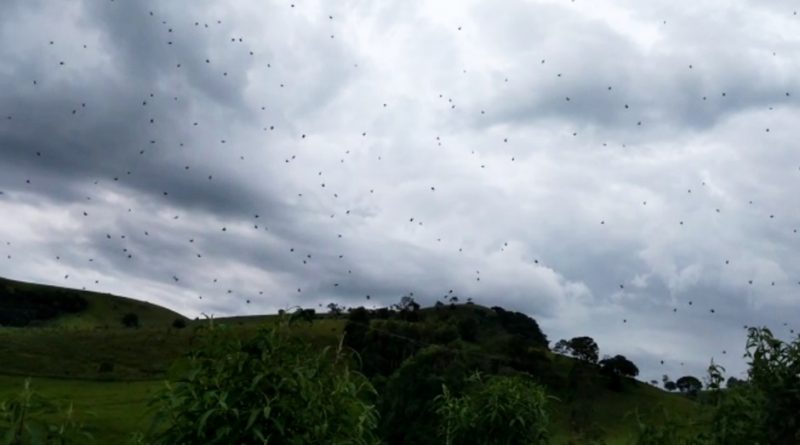
The rural municipality of Espírito Santo do Dourado in Minas Gerais State, Brazil, has been troubled by a 'rain' of Spiders this week; a phenomenon in which thousands of Spiders build webs strung from tree-to-tree (or where the opportunity arises, from tree-to-telegraph-pole-to-house-to-tree), high above the town, with the sky appearing filled with Spiders, a harmless, if somewhat alarming sight. This phenomenon is apparently not unusual in this time of year, when the warm, humid climate provides ample insect food for social Spiders of the species Parawixia bistriata.
 
 'Rain' of Spiders over Espírito Santo do Dourado in Minas Gerais State, Brazil, this week. João Pedro Fonseca Martinelli/Terra do Mandu.

Social Spiders are unusual in that the females form colonies of hundreds to thousands of individuals, which cooperate in the building of webs, capture of prey, defence of the colony and raising of young. Unlike in Insects, where social numerous highly successful species are known in several groups, most of which are exclusively social, of the approximately 41 000 known species of Spider only about 25 are social. However sociality appears to have arisen separately at least 18 times in tropical and subtropical Spiders, suggesting that under some circumstances there must be strong evolutionary pressure for Spiders to develop sociality.

Of the 28 described species of Parawixia, only Parawixia bistriata is social, with females resting in a communal nest during the hottest part of the day, and building a framework of long web strands between trees and other tall structures, with individual Spiders building their own orb-webs (which are defended assertively against intrusion by other Spiders) on this framework.

Typical behaviours of Parawixia bistriata. (a) The Spiders’ daytime retreat or bivouac (white arrow). (b) Spiders leaving the bivouac en masse after sunset. (c) Two Spiders passing each other, without any aggressive interaction, while depositing silk on the main support lines before initiating web building. (d) A Spider that has just completed her web. (e) A webless spider (top) is being bounced at by a web owner (bottom). (f) A prey item is shared between a web owner, a spider from a neighbouring web, and a webless spider that had been at the edge of the web. Wenseleers et al. (2013).

See also...


https://sciencythoughts.blogspot.com/2018/10/pahangone-mirabilis-new-species-of.htmlhttps://sciencythoughts.blogspot.com/2018/04/cangoderces-globosa-new-species-of.html
https://sciencythoughts.blogspot.com/2018/01/guhua-kakamegaensis-apneumonella.htmlhttps://sciencythoughts.blogspot.com/2017/12/dolichothele-mottai-dolichothele.html
https://sciencythoughts.blogspot.com/2017/11/ocyale-ghost-new-species-of-wolf-spider.htmlhttps://sciencythoughts.blogspot.com/2017/09/maevia-eureka-new-species-of-jumping.html
Follow Sciency Thoughts on Facebook.

Saturday, 9 August 2014

The subsocial lifestyle of an Australian Crab Spider.

Sociality is rare in Spiders, which are by nature solitary and aggressive. However it is known to have evolved separately several times in different Spider groups, and this occurrence is considered a good model for the understanding of the evolution of sociality across the animal kingdom, because it involves a switch in behaviour which is apparently strongly against the basic nature of Spiders. Social Spiders gain an advantage over non-social species in that they are able to hunt collectively, thereby often targeting larger prey, and mount a common defence against predators. However they also suffer disadvantages compared to other species, in the form of competition for resources within the nest. 

In the case of Spiders competition for mates can be an important evolutionary driver, as male Spiders are typically only capable of mating with a single female, and the evolution of sociality often comes via the ‘subsocial route’, wherein species go through a subsocial stage, with Spiders living communally during a period of extended maternal care, but dispersing prior to mating, and the switch from subsociality to full sociality (in which Spiders live communally for their entire lives) being also accompanied by a switch from outbreeding (mating between unrelated Spiders) to inbreeding (mating between related Spiders, within the same nest), a switch that tends to trigger other evolutionary changes.

Sociality is known to have arisen separately in at least eight groups of Spiders. The majority of these are web-builders, with the advantages of larger, communally built webs, that are capable of netting larger prey, seems to be important in the development of sociality. However it is also found in two groups of non-web-building Spiders, Huntsman Spiders (Sparassidae) and Crab Spiders (Thomisidae). In both cases this development has been found only in Australia, a continent whose long isolation and harsh climate has led to novel innovations in a wide variety of organisms. 

The social Huntsman Spiders were formerly placed in two genera, Delena and Eodelena, however a recent molecular study of the group has revealed that all are more closely related than previously thought, and all are now placed within the single genus Delena. Three species of social Crab Spiders described to date, all of which have been placed within the genus Diaea.

In a paper published in the journal ZooKeys on 21 July 2014, Jasmin Ruch of the Department of Biological Sciences at Macquarie University and the Zoological Institute and Zoological Museum at Biocenter Grindel at the University of Hamburg, Torben Riehl, also of the Zoological Institute and Zoological Museum at Biocenter Grindel and Peter Michalik of the Zoological Institute and Museum at Ernst-Moritz-Arndt-University, describe the occurrence of subsocial behaviour in a fourth species of Australian Crab Spider, Xysticus bimaculatus from southern Queensland. Xysticus bimaculatus was first described in 1867, but its behaviour has not been studied until now.

Male and female Xysticus bimaculatus. Scale bar is 1 cm. Ruch et al. (2014).

Ruch et al. found that Xysticus bimaculatus builds social nests containing multiple females and their young. The nests were built from leaves in broadleaved forests around Brisbane (all species of Diaea nest exclusively in Eucalyptus trees, and none occur as far north as Brisbane), with the most used tree being the Blackwood (Acacia melanoxylon), which is also the most abundant tree in the area, though the Spiders seemed quite willing to use any tree. The nests were constructed from leaves, with the spiders inhabiting old, brown leaves at the centre of the nest, but continuously adding new green leaves to the outside. 

The Spiders attach leaves with silk to construct a typical nest. Scale bar is 1 cm. Ruch et al. (2014).

Most nests contained a single female and her young, however nests in which multiple adults were found caring for a single brood, and nests in which there was more than one separate brood were also found. The Spiders have an annual life-cycle, and all the young within a nest appeared to be the same age. The likelihood of the females being present with the young decreased as the Spiderlings grew, though whether this was due to matrophagy (the eating of the mother by the young, common in Spiders) or some other factor was unclear.

Prey items found within the nests included mainly Beetles and Ants, however Wasps, Caterpillars and Flies were apparently also consumed. Wooly Scale Insects and Cockroaches were found living in some nests as apparent commensals (species living in the nest of another without harming or benefiting the host), and other species of Spider (potential predators of young Spiderlings) were also found in some nests.

See also…


Cave Spiders (Nesticidae) are found across the Mediterranean Basin, as well as in the Canary Islands...


In 2011 Paul Seldon of the College of Life Sciences at Capital Normal University in Beijing, the Paleontological Institute and Department of Geology at the University of Kansas and the Natural History Museum in London, along with ChungKun Shih and Dong Ren, also of the College of Life Sciences at Capital Normal University, described a large female Spider...


Social Spiders are unusual in that the females form colonies of hundreds to thousands of individuals, which cooperate in the building of webs, capture of prey, defence of the colony and raising of young. Unlike...

Follow Sciency Thoughts on Facebook.

Wednesday, 12 March 2014

The repeated evolution of sociality in a genus of Eresid Spiders.


Social Spiders are unusual in that the females form colonies of hundreds to thousands of individuals, which cooperate in the building of webs, capture of prey, defence of the colony and raising of young. Unlike in Insects, where social numerous highly successful species are known in several groups, most of which are exclusively social, of the approximately 41 000 known species of Spider only about 25 are social. However sociality appears to have arisen separately at least 18 times in tropical and subtropical Spiders, suggesting that under some circumstances there must be strong evolutionary pressure for Spiders to develop sociality.

In a paper published in the journal Frontiers in Zoology on 23 February 2013, Marija Majer, Jens-Christian Svenning and Trine Bilde of the Department of Bioscience at Aarhus University examined the distribution and occurrence of sociality in Eresid Spiders of the genus Stegodyphus, which is found across Africa, the Mediterranean Basin, The Middle East and the Indian Subcontinent, and which contains three social species (two in Africa and one in India) believed to have evolved the trait separately, as well as eighteen non-social species.

A colony of the Indian colonial Spider Stegodyphus sarasinorum tackling a large Moth. Spiderlab Aarhus University.

Majer et al. found that the social species were found in the areas with the greatest plant productivity and Insect biomass, suggesting that the abundance of prey is a driving factor in the evolution of sociality in these Spiders. High prey abundance is an extremely good thing for any Spider, and Majer et al. suggest the ability to secure large amounts of prey may be a determining factor in the adoption of sociality in Spiders, overcoming the disadvantages that would otherwise come from intra-specific competition, and enabling the Spiders to gain the advantages from communal breeding and defence.

Distribution map of Stegodyphus species on a continental gradient of vegetation productivity (unitless ratio). Three regions, defined to separate the distributions of the social species, are indicated by circles (region 1), triangles (region 2) and rectangles (region 3). Empty and filled symbols indicate the occurrences of social and solitary species, respectively (n = 366 occurrences in total). The darker the green the more productive the continental area is. Majer et al. (2013).


Follow Sciency Thoughts on Facebook.