Showing posts with label Montana. Show all posts

Thursday, 22 September 2022

Gastroliths, Theropod teeth, and Plant remains associated with an Ornithopod skeleton from the Early Cretaceous of Montana.

The Ornithopod Dinosaur Tenontosaurus tilletti is known from about 80 skeletons and partial skeletons, recovered from the Early Cretaceous Cloverly Formation of Wyoming and Montana. Slightly older skeletons from other sites in the American Midwest have been assigned to a second species of TenontosaurusTenontosaurus dossi. The Cloverly Formation also produces a variety of other Dinosaur skeletons, including Ankylosaurs, Sauropods, Ornithomimids, Hypsilophodonts, and Dromaeosaurids, as well as Turtles, Frogs, Crocodiles, and Triconodont Mammals.

In a paper published in the journal Cretaceous Research on 11 August 2022, John Nudds and Dean Lomax of the Department of Earth and Environmental Sciences, at the University of Manchester, and the late Jonathan Tennant, formerly of the Institute for Globally Distributed Open Research and Education, describe some material associated with a specimen of Tenontosaurus tilletti obtained from the Cloverly Formation in Montana, and currently in the collection of the University of Manchester Museum.

The specimen, MANCH LL.1227, was found on the Kelly Ranch in Wheatland County, Montana, by rancher Robert Kelly in 1994, and obtained for the Manchester Museum by John Nudds in 1999, where it became the centrepiece of the (then) newly refurbished Fossil Gallery. The fossil was prepared and mounted, and came with what were described as 'gastroliths' and 'Cycad seeds' found in the stomach region, and two 'Deinonychus teeth' found associated with a cervical vertebrae, and was described as having arthritis in one hand. The specimen was replaced as the centrepiece of the gallery in 2004, when it was replaced with a cast of a Tyrannosaurus skeleton, and placed into storage. The specimen was later studied by Jonathan Tennant, and fully described as a Master's Thesis, published on the arXiv database.

Tenontosaurus tilletti skeleton (MANCH LL.12275) fully articulated and mounted in bipedal stance for 1999 Lottery-funded gallery display at Manchester University Museum. Nudds et al. (2022).

The specimen has been disassembled, although parts of it remain attached to the metal frame upon which it was displayed. Some parts of the skeleton have been modified, mostly by the addition of plaster sections to make up for missing bones or portions of bones. Many of the more slender bones of the skeleton are broken, some beyond repair, while others, such as the ossified tendons, are missing. The whole was painted with a coloured varnish, which has now been removed. The museum intends to reconserve the skeleton for inclusion in a future display.

Various associated materials were obtained along with the skeleton. These include twelve stones identified as gastroliths and two spherical objects identified as Cycad seeds which were found in the gut region of the skeleton, as well as two Theropod teeth, identified as Deinonychus antirrhopus, which were associated with the cervical vertebrae, and a sample of the sediment in which the fossil was buried, identified as volcanic ash.

Gastroliths (MANCH LL. 12278a-l) found in the gastric region of MANCH LL.12275. Scale bar is 3 cm. Nudds et al. (2022).

The gastroliths, if correctly identified, would lend support to the theory that early-branching Ornithopods, such as Tenontosaurus tilletti, lacked the chewing capacity of later branching forms such as Hadrosaurs. Gastroliths have been found in three Orinithopod specimens to date, all of which were early-branching forms, namely Gasparinisaura cincosaltensis, from the Late Cretaceous of Argentina, Haya griva, from the Late Cretaceous of Mongolia, and Changmiania liaoningensis, from the Early Cretaceous of China. Possible gastroliths have also been reported from Notohypsilophodon comodorensis, also from the Late Cretaceous of Argentina. Therefore, if the pebbles associated with MANCH LL.12275 are in fact gastroliths, then they are the second oldest known example of such in an Ornithopod. The specimen came with a (less than perfect) photograph of the stones in place within its body cavity, and with no other such pebbles visible elsewhere. Furthermore, the specimen was buried within a fine-grained matrix, from which such pebbles are unlikely to have been derived, and within which any pebbles present are unlikely to have been preferentially sorted to form an accumulation. On the basis of this, Nudds et al. conclude that, while they cannot completely rule out another origin, the most likely explanation for the pebbles is that they were in fact gastoliths.

Also found within the body cavity of MANCH LL.12275 were two spherical objects interpreted as Cycad seeds. These were subjected to computerised tomographic scanning, which revealed that they have an irregular amorphous core, surrounded by an outer radial structure, quite different from the structure of Cycad seeds.
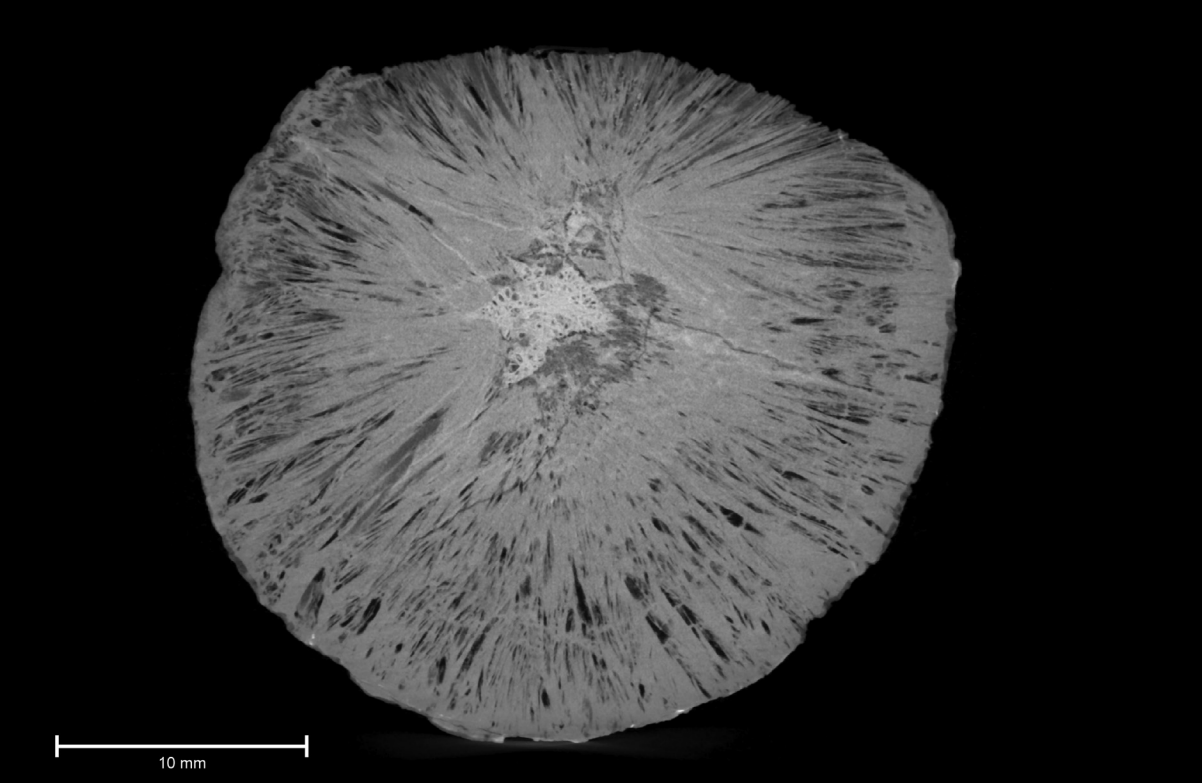
Computerised tomographic scan showing a cross section of one of the spherical structures (MANCH LL. 12279b) revealing internal radial structure with central core. Nudds et al. (2022).

While the structure of these objects rules out a Cycad origin, it is consistent with their being derived from a member of the  Bennettitales, an extinct order of Gymnosperms, which produced cones with a radial structure similar to that seen on the spherical structures. Notably, the structures are very similar to cones of the Bennettitalean Williamsonia from the Late Cretaceous of Vancouver Island.

However, further examinations made by cutting one of the structures into thin sections revealed that the core is composed of iron oxyhydroxides (goethite/limonite), and the outer radial structures are probably the highly insoluble baryte with a feathery texture. Such a composition is highly unlikely to have derived from any plant source, but rather probably formed as the skeleton was exhumed, and nodules of pyrite or marcasite, which nucleated around some form of decaying organic matter as the specimen was first buried, were exposed to oxidising conditions. Under such circumstances these iron minerals will oxidise to goethite/limonite, with iron sulphites and barium ions dissolved within pore fluids being extruded and forming baryte. Thus the structures are thought likely to be of entirely mineral origin, and not informative about the diet of the living Animal.

Two teeth were found associated with one of the cervical vertebrae of MANCH LL.12275, and identified as belonging to the Therapod Dinosaur Deinonychus antirrhopus. One of these teeth has subsequently been lost. The presence of these teeth in association with a skeleton of Tenontosaurus tilletti would appear to be a rare example of a direct predator-prey interaction, something seldom seen in Dinosaurs. Curiously, remains of Deinonychus antirrhopus and Tenontosaurus tilletti are quite often found in association, while Tenontosaurus tilletti remains have never been found in association with even fragmentary remains (such as shed teeth) of other predators known to have been present in the Cloverly ecosystem, such as Crocodiles. The reasons for this are unclear, though the association of two Deinonychus antirrhopus teeth with MANCH LL.12275 does suggest that at least one of these Theropods (it is thought possible that Deinonychus may have hunted in packs) was feeding upon the carcass of this Dinosaur before it was burried.

One of the Deinonychus teeth (MANCH LL. 12277) found associated with the cervical vertebrae of MANCH LL. 12275. Scale bar is 0.5 cm. Nudds et al. (2022).

The sediment layer from which MANCH LL. 12277 was excavated was identified by its discoverers as volcanic ash. However, analysis of the sediment supplied with the specimen found that it was 87% calcium carbonate and 7% silica, with any potentially ash-derived minerals being present only at trace levels. This is unsurprising for the Cleverly Formation, where ash inclusions are rare. 

Determining the way in which extinct prehistoric Animals behaved in life is one of the greatest problems faced by palaeontologists. For the most part, this must be done entirely by analysis of the morphology of the fossils these Animals leave behind, but on rare occasions, it is possible to recover direct evidence of interactions from fossils.

MANCH LL. 12277 is one of the most complete Tenontosaurus tilletti specimens known, and was initially interpreted as providing several lines of evidence about the world that it lived in and how it interacted with that world. The specimen was originally reported to have been found buried in a volcanic ash matrix, neither of these turned out to be true, with the specimen found to be buried in a limestone sand, while the 'Cycad seeds' were found to be diagenetic features of non-biological origin. 

However, the teeth found associated with the skeleton do appear to be evidence of a trophic relationship (i.e. one organism feeding on another), while the presence of gastroliths within the body cavity of the specimen is a new discovery for this species (albeit not an unexpected one), and provides us with insight into this Dinosaurs diet and feeding habits.

See also...
Online courses in Palaeontology

Follow Sciency Thoughts on Facebook.

Follow Sciency Thoughts on Twitter.


Sunday, 27 March 2022

Hiker believed to have been killed by Bear in Montana.

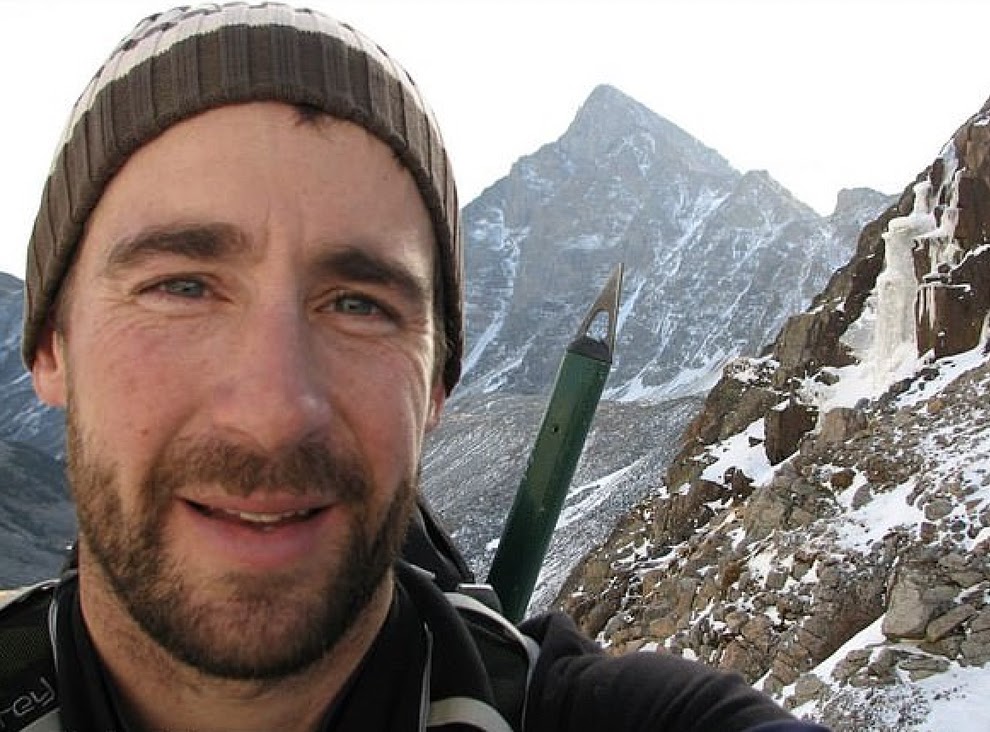
A hiker is believed to have died in a Brown Bear, Ursus arctos horribilis, attack in the Absaroka Mountains of Montana on Thursday 24 March 2022. Craig Clouatre, 40, of Livingston in Park County, Montana, went missing while hiking with a friend Paradise Valley. A search carried out by officers from the Park County Search and Rescue Team, went on late into the night, but was unable to find him. The following morning a set of Human remains were discovered, showing what appeared to be signs of a Bear attack. These were subsequently identified as Mr Clouatre.

 
Craig Clouatre, 40, of Livingston, Montana, believed to have died in a Bear attack in Paradise Valley on Thursday 24 March 2022. Craig Clouatre/Facebook.

Brown Bears are highly adaptable large omnivores found across much of the Northern Hemisphere. They are extremely flexible in their dietary habits, and able to change their diet in response to Human or other environmental pressures in ways that few other large animals can manage. Whilst Bears have a fearsome reputation, and are rightly treated with great respect by people that share their environment, attacks on humans are exceptionally rare. 

See also...


Follow Sciency Thoughts on Facebook.

Follow Sciency Thoughts on Twitter.


Thursday, 24 October 2019

Stegosaurs from the Late Jurassic Morrison Formation of Montana.

The Stegosauria is a group of Ornithischian (Bird-hipped) Dinosaurs that is characterised by the possession of a series of plates and spikes that extend from the neck to the tail in two parasagittal rows. The best known genus of the group, Stegosaurus, is from the Upper Jurassic of the western USA, but members of the group are known from all continents except for Antarctica and Australia, and their temporal range extends from the Middle Jurassic to the late Early Cretaceous. Despite the iconic status of Stegosaurs among Dinosauria, they are poorly known as fossils, with most genera being known from single partial skeletons and/ or fragmentary remains. Consequently, they have received relatively little attention, and much remains unknown about their palaeobiology.

In a paper published in the journal Acta Palaeontologica Polonica on 5 August 2019, Cary Woodruff of the Great Plains Dinosaur Museum and Field Station, the Department of Ecology and Evolutionary Biology at the University of Toronto, and the Royal Ontario Museum, David Trexler of the Two Medicine Dinosaur Center, and Susannah Maidment of the Department of Earth Sciences at the Natural History Museum, describe two sets of Stegosaur remains from the Late Jurassic Morrison Formation of Montana, an area further north than any that have previously produced described Stegosaur remains.

The Upper Jurassic Morrison Formation of the western United States comprises the deposits of rivers and floodplains that were laid down in a broad shallow basin over about 10 million years in the Kimmeridgian (157.3-152.1 million years ago and Tithonian (152.1-145.0 million years ago). The deposits host a diverse and well-preserved Dinosaurian fauna that includes such well-known taxa as Apatosaurus, Diplodocus, and Stegosaurus. The Dinosaurs of the southern part of the Morrison Basin, from Colorado, Utah, and southern Wyoming, have been intensively studied for about 150 years, but those from northern outcrops in northern Wyoming and Montana are much less exploited. An increasing body of evidence suggests that northern Morrison faunas were somewhat different to their southern counterparts but further exploration in this part of the basin is needed.

The first specimen described by Woodruff et al., GPDM 205, was collected in 2004 by the Judith River Dinosaur Institute from the 5E Ranch, owned by the Hein family, in the Little Snowy Mountains of Fergus County, Montana. The specimen is now housed at the Great Plains Dinosaur Museum in partnership with the Judith River Foundation. GPDM 205 was collected in close proximity to Camarasaurus sp. specimen GPDM 220. Unfortunately, neither field notebooks nor quarry maps exist for the excavation of this specimen, so Woodruff et al. do not possess any documentation regarding taphonomy. However, Susanneh Maidment visited the 5E Ranch quarry in 2005 and was told by the excavation crew that the specimen was found disarticulated, and stratigraphically above the Camarasaurus remains. 

The material assigned to GPDM 205 comprises a prepared humerus, ulna, and radius, plus an unprepared coracoid, fragmentary scapula, humerus, and ulna. During the 2005 field season, at the time of Susanneh Maidment’s visit, a carpal and some poorly preserved dermal plates from this specimen were also recovered. Several other Stegosaur specimens were discovered during the 2005 field season at the 5E Ranch quarry, and were excavated over subsequent years. These specimens currently reside in a private collection, and thus are unavailable for study.

Left humerus of Stegosaur GPDM 205 from the 5E Ranch, Little Snowy Mountains, Fergus County, Montana, USA; in anterior (A₁), posterior (A₂), lateral (A₃), medial (A₄), dorsal (A₅), and ventral (A₆) views. Woodruff et al. (2019).

The second specimen, GPDM 178, was collected in 2003 and 2004 by the Judith River Dinosaur Institute near the town of Giffen, Cascade County, Montana, on land belonging to the Yurek family. Elements were initially found eroding out of a hill adjacent to the Yurek’s house. The distal end of the right tibia was the first element recovered, and it was not immediately recognised as a fossil. For a period of time, this 'black rock'  served as a door stop until construction of a pole barn on the hill started, and further elements were discovered below the surface. At this time the Yurek family contacted the Judith River Dinosaur Institute, and the excavation commenced. The specimen is now housed at the Great Plains Dinosaur Museum in partnership with the Judith River Foundation 

 Partial right tibia of Stegosaur GPDM 178, near Giffen, Cascade County, Montana; in medial (A₁, A₆), lateral (A₂, A₇), anterior (A₃, A₅), dorsal (A₄), and ventral (A₈) views. (A₁)–(A₄) proximal end, (A₅)–(A₈), distal end. Woodruff et al. (2019).

GPDM 178 consists of a partial skeleton including both crania and post-crania. Several field jackets that are labelled as dorsal ribs or vertebrae await preparation. Only those elements prepared to-date are described, though the skeletal reconstruction for this specimen includes all elements collected as recorded in the quarry log.

Skeletal reconstruction of the stegosaurs GPDM 178 (A) and GPDM 205 (B) scaled together based on humeral lengths. Black, elements preserved in each specimen; gray, missing elements. Human scale is the Artemision Bronze featuring the deity of Zeus as 1.83 m in height. Woodruff et al. (2019).

Three genera of Stegosaur have previously been described from the Morrison Formation, Alcovasaurus, Hesperosaurus, and Stegosaurus, though unfortunately neither of the Montana specimens is complete enough to assign them to a specific genus, as useful diagnostic features are not preserved.

The specimens GPDM 178 and 205 represent the northernmost Stegosaurs found to-date, and GPDM 178 is the northernmost Dinosaur fossil thus far recovered from the entire Morrison Formation. Interestingly, according to a Works Progress Administration report from 1938, a 'Stegosaurus' was found at Sheep Creek, 25 miles north of Great Falls, Montana. If true, then this specimen is the northernmost Morrison Formation dinosaur, as GPDM 178 was found near equivalent distance southeast of Great Falls, Montana. Unfortunately, this report does not mention what material was collected or where it was sent. Searching for this material in Montana institutions with historic palaeontological collections and the National Museum of Natural History has yielded no results. Therefore Woodruff et al. believe that these remains, if true, have subsequently been lost or discarded. Thus by default, GPDM 178 is the northernmost record of the Stegosauria.

(A) Map of the USA with indicated the state of Montana, were the Stegosaur specimens GPDM 178 and GPDM 205 were found. (B) Map of Montana with the extent of the Morrison Formation in green, and the general locations of GPDM 178 and GPDM 205 indicated by the Stegosaurus skull silhouettes. Woodruff et al. (2019).

See also...

https://sciencythoughts.blogspot.com/2019/04/cricosaurus-bambergensis-new-species-of.htmlhttps://sciencythoughts.blogspot.com/2018/10/piranhamesodon-pinnatomus-piranha-like.html
https://sciencythoughts.blogspot.com/2018/10/maraapunisaurus-fragillimus-edward.htmlhttps://sciencythoughts.blogspot.com/2018/10/evidence-of-giant-theropods-from-late.html
https://sciencythoughts.blogspot.com/2018/01/vadasaurus-herzogi-new-species-of.htmlhttps://sciencythoughts.blogspot.com/2017/12/ostromia-crassipes-second-species-of.html
Follow Sciency Thoughts on Facebook.

Friday, 20 September 2019

Investigation under way after two Bear attacks in Montana.

Montana Fish, Wildlife, & Parks is investigating after three people were injured in two separate Brown Bear attacks in in the Gravelly Mountains in Madison County, on Monday 16 September 2019. The first incident happened at about 7.30 am local time when two hunters from New Mexico stalking Elk with bows were charged without warning by a Bear which knocked down one of the men and began to maul him. His companion used a Bear Spray (aerosol containing capsaicinoids, members of the chemical group that give Chile Peppers their distinctive taste) on the animal, which then turned on him, but retreated after being repeatedly sprayed. Both men recieved hospital treatment in Ennis and were released later the same day.
 
 A Brown Bear, Ursus arctos, in Montana. Getty Images.

The second attack happened at about 6.30 pm when two hunters from Washington, also armed with bows were again charged without warning, with the Bear knocking down and mauling one of them. On this occasion the other hunter shot the Bear with a pistol, causing it to charge him, but break off when shot again. After charging and being shot a further two times the Bear eventually retreated. This incident led to the attacked man receiving more serious head injuries, and being retained in hospital in Butte for several days.

Brown Bears are highly adaptable large omnivores found across much of the Northern Hemisphere. They are extremely flexible in their dietary habits, and able to change their diet in response to Human or other environmental pressures in ways that few other large animals can manage. Whilst Bears have a fearsome reputation, and are rightly treated with great respect by people that share their environment, attacks on humans are exceptionally rare.
 
The Gravelly Mountains form part of the Yellowstone National Park, where Bears are protected, although a Bear considered to be a risk to Humans can lose this protection and be captured and relocated or even killed if it is thought likely to attack again. However, before any such steps are taken local wildlife authorities will attempt to ascertain whether these were intentional attacks by the Bear, or simply the result of Humans startling a Bear, and indeed if a single Bear was involved in the two separate incidents.

See also...

https://sciencythoughts.blogspot.com/2019/08/pensioner-killed-by-bear-in-russian-far.htmlhttps://sciencythoughts.blogspot.com/2018/04/ursus-arctos-marsicanus-rare-marsican.html
http://sciencythoughts.blogspot.com/2016/04/understanding-role-of-bears-in-enabling.htmlhttp://sciencythoughts.blogspot.co.uk/2015/03/changes-in-diet-of-brown-bears-on.html
http://sciencythoughts.blogspot.com/2014/05/worker-killed-by-bear-at-alberta-oil.htmlhttp://sciencythoughts.blogspot.com/2013/05/fossil-pandas-from-middle-miocene-of.html
Follow Sciency Thoughts on Facebook.

Sunday, 18 February 2018

Missing man found dead at Montana mine.

A Montana man missing since late January 2018 has been found dead at an old mine near Butte in Silver Bow County. Frank Piazzola, who was last seen on 28 January, was found dead at the foot of the gallows head frame (structure above a mineshaft that supports a lift hoist) at the Anselmo Mine Yard. The investigating coroner believes he fell to his death, and plans to carry out toxicology tests on his body.

The gallows frame head at the Anselmo Mine Yard in Silver Bow County, Montana. Travel Montana/Montana Photo Gallary/State of Montana.

The Anselmo Mine Yard was an active mine between 1887 and 1959, producing lead, zinc, copper and silver, and reaching a depth of 1310 m. It is now opperated by Silver Bow County as an industrial museum, and is a popular tourist attraction. However it is only open between April and October, which is presumably how Mr Piazzola's body was able to remain undiscovered for almost three weeks.

See also...

http://sciencythoughts.blogspot.co.uk/2013/09/magnitude-31-earthquake-in-madison.htmlhttp://sciencythoughts.blogspot.co.uk/2013/03/exxon-mobile-fined-17-million-for.html
Follow Sciency Thoughts in Facebook.

Sunday, 14 May 2017

Zuul crurivastator: A new and exceptionally well preserved Ankylosaur from the Late Cretaceous Judith River Formation of northern Montana.

The Ankylosaurids were large armoured Dinosaurs from the Cretaceous of Europe, Asia and North America. Their bodies were encased in heavy armour forming an effective shell and they had large bony clubs on the ends of their tails. They are believed to have been entirely herbivorous, and had beak-like mouths, occasionally with residual teeth. Despite the extensive armour of the Ankylosaurids, which gives them excellent preservational potential, complete skeletons of these Dinosaurs are rare, hampering our understanding of the group.

In a paper published in the journal Royal Society Open Science on 10 May 2017, Victoria Arbour and David Evans of the Department of Palaeobiology at the Royal Ontario Museum and the Department of Ecology and Evolutionary Biology at the University of Toronto, describe a new and exceptionally well preserved Ankylosaurid Dinosaur from the Late Cretaceous Judith River Formation of Hill County in Montana.

The Judith River Formation was laid down between 75 and 80 million years ago on what was then a coastal plain on the Bear Paw Sea coast of the island of Laramida, and is now northern Montana. It is roughly equivalent in age to the Oldman and Dinosaur Park formations of southern Alberta and the Two Medicine Formation of Montana. These strata have been excavated for Dinosaur remains since the early nineteenth century, though the majority of material produced from the Judith River Formation has been fragmentary in nature.

The new Dinosaur is named Zuul crurivastator, where 'Zuul' refers to 'Zuul the Gatekeeper' a monster in the 1984 film Ghostbusters, and 'crurivastator' means 'destroyer of shins' in Latin, in reference to the large tail-club of the specimen. The species is described from a single specimen located during the excavation of a Tyraosaurus specimen by a commercial fossil extraction company and later acquired by the Royal Ontario Museum. The specimen comprises two blocks recovered from the overturned above the Tyranosaurus specimen (i.e. material that was removed because it was above that specimen), one containing the head and torso and the other the tail.. The specimen had been exposed prior to discovery and was partially eroded away, nevertheless it appears to be fairly complete (it has not yet been completely extracted from the rock matrix) with an almost complete skull and some soft tissue preservation.

Well-preserved skull and jaws of Zuul crurivastator showing quality of preservation. Arbour & Evans (2017).

See also...

http://sciencythoughts.blogspot.co.uk/2014/10/a-new-species-of-ankylosaurid-dinosaur.htmlhttp://sciencythoughts.blogspot.co.uk/2013/07/nodosaurid-teeth-from-early-cretaceous.html
http://sciencythoughts.blogspot.co.uk/2013/07/a-new-species-of-ankylosaurid-dinosaur.htmlhttp://sciencythoughts.blogspot.co.uk/2012/02/new-description-of-ankylosaurid.html
Follow Sciency Thoughts in Facebook.

Friday, 31 March 2017

Daspletosaurus horneri: a new species of Tyrannosaurid Dinosaur from the Late Cretaceous of Montana.

Tyrannosaurs are possibly the most iconic of all Dinosaurs, appearing in almost all Dinosaur-related fiction and among the most popular exhibits in museums of palaeontology. They were large, bipedal carnivorous Therapods from the Late Cretaceous of North America and Asia, noted for their reduced forearms and (in fictional accounts) presumed ferocity. Tyrannosaur remains are quite numerous in some North American deposits, and the group has been extensively studied, though these studies have concentrated largely on the diet and locomotion of the animals, with other areas of their biology often neglected.

In a paper published in the journal Scientific Reports on 30 March 2017, Thomas Carr of Carthage College, David Varricchio of the Department of Earth Sciences at Montana State University, Jayc Sedlmayr of the Louisiana State University Health Sciences Centre, Eric Roberts of Geosciences at James Cook University and Jason Moore of Honors College at the University of New Mexico describe a new species of Tyrannosaurid Dinosaur from the Late Cretaceous Two Medicine Formation of Glacier, Lewis and Clark and Teton counties in Montana.

The new species is placed in the genus Daspletosaurus, as it is thought to be closely related to the only previously described species in this genus, Daspletosaurus torosus, and given the specific name horneri, in honour of the distinguished American palaeontologist Jack Horner, for his extensive work on the Two Medicine Formation and mentoring of many students who went on to become leaders in the field. The species is described from a complete skull, partial pectoral limb, and nearly complete hind limb, thought to come from one animal, with several other specimens referred, including an incomplete skull, partial axial series, and partial pelvic girdle and hind limb, a nearly complete dentary of a small juvenile, a maxilla, partial postorbital, and parietal, a partial mandibular ramus, a left ectopterygoid and a right ectopterygoid. 

Skull and jaws of Daspletosaurus horneri; (A) photograph and, (B) labeled line drawing of skull and jaws in left lateral view; (C) photograph and, (D) labelled line drawing of occiput and suspensorium in caudal view; (E) photograph and, (F) labelled line drawing of skull in dorsal view. Scale bars equal 10 cm. Carr et al. (2017).


The largest specimen of Daspletosaurus horneri is estimated to have been 9 m in length and 2.2 m at the acetabulum (hip joint). The species has a distinctly wide dental arcade at the front of the snout compared to other Tyrannosaurids, and shows a reduction in tooth numbers in the oldest specimens, something that has been recorded in some other Tyrannosaurids, including Daspletosaurus torosus and Tyranosaurus rex (Tyrannosaurs, unlike Mammals, continuously shed and grew new teeth throughout their lives, so that the number and positioning of teeth was not fixed; this meant that as the animals grew and their jaws got longer the number of teeth tended to increase, but in some species, including Daspletosaurus horneri, the adults have a slightly reduced tooth count compared to the oldest subadults).

 The growth series of Daspletosaurus horneri, based on parsimony analysis. Unambiguously optimized derived phylogenetic characters were recovered as synontomorphies at two of the five growth stages, which are labeled at the corresponding numbers. Scale bar equals 10 cm. Abbreviations: AMNH FARB, American Museum of Natural History, Fossil Amphibians, Reptiles, and Birds; MOR, Museum of the Rockies. Carr et al. (2017).

Several of the specimens referred to the species show exceptional preservation of the facial bones (premaxilla, maxilla, nasal, lacrimal, jugal, postorbital, squamosal, dentary), enabling Carr et al. to make an assessment of the soft tissue covering of the face. These specimens show a course, hummocky texture to the surface of these bones, similar to that seen in extant Crocodylians, which is assumed to be indicative of a scaly outer integument (skin) like that of Crocodylians.

Also preserved are the neurovascular foramina, channels in the bone through which nerves and blood vessels run. In modern Birds these are limited to the jaw tips, the caudal end of the maxilla, and in a row along the side of the lower jaw, but in Crocodylians they are arranged in repeated rows associated with the positioning of scales; this is also the pattern seen in Daspletosaurus horneri, lending further support to the idea that these animals had a face covered by a Crocodile-like scaly skin.

These neurovascular foramina are very numerous and densely packed, which is taken to be indicative of a highly sensitive snout. This is also seen in modern Crocodylians, where the facial skin plays an important role in a number of behaviours, most notably detecting movements in water that could indicate potential prey, and monitoring the temperature of nesting sites (very important for Crocodylians, which have a temperature dependent method of sex determination). Tyrannosaurids are thought to have been terrestrial hunters, making it highly unlikely that they would have used sensitive facial skin to detect movements in the water, and though Carr et al, consider it quite likely that they had a temperature dependent sex determination system and a consequent need to asses the temperature of nesting sites, they feel that this in itself would be unlikely to be the sole reason for the high levels of  neurovascular development in the face of Daspletosaurus horneri. Instead they suggest that this area of skin may have been important in tactile communication, possibly with Tyrannosaurs touching or rubbing one another's faces during courtship.

The craniofacial epidermis of Daspletosaurus horneri, based on comparison with its closest living relatives, Crocodylians and Birds. Bone texture indicates large zones of large, flat scales and subordinate regions of armor-like skin and cornified epidermis; integumentary sense organs occur on the flat scales that cover the densest regions of neurovascular foramina. The region outside of the Crocodylian-like skin is reconstructed with small scales after fossilized skin impressions of Tyrannosaurids. Dino Pulerà in Carr et al. (2017).

See also...

http://sciencythoughts.blogspot.co.uk/2015/02/exceptionally-large-theropod-teeth-from.htmlhttp://sciencythoughts.blogspot.co.uk/2014/03/a-dwarf-tyrannosaurid-from-late.html
http://sciencythoughts.blogspot.co.uk/2012/12/dinosaur-smuggler-changes-plea-to-guilty.htmlhttp://sciencythoughts.blogspot.co.uk/2012/10/a-tyrannosaurid-metatarsal-from-el.html
http://sciencythoughts.blogspot.co.uk/2012/06/police-seize-dinosaur-from-new-york.htmlhttp://sciencythoughts.blogspot.co.uk/2012/02/bite-of-t-rex.html
Follow Sciency Thoughts on Facebook.