Showing posts with label Algeria. Show all posts

Sunday, 17 May 2026

Algeria, Australia, and Tunisia have all eliminated Trachoma as a public health risk.

On 23 April 2026 the World Health Organization published a press release confirming that Algeria had eliminated Trachoma, a transmissible Bacterial disease which is thew world's leading infectious cause of blindness. On 29 April a second press release confirmed that Australia had eliminated the disease. On 14 May a third press release confirmed that Trachoma had also been eliminated in Tunisia. This brings the number of countries which have eliminated the once widespread tropical disease to 31. Countries where it has previously been eliminated are: Benin, Burundi, Cambodia, China, Egypt, Fiji, The Gambia, Ghana, India, Iraq, Iran, Laos, Libya, Malawi, Mali, Mauritania, Mexico, Morocco, Myanmar, Nepal, Oman, Pakistan, Papua New Guinea, Saudi Arabia, Senegal, Togo, Vanuatu and Vietnam.

Regular examination of eyes at risk can help to reduce the incidence of communicable diseases such as Trachoma. Lily Solomon/World Health Organization.

Trachoma is caused by the Bacterium Chlamydia trachomatis, and spread through contact with mucus emitted from the eyes and nose during infection, and can be spread by Flies. Infections are most common among children, and the disease can spread rapidly in overcrowded environments, particularly where sanitation is poor and access to clean water is limited. The Bacterium infects the inside of the eyelid, causing a roughening which can in turn lead to damage to the surface of the eye. Eventually the disease can lead to the eyelids turning inwards, blinding the patient. Infections are generally fought off fairly quickly, particularly in adults, but having been infected does not offer protection against future infections, and the damage caused by each infection is cumulative. Chlamydia trachomatis is vulnerable to the antibiotics azithromycin and tetracycline.

McCoy cell monolayer micrograph reveals a number of intracellular Chlamydia trachomatis inclusion bodies; Magnified 200 times. The intracellular inclusion body represents the replication phase of the Chlamydia spp. organisms, whereupon, the reorganised reticulate body multiplies through binary fission into 100-500 new reticulate bodies, which mature into elementary bodies. Eugene Arum/Norman Jacobs/Centers for Disease Control and Prevention/Wikimedia Commons.

All three countries have been waging public health campaigns against Trachoma for many decades, with recent successes in eliminating infections attributed to the adoption of the World Health Organization's 'SAFE' strategy on the disease. This relies on four pillars, Surgery, which is used to save patients sight before it is lost in advances cases, Antibiotics, which are administered en masse during outbreaks, Facial cleanliness, in which large scale public health campaigns promote personal hygeine as a way to stop the spread of the disease, and Environment, in which access to clean water and good sanitation is improved. 

Mural promoting facial cleanliness to eliminate Trachoma, at Warburton in Western Australia. Minum Barreng: Indigenous Eye Health Unit/University of Melbourne/World Health Organization.

Both Algeria and Tunisia have historically had particular problems with Trachoma in their more arid southern provinces, where access to clean water has been limited. It has been estimated that in the early and mid twentieth centuries, as much as half of the population of southern Tunisia may have been affected by the disease.

World Health Organization consultant, Mario Tarizzo, prepares to take an eye smear from a school child at Srendi on the Tunisian island of Djerba. The World Health Organization has supported long-standing efforts in Tunisia to eliminate Trachoma, a disease of the eye that can cause blindness if left untreated. Eric Schwab/World Health Organization.

In Australia Trachoma was eliminated in much of the country decades ago, but has persisted in many remote Aboriginal and Torres Strait Islander communities, where access to both clean water and healthcare facilities can be very limited, and not everyone speaks English as a first language. In recent years bringing healthcare to such communities has been driven by a network of Aboriginal Community Controlled Health Organisations, which are better able to understand the healthcare needs of indigenous Australians, and deliver solutions in a culturally appropriate way.

Trachoma is one of 21 Neglected Tropical Diseases associated with devastating health, social and economic consequences outlined in the Roadmap proposed by the World Health Organization's Executive Board at its 146th session in February 2020, and adopted by the Seventy-third World Health Assembly in November 2020. This Roadmap aims to control, eliminate, or eradicate all of these diseases by 2021, in line with the United Nation's third Sustainable Development GoalEnsure healthy lives and promote well-being for all at all ages. The elimination of Trachoma in Algeria and Tunisia makes then the 62nd and 63rd countries to have eliminated at least one Neglected Tropical Disease since the adoption of the Roadmap.

See also...

Tuesday, 2 December 2025

Ongoing Diphtheria Crisis affects eight African countries.

Between 1 January and 2 November 2025, 20 412 cases of suspected Diphtheria were recorded across the African continent, with 1252 people believed to have died from the disease (a case fatality ratio of 6%) according to a press release issued by the World Health Organization on 21 November 2025. Eight countries have recorded ongoing epidemics of Diphtheria, Algeria, Chad, Guinea, Mali, Mauritania, Niger, Nigeria, and South Africa. Epidemics in some places have been ongoing since 2023, with the disease continuing to spread to new areas. 

In many areas, laboratory confirmation of cases remain the exception rather than the rule, due to a shortage of suitable testing facilities, as well as a shortage of diagnostic equipment. There is also currently a global shortage of Diphtheria Antitoxin, the most effective treatment for the disease, as well as a shortage of suitable facilities for administering the treatment in many areas. Many of the countries affected have extremely fragile healthcare systems, combined with large numbers of displaced persons and in many cases ongoing civil conflicts, leading to a strong possibility of the disease spreading further within the region. This has led the World Health Orgnization to categorise the crisis as a Grade 2 Emergency under the terms of the Emergency Response Framework.

Diphtheria is a highly contagious vaccine-preventable disease caused mainly by the Actinomycete Bacterium Corynebacterium diphtheria but also by the related Corynebacterium ulcerans. It spreads between people mainly by direct contact or through the air via respiratory droplets. The disease can affect all age groups; however, unimmunized children are most at risk.

Symptoms often come on gradually, beginning with a sore throat and fever. In severe cases, the Bacteria produce a poison (toxin) that causes a thick grey or white patch at the back of throat. This can block the airways, making it hard to breathe or swallow, and also creates a barking cough. The neck may swell in part due to enlarged lymph nodes.

Treatment involves administering Diphtheria antitoxin as well as antibiotics. Vaccination against Diphtheria has been effective in reducing the mortality and morbidity from Diphtheria dramatically. Diphtheria is fatal in 5-10% of cases, with a higher mortality rate in young children. However, in settings with poor access to Diphtheria antitoxin, the case fatality ratio can be as high as 40%.

Niger is suffering an ongoing Diphtheria epidemic which began in the Zinder Region in November 2022, and which has subsequently spread to the Adadez and Diffa regions, with 34 of the country's 72 districts reporting cases. In 2025, there have been 1926 suspected cases, with 122 deaths (a case fatality ratio of 6.3%), with 765 cases confirmed by laboratory testing. Attempts to combat the outbreak have been hampered by a severe humanitarian crisis, driven by civil conflict, climatic effects, economic breakdown, and a large number of displaced persons, with around 2.6 million people currently reliant upon humanitarian assistance. A vaccination program was initiated in September 2025, with uptake reported to be good, and a second round is being planned.

A woman receives a dose of Diphtheria vaccine in Niger. World Health Organization.

Nigeria has been suffering an ongoing Diphtheria epidemic since December 2022, and has the highest number of cases in Africa. In 2025 till November 2, a total of 12 150 cases were reported (8587 of which have been confirmed by laboratory testing), with 884 deaths (a case fatality ratio of 7.2%). Diphtheria has been reported this year from 240 local government areas in 30 of Nigeria's 36 states. This outbreak is disproportionately affecting children and adolescents, and is being exasperated by a low vaccine take-up rate, with around 71% of the population having received a first dose of vaccine and about 67% having received all three recommended doses. Nigeria is suffering from a shortage of vaccines, a limited ability to carry out laboratory testing, a poor public understanding of Diphtheria, and weak infection control practices.  

A Diphtheria outbreak has been ongoing in Chad since mid 2024, with 4462 cases and 47 deaths reported in 2025 to 2 November, a case fatality ratio of 1.1%. Most of the cases have been among children aged 3-13 years. Chad is currently at the centre of a humanitarian crisis triggered by conflicts in multiple neighbouring countries, as well as political instability within its own borders. It is currently home to 1.4 million refugees, including 870 000 from Sudan, as well as about 300 000 internally displaced people. This makes it hard to assess the vaccination status of much of the population in areas where the outbreak is ongoing.

A patient receiving treatment for Diphtheria at a hospital in Chad. Seigneur Yves Wilikoesse/Medecins Sans Frontieres.

Mali is suffering an ongoing Diphtheria epidemic, which began in the northern part of the country in September 2024, with 430 suspected cases and 29 deaths (a case fatality ratio of 6.7%) in 2025 till 2 November. The epidemic spread significantly during 2025, reaching seven of the country's eleven regions and 30 of 75 districts, including the capital city, Bamako. Mali is currently suffering a complex humanitarian crisis, driven by civil conflict and climate-related disruptions, with 6.4 million people currently reliant on humanitarian assistance. Vaccine uptake is low, with 91% of the population having received a first dose, and only 82% all three recommended doses. The country also has a shortage of Diphtheria Antitoxin, as well as a healthcare system which has been severely overstretched by the multiple crises in the country.

Mauritania is suffering a Diphtheria outbreak which began in September 2024, and has spread to 11 of the country's 53 departments, with 849 suspected cases and 33 deaths (a case fatality ratio of 4%). Mauritania has a fairly high vaccination rate for Diphtheria, with 95% of the population having received a first dose of the vaccine, and 86% having received all three doses, but it is also currently home to a population of 118 000 Malian refugees, with vaccine records only available for about 10% of this population. The epidemic also coincides with an outbreak of Rift Valley Fever in the same areas. Efforts to combat these outbreaks has been hampered by poor funding, logistical problems, and a shortage of skilled healthcare workers.

A child receiving treatment for Diphtheria at the Mbaerra Refugee Camp in Mauritania. World Health Organization.

A Diphtheria outbreak began in Guinea in June 2025, with 476 suspected cases and 123 deaths (a case fatality ratio of 25.8%, currently the highest of any affected country). Four of the country's 38 prefectures have been affected, although the outbreak is centred on the gold mining areas of Kankan, particularly in Siguiri District. Only 70 cases have been laboratory confirmed, largely due to a lack of facilities. Guinea also has a low vaccine uptake, with only 77% of the country having had a first vaccine dose, and 63% having received all three recommended doses. The country also has a chronic shortage of Diphtheria Antitoxin, as well as few facilities for treating patients.

Algeria is generally considered to be Diphtheria-free, with a high vaccination rate (98% of the population having received at least one vaccine dose, and 92% having received the recommended three doses). However, in recent years the southern part of the country has become host to a large number of displaced people, fleeing conflict zones in the Sahel Region. In 2024 this area suffered a Diphtheria outbreak in which over 900 people were infected and 119 people died (a case fatality ratio of 13%). A new outbreak was reported in southern Algeria in October 2025, with 13 people infected and two deaths. 

Uniquely among affected countries, the Diphtheria epidemic in South Africa is unrelated to the ongoing crisis in the Sahel Region. The country has a long history of sporadic outbreaks, although these are usually small and quickly contained. The current outbreak, however, first appeared in Western Cape in October 2023, and quickly spread to KwaZulu-Natal, since when it has proven hard to contain. In 2025 till November 2, a total of 106 cases of Diphtheria have been reported in South Africa, all of them laboratory confirmed - a total which includes 37 asymptomatic carriers. The epidemic is still centred on Western Cape, but cases have also been reported in Limpopo, Gauteng, KwaZulu-Natal, and Mpumalanga. Vaccination cover remains low in South Africa, with 76% of the population having received a first dose and 74% all three doses, and this is believed to be worsening. South Africa is also affected by the global shortage of Diphtheria Antitoxin, as well as a health service stretched by multiple other issues.

Geographical distribution of Diphtheria outbreaks in Africa, January 2025 until 2 November 2025. World Health Organization.

Diphtheria is a recurrent problem in many areas of Africa, with 18 789 cases reported between 2020 and 2022. However, this has become much worse since 2023, with 57 000 cases and about 2000 fatalities reported in 2023 and 2024, across  Algeria, Chad, Gabon, Guinea, Mali, Mauritania, Niger, Nigeria and South Africa, with Guinea, Niger, and Nigeria being the worst affected. The disease particularly infects children under 15, and females more than males. About 50% of those infected in 2020-24 are thought to have been unvaccinated. 

See also...

Wednesday, 8 November 2023

Understanding how the Earthen Architecture of southern Algeria is perceived by the people of the region.

Architecture can be an important source of cultural and social identity, with traditional styles of architecture serving as a form of cultural repository, as well as social spaces reflecting the way in which family divisions are managed by a culture. The architecture of southern Algeria is distinctive, both in the materials it uses and the way in which homes are organised. Traditionally a form of earthen home called a Ksar (plural Ksour) were built alongside palm groves at oases in the desert, making them a key part of how people adapted to living in this harsh environment. 

In a paper published in the journal Open Archaeology on 9 October 2023, Haroune Ben Charif of the Department of Architecture and Industrial Design at the University of Campania Luigi Vanvitelli, Azeddine Belakehal of the Department of Architecture at the Université de Biskra, and Sami Zerari, also of the Department of Architecture and Industrial Design at the University of Campania Luigi Vanvitelli, examine social attitudes to earthen houses in the Gourara Region of southern Algeria, and in particular the capital of the region, Timimoun, where traditional local building styles have started to be replaced by more 'modern' structures, as the area has become an urbanised administrative centre with more people employed in non-traditional roles.

The Gourara Region is bounded by the Grand Erg Occidental to the north, the Touat and Saoura regions to the west, and the Tademaït Plateau to the south and east, and comprises about 100 oases. The area has been continuously inhabited since at least the Neolithic, and is thought to have been settled by several waves of migrants, prior to the arrival of Islam and then, several centuries later, the colonial French.

Timimoun, has long been a cultural and economic hub, and officially became the administrative centre of the region in 2019. Its population has risen sharply in recent decades, from 3000 in 1954 to 20 607 in 2008. The promotion to an official administrative centre was accompanied by significant government investment in infrastructure projects, including housing programs, school facilities, healthcare, and other services, prompting more people to move to the city.

Left: the position of the province of Timimoun; right: the situation of the city of Timimoun in the Gourara region. Ben Charif et al. (2023).

The city of Timimoun began as a group of fortresses, each controlled by a different family or clan. In the fifteenth century these were united by Wali Sidi Moussa, leading to the formation of a market and ksour between the forts. In the twentieth century a colonial village was added to the urban area. Since independence from France urban growth in the eastern part of the city has changed the fabric of the urban area, with modern houses displacing traditional areas of Palm cultivation.

Development of the city of Timimoun. Ben Charif et al. (2023).

The traditional town of Timimoun is known for its distinctive traditional architecture, with a distinctive Gourari house made from earthen blocks, stone, and Palm wood, with an angled entrance and narrow inner courtyard. These houses provide excellent thermal insulation, and are resilient to the desert climate. The distinctiveness of these structures is further enhanced by their distinctive ornamentation, with geometric patterns carved into the clay in places, and a form of plastering on some outer walls involving balls of clay, which increases shading and reduces sun exposure.

Architectural plans of typical configuration of the Gourarian house situated on the path towards the Moulay Ahmed cemetery in the Ksar of Timimoun. Boufeldja Arif in Ben Charif et al. (2023).

This style of architecture remained the predominant one in Timimoun, even being adopted during the colonial period for structures such as the hotels Oasis Rouge and Gourara. However, recent urbanization projects by the Algerian government have introduced more 'modern' manufactured building materials to the region.

Earthen decorative technique adopted in various edifices in the city of Timimoun. (1) Ex-hotel Oasis Rouge built between 1912 and 1917. (2) Hotel Gourara built in the 1970s by the French architect Fernand Pouillon. (3) Recent renovation on the Central post office of Timimoun. Ben Charif et al. (2023).

In the Gourara Region, architecture is not just utilitarian, it is also an expression of local heritage tied to cultural practices such as annual festivals and artforms. This cultural distinctiveness has been recognised by UNESCO, with the Pilgrimage to Sbuâ, and the Ahellil musical genre recognised as being of international cultural importance.

Exterior wall plaster type in Timimoun. Ben Charif et al. (2023).

Homes are more than just buildings, they have deep emotional ties for their inhabitants, reflecting their association with family and culture. The architectural style of the home is tied to this, and people will often have strong emotional feelings, positive of negative, about building styles and or materials. Archaeologist Louise Cook investigated earthen architecture in Turkmenistan and found that it a number of both positive and negatuve perceptions were frequently expressed. On the positive side earthen architecture was seen as an ancient local practice, aesthetically pleasing and easily adaptable, something available to the entire local population without reliance on outside resources, durable, able to cope with the local environment, resilient to natural disasters, recyclable, and symbolic of local culture. On the negative side, it was seen as poor people's housing, weaker than buildings made of more modern materials, easily damaged, unhealthy, and often the housing choice of last resort.

Transformation of the architectural heritage in the Ksar of Timimoun, demonstrating the impact of industrial construction methods on traditional earthen urban fabric. Ben Charif et al. (2023).

Charif et al. set out to assess attitudes to earthen architecture and 'modern' buildings in Timimoun, Algeria, using questionnaires aimed at inhabitants of both the traditional and modern buildings. 

It was found that dwellers in both types of houses found that their homes were healthy and comfortable, with both groups expressing that this was important to them. Both groups also thought that their homes were aesthetically pleasing, although this appeared to be far more important to the inhabitants of earthen houses. Conversely, while both groups thought it was important that homes were resilant to natural disasters, the inhabitants of modern homes placed more importance on the ability of homes to physically resist damage, rather than being easily repaired.

Renovation of a mausoleum during the Sbuâ annual pilgrimage. Charif et al. (2023).

Dwellers in both types of houses reported believing that cheap, low quality building materials were a bad thing, although neither group reported feeing particularly unhappy with the level of comfort provided by their homes. Dwellers in more modern buildings tended to report that autonomy of building design was more important to them. Similarly, all the participants reported that the ability to recycle building materials was important to them; notably dwellers in traditional houses felt that their homes were easily modified, allowing a degree of flexibility to the users which the dwellers in modern houses lacked, while the dwellers in modern houses were concerned by the difficulty in modifying their homes, and the lack of recyclability of the materials involved. 

Dwellers in modern houses tended to report that the modernity of their homes was a desirable feature. However, dwellers in traditional earthen houses did not see a lack of modernity as a drawback. This may be connected to the differing occupations of the dwellers in the two types of home, with dwellers in the more modern buildings tending to be employed in professional and administrative roles, which leave less time for regular building maintenance. 

All the inhabitants of Timimoun reported positive feelings about the types of houses they lived in, although this was more pronounced in the dwellers in more traditional homes. This may reflect a recent perceptual shift towards the desirability of modern housing, driven by social and economic factors, as well as exposure to media in which such homes are portrayed as more desirable. Contrary to Cook's findings, the only 'negative' perception reported about earthen houses was their lack of modernity, which does not seem to be perceived as a great problem. 

The distinctive architecture of the Gourara Region appeared to be valued by all of the respondants, although it was clearly more important to the people dwelling in these traditional homes. Despite this perception, the traditional architectural style is under threat, with modern houses slowly coming to replace traditional earthen ones. Although the traditional houses are perceived as more aesthetically pleasing, the lower maintenance needs of modern houses is apparently becoming more attractive. 

See also...

Follow Sciency Thoughts on Facebook.

Follow Sciency Thoughts on Twitter


Friday, 31 December 2021

Investigating ancient burials in western Africa.

The organised disposal of the dead is considered to be an important step in the development of Human cognition, an activity driven by the needs of the living to cope with the loss of a loved one, rather than any need of the deceased. In Africa, the earliest burials appear about 90 000 years ago, and are generally of single people thought to have been buried by nomadic or semi-nomadic peoples, with notable examples at Taramsa I in Egypt (about 55 000 years old), Shum Laka in Cameroon (7100-6900 and 3300-3000 years old), Mbi-Crater, also in Cameroon (about 7790 years old), Wadi Kubbaniya in Egypt 19 000-17 000 years old), Amekni in Algeria (9000-8000 years old), Ti-n-Hanakaten, also in Algeria (about 6000 years old), and Iwo Eleru in Nigeria (16 000-11 000 years old). These are eventually replaced by the emergence of formal cemeteries, about 25 000-23 000 years ago, in which the dead are buried together at sites dedicated to the purpose, thought to be a sign of people living together in settled communities, with notable examples at Mechta el Arbi in Algeria (22 000-13 000  years old), Afalou Bou Rhummel, also in Algeria (12 450-10 500 years old), Columnata, again in Algeria (8300-7300 years old), Taforalt in Morocco (15 100-14 000 years old), and in northern Sudan (14 340-13 140 years old).

In a paper published in the Journal of Anthropological And Archaeological Sciences on 20 December 2021, Augustin Holl of the Department of Anthropology and Ethnology at Xiamen University explores the Iwo Eleru, Amekni, Ti-n-Hanakaten, and Shum Laka burial sites, and what these can tell us about the people buried there, and the people who buried them.

 
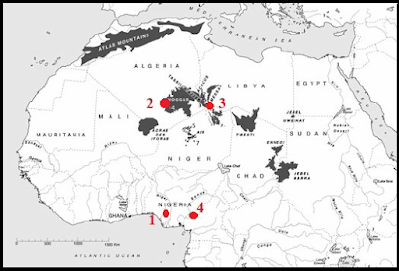
Location of the sites discussed. (1) Iwu Eleru. (2) Amekni. (3) Ti-n-Hanakaten. (4) Shum Laka. Holl (2021).

The Iwo Eleru Rock Shelter in southwestern Nigeria (modern Ondo State). The site was first excavated in the 1960s by a team led by Thurstan Shaw, revealing a Human skeleton in a tightly crouched position between two large collapsed stone slabs. The skeleton was poorly preserved, but is thought to have been a man between 35 and 45 years of age at the time of death. The teeth of Iwu Eleru Man were very badly worn, ground down to the gums in a series of great sweeping oblique curves running in different directions. Damage of this kind can be caused by certain forms of craft-working, notably basket or Reed-mat making, or by eating extremely fibrous foods, such as raw and sometime sandy fibrous tropical tubers. The body was covered by about 1.5 m of sediment, containing numerous lithic artefacts, notably quartz and chalcedony segments, borers, scrapers, trapezes, trapezoïds, points, and truncated blades. Towards the top of this sequence pottery fragments and ground stone axes appear, although there are no obvious stratigraphic breaks in these deposits.

The deposits above the burial indicate that the site continued to be used by living Humans after the burial, although probably not continuously. The site is likely to have been repeatedly used as a shelter by non-settled peoples passing through the area, perhaps seasonally, with the burial being placed there because a member of the community died while they were staying there. No grave goods were found, but the body was covered over by two large stone slabs, and possibly leaves, twigs, and tree branches, which implies some form of ritual, and a desire to protect the body from scavenging by wild Animals.

 
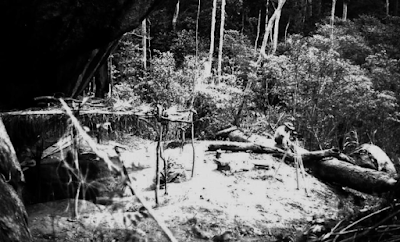
View of Iwo Eleru rock-shelter. Holl (2021).

The Amekni burial is in a granite boulder field to the southwest of the Ahaggar Mountains of southern Algeria. The area is known to have been inhabited by pottery-making foragers between 7000 and 6000 BC, and these are thought to be the people responsible for the burial. Three skeletons were found at this site, a woman thought to be 40-50 years old, and two children aged roughly 2-3 and 5-6, who were buried in a crouched position, and possibly wrapped in Animal skins. The woman is probably two old to have been the children's mother, though she could possibly have been their grandmother. This does not appear to have been the beginnings of an organised cemetery, but rather the burial of three members of a mobile community, and possibly the same family, who died at approximately the same time and were therefore buried in the same place.

The Ti-n-Hanakaten rock shelter is located at the junction of the Tadrart Acacus and Tassili-n-Ajjer mountains, about 150 km to the southeast of the town of Djanet. The site has a Epipalaeolithic archaeological sequence about 5 m thick, which spans about 20 000 years and records the advent of pottery in the area, as well as a scattering of Acheulean artefacts (an Old Stone Age technology, associated with Homo erectus rather than Modern Humans). The site produced a single burial, a child of uncertain age, who was buried in a tightly crouched position, wrapped in an Animal skin, within a circular pit filled with grass and straw, and sealed with a large stone slab, which had been smeared with red ochre. The Ti-n-Hanakaten burial has been dated to about 6000 years old, making it a similar age to the Amekni burial, with which it shares some similarities; in both cases children were buried in crouched positions and wrapped in Animal skins. However, the Ti-n-Hanakaten burial is more elaborate than the Amekni burial.

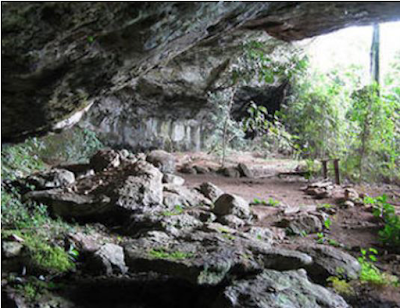
The Shum Laka rock-shelter is located in the volcanic highlands of northwestern Cameroon, at an altitude of 1600 m above sealevel, overlooking the Laka Valley. The rockshelter is located at the foot of a waterfall, and measures roughly 54 m by 25 m, with a floor surface of about 1181 m², of which 82 m² has been excavated, and an 8 m high roof.

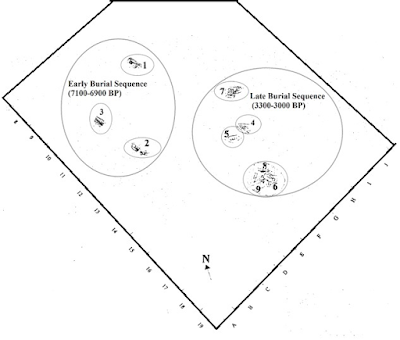
The site has yielded four distinct archaeological units, ranging in age from 32 000 to 3000 years. There are two sets of burials here, both associated with Holocene layers, the older dating from 7100-6900 years ago with four sets of remains in three burial and the younger from 3300-3000 years ago with fourteen sets of remains in nine burials. This larger clustering of burials raises the possibility that the people here might have been moving towards the organised burial of their dead in permanent cemeteries set aside for this purpose.

 
View of Shum-Laka rock-shelter. Holl (2021).

The earlier phase contains three burials at the northwest of the excavated area. The first of these is a man of about thirty with moderate osteophytosis on some vertebrae, some inflammation of the limbs, and two healed fractures, on the clavicle and left humerus, as well as dental calculus and heavy wear to the canine teeth, something which is almost certainly associated with some form of craftwork. His death appears to have been due to the cumulative effects of illness and old age, and his remains have been dated to about 7040 years ago. He was buried bout 8 m from the entrance to the cave, laid on the bedrock and covered with stones (in a similar fashion to the Iwu Elero burial), and covered by about 80 cm of sediment. The skeleton was in a sleeping position on its right side, with hands under the head, fcing towards the entrance of the shelter. 

The second early phase burial is locater 3 m south of the first, and 5 m from the entrance. It contains two sets of remains, a boy of about four years and a subadult about 15 years old, of indeterminate sex, with the child buried on top of the subadult, at the same time, in a pit surrounded by and filled with stones.

The boy has Harris lines on his bones, suggesting periods of arrested growth in his development, possibly indicating he was suffering from an infectious disease before his death. He was buried on his left side in a tightly contracted position, with his knees under his chin, facing towards the north, under about 65-95 cm of sediment, and his remains have been dated to approximately 7150 years ago.

The second skeleton has signs of an injury to the lower jaw, which caused a number of dental deformities, which possibly occurred when they were six or seven years old, as well as signs of an old injury to the left foot, which led to localised vascular disturbance. In addition to the injuries the skeleton had a hypertrophy of the supinator crest, which is an indication of regular practice with a throwing implement, such as a spear. The remains were buried in a half flexed half stretched position, the left arm stretched, the right one folded at right angle, and, like the younger child's, have been dated to 7150 years ago.

The final early stage grave appears to be a secondary grave for someone who was initially buried somewhere else. This contains a selection of limb bones, namely a right and left femur, right radius, and right fibula, all apparently from an 18-year-old male, 1.64 – 1.66 m tall. These were buried in a pit 60 cm deep, 75 cm long, and 25 cm wide, into which some Animal bones had also been deposited, although it is unclear if this association was deliberate. This individual appears to have been suffering from an unhealed ankle injury at the time of death, but was otherwise physically fit, with muscle attachments which suggest a powerful physique, and again regular practice with a spear or similar implement. These remains have been dated to 6870 years ago.

The wide range of dates obtained for these burials combined with the differences in burial style strongly suggest this was not a sign of a developing cemetery, but rather of a series of separate burials by different groups of people who moved through the area, and used the shelter temporarily, burying members of their groups who died while they were there.


Early and Late Holocene burial clusters from Shum Laka. Holl (2021).

The second group of burials are dated to between 3300 and 3000 years ago, and comprise fourteen sets of remains in nine separate burials, located at the eastern end of the excavated area. 

The first of these burials is a girl of about eight years old. The teeth of this girl suggest a series of severe health crises throughout her life beginning when she was about 6-9 months old, and continuing throughout her life. She was buried in a flexed position on her left side, facing to the north, about 7 m from the cave entrance and 25 cm deep. Her remains have been dated to about 3045 years ago.

The second of the younger phase burials is another young child, this time about four years old, and probably a girl. This individual seems to have been healthier than the first until the time of death, with some dental calculus, but no other pathologies. The body was laid on its back in a pit less than a meter from the previously described burial, and 4-5 m from the cave entrance. These remains have also been dated to about 3045 years ago.

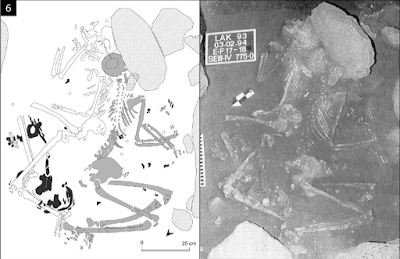
The third of the younger phase burials contains two sets of remains, both those of adult women. This grave was placed 5 m from the rock shelter entrance, and was about 75-95 cm deep. They were placed on their sides, back-to-back, with the first woman facing to the west and the second to the east. Both sets of remains have been dated to 3300 years ago.

The first of these women was 20-30 years old and about 1.53-1.55 m tall at her time of death. She had several dental pathologies which suggest several episodes of illness or malnutrition in her childhood, with muscle attachments that suggest she was physically strong and regularly took part in repetitive physical activity.

The second woman is estimated to have been 30-50 years old at her time of death, and 1.43-1.48 m tall. Unlike the first woman, she appeared to be suffering from a number of health problems, including severe dental decay and Arthritis of the spine and lower arms, which appear to have related to her age and a lifestyle involving frequent hard labour. Despite this, she also appears to have been well muscled, and from the asymmetry of her muscle attachments, probably right handed.

 
The joint burial of two women from the younger burial phase at Shum Laka. Lipson et al. (2020).

The fourth burial of the new phase is located about 1.5 m to the north of the first, and contains 273 skeletal elements, derived from at least seven children, placed in a pit 1 m long, 60 cm wide, and 45 cm deep. This pit appears to contain a mixture of primary and secondary burials, with some of the remains showing signs of heating. The two primary internments are a boy of 5-7 years old showing signs of repeated environmental stresses in his life, and a stone arrowhead stuck in his left ilium, which appears to have been the cause of death, and another child of 10-16 years old. The remaining bones are from disarticulated skeletons, presumed to be secondary burials. These include three children aged 2-4 years, a 3-5 year old, and a 5-9 year old, most of which show pathologies that would have related to health problems in life.

This grave is confusing, and difficult to interpret, but Holl notes that there appear to have been two phases of burial within the same pit, with the two children identified as primary burials interned together, between 3180 and 3025 years ago, and the disarticulated and possibly cremated remains (which could not be dated) added later, possibly accidentaly uncovering the earlier grave in the process.

 
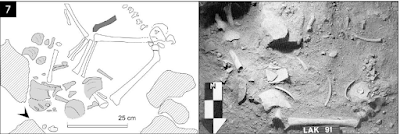
Burial Unit 7 (collective) showing disarticulated crania and one partially articulated post-cranial skeleton (20-30 cm below surface). Lipson et al. (2020).

The fifth of the new phase burials contains the remains of two robust adult males, aged 30-35 and 40-45 years. These remains had been cremated prior to burial, and was disarticulated and separated into three piles, the first containing cranial vault and tibia fragments, the second long bones and cranial vault fragments, and the third long bones and mandibulae fragments. These remains could not be dated, but appear to predate the third new phase burial, which overlies and partially disturbs this burial; this is a reversal of the situation in the fourth new phase burial, in which the deposition of cremated remains appears to have disturbed un-cremated remains which were buried earlier.

The final new phase burial is another set of cremated remains, this time of a single individual. In this case a high temperature appears to have been achieved during the cremation (probably about 800°C) resulting in very white and fragmentary remains, although parts of the skull, teeth, vertebrae, ribs, scapulae and clavicles, hands, sacrum, coccyx, and coxal bones, long bones, feet, and undetermined long bones could be identified, supporting the hypothesis that this was a single, intact, individual. These remains could not be dated, but again they appear to have pre-dated and been partially disturbed by, the third new-phase burial.

Although these burials represent a reasonably high number of individuals in a moderately short period of time (14 individuals in about 300 years), the differences in the ways in which they were buried, combined with the fact that some of the burials appeared to have accidentally disturbed older burials, suggests that this was still not a site being used specifically as a cemetery, but rather repeatedly chosen as a burial site by different groups of people moving through the area, and probably using the rock shelter as a temporary dwelling place.

See also...


Follow Sciency Thoughts on Facebook.

Follow Sciency Thoughts on Twitter.