
The Fouta Djallon Highlands of west-central Guinea form a series of plateaus, deep valleys, and steep slope-faces covered by a mixture of tropical and sub-tropical forests and grasslands. The area receives some of the highest rainfall in West Africa, but also has a wide range of micro-climates, providing a highly diverse environment with a high number of endemic species, which is relatively understudied by scientists. The floral uniqueness of the region has long been recognised, and there have been many calls to protect areas of pristine forest being encroached upon by agriculture and Cattle ranching, but the faunal uniqueness of the area has been very little studied.
In a paper published in the journal Zoosystematics and Evolution on 19 January 2022, Karla Neira-Salamea of the Museum für Naturkunde Berlin, Joseph Doumbia of ONG EnviSud Guinée, Annika Hillers of the Wild Chimpanzee Foundation, Laura Sandberger-Loua, also of the Museum für Naturkunde Berlin, N’Goran Kouamé of the Laboratoire de Biodiversité et Ecologie Tropicale at the Université Jean Lorougnon Guédé, Christian Brede of Lübeck in Germany, Marvin Schäfer, again of the Museum für Naturkunde Berlin, David Blackburn of the Department of Natural History at the Florida Museum of Natural History, and Michael Barej and Mark-Oliver Rödel, once again of the Museum für Naturkunde Berlin, describe a new species of Slippery Frog from the Fouta Djallon Highlands of west-central Guinea.

Slippery Frogs, Conraua spp., are endemic to Africa, with seven species currently recognised, one from East Africa, three from Central Africa, and three from West Africa. However, a recent phylogenetic study of one of these species, Conraua alleni, should in fact be considered to be a species cluster (group of morphologically identical but genetically distinct species, known as 'cryptic species') rather than a distinct species. With this in mind, Neira-Salamea et al. carried out morphological and genetic tests on a group of Slippery Frogs held in the Museum für Naturkunde Berlin, which were collected during an expedition to the Fouta Djallon in 2011, establishing that Frogs from Hörè Binti, Pita and Chute de Ditinn and Dalaba in the Fouta Djallon are all members of a new, previously undescribed species.
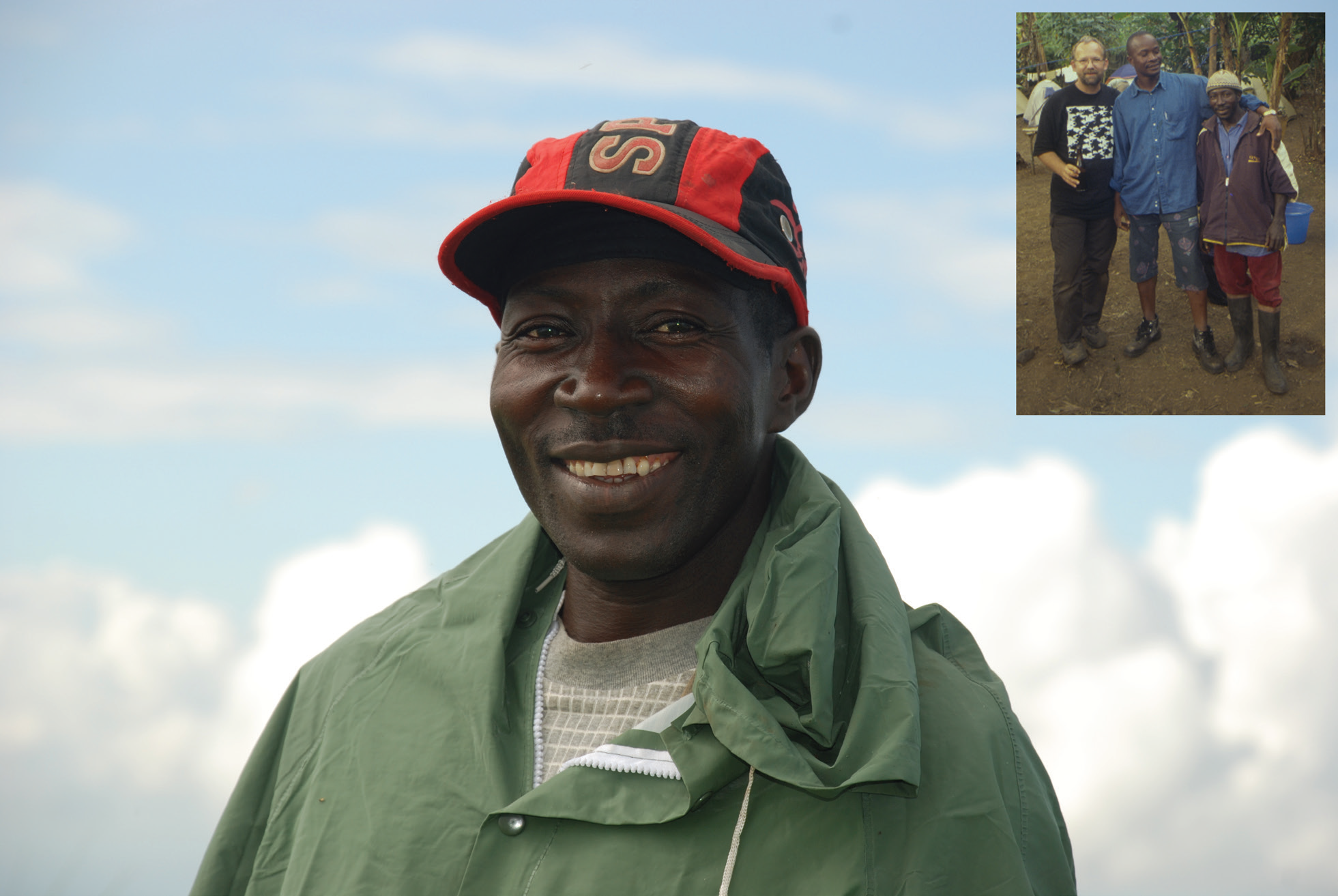
The new species is named Conraua kamancamarai, in honour of the late Kaman Camara, a long term field assistant and friend of the team, who began working with Mark-Oliver Rödel in 2002 on a survey to the Simandou Range that was organised by Conservation International, and worked with the team full time from 2007 until his death after a short illness in 2020, investigating the amphibians of the Nimba Mountains and other Guinean areas. Neira-Salamea et al. note that 'Kaman had outstanding skills in detecting and catching Frogs, and, more importantly, an unswerving positive attitude'. Kaman was born and lived in a remote village at the western foothills of the Simandou Range. He never received any formal education. Still, he repeatedly rejected other better paying job offers from mining companies, preferring instead to work with his frog team whenever it was possible.
Specimens of Conraua kamancamarai have a slightly dorsoventrally flattened, short and rounded body; the snout is rounded in dorsal and lateral view, the upper lip slightly projects forward. They range from 74.3 to 81.7 mm in length. Dorsal colouration ranges from uniform dark brown to predominantly brown with dark mottling or predominantly brown with dark spots. Ventral colour pattern of all specimens similar: whitish with distinct brown blotches, however, these blotches are lighter in the subadult specimens.
 Colouration of life Conraua kamancamarai from the Fouta Djallon and surrounding region, Guinea, illustrating variation in colour pattern and skin texture. (a) From Dubreka, River Bindinbandan; (b) From Dalaba, Chute de Ditinn; (c) From Hörè Binti; (d) From Dubreka, River Bindinbandan; (e) From Dalaba, Chute de Ditinn; (f) From Télimélé, locality Kourakoto, river Didounpouriguè; Frogs in lower row in typical calling position, sitting in shallow water; specimens either not collected or not assignable to a voucher specimen, whereas the Frogs from Hörè Binti and Chute de Ditinn can be assigned to Conraua kamancamarai without doubt; the other Frogs may represent an undescribed Conraua species. Neira-Salamea et al. (2022).
Conraua kamancamarai occupies fast-flowing rocky streams with waterfalls within riverine forest in mountainous areas in the Fouta Djallon. Like other Frogs of the genus, Conraua kamancamarai is predominately nocturnal and aquatic. Despite their occurrence in fast flowing streams, adults show a preference for calmer river sections, where turbulent water is absent. Usually, Frogs are encountered at least partly submerged in shallow water, facing the riverbanks. When outside of the water, they remain within jumping distance to water. Disturbed Frogs seek shelter on the ground of pools, sometimes trying to burrow deeper into them and cover themselves with gravel or substrate. Mating has never been observed; however, single observations of clutches and jelly remnants of spawn indicate that oviposition sites are small puddles or depressions on the riverbanks near the spray water zone of cascades and waterfalls. Conraua Tadpoles usually were observed in silted calm ponds where up to 50 Tadpoles of about the same size have been encountered.

The forest fragments where Conraua kamancamarai occurs are generally degraded by anthropogenic disturbance, particularly Peanut and Rice crops and Cattle grazing. The type locality is located between Konkouré and the largest city within the Fouta Djallon, Mamou, within a relatively short distance to the connection road and was surveyed on 20 June 2011. Along the national route one (N1), one of the largest roads connecting the East with the West of Guinea, houses are numerous, but already within a relatively short distance to the road, Human presence may be considerably scarcer. Slopes are either covered by an open, short, dry forest with signs of Cattle grazing and used for charcoal production or comparatively large fields for Peanuts or Rice crops. Only steep slopes surrounding rivers had sometimes larger trees and denser vegetation with higher humidity levels than the surroundings. The type locality is at a river within denser forest, with large boulders and some cascades, allowing for a diverse river site with fast and slow flowing parts and comparatively clear water. These forests are not protected and were in the past burned by the population as protest against government decisions in Conakry.

The classified forest (partly protected areas allowing forestry) of Hörè Binti is located within a mountainous area containing several freshwater sources. It was surveyed from 22–23 July 2010. Many fast-flowing streams with cascades have its source on the mountain. The habitat degradation due to anthropogenic alterations was dramatic and only very small forest fragments remained. The anthropogenic pressure consisted of cultivations/fields (mainly Peanut and Rice) and grazing Cattle. Only streams were surrounded by some remaining larger trees. The Ditinn/Dalaba site was within a small fragment of gallery forest with a stream, next to the waterfall of Ditinn. It was surveyed from 24–25 July 2010. Although there is a small village next to the forest, only minor anthropogenic alterations were detectable.
Because the full range of Conraua kamancamarai is unknown, Neira-Salamea et al. recoment that it be treated as 'Data Deficient' under the terms of the International Union for the Conservation of Nature’s Red List of Threatened Species. However, they also note that if the known populations do represent the entire range of the species, then it should be considered to be Endangered.
See also...





Follow Sciency Thoughts on Facebook.
Follow Sciency Thoughts on Twitter.


