Showing posts with label Liberia. Show all posts

Monday, 25 January 2021

Kenyan man extradited by the United States for trafficking in Rhinoceros horns, Elephant ivory and heroin.

Audrey Strauss, the United States Attorney for the Southern District of New York, announced in a press release on Monday 25 January 2021, that Mansur Mohamed Surur, 60, a Kenyan citizen, was extradited from Kenya and arrived in the United States this morning. Surur was arrested by Kenyan authorities on 29 July 2020, in Mombasa, Kenya, on charges of conspiracy to traffic in Rhinoceros horns and Elephant ivory, both endangered wildlife species, which involved the illegal poaching of more than approximately 35 Rhinoceros and more than 100 Elephants.  In addition, Surur was charged with conspiracy to commit money laundering and conspiracy to distribute and possess with intent to distribute more than 10 kilograms of heroin. Surur's co-defendant, Moazu Kromah, a citizen of Liberia, was previously deported to the United States from Uganda on 13 June 2019.  Co-defendant Amara Cherif, a citizen of Guinea, was extradited to the United States from Senegal on 3 April 2020.  Co-defendant Abdi Hussein Ahmed, citizen of Kenya, remains a fugitive. Surur is expected to be arraigned later today before U.S. Magistrate Judge Debra Freeman.  The case has been assigned to U.S. District Judge Gregory Woods.
 
 
Mansur Mohamed Surur, extracted from Kenya to the United States to face charges of trafficking in Rhinoceros horns, Elephant ivory and heroin. The Standard.
 
Manhattan U.S. Attorney Audrey Strauss said:  'Mansur Mohamed Surur is alleged to be a member of an international conspiracy to traffic in Rhino horns, Elephant ivory, and heroin.  The enterprise is allegedly responsible for the illegal slaughter of dozens of Rhinos and more than 100 Elephants, both endangered species.  The excellent work of the Fish and Wildlife Service and the Drug Enforcement Administration has put an end to this operation.'
 
According to allegations in the indictment Kromah, Cherif, Surur,  and Ahmed were members of a transnational criminal enterprise based in Uganda and surrounding countries that was engaged in the large-scale trafficking and smuggling of Rhinoceros horns and Elephant ivory, both protected wildlife species. Trade involving endangered or threatened species violates several U.S. laws, as well as international treaties implemented by certain U.S. laws.
 
From at least in or about December 2012 through at least in or about May 2019, Kromah, Cherif, Surur, and Ahmed conspired to transport, distribute, sell, and smuggle at least approximately 190 kilograms of Rhinoceros horns and at least approximately 10 tons of Elephant ivory from or involving various countries in East Africa, including Uganda, the Democratic Republic of the Congo, Guinea, Kenya, Mozambique, Senegal, and Tanzania, to buyers located in the United States and countries in Southeast Asia.  Such weights of Rhinoceros horn and Elephant ivory are estimated to have involved the illegal poaching of more than approximately 35 Rhinoceros and more than approximately 100 Elephants.  In total, the estimated average retail value of the Rhinoceros horn involved in the conspiracy was at least approximately $3.4 million, and the estimated average retail value of the Elephant ivory involved in the conspiracy was at least approximately $4 million.
 
The defendants exported and agreed to export the Rhinoceros horns and Elephant ivory for delivery to foreign buyers, including those represented to be in Manhattan, in packaging that concealed the Rhinoceros horns and Elephant ivory in, among other things, pieces of art such as African masks and statues.  The defendants received and deposited payments from foreign customers that were sent in the form of international wire transfers, some which were sent through U.S. financial institutions.
 
On a number of occasions, Kromah, Surur, and Ahmed met with a confidential source (identifies as 'CS-1'), both together and separately, concerning potential purchases of Elephant ivory and Rhinoceros horn.  During these meetings and at other times via phone calls and electronic messages, CS-1 discussed with Kromah, Surur, and Ahmed, in substance and in part, the terms of such sales, including the price, weight, or size of the rhinoceros horns, as well as payment, destination, and delivery options.  CS-1 also discussed with Cherif via phone calls and electronic messages, in substance and in part, the terms of the sales, as well as how to send payment for Rhinoceros horns from a United States bank account located in New York, New York.  On or about 16 March 2018, law enforcement agents intercepted a package containing a Black Rhinoceros horn sold by the defendants to CS-1 that was intended for a buyer represented to be in New York, New York.  From in or about March 2018 through in or about May 2018, the defendants offered to sell CS-1 additional Rhinoceros horns of varying weights, including horns weighing up to approximately seven kilograms.  On or about 17 July 2018, law enforcement agents intercepted a package containing two Rhinoceros horns sold by the defendants to CS-1 that were intended for a buyer represented to be in New York, New York. 
 
Separately, from at least in or about August 2018 through at least in or about May 2019, Surur and Ahmed conspired to distribute and possess with intent to distribute more than approximately 10 kilograms of heroin to a buyer represented to be located in New York. 
 
Surur is charged with one count of conspiracy to commit wildlife trafficking and two counts of wildlife trafficking, which each carry a maximum sentence of five years; one count of conspiracy to commit money laundering, which carries a maximum sentence of 20 years; and one count of conspiracy to distribute and possess with intent to distribute one kilogram or more of heroin, which carries a maximum sentence of life imprisonment and a mandatory minimum sentence of 10 years in prison.  The maximum potential sentences are prescribed by Congress and are provided here for informational purposes only, as any sentencing of the defendant will be determined by the judge.
 
Ms. Strauss praised the outstanding investigative work of the U.S. Fish and Wildlife Service and the U.S. Drug Enforcement Administration.  In addition, she thanked law enforcement authorities and conservation partners in Uganda as well as the Kenyan Directorate of Criminal Investigations and the Kenyan Office of the Director of Public Prosecutions for their assistance in the investigation.  Ms. Strauss also thanked the U.S. Department of Justice’s Office of International Affairs for their assistance, and noted that the investigation is continuing.
 
The prosecution of this case is being handled by the Office’s Complex Frauds and Cybercrime Unit.  Assistant United States Attorneys Sagar Ravi and Jarrod Schaeffer are in charge of the prosecution. The charges contained in the Indictment are merely accusations.  The defendants are presumed innocent unless and until proven guilty.
 
See also...


Follow Sciency Thoughts on Facebook.

Follow Sciency Thoughts on Twitter.


Tuesday, 12 May 2020

Four miners thought to have died after collapse at Liberian gold mine.

Four miners are thought to have died, and ten more may be trapped below ground following a landslide at a gold mine in Bong County, Liberia, on Friday 8 May 2020. The landslide is thought to have been triggered by heavy rains in the area rather than the activities of the miners themselves, and to have covered the entrance to the mine. Landslides are a common problem after severe weather events, as excess pore water pressure can overcome cohesion in soil and sediments, allowing them to flow like liquids. The miners are thought to have been working at depth of about 20 m below ground, at an artisanal mine (mine dug by local people using traditional methods) located in the village of Camp Jackson. The alarm was raised by two miners who managed to escape from the pit.

The entrance to an artisanal gold mine in Bong County, Liberia, which was covered by a landslide on 9 May 2020. Front Page Africa.

Artisanal mining is widespread in Liberia and Sierra Leone. It is often referred to as 'illicit', though in an area with little formal employment this is somewhat unfair, with local people viewing small scale mining as a traditional way of gaining some hard cash. The area is covered by poorly consolidated alluvial (river) sediments, washed out from the mineral rich Fouta Djallon Highlands, in neighbouring Guinea, since the last ice age. These loose sediments can be excavated and panned to produce small amounts of gold and diamonds. This can be a dangerous task, as sediments close to the surface are likely to have been worked by previous generations of villagers, requiring deeper pits to be dug into the, often waterlogged, sediments, with the accompanying risk of pit collapses.

 The approximate location of the Camp Jackson gold mine. Google Maps.

West Africa has a distinct two season climatic cycle, with a cool dry season during the northern winter when prevalent winds blow from the Sahara to the northeast, and a warm rainy season during the northern summer when prevalent winds blow from the Atlantic Ocean to the southwest. These warm winds from the Atlantic are laden with moisture, which can be lost rapidly when the air encounters cooler conditions, such as when it is pushed up to higher altitudes by the Futa Jallon Mountains of Guinea, Sierra Leone and Liberia.

Rainfall and prevalent winds during the West African dry and rainy seasons. Encyclopedia Britanica.

See also...

https://sciencythoughts.blogspot.com/2020/05/collapse-at-mine-kills-at-least-two-in.htmlhttps://sciencythoughts.blogspot.com/2020/02/collapse-at-gold-mine-kills-at-least.html
https://sciencythoughts.blogspot.com/2019/02/collapse-at-gold-mine-feared-to-have.htmlhttps://sciencythoughts.blogspot.com/2018/06/flooding-kills-at-least-eighteen-in.html
https://sciencythoughts.blogspot.com/2017/10/unsustainable-chocolate-production.htmlhttps://sciencythoughts.blogspot.com/2017/08/hundreds-dead-after-mudslide-in-sierra.html
Follow Sciency Thoughts on Facebook.

Tuesday, 5 May 2020

Collapse at mine kills at least two in Liberia.

Two people have now been confirmed dead, and it is feared that as many as sixty more may be missing following a collapse at a mine in Grand Cape Mount County, Liberia, on Tuesday 5 May 2020. The mine is located in a remote area known for its gold resources, and has been described as 'artisanal' (dug by local people using traditional methods) in nature.

The approximate location of the Grand Cape Mount mine collapse. Google Maps.

Artisanal mining is widespread in Liberia and Sierra Leone. It is often referred to as 'illicit', though in an area with little formal employment this is somewhat unfair, with local people viewing small scale mining as a traditional way of gaining some hard cash. The area is covered by poorly consolidated alluvial (river) sediments, washed out from the mineral rich Fouta Djallon Highlands, in neighbouring Guinea, since the last ice age. These loose sediments can be excavated and panned to produce small amounts of gold and diamonds. This can be a dangerous task, as sediments close to the surface are likely to have been worked by previous generations of villagers, requiring deeper pits to be dug into the, often waterlogged, sediments, with the accompanying risk of pit collapses.
 
See also...
 
https://sciencythoughts.blogspot.com/2020/03/necrosyrtes-monachus-around-thousand.htmlhttps://sciencythoughts.blogspot.com/2020/02/collapse-at-gold-mine-kills-at-least.html
 
https://sciencythoughts.blogspot.com/2019/11/france-begins-to-return-artefacts.htmlhttps://sciencythoughts.blogspot.com/2019/09/how-changing-climate-is-promoting.html
https://sciencythoughts.blogspot.com/2019/02/collapse-at-gold-mine-feared-to-have.htmlhttps://sciencythoughts.blogspot.com/2018/08/offshore-oil-prospecting-returns-to.html
Follow Sciency Thoughts on Facebook.

Wednesday, 13 February 2019

Collapse at gold mine feared to have killed forty in Liberia.

As many as forty miners are feared to have died following a collapse at a gold mine in Nimba County, Liberia, on Saturday 9 February 2019. About sixty miners were bellow ground when the incident happened at the Gbanepea Gold Mine near Tappita. Twenty of the miners were able to escape the scene, and five bodies have been recovered, but the fate of the remaining miners is unclear, and local residents are asking the government for aid in mounting a rescue attempt.

Miners outside a tunnel at the Gbanepea Gold Mine in Nimba County, Liberia. Liberia Dispatch.

The Gabanepea Gold Mine was first opened as an open pit mine in the 1930s, but abandoned during the Liberian Civil War (1989-1997). Artisanal miners using traditional tools began to excavate at the site in September last year, resulting in a series of landslips, prompting authorities to intervene and close the site. However since then miners have apparently dug a series of deep holes into the sides of the pit, reaching as far as 200 m from the surface, an operation which appears to have been successful until this week's collapse.

Artisanal mining is widespread in eastern Liberia and Sierra Leone. It is often referred to as 'illicit', though in an area with little formal employment this is somewhat unfair, with local people viewing small scale mining as a traditional way of gaining some hard cash. The area is covered by poorly consolidated alluvial (river) sediments, washed out from the mineral rich Fouta Djallon Highlands, in neighbouring Guinea, since the last ice age. These loose sediments can be excavated and panned to produce small amounts of gold and diamonds. This can be a dangerous task, as sediments close to the surface are likely to have been worked by previous generations of villagers, requiring deeper pits to be dug into the often waterlogged sediments, with the accompanying risk of pit collapses.

See also...

https://sciencythoughts.blogspot.com/2018/06/flooding-kills-at-least-eighteen-in.htmlhttps://sciencythoughts.blogspot.com/2017/08/hundreds-dead-after-mudslide-in-sierra.html
https://sciencythoughts.blogspot.com/2017/10/unsustainable-chocolate-production.htmlhttps://sciencythoughts.blogspot.com/2017/07/landslide-kills-at-leat-three-at-guinea.html
https://sciencythoughts.blogspot.com/2013/11/25-miners-believed-to-be-dead-after.htmlhttps://sciencythoughts.blogspot.com/2013/08/at-least-fifteen-dead-following.html
Follow Sciency Thoughts on Facebook.

Sunday, 1 November 2015

Evidence for sexual transmission of the Ebola Virus.


In December 2013 cases of Ebola, a viral haemorrhagic fever with an extremely high mortality rate, began to emerge in Guinea, West Africa, marking the beginning of the most severe outbreak of the disease ever recorded. The epidemic rapidly spread to several neighbouring countries, including Sierra Leone and Liberia where if became established and killed large numbers of people before being eradicated. Liberia was officially declared free of Ebola on 3 September 2015, though cases were still being reported in Guinea and Sierra Leone, albeit at a much lower rate than during the peak of the epidemic.

Areas affected by the 2013-5 West African Ebola Virus outbreak. Digital Data Services.

Sexual transmission of the Marburg Virus, which is related to the Ebola Virus, has been known to occur at least once, and Ebola has been detected in other bodily fluids after blood samples have been shown to be clear of the Virus. For this reason Ebola survivors are advised to abstain from unprotected sex for at least three months after being diagnosed clear of the Virus.

In a paper published in the New England Journal of Medicine on 14 October 2015, a team of scientists led by Suzanne Mate and Jeffrey Kugelman of the Center for Genome Sciences at the U.S. Army Medical Research Institute of Infectious Diseases, Tolbert Nyenswah of the Ministry of Health and Social Welfare of the Republic of Liberia and Jason Ladner, also of the Center for Genome Sciences at the U.S. Army Medical Research Institute of Infectious Diseases report the first known case of sexual transmission of the Ebola Virus.

On Friday 20 March 2015 a 44-year-old woman from Montserrado County, Liberia, was diagnosed to be infected with the Ebola Virus. The woman died a week later on 27 March. Before dying she reported having had unprotected virginal sex with an Ebola survivor on 7 March 2015. This man had been diagnosed clear of the Virus (a test based upon blood samples) on 3 October 2014, and discharged from the unit where he was treated on 7 October. This man was contacted and voluntarily provided blood and semen samples on 27 March 2015. The blood was tested and shown to be clear of the Virus, but the semen sample proved to be Ebola positive, 175 days after after the patient’s blood was found to be clear. Subsequent tests of the male patients semen collected on 28 April and 2 May 2015 were shown to be clear of the Virus.

Electron micrograph of an Ebola Virus particle. Frederick Murphy/Centers for Disease Control and Prevention/Wikimedia Commons.

A genetic analysis of Virus samples taken from the two patients showed that they were very closely related, and no other plausible cause of transmission could be identified, leading Mate et al. to conclude that in this case the Ebola Virus had been transmitted sexually.

See also…

The first known cases of Heartland Virus, a form of Phlebovirus in the Family Bunyaviridae, were reported in northwest Missouri in 2009, were two agricultural workers were struck down with an illness that causes fever, leukopenia (a decrease in...


In late spring 2014 a previously healthy man in his 50s was admitted to a hospital in Bourbon County, Kansas, suffering from Tick bites and a fever. Despite...

In December 2013 cases of the haemorrhagic Virus...


Follow Sciency Thoughts on Facebook.

Wednesday, 29 April 2015

Cryptic diversity in West African Torrent Frogs.


The West African Torrent Frog, Odontobatrachus natator, is found in fast moving streams and waterways in the forests of Guinea, Sierra Leone Liberia, and western Côte d’Ivoire, part of the Upper Guinean Biodiversity Hotspot. While it has been known to science for over a hundred years, a recent study has shown it to be sufficiently genetically isolated from all other Frogs to merit placing it in its own family, the Odontobatrachidae, this being the first family of Vertebrates discovered which is entirely restricted to West Africa.

In a paper published in the journal BMC Evolutionary Biology on 19 April 2015, Michael Barej and Johannes Penner of the Museum für Naturkunde Berlin at the Leibniz Institute for Evolution and Biodiversity Science, Andreas Schmitz of the Department of Herpetology and Ichthyology at the Natural HistoryMuseum of Geneva and Mark-Oliver Rödel, also of the Museum für Naturkunde Berlin at the Leibniz Institute for Evolution and Biodiversity Science examine the genetic diversity of West African Torrent Frogs in order to determine if they were truly all one widespread species or a cluster of morphologically indistinguishable cryptic species.

A West African Torrent Frog, Odontobatrachus natator. Barej et al. (2014).

Cryptic species are species which resemble one-another closely but which are reproductively isolated. These have been known about for a long time in groups such as calling Frogs and Songbirds, where morphologically identical populations can be separated on the basis of different mating calls, but the true extent of hidden diversity in many groups did not become apparent until genetic tools became available to study wild populations in the 1990s. The discovery of cryptic species can have profound implications for conservation efforts, as what was thought to be a single, widespread species with a large population can suddenly be found to be a cluster of species, each with very limited populations and ranges. Cryptic diversity seems to be particularly common among groups such as small Amphibians and Reptiles, but has been found even in large charismatic animals such as Elephants, Giraffes, Baboons and Hammerhead Sharks.

Barejet al. found that the population of Odontobatrachus natator contains six distinct genetic lineages, and though they do not go so far as to name them as new species from this preliminary study, they do indicate that further studies are likely to result in the group being divided into a number of separate species.

Tree resulting from partitioned Bayes and ML analyses of mitochondrial genes 16S, 12S, cytb and nuclear genes RAG1, SIA and BDNF (outgroups not shown). Barej et al. (2015).

The most widespread of these is found in western Guinea, across Sierra Leone and as far to the east as eastern Guinea and eastern Liberia. This includes the area from which the species was first described (Sierra Leone, unspecified), and will therefore retain the name Odontobatrachus natator however the group is subdivided in future. This population is considered to be of ‘Least Concern’ under the terms of the International Union for the Conservation of Nature’s Red List of ThreatenedSpecies.

The most closely related outgroup to this (and therefore the group least likely to subsequently be described as a separate species) was a population found only on the Freetown Peninsula in Sierra Leone. This population is referred to as Odontobatrachus natator (Freetown Peninsula), and while closely related to the larger population, does appear to be separate on the basis of the genes studies and is separated from the main population by a wide area of unsuitable habitat, which may have allowed reproductive isolation to develop. If this population is recognized as a separate species then it would be recognized as ‘Critically Endangered’ under the terms of the International Union for the Conservation of Nature’s Red List of Threatened Species, due to the limited geographical range it inhabits.

Environmental niche modelling map of genetically confirmed records of the Operational Taxonomic Units Odontobatrachus natatorand Odontobatrachus natator (Freetown Peninsula). Barej et al. (2015).

In addition four other distinctive genetic lineages are identified, and provisionally named as ‘Operation Taxonomic Units’ (OTUs) 1 to 4. These can be further groups as (OTU 1 and OUT 4) which are most closely related to one-another and the sister group to (Odontobatrachus natatorand Odontobatrachus natator (Freetown Peninsula)), and (OUT 2 and OUT 3) which are more closely related to one-another, and form an outgroup to all the other populations.

OTU 1 is found in the Simandou Range and the Massif du Ziama in south-eastern Guinea, and environmental niche modelling suggests that it may also occur westwards into parts of Sierra Leone. This population is considered to be ‘Vulnerable’ under the terms of the International Union for the Conservation of Nature’s Red List of Threatened Species.

Environmental niche modelling map of genetically confirmed records of Operational Taxonomic Unit 1. Barej et al. (2015).

OTU 2 was found in western Guinea, though Environmental Niche Modelling suggested that it may also be found as far east as central Sierra Leone, though Barej et al. deem this unlikely. This population is considered to be ‘Vulnerable’ under the terms of the International Union for the Conservation of Nature’s Red List of Threatened Species.

Environmental niche modelling map of genetically confirmed records of Operational Taxonomic Unit 2. Barej et al. (2015).

OTU 3 was also found in wesertn Guinea, though Environmental Niche Modelling suggests that it may be found as far east as central Sierra Leone and as far west as parts of Guinea Bissau, though againBarejet al. deem this unlikely.This population is considered to be ‘Endangered’ under the terms of the International Union for the Conservation of Nature’s Red List of Threatened Species.

Environmental niche modelling map of genetically confirmed records of Operational Taxonomic Unit 3. Barej et al. (2015).

OTU 4 was found in the Nimba Mountains of southeaster Guinea and the surrounding area, as well as in northeastern Liberia and the Mont Sangbé National Park in western Côte d’Ivoire. Environmental niche modelling suggested that this population could extend across much of eatern Guinea and northern Liberia, and even into eastern Sierra Leone. This population is considered to be ‘Endangered’ under the terms of the International Union for the Conservation of Nature’s Red List of Threatened Species.

Environmental niche modelling map of genetically confirmed records of Operational Taxonomic Unit 4. Barej et al. (2015).

Although this is only a preliminary study, the degree of genetic separation between the populations suggests that they may have diverged during the Plio-Pleistocene. This is consistent with palaeoclimatic models of West Africa, which suggest while the region was not directly affected by glaciation during the Pleistocene, glacial intervals at higher latitudes led to a cooler drier climate in which forests withdrew and grasslands expanded. During such periods forest species would have been restricted to isolated refugia, where populations cut off from one-another geographically could become permanently separated by genetic drift.

See also….

Robber Frogs of the genus Eleutherodactylus are found from Texas to Guatemala and Belize and across the islands of the Caribbean. The genus was formerly the most specious of any genus of Vertebrate Animals (i.e. it contained more species than any other Vertebrate...

In the late 1960s and early 1970s a series of anthropological excavations were carried out at Minatogawa Fissure on southern Okinawa Island, producing a number of Late Pleistocene Human...


Fanged Frogs, Limnonectes spp., are unique among Frogs in that the males are typically larger than the females, and frequently fight for territories, the females then mating with the males perceived as having the...


Follow Sciency Thoughts on Facebook.

Monday, 24 November 2014

Nine new species of Crab Spiders from Africa.


Crab Spiders of the genus Mystaria are found in Africa from Guinea in the west to Ethiopia in the east and south to Cape Province in South Africa. They are ambush hunters, lying in wait for prey on plants in a wide variety of environments, from forest canopies to grasses to coastal wetlands.

In a paper published in the journal Zootaxa on 15 October 2014, Allet Honibull Lewis of the Department of Zoology & Entomology at the University of Pretoria and Ansie Dippenaar-Schoeman of the Department of Zoology & Entomology at the University of Pretoria and the ARC-Plant Protection Research Institute describe nine new species of Crab Spiders from across Africa, eight of them in the genus Mystaria, and one in a new genus, Leroya, which lives exclusively in the rainforest canopy. In addition they contend that the previously described genus Paramystaria is invalid, and move six species from this genus to Mystaria, and one species from Mystaria to Leroya.

The first new species described is named Mystaria budongo, in reference to the Budongo Forest of Uganda, where it was most abundant. The species is described from sixteen specimens collected in Rwanda, Democratic Republic of Congo, Kenya and Uganda. All of the known specimens are male. Mystaria budongo is 2.7-2.9 mm in length, and has a pear-shaped carapace with an orange-yellow median band and horizontal black and brown bands. The legs are yellow. The species lives in the forest canopy.

Mystaria budongo male from Rwanda, Ibanda Makera (dorsal view). Honibull Lewis & Dippenaar-Schoeman (2014).

The second new species described is named Mystaria irmatrix, in honour of Allet Honibull Lewis’ mother. The species is described from 19 specimens collected in Mozambique and South Africa, including members of both sexes and juveniles. Females were 3.15-4.14 mm in length and either orange with black markings or black with orange markings. Males were smaller, at 2.50-3.13 mm in length, and orange or brown with black markings. The species was found living in trees in coastal woodlands and grasslands, along rivers and around sand dunes

Mystaria irmatrix female from Mozambique, Marracuene in antero-dorsal view. Honibull Lewis & Dippenaar-Schoeman (2014).

The third new species is named Mystaria lindaicapensis, honouring Linda Wiese who collected the first specimen, and referring to the Cape region of South Africa where it is found (in both Eastern and Western Cape Provinces). The species is described from one female and two male specimens. The female is 3.9 mm in length and brown with orange markings. The males are 2.78 and 2.87 mm in length, and blackish brown with orange-red markings. Two of the specimens were collected from a garden the third from woodland.

Mystaria lindaicapensis female from South Africa, Jeffreys Bay in antero-dorsal view. Honibull Lewis & Dippenaar-Schoeman (2014).

The fourth new species described is named Mystaria mnyama, meaning ‘black’ in Zulu, a reference to the colouration of areas on the face and around the eyes. The species is described from one male and one female specimen, collected from grass and shrubs in Tembe Elephant Park in KwaZulu-Natal Province, South Africa. The female is 2.64 mm in length and copper-red in colour with dark facial markings and a lighter abdomen with two dark spots. The male is 2.29 mm in length with a dark copper-black body with lighter markings.

Mystaria mnyama female from South Africa, Tembe Elephant Parkinantero-dorsal view. Honibull Lewis & Dippenaar-Schoeman (2014).

The fifth new species described is named Mystaria oreadae, in reference to the Oreads (Mountain Nymphs) of Greek mythology, as the species was found exclusively in mountainous regions. The species is described from four female specimens, three from Nord Province in Rwanda and one from Orientale Region in the Democratic Republic of Congo. The specimens are 2.74-3.53 mm in length, red to orange copper with lighter or darker markings and a pale carapace.

Mystaria oreadae female from Rwanda, Rwankuba in antero-dorsal view. Honibull Lewis & Dippenaar-Schoeman (2014).

The sixth new species is named Mystaria savannensis, meaning ‘Savanah-dweller’. The species is named from 111 specimens collected in Zambia, Botswana, South Africa and Zimbabwe, including males, females and juveniles. The females are 3.15-5.08 mm in length and orange red or dark brown with a pale abdomen with a darker central stripe. The males are 2.50-3.27 mm in length and copper brown in colour with a darker abdomen. The species was found in trees, shrubs and leaf litter across a wide area of southeast Africa.

Mystaria savannensis female from South Africa, Soutpansberg in antero- dorsal views. Honibull Lewis & Dippenaar-Schoeman (2014).

The seventh new species is named Mystaria soleil, meaning ‘Sun’ in French, due to its bright yellow colour. The species is described from 42 specimens collected in Masindi District, Uganda and Western Province, Kenya. The females are 3.13-3.48 mm in length, the males 2.46-2.70 mm, females are pale brown with darker bands and spots and yellow legs, males also have a yellow abdomen.

Mystaria soleil female from Kenya, Kakamega in dorsal view. Honibull Lewis & Dippenaar-Schoeman (2014).

The eighth new species described is named Mystarias takesbyi, in honour of Eduard Stakesby, the husband of Allet Honibull Lewis. The species is described from 15 specimens from Ghana, the Democratic Republic of Congo, Gabon, Liberia, Kenya, Rwanda, Tanzania and Uganda. Females are 2.72-4.07 mm in length and copper-red, orange or brown in colour, usually with a darker central band and lighter patches. Males are 2.34–2.76 mm in length and a uniform dark copper red, with a lighter abdomen with faint black marks. The species was found primarily in the rainforest canopy, but was also found in leaf litter.

Mystaria stakesbyi female from Ghana, Legonin dorsal view. Honibull Lewis & Dippenaar-Schoeman (2014).

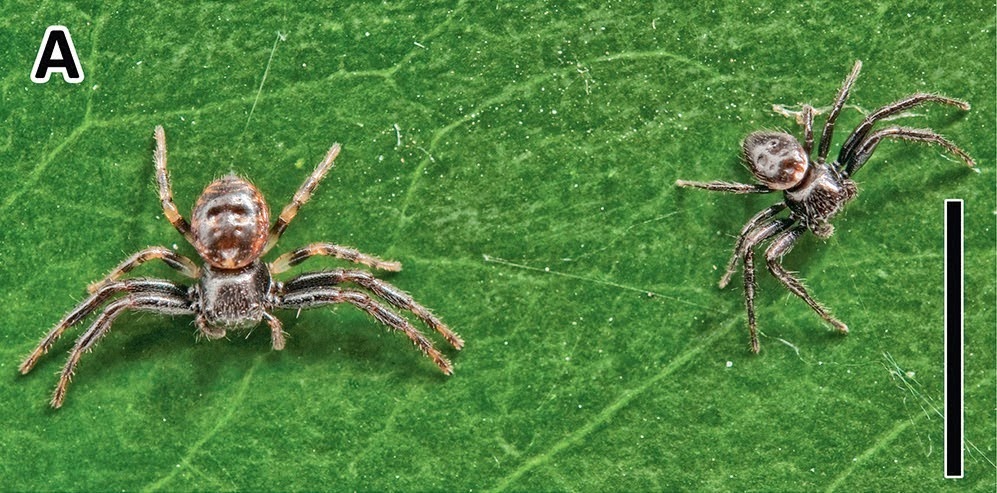
The final new species is placed in a new genus, Leroya, named in honour of John and Astri Leroy; John Leroy collected a specimen of Mystaria unicolor, at Rwankwi in the Belgian Congo (now the Democratic Rebulic of Congo) in 1951, when he was six years old, which is one of the specimens used to re-assign this species to the new genus (becoming Leroya unicolor). It is given the specific name Leroya silva, which means forest in Latin. The species is described from nine specimens from the Democratic Republic of Congo, Rwanda and Uganda. Females are 3.89-4.22 mm in length and copper brown in colour with a metallic sheen. The males are 3.04–3.92 mm in length and copper or blackish-turquoise in colour, also with a metallic sheen. The species was found exclusively in the rainforest canopy.

Leroya silva from the Democratic Republic of Congo, Mayombe, male in dorsal view. Honibull Lewis & Dippenaar-Schoeman (2014).

See also…

http://sciencythoughts.blogspot.co.uk/2014/10/how-invasive-grass-species-makes.html How an invasive Grass species makes American Toads more vulnerable to Wolf Spiders. 
Invasive plants can significantly modify local habitats, particularly if they lack herbivores in the environments they are colonising, by both...


Sociality is rare in Spiders, which are by nature solitary and aggressive. However it is known to have evolved...

Cave Spiders (Nesticidae) are found across the Mediterranean Basin, as well as in the Canary Islands and parts of Asia. They are cave-dwelling...

Follow Sciency Thoughts on Facebook.