Showing posts with label Frogs. Show all posts

Friday, 28 July 2023

Stefania maccullochi: A new species of Carrying Frog from the Guiana Shield Highlands of northern South America.

The Guiana Shield is a range of ancient mountains covering much of French Guiana, Surinam, Guyana, and southern Venezuela. The area is one of the most biodiverse regions on Earth, particularly in the Highlands area, which comprises a series of flat-topped sandstone plateaus known as 'tepuis', which have been largely isolated from both one-another and the outside world for millions of years, giving rise to a huge number of endemic species (the area was the inspiration for Sir Arthur Conan Doyle's 'Lost World'). 

In a paper published in the journal Zoological Letters on 25 May 2023, Philippe Kok of the  Department of Ecology and Vertebrate Zoology at the University of Łódź and Department of Life Sciences at the Natural History Museum, describes a new species of Carrying Frog from Wei-Assipu-tepui, a 2260 m high flat-topped plateau on the border between Guyana and Brazil.

Carrying Frogs, Stefania spp., are a genus of Frogs restricted to the Guiana Shield, and for the most part to the tepuis of the Guiana Highlands. Most species are endemic to a single tepui, with most tepuis having 1-2 species, while the largest can have 5-6. A single species, Stefania evansi, is found in lowland environments. The group get their common name from their reproductive behaviour, with the females carrying their eggs on their backs until they hatch producing Froglets (there is no Tadpole stage), which are also carried until they are large enough to fend for themselves. The taxonomy of Carrying Frogs can be difficult, as all members of the group tend to be morphologically similar to one another and all species are quite variable in colouration. Furthermore, genetic analysis of Carrying Frogs has revealed that apparently similar populations are genetically distinct, while apparently morphologically distinct groups are in fact the same species.

Wei-Assipu-tepui has a surface area of a only 3 km³, and is entirely surrounded by high cliffs, so that it can only be reached by helicopter of ascending a vertical rock-face. The surface of the plateau is divided by a series of fractures, the deepest of which, Sima de los Guácharos, reaches more than 100 m beneath the plateau surface. The first recorded expedition to the plateau was in July 2000, when a joint expedition by the Sociedad Espeleológica Italiana and the Sociedad Venezolana de Espeleología visited the summit with the intention of exploring its cave systems. 

Summit of Wei-Assipu-tepui. (A) Aerial photograph taken facing southwest. (B) Aerial photograph taken facing northwest. Adrian Warren & Philippe Kok in Kok (2023).

The 2000 expedition to Wei-Assipu-tepui made a small collection of Amphibians was made, including a previously unknown species of Bush Toad, Oreophrynella sp., which was later described as Oreophrynella weiassipuensis, as well as a Carrying Frog, Stefania sp., which was never identified. The plateau was visited again in November 2009 by Philippe Kok, who spent two weeks there, collecting Amphibian and Reptile specimens. Kok collected nine species, including 23 specimens of a Carrying Frog morphologically identical to Stefania riveroi, a species known from Yuruani-tepui in Venezuela, about 20 km to the northwest of Wei-Assipu-tepui. However, a DNA analysis carried out several years later showed that these Frogs were not closely related to Stefania riveroi, instead forming a sister group to Stefania ayangannae, a morphologically distinct species found on Mount Wokomung, and Mount Ayanganna, two large tepuis in western Guyana, both more than 80 km to the east of Wei-Assipu-tepui. 

Based upon this, Kok describes the population from Wei-Assipu-tepui as a new species, which he names Stefania maccullochi, in honour of the Canadian herpetologist Ross Douglas MacCulloch, for his seminal contribution to the systematics and taxonomy of the genus Stefania in particular, and to the knowledge of the Amphibians and Reptiles of Guyana in general.

Main colour pattern variation in Stefania maccullochi. (A) IRSNB 15854, male. (B) NHMUK 2023.3188 (PK2098), female. (C) IRSNB 15855, female. (D) NHMUK 2023.3193 (PK2148), male. (E) NHMUK 2023.3192 (PK2137), male. (F) NHMUK 2023.3187 (PK2084), male. Kok (2023).

Stefania maccullochi is a large species of Carrying Frog, with the largest female found measuring 72.9 mm in length, while the largest male is 54.6 mm, with a head no longer than it is wide. Although this species appeared morphologically identical to Stefania riveroi on initial examination, a more thorough examination made after it was discovered the two populations were genetically distinct found that there were some subtle differences between the skeletons of the two species, most notably a deep indentation along the anteromedial base of the alary process of the premaxilla of Stefania maccullochi, which Stefania riveroi lacks, and the contact between the posterodorsal projection of the maxilla and the orbital/zygomatic ramus of the squamosal, which is fused in Stefania riveroi, while in Stefania maccullochi there is barely a contact.

Three-dimensional model of the cranium of the holotype of Stefania maccullochi. (NHMUK 2023.3184) based on computed tomography imagery. (A) Dorsal view. (B) Ventral view. (C) Frontal view. (D) Left lateral view. Abbreviations: ang, Angulosplenial; ang.cp, Coronoid process of the angulosplenial; col, Columella; c.p, Cultriform process; d, Dentary; exo, Exoccipital; fp, Frontoparietal; lam.p, Lamina perpendicularis; mmk, Mentomeckelian; mx, Maxilla; mx.pp, Posterodorsal projection of the maxilla; na, Nasal; na.mp, Maxillary process of the nasal; neo, Neopalatine; p.f, Pars facialis; pmx, Premaxilla; pmx. ap, Alary process of the premaxilla; pmx.lp, Lateral process of the premaxilla; pmx.pp, Palatine process of the premaxilla; pro, Prootic; psp, Parasphenoid; psp.ar, Alary process of the parasphenoid; psp.pp, Posteromedial process of the parasphenoid; pt, Pterygoid; pt.ar, Anterior ramus of the pterygoid; pt. mr, Medial ramus of the pterygoid; pt.pr, Posterior ramus of the pterygoid; qua, Quadratojugal; smx, Septomaxilla; sph, Sphenethmoid; squa, Squamosal; squa.or, Otic ramus of the squamosal; squa.vr, Ventral ramus of the squamosal; squa.zr, Zygomatic ramus of the squamosal; v, Vomer. Kok (2023).

Phylogenetically, Stefania riveroi has previously been seen as the sister species to the pairing of Stefania ayangannae and Stefania coxi, two species which are both found on the large tepuis Mount Wokomung and Mount Ayanganna, far to the east of Wei-Assipu-tepui. Both of these tepuis are noted for their high diversity of Stefania species, with six found on Mount Wokomung and five on Mount Ayanganna.

Distribution map of the Stefania riveroi clade as currently understood. Kok 2023.

Despite being morphologically very similar to Stefania riveroi, a species found on a neighbouring tepui, Stefania maccullochi was found to be the sister species to Stefania ayangannae. Kok suggests that this implies the species have a combination of retained ancestral traits and similar environmental pressures, both inhabiting small, high platues where they are the only species of Stefania found, while Stefania ayangannae and Stefania coxi inhabit larger, lower plateaus which they share with a range of other species. he furthermore designates the four species together as the 'Stefania riveroi clade' within the genus Stefania. Interestingly, molecular clock analyses suggests that the splits between these species are not recent, with no divisions between any species likely to be more recent than the Miocene.

Phylogenetic relationships of the Stefania riveroi clade, based on 2301 base pairs of nuclear and mitochondrial DNA (Bayesian statistical supports are provided at nodes), and comparison of crania in dorsal and lateral views. Circles and arrows highlight potential diagnostic characters: blue circles highlight absence/presence/location of a constriction in the frontoparietal bones; blue arrows highlight the condition of the frontoparietal crests; red arrows highlight the condition of (1) the contact between the posterodorsal projection of the maxilla and the orbital/zygomatic ramus of the squamosal, and (2) the contact between the maxillary process of the nasal and the maxilla. Kok (2023).

Wei-Assipu-tepui, the home to Stefania maccullochi, rises to 2260 m above sealevel and has a surface area of about 3 km³. Yuruani-tepui, the home to Stefania riveroi, reaches about 2400 m above sealevel, and has a surface area of 4.38 km³. The nearby tepuis of Roraima-tepui (2800 m), Kukenán-tepui (2600 m), Maringma-tepui (2100 m), and Maringma-tepui (about 2140 m) all appear to lack any species of Stefania.

The plateau of Wei-Assipu-tepui, is largely covered in vegetation, with  extensive areas of coarse herbs mixed with woody subshrubs on peat soils, as well as some quaking bogs and extensive patches of dwarf forests. These dwarf forests are dominated by Bonnetia roraimae, a flowering shrub found only on tepui tops. Other species common on the plateau are the Bromeliads Brocchinia tatei and Brocchinia reducta, the Rapateaceaen Stegolepis guianensis, the Yellow-eyed Grass Orectanthe sceptrum, and the Pitcher Plant Heliamphora nutans. The highest temperature recorded on the summit in the day was 29°C, and the lowest at night was 11°C. The relative humidity varied by between a minimum of 24% in the day and a maximum of 98% at night. All measurements were taken in November.

Main macrohabitats on the summit of Wei-Assipu-tepui. The clif visible in the background of (A) is the eastern fank of Roraima-tepui. Kok (2023).

Active Stefania maccullochi, including females with eggs, were observed at night, crawling on the ground and on low vegetation. Females with carried young were observed within Bromeliad tubes at night and by day, while another was found hiding under a rock by day. Other resting specimens were observed in the day on the ground, between rocks, and on trees as much as 2 m above the ground. On individual was observed sitting on a mossy rock at the bottom of a 30 m-deep crevice. No males were observed calling, but load single-note 'peeps' consistent with the a male Stefania.

Various females of Stefania maccullochi carrying eggs and juveniles. (A) & (B) Uncollected female carrying 9 juveniles. (C) NHMUK 2023.3190 (PK2122), carrying 10 eggs/metamorphs. (D) NHMUK 2023.3185 (PK2063), carrying 2 near-term juveniles. (E) & (F) IRSNB 15853, carrying 4 near-term juveniles. Kok (2023).

All known individuals of Stefania maccullochi have been observed within an area of less than 10 km², and that single location, the summit plateau of Wei-Assipu-tepui, is considered to be at threat from Human-set fires in the region, and the effects of climate change. It's isolation probably currently protects it from hazards such as Human-introduced pathogens such as Chytridiomycosis, although the species cannot be presumed to be completely safe, and strict hygiene protocols would need to be followed by documentary film-makers or others visiting the plateau. For these reasons, Kok considers that Stefania maccullochi should be considered to be Critically Endangered under the terms of the International Union for the Conservation of Nature’s Red List of Threatened Species

See also...

Follow Sciency Thoughts on Facebook.

Follow Sciency Thoughts on Twitter.


Friday, 10 March 2023

Centrolene zarza: A new species of Glassfrog from Zamora Chinchipe Province, southern Ecuador.

Glassfrogs, Centrolenidae, are a charismatic group of Neotropical Treefrogs distinguished by the transparent skin on their undersides, generally combined with a leaf-green dorsal surface. These Frogs lay their eggs in out-of-water environments close to streams, and have forward directed eyes. The males often have spines on their humeri. The Family Centrolenidae takes its name from the genus Centrolene, the third most species-rich genus in the group, currently containing 24 confirmed species and six possible ones. The genus has been well studied genetically, with DNA sequences available for 21 of the 24 confirmed species. Sixty three species of Glassfrogs, from ten genera, have been described from Ecuador to date, including 12 species of Centrolene, with DNA sequences available for 11 of these. 

In a paper published in the journal ZooKeys on 22 February 2023, Paul Székely of the Museo de Zoología and the Laboratorio de Ecología Tropical y Servicios Ecosistémicos at the Universidad Técnica Particular deLoja, and the Research Center of the Department of Natural Sciences at Ovidius University Constanţa, María Córdova-Díaz, Daniel Hualpa-Vega, and Santiago Hualpa-Vega, also of the Museo de Zoología at the  Universidad Técnica Particular de Loja, and of the Fundación Green Jewel, and Diana Székely, again of the Museo de Zoología and the Laboratorio de Ecología Tropical y Servicios Ecosistémicos at the Universidad Técnica Particular de Loja, and the Research Center of the Department of Natural Sciences at Ovidius University Constanţa, describe a new species of Centrolene from the Refugio de Vida Silvestre El Zarza in Zamora Chinchipe Province, southern Ecuador.

The new species is named Centrolene zarza, in reference to the Refugio de Vida Silvestre El Zarza, a nature reserve founded in 2006, in order to protect the Cordillera del Cóndor’s biological richness, with a particular emphasis on its Amphibians and the Amazonian Tapir; the reserve is home to more than 50 species of Amphibians, as well as the Amazonian Tapirs, and other distinctive Mammal species, such as Jaguars, Oncilla (Spectacled Bears), and countless species of Plants and Birds. The species is described from two female and five male specimens, all collected within the reserve.

Holotype of Centrolene zarza (MUTPL 932, adult female), Snout-vent length 25.5 mm, in life. (A) Lateral view, (B) dorsolateral view, (C) ventral view. Székely et al. (2023).

Centrolene zarza is a medium-sized Glassfrog, with the holotype female measuring 25.5 mm from snout to vent and weighing 1.05 g. The dorsal surface of the species is light green, being slightly darker above the head and arms, The flanks are white or transparent, the underside transparent. The bones, visible through the skin, are green, other internal organs white or yellowish. The head is slightly narrower than the body, but still wider than it is long. The snout is rounded, with slightly elevated nostrils. The eyes are moderately sized, with a diameter 34% of the head length, the iris is yellow with thick and thin black reticulations. Some warts are present on the dorsal surface, these are elevated, sometimes enameled, and marked by white spots. The limbs are slender.

Morphological variation of Centrolene zarza in live specimens: (A), (B) Female, paratype (MUTPL 1051); (C), (D) male, paratype (MUTPL 933); (E), (F) male, paratype (MUTPL 1022). Székely et al. (2022).

Two clutches of eggs were observed, both laid on the upper side of leaves, about 3 m above a stream. These clutches contain 13 and 33 eggs respectively, and were apparently not tended by adults. Székely et al. were able to hatch the eggs in the laboratory, but not raise them as far as metamorphosis.

Egg-clutches of Centrolene zarza collected from the type locality (MUTPL-T22). (A) The egg-clutches attached to a leaf (10 June 2021). (B) Hatchlings in stage Gosner 20 (10 June 2021). (C) Hatchlings in stage Gosner 22 (13 June 2021). Székely et al. (2023).

Centrolene zarza was found only in the vegetation bordering two small streams within the Refugio de Vida Silvestre El Zarza, although within this limited range it was apparently quite abundant, being seen or heard on 50% of occasions when the site was visited, typically on the upper side of leaves. Males were heard calling in January, March, June, October, and November, although they were distinctly more active in March and October. No direct interactions between Frogs were observed. 

Given this very limited distribution, less than 7 km ², Székely et al. recommend that Centrolene zarza be treated as being Critically Endangered under the terms of the International Union for the Conservation of Nature’s Red List of Threatened Species. They further note, that while the species entire known distribution is within a protected area, that area is now surrounded by mining concessions, with mining reaching the northern boundaries of the reserve and signs of illegal mining within the reserve, particularly along the banks of streams. 

See also...

Follow Sciency Thoughts on Facebook.

Follow Sciency Thoughts on Twitter.


Sunday, 27 March 2022

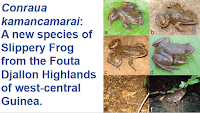
Conraua kamancamarai: A new species of Slippery Frog from the Fouta Djallon Highlands of west-central Guinea.

The Fouta Djallon Highlands of west-central Guinea form a series of plateaus, deep valleys, and steep slope-faces covered by a mixture of tropical and sub-tropical forests and grasslands. The area receives some of the highest rainfall in West Africa, but also has a wide range of micro-climates, providing a highly diverse environment with a high number of endemic species, which is relatively understudied by scientists. The floral uniqueness of the region has long been recognised, and there have been many calls to protect areas of pristine forest being encroached upon by agriculture and Cattle ranching, but the faunal uniqueness of the area has been very little studied.

In a paper published in the journal Zoosystematics and Evolution on 19 January 2022, Karla Neira-Salamea of the Museum für Naturkunde Berlin, Joseph Doumbia of ONG EnviSud Guinée, Annika Hillers of the Wild Chimpanzee Foundation, Laura Sandberger-Loua, also of the Museum für Naturkunde Berlin, N’Goran Kouamé of the Laboratoire de Biodiversité et Ecologie Tropicale at the Université Jean Lorougnon Guédé, Christian Brede of Lübeck in Germany, Marvin Schäfer, again of the Museum für Naturkunde Berlin, David Blackburn of the Department of Natural History at the Florida Museum of Natural History, and Michael Barej and Mark-Oliver Rödel, once again of the Museum für Naturkunde Berlin, describe a new species of Slippery Frog from the Fouta Djallon Highlands of west-central Guinea.

 
Hörè Binti landscape, Fouta Djallon, Guinea. Neira-Salamea et al. (2022).

Slippery Frogs, Conraua spp., are endemic to Africa, with seven species currently recognised, one from East Africa, three from Central Africa, and three from West Africa. However, a recent phylogenetic study of one of these species, Conraua alleni, should in fact be considered to be a species cluster (group of morphologically identical but genetically distinct species, known as 'cryptic species') rather than a distinct species. With this in mind, Neira-Salamea et al. carried out morphological and genetic tests on a group of Slippery Frogs held in the Museum für Naturkunde Berlin, which were collected during an expedition to the Fouta Djallon in 2011, establishing that Frogs from Hörè Binti, Pita and Chute de Ditinn and Dalaba in the Fouta Djallon are all members of a new, previously undescribed species.

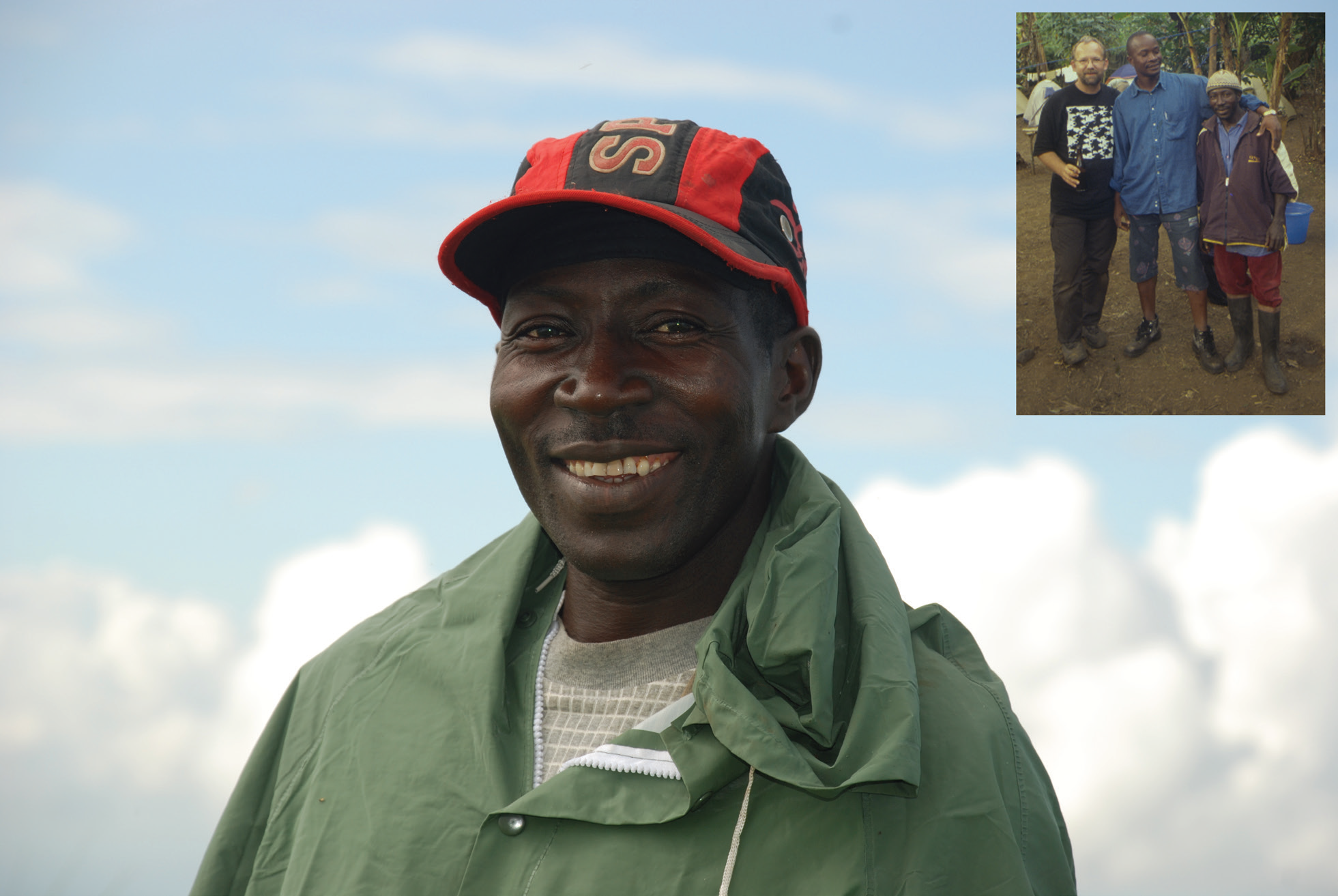
The new species is named Conraua kamancamarai, in honour of the late Kaman Camara, a long term field assistant and friend of the team, who began working with Mark-Oliver Rödel in 2002 on a survey to the Simandou Range that was organised by Conservation International, and worked with the team full time from 2007 until his death after a short illness in 2020, investigating the amphibians of the Nimba Mountains and other Guinean areas. Neira-Salamea et al. note that 'Kaman had outstanding skills in detecting and catching Frogs, and, more importantly, an unswerving positive attitude'. Kaman was born and lived in a remote village at the western foothills of the Simandou Range. He never received any formal education. Still, he repeatedly rejected other better paying job offers from mining companies, preferring instead to work with his frog team whenever it was possible.

 
Kaman Camara in June 2007 on Mount Nimba, Guinea. Inset figure taken on a Rapid Assessment to south-eastern Guinea, organised by Conservation International and Kaman’s first experience with frog work, from left to right: Mark-Oliver Rödel, Mohamed Alhassane Bangoura and Kaman Camara. Neira-Salamea et al. (2022).

Specimens of Conraua kamancamarai have a slightly dorsoventrally flattened, short and rounded body; the snout is rounded in dorsal and lateral view, the upper lip slightly projects forward. They range from 74.3 to 81.7 mm in length. Dorsal colouration ranges from uniform dark brown to predominantly brown with dark mottling or predominantly brown with dark spots. Ventral colour pattern of all specimens similar: whitish with distinct brown blotches, however, these blotches are lighter in the subadult specimens.

Colouration of life Conraua kamancamarai from the Fouta Djallon and surrounding region, Guinea, illustrating variation in colour pattern and skin texture. (a) From Dubreka, River Bindinbandan; (b) From Dalaba, Chute de Ditinn; (c) From Hörè Binti; (d) From Dubreka, River Bindinbandan; (e) From Dalaba, Chute de Ditinn; (f) From Télimélé, locality Kourakoto, river Didounpouriguè; Frogs in lower row in typical calling position, sitting in shallow water; specimens either not collected or not assignable to a voucher specimen, whereas the Frogs from Hörè Binti and Chute de Ditinn can be assigned to Conraua kamancamarai without doubt; the other Frogs may represent an undescribed Conraua species. Neira-Salamea et al. (2022).

Conraua kamancamarai occupies fast-flowing rocky streams with waterfalls within riverine forest in mountainous areas in the Fouta Djallon. Like other Frogs of the genus, Conraua kamancamarai is predominately nocturnal and aquatic. Despite their occurrence in fast flowing streams, adults show a preference for calmer river sections, where turbulent water is absent. Usually, Frogs are encountered at least partly submerged in shallow water, facing the riverbanks. When outside of the water, they remain within jumping distance to water. Disturbed Frogs seek shelter on the ground of pools, sometimes trying to burrow deeper into them and cover themselves with gravel or substrate. Mating has never been observed; however, single observations of clutches and jelly remnants of spawn indicate that oviposition sites are small puddles or depressions on the riverbanks near the spray water zone of cascades and waterfalls. Conraua Tadpoles usually were observed in silted calm ponds where up to 50 Tadpoles of about the same size have been encountered.

 
The type locality of Conraua kamancamarai near Konkouré Fetto, Fouta Djallon, Guinea. The Frogs live in clear, fast flowing streams, with riverine forest. Neira-Salamea et al. (2022).

The forest fragments where Conraua kamancamarai occurs are generally degraded by anthropogenic disturbance, particularly Peanut and Rice crops and Cattle grazing. The type locality is located between Konkouré and the largest city within the Fouta Djallon, Mamou, within a relatively short distance to the connection road and was surveyed on 20 June 2011. Along the national route one (N1), one of the largest roads connecting the East with the West of Guinea, houses are numerous, but already within a relatively short distance to the road, Human presence may be considerably scarcer. Slopes are either covered by an open, short, dry forest with signs of Cattle grazing and used for charcoal production or comparatively large fields for Peanuts or Rice crops. Only steep slopes surrounding rivers had sometimes larger trees and denser vegetation with higher humidity levels than the surroundings. The type locality is at a river within denser forest, with large boulders and some cascades, allowing for a diverse river site with fast and slow flowing parts and comparatively clear water. These forests are not protected and were in the past burned by the population as protest against government decisions in Conakry.

 
The surroundings of the type locality are heavily degraded by agriculture, Cattle grazing and charcoal production (inset figure). Neira-Salamea et al. (2022).

The classified forest (partly protected areas allowing forestry) of Hörè Binti is located within a mountainous area containing several freshwater sources. It was surveyed from 22–23 July 2010. Many fast-flowing streams with cascades have its source on the mountain. The habitat degradation due to anthropogenic alterations was dramatic and only very small forest fragments remained. The anthropogenic pressure consisted of cultivations/fields (mainly Peanut and Rice) and grazing Cattle. Only streams were surrounded by some remaining larger trees. The Ditinn/Dalaba site was within a small fragment of gallery forest with a stream, next to the waterfall of Ditinn. It was surveyed from 24–25 July 2010. Although there is a small village next to the forest, only minor anthropogenic alterations were detectable.

Because the full range of Conraua kamancamarai is unknown, Neira-Salamea et al. recoment that it be treated as 'Data Deficient' under the terms of the International Union for the Conservation of Nature’s Red List of Threatened Species. However, they also note that if the known populations do represent the entire range of the species, then it should be considered to be Endangered.

See also...


Follow Sciency Thoughts on Facebook.

Follow Sciency Thoughts on Twitter


Sunday, 16 January 2022

Pristimantis gretathunbergae: A new species of Rain Frog from Panama, named in honour of Swedish climate activist Greta Thunberg.

Tropical forests are noted for their high biodiversity and species richness, with a wide range of ecological variables which favour the emergence of numerous species with limited distributions among some groups of Animals and Plants. One such group are the Anurans (Frogs), of which very high species numbers are found in many tropical regions. One particularly notable group of Frogs are the Rain Frogs, Pristimantis spp., of the Caribbean and Central and South America. The genus Pristimantis currently contains at least 574 species (possibly the highest number of species in any Vertebrate genus), distributed primarily in Tropical Andes of Colombia, Ecuador, and Peru, yet is considered to be understudied, with many more species likely to exist (124 species have been described within the past decade), and many of the currently described species having uncertain relationships to other members of the group. The species richness within this genus is driven by its ability to breed away from water, enabling them to colonise environments closed to other Frogs, while the taxonomic uncertainty is caused by the high variability of many species, with members of different species often resembling one-another than they do members of their own species. This is slowly being unravelled with modern genetic methods, although this is showing an even greater diversity within the genus than previously supposed, apparently caused by a recent radiation event, resulting in the genus now comprising 7.4% of all known Anuran species, and 6.7% of all Lisamphibians.

In a paper published in he journal ZooKeys on 10 January 2022, a team of scientists led by Konrad Mebert of the Programa de Pós-graduação em Zoologia at the Universidade Estadual de Santa Cruz, Global Biology, and Los Naturalistas, describe a new species of Rain Frog from Panama.

The new species is named Pristimantis gretathunbergae, in honour of Swedish climate activist Greta Thunberg, for her 'authentic voice that exposes the motivations behind the diplomatic curtain of politicians and business stakeholders'. The species is described upon the basis of a series of specimens collected on the top of Cerro Chucantí in the Maje Mountains of Darién Province, Panama, though the species was later shown to be found across a wider area.

   
Colouration in life of specimens of Pristimantis gretathunbergae sp. nov. and Pristimantis cruentus from eastern Panama. (A) Holotype male (MHCH 3082), Cerro Chucantí. (B) Paratype female (SMF97520), Cerro Chucantí. (C) :eft, paratype female (MHCH 3081), right Pristimantis cruentus female (MHCH3034). (D) Female from Cerro Chucantí, not collected. (E) Female (MHCH3115) La Javillosa. (F) Female, Cerro La Javillosa, Ambroya, Maje Mountain Range (SMF97517). (G) Female (MHCH3079), Rio Tuquesa. Coloured lines point to some diagnostic characters as follow: red: blackish iris; yellow: single spine-like tubercle; turquoise: light-coloured upper lip; pink: cream, yellow to red groin. Mebert et al. (2022).

Pristimantis gretathunbergae has a slightly blotchy brown colouration, more notable on the darker upper surface than the paler lower side, this is accentuated by a scattering of tubercles on the dorsal surface. The tympanum (ear) is invisible, or at least hard to distinguish, the snout is short and slightly rounded, and the upper eyelid has a spine-like tubercle. Each vomer (bone in the roof of the mouth, behind the jaw, bears 5-10 teeth. The groin and inner thighs are white, yellow or orange-red, some with flecks matching the dorsal ground colour or red. The iris is black, though some individuals have a very dark red iris, or a black iris with red-golden speckling.

 
Habitat, mating, and parental care in females of Pristimantis gretathunbergae from Cerro Chucantí. (A) Habitat on Cerro Chucantí at about 1300 m above sealevel. (B) Understory Bromeliad with a Pristimantis gretathunbergae in situ (blue line) and zoomed in on inset (MHCH 3115). (C) Amplectant pair on axillary part of Bromeliad leaf (not collected). (D) Same female after amplexus guarding eggs. (E) Female of Pristimantis gretathunbergae taking care of its eggs with a male Pristimantis cruentus holding on the female in reverse position (not collected). (F) Female with eggs about to hatch, note the transparency of the egg membrane (not collected). Mebert et al. (2022).

Wider sampling, combined with genetic profiling of collected specimens, found that Pristimantis gretathunbergae is present across much of eastern Panama, and could potentially be present in adjacent areas of Colombia. The species was found in the Darien Mountains within Embera Comarca and the Maje Mountains within Darien and Panama Provinces, including the type locality at Cerro Chucantí. The species was also found to be present in parts of western Panama, including the Piedras-Pacora Mountains in Panama Province, and Cerro Bruja in Colon Province, both within the Chagres National Park. Beyond the Panama Canal Pristimantis gretathunbergae is present in the Altos del Maria region of the Gaita Hills in Panama Oeste Province, and in the region of El Cope within the Omar Torrijos National Park in Coclé Province.

Pristimantis gretathunbergae has been recorded at altitudes of between 718 and 1439 above sealevel, predominantly within montane forest (cloud forest consisting predominantly of trees covered with Moss and a large variety of understory and midstory Bromeliads). During the nights the Frogs were found from 50 cm to 3 m above the ground on tree bark and in the Bromeliad foliage; in the day they hid between Bromeliad leaves. In the rainy season the males make a sporadic 'chack' call. Females have been observed guarding clusters of eggs in Bromeliads and on Moss-covered tree branches. The species has not been observed eating, but other members of the genus Pristimantis feed primarily on small Arthropods, such as Ants, Orthopterans, and Spiders.

Despite its widespread distribution, Mebert et al, believe that Pristimantis gretathunbergae is likely to face decline of many populations due to habitat destruction caused by anthropogenic pressure. Only a few areas where the species is found are within National Parks or other protected areas, and the species is known only from patches of primary forest and slightly disturbed areas, many of which are surrounded by agriculture and pastures. The species is also found close to areas where Amphibian populations have been decimated by the Chytrid Fungus, Batrachochytrium dendrobatidis, which the species must also be presumed to be threatened by. For this reason, Mebert et al. recommend that Pristimantis gretathunbergae be classified as Vulnerable under the terms of the International Union for the Conservation of Nature’s Red List of Threatened Species

See also...


Follow Sciency Thoughts on Facebook.

Follow Sciency Thoughts on Twitter.


Wednesday, 16 December 2020

International Union for the Conservation of Nature declares 31 species extinct in 2020.

The European Bison, Bison bonasus, Europe’s largest land Mammal, has moved from Vulnerable to Near Threatened thanks to continued conservation efforts, according to a press release issued by the International Union for the Conservation of Nature on 10 December 2020. With this update, 31 species also move into the Extinct category, and all of the world’s Freshwater Dolphin species are now threatened with extinction.

 
European Bison, Bison bonasus. Rafał Kowalczyk/International Union for the Conservation of Nature.

There are now 128 918 species on the International Union for the Conservation of Nature's Red List of Threatened Species, of which 35,765 are threatened with extinction.

'The European Bison and twenty-five other species recoveries documented in today’s IUCN Red List update demonstrate the power of conservation,' said Bruno Oberle, International Union for the Conservation of Nature's Director General. 'Yet the growing list of Extinct species is a stark reminder that conservation efforts must urgently expand. To tackle global threats such as unsustainable fisheries, land clearing for agriculture, and invasive species, conservation needs to happen around the world and be incorporated into all sectors of the economy.'

'The conservation successes in today’s Red List update provide living proof that the world can set, and meet, ambitious biodiversity targets. They further highlight the need for real, measurable commitments as we formulate and implement the post-2020 global biodiversity framework,' said Jane Smart, Global Director of International Union for the Conservation of Nature's Biodiversity Conservation Group

As a result of long-term conservation management, the wild population of European Bison, Bison bonasus, has grown from around 1800 in 2003 to over 6200 in 2019, justifying the move from Vulnerable to Near Threatened. The species survived only in captivity in the early 20th century, and was reintroduced to the wild in the 1950s. The largest subpopulations are now found in Poland, Belarus and Russia. There are currently 47 free-ranging European Bison herds. However, herds are largely isolated from one another and confined to non-optimal forest habitats, and only eight of them are large enough to be genetically viable in the long term. The species remains dependent on ongoing conservation measures such as translocations of Bison to more optimal open habitats and reduction of Human-Bison conflicts.

'Historically, European Bison were reintroduced mostly to forest habitats, where they don’t find enough food in winter. However, when they move out of the forest into agricultural areas, they often find themselves in conflict with people. To reduce the conflict risk and the bison’s dependence on supplementary feeding, it will be important to create protected areas that include open meadows for them to graze”, said Rafał Kowalczyk, co-author of the new assessment and member of the International Union for the Conservation of Nature's Bison Specialist Group

 
A European Bison, Bison bonasus. Rafał Kowalczyk/International Union for the Conservation of Nature.

With the Tucuxi, Sotalia fluviatilis, moving from Data Deficient to Endangered, all of the world’s Freshwater Dolphin species are now listed as threatened on the International Union for the Conservation of Nature's Red List. This small grey Dolphin species found in the Amazon river system has been severely depleted by incidental mortality in fishing gear, damming of rivers and pollution. Eliminating the use of gillnets, curtains of fishing net that hang in the water, and reducing the number of dams in Tucuxi habitat are priorities to enable numbers to recover. Enforcing the ban on the deliberate killing of Tucuxis is also essential.

 
Tucuxi, Sotalia fluviatilis. Fernando Trujillo/International Union for the Conservation of Nature.

The Lost Shark, Carcharhinus obsoletus, which was only formally described last year, enters the Red List as Critically Endangered (Possibly Extinct). The species was last recorded in 1934. Its habitat in the South China Sea has been extensively fished for more than a century and remains one of the most overexploited marine regions in the world. As it is unlikely that the species could have persisted under this heavy pressure, the Lost Shark may already be extinct.

All of the 17 Freshwater Fish species endemic to Lake Lanao and its outlet in the Philippines are now Extinct (15 species) or Critically Endangered (Possibly Extinct) (two species). The extinctions were caused by predatory introduced species, compounded by overharvesting and destructive fishing methods.


Extinct Cyprinid Fish from Lake Lanao, the Philippines. Armi Torres/International Union for the Conservation of Nature.

Three Central American Frog species have been newly declared Extinct. Additionally, twenty-two Frog species across Central and South America were listed as Critically Endangered (Possibly Extinct). The main driver of these drastic declines is Chytridiomycosis disease. Conservation efforts to protect critical habitat are helping populations of several other Amphibian species to recover. Among them is the Oaxaca Treefrog, Sarcohyla celata, which moved from Critically Endangered to Near Threatened thanks to actions by local communities in Mexico.
The Protea family has been comprehensively assessed with this update, revealing that 45% (637 of 1464 species) of these striking Flowering Plants that grow mainly across the Southern Hemisphere are Vulnerable, Endangered or Critically Endangered. Many of the species have highly restricted ranges, making them more vulnerable to the spread of invasive alien species, changes to natural fire cycles caused by Humans and linked with climate change, and loss of habitat to agriculture. The Protea family includes three Macadamia species, the same species that produce the farmed Macadamia nut crop, which have entered the International Union for the Conservation of Nature's Red List as threatened with extinction in the wild. The Macadamia Nut (Macadamia integrifolia) is listed as Vulnerable, while Macadamia ternifolia and Macadamia tetraphylla are listed as Endangered.

 
The Protea, Grevillea caleyi, from New South Wales, now classified as Critically Endangered. Tony Auld/International Union for the Conservation of Nature.

Oak trees have been comprehensively assessed, revealing that almost one third (31%, 113 of 430 species) are threatened with extinction. Nine Asian oaks enter the International Union for the Conservation of Nature's Red List already Critically Endangered (Possibly Extinct or Possibly Extinct in the Wild). The highest numbers of threatened species are in China and Mexico, followed by Viet Nam, the United States and Malaysia. Land clearance for agriculture and logging are the most common threats in China, Mexico and Southeast Asia. Invasive alien species and diseases and climate change are the key threats to Oaks in the United States.

 
Quercus liaoi, a species of Oak known only from Taiwan. Béatrice Chassé/International Union for the Conservation of Nature.

See also...


Follow Sciency Thoughts on Facebook.

Follow Sciency Thoughts on Twitter.