Showing posts with label Apidae. Show all posts

Wednesday, 15 October 2025

Apis (Apis) aibai: A new species of Honeybee from the Early Pleistocene of Japan.

Honeybees, Apis spp., are important pollinators in modern ecosystems and agricultural settings, with one species, Apis mellifera being the world's most abundant domesticated Insect. There are nine described species of extant Honeybees, split into three genera, Cavity-nesting Honeybees Apis (Apis), Small Honeybees Apis (Micrapis), and Giant Honeybees Apis (Magaapis), although the Domestic Honeybee does not appear to fit into any of these, and may be a hybrid. Apis mellifera is found over a wide area of Asia, Africa, and Europe, but other extant species of Honeybee are restricted to tropical and subtropical areas of South and Southeast Asia, with the exception of Apis cerana, which has a range extending into temperate parts of East Asia. 

A number of Fossil Honeybee species have been described from the Oligocene and Miocene of Europe, East Asia, and North America, most of which are assigned to extinct subgenera. These include Apis (Cascapis) nearctica, Miocene, from Nevada, Apis (Priorapis) vetusta, Oligocene, Apis (Synapis) henshawi, Oligo-Miocene, and Apis (Cascapis) armbrusteri, Miocene, from Germany, Apis (Synapis) petrefacta, Oligocene, from Czechia, Apis (Synapis) miocenica, and Apis (Synapis) dalica, both Miocene, from China, Apis (Synapis) longtibia, and Apis (Megapis) lithohermaea, both Miocene, from Japan. Thus, of the three extant subgenera, only Apis (Megapis) has a fossil record, although phylogenetic reconstructions suggest that all three originated towards the end of the Eocene. A number of subfossil Honeybees are also known from Latest Pleistocene and Holocene deposits, all of which have been ascribed to living species.

In a paper published in the journal Zookeys on 13 October 2025, Yui Takahashi of the Keio Yochisha Elementary School, and Jun-ichi Takahashi of the Faculty of Life Sciences at Kyoto Sangyo University, describe a new species of Honeybee from the Early Pleistocene Teragi Group, of Hyogo Prefecture, Japan.

The Teragi Group comprises a series Late Pliocene and Early Pleistocene lake deposits outcropping across eastern Tottori and northwestern Hyogo prefectures in southwestern Japan. The sedimentary deposits are interspersed with volcanic deposits, mostly from pyroclasic flows, the whole being contained within a volcanic collapse basin called the Teragi Cauldron. Fossils within this sequence come from the Haruki Mud, a series of sandstones and siltstones, with volcanic tuff layers, laid down between 2.8 and 2.2 million years ago. These deposits produce abundant Plant and Insect fossils, and although well known to fossil collectors, have not been extensively studied by scientists. An analysis of leaf fossils from the Haruki Mud suggests that the ancient lake was surrounded by temperate woodland.

Locality of the studied specimen. (A) Map of the Japanese Islands; (B) Distribution of the Teragi Cauldron between Tottori and Hyogo prefectures. (C) Simplified geological map of the Teragi Cauldron, representing the fossil locality; (D) Photo of the riverside fossil locality (35°29'39.41"N, 134°26'24.53"E), with whitish tuffaceous siltstones. Takahashi & Takahashi  (2025).

As with many Insect groups, it is possible to classify Bees entirely upon the venation of their wings, which has been shown to be a good proxy for taxonomic relationships. Based upon this, Takahashi and Takahashi feel confident in assigning the new species to subgenus level, identifying it as Apis (Apis) aibai, where 'aibai' honours the Japanese palaeontologist Hiroaki Aiba, who has studied the Umigami site from which the new fossil comes, and described a species of Nymphalid Butterfly from that site, for his contributions to Earth science education through the use of fossil collection activities.

Photographs of Apis (Apis) aibai (SOU-002). (A) Fossil-bearing piece (38.3 mm × 67.1 mm × 9.8 mm);  (B) Studied fossil reflecting dorsal view of SOU-002. Takahashi & Takahashi  (2025).

Apis (Apis) aibai is described from a single specimen, SOU-002, held in the collection of the Museum of  Unique Insect Fossils, in the town of Shin’onsen in Hyogo Prefecture. It is a middle-sized worker Honeybee preserved as a compression fossil with no counterpart. This specimen is 9.81 mm in length, but part of the head is missing, so it was probably about 10 mm long in life. 

Takahashi and Takahashi did not carry out a full phylogenetic analysis for Apis (Apis) aibai, but based upon its wing venation, they suggest that its closest known relative is probably Apis (Apis) nigrocincta, an extant species found in the Philippines and Indonesia. This suggests that the two species form a single clade (group of species with shared ancestry) which once had a wider distribution, including temperate Japan as well as the tropical regions of the Philippines and Indonesia. It has also previously been suggested that Apis (Apis) nigrocincta is the closest living relative of Apis cerana, the only native Honeybee species found in Japan today, suggesting that the three may form a single group.

See also...


Tuesday, 31 July 2018

Apis dalica: A new species of Honey Bee from the Middle Miocene of Yunnan Province, China.

Honey Bees. Apis spp., are highly social Bees extensively domesticated by Humans for their Honey and Wax, which also makes them the most extensively studied Bee group. They have a fossil record dating back to the Oligocene, and like other social Bees, their fossils are much more abundant than those of solitary Bees, probably due to their higher population levels. Honey Bees today are native to Eurasia and Africa, however almost all known fossil Honey Bees are known from Europe, with Asian specimens being much more rare.

In a paper published in the journal ZooKeys on 19 July 2018, Michael Engel of the Division of Entomology at the Natural History Museum of the University of Kansas, the Department of Ecology & Evolutionary Biology, also at the University of Kansas, and the Division of Invertebrate Zoology at the American Museum of Natural History, Bo Wang of the State Key Laboratory of Palaeobiology and Stratigraphy at the Nanjing Institute of Geology and Palaeontology, and the Key Laboratory of Zoological Systematics and Evolution of the Institute of Zoology of the Chinese Academy of Sciences, Abdulaziz Alqarni of the Department of Plant Protection at King Saud University, Lin-Bo Jia of the Key Laboratory for Plant Diversity and Biogeography of East Asia at the Kunming Institute of Botany, Tao Su of the Key Laboratory of Tropical Forest Ecology at the Xishuangbanna Tropical Botanical Garden, Zhe-kun Zhou, also of the Key Laboratory for Plant Diversity and Biogeography of East Asia at the Kunming Institute of Botany, and the Key Laboratory of Tropical Forest Ecology at the Xishuangbanna Tropical Botanical Garden, and Torsten Wappler of the Natural History Department at the Hessisches Landesmuseum Darmstadt, describe a new species of Honey Bee from the Huazhige Formation of the northwestern Maguan Basin in Maguan County of Yunnan Province, China.

The Huazhige Formation is a finely laminated grey and yellow siltstone and mudstone deposit laid down in a lake bed between 16.5 and 15.2 million years ago (i.e. during the Middle Miocene). This formation has produced numerous fossil Insects, Fish, Birds and Plants, which are interpreted as having come from a subtropical evergreen forest with a warm and wet environment.

The new Bee species is named Apis dalica, in reference to the Medieval Dali Kingdom, which occupied roughly the same territory as Yunnan Province between 937 and 1253 (when it was invaded by a Mongol army under Kublai Khan). The species is described from a single Worker Bee preserved with its underside showing, this is 17.06 mm in length, and charcoal black in colour. Little detail of the head, body and legs are preserved, but the wings are clearly visible, allowing comparison to other Bees, fossil and extant. This is the first fossil Honey Bee from South China.

Worker of Apis dalica, from Maguan County, southeastern Yunnan Province, China. (4) Entire specimen as preserved. (5) Reconstruction of wing venation; forewing above, hind wing below. (6) Detail of foreleg. (7) Detail of apical sterna. Abbreviations: ppl, propleuron; mcx mesocoxa; tr, trochanter; fm, femur; tb, tibia. Engel et al. (2018).

See also...

https://sciencythoughts.blogspot.com/2017/11/xylocopa-sarawatica-new-species-of.htmlhttp://sciencythoughts.blogspot.co.uk/2017/10/bombus-trophonius-new-species-of-bumble.html
http://sciencythoughts.blogspot.co.uk/2017/01/endothermy-in-ivory-palms.htmlhttp://sciencythoughts.blogspot.co.uk/2016/10/ceropegia-sandersonii-flower-mimicking.html
http://sciencythoughts.blogspot.co.uk/2016/10/fossil-bees-nests-from-taung-child.htmlhttp://sciencythoughts.blogspot.co.uk/2016/01/townsendiella-ensifera-new-species-of.html
Follow Sciency Thoughts on Facebook.

Sunday, 26 November 2017

Xylocopa sarawatica: A new species of Large Carpenter Bee from Saudi Arabia.

Large Carpenter Bees, Xylocopa spp., are large Bees resembling Bumble Bees, Bombini, though they can generally be told apart by inspection of the abdomen, which tends to be glossier and less furry in Large Carpenter Bees. The name Carpenter Bee (which they share with Small Carpenter Bees, ceratina spp.)  Comes from their habit of building nests in tough plant material, such as dead wood or Bamboo, though there are some ground nesting species. Most Large Carpenter Bees are solitary, though some species have a simple form of sociality, with females remaining in the nests of their mothers and sharing resources. Two different mating patterns are found within this group, with some species having large-headed, large-eyed males that actively hunt females to mate with, while others have small-headed males which release pheromones to attract females.

In a paper published in the journal ZooKeys on 23 November 2017, Michael Engel of the Division of Entomology at the Natural History Museum of the University of Kansas, the Department of Ecology & Evolutionary Biology, also at the University of Kansas, and the Division of Invertebrate Zoology at the American Museum of Natural History, Abdulaziz Alqarni of the Department of Plant Protection at King Saud University, Mohamed Shebl, also of the Department of Plant Protection at King Saud University, and the Department of Plant Protection at the Suez Canal University, Javaid Iqbal, again of the Department of Plant Protection at King Saud University, and of the Department of Entomology at the Muhammad Nawaz Shareef University of Agriculture, and Ismael Hinojosa-Díaz, of the Departamento de Zoología at the Universidad Nacional Autónoma de México, describe a new species of Large Carpenter Bee from the Sarawat Mountains of southwest Saudi Arabia.

The new species is named Xylocopa sarawatica, where 'sarawatica' in reference to the Sarawat Mountains, where it was discovered. Females of this species reach 14.8-17.0 mm in length, with the only male measured being 14.9 mm long. Both sexes are black or dark brown and covered in fur, which is again black over much of the body, though the fur on the upper part of the thorax is yellow.

Xylocopa sarawatica, female specimen. Engel et al. (2017).

See also...

http://sciencythoughts.blogspot.co.uk/2017/10/bombus-trophonius-new-species-of-bumble.htmlhttp://sciencythoughts.blogspot.co.uk/2017/01/endothermy-in-ivory-palms.html
http://sciencythoughts.blogspot.co.uk/2016/10/ceropegia-sandersonii-flower-mimicking.htmlhttp://sciencythoughts.blogspot.co.uk/2016/10/fossil-bees-nests-from-taung-child.html
http://sciencythoughts.blogspot.co.uk/2016/01/townsendiella-ensifera-new-species-of.htmlhttp://sciencythoughts.blogspot.co.uk/2014/07/nest-cells-of-leafcutter-bees-from.html
Follow Sciency Thoughts on Facebook.

Monday, 23 October 2017

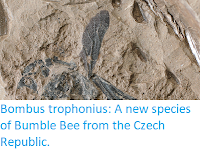
Bombus trophonius: A new species of Bumble Bee from the Czech Republic.

Bumble Bees, Bombini, are one of the most familiar groups of Bees, Apidae, in temperate regions, being large, robust, solitary, social or parasitic Bees (the parasitic Bumble Bees are brood parasites, that lay their eggs in the nests of other Bee species, like Cuckoos) covered with dense fur, found on every continent except Africa and Australia. They are thought to have derived from their nearest ancestors in the Late Cretaceous, although all 263 described living species appear to have derived from a more recent common ancestor and are all placed in a single genus, Bombus, leaving a long stem lineage (i.e. Bees more closely related to modern Bumble Bees than they are to any other group of Bees, but less closely related to them than any living Bumble Bee is to any other living Bumble Bee). However the fossil record of Bumble Bees is somewhat sparse compared to other Bee groups, with two Late Eocene species known, from Teller County in Colorado and the Isle of Wight in England, and one Late Miocene specimen known from Catalonia, Spain, this last specimen being the oldest species assigned to the living genus Bombus.

In a paper published in the journal ZooKeys on 19 October 2017, Jakub Prokop of the Department of Zoology at Charles University, Manuel Dehon and Denis Michez of the Laboratory of Zoology at the University of Mons, and Michael Engel of the Division of Entomology at the Natural History Museum, and Department of Ecology & Evolutionary Biology of the University of Kansas and Division of Invertebrate Zoology at the American Museum of Natural History, describe a new species of Bumble Bee from the Early Eocene Most Formation of Teplice District in the Czech Republic.

The fossils of the Most Formation has been studies since the nineteenth century, and are noted for their high quality Plant and Insect fossils, with Ants being the most abundant group. The fossils occur in a lucastrine (lake derived) clay, laid down a subtropical to temperate climate.

The new species is placed within the genus Bombus, making it both the oldest known Bumble Bee and the oldest member of the crown group, and given the specific name trophonius, in reference to the Greek hero Trophonius, who died in a cave while hiding with stolen treasure, was lost and forgotten, and was rediscovered and worshipped as a demigod after a boy followed a trail of Bees to his final resting place. The species is described from a single female specimen, preserved as a black film, with a forewing length of 14.6 mm.

Photograph of Bombus trophonius, from the Early Miocene of Bílina Mine in northern Bohemia, Czech Republic. Prokop et al. (2017).

See also...

http://sciencythoughts.blogspot.co.uk/2016/10/ceropegia-sandersonii-flower-mimicking.htmlhttp://sciencythoughts.blogspot.co.uk/2016/10/fossil-bees-nests-from-taung-child.html
http://sciencythoughts.blogspot.co.uk/2016/01/townsendiella-ensifera-new-species-of.htmlhttp://sciencythoughts.blogspot.co.uk/2014/07/nest-cells-of-leafcutter-bees-from.html
http://sciencythoughts.blogspot.co.uk/2014/05/two-new-species-of-orchid-bee-from.htmlhttp://sciencythoughts.blogspot.co.uk/2014/05/a-new-species-of-leafcutter-bee-from.html
Follow Sciency Thoughts on Facebook.

Wednesday, 6 January 2016

Townsendiella ensifera: A new species of Cuckoo Bee from the Pinnacles National Park in California.

Cuckoo Bees, Nomadinae, are cleptoparasitic Bees which resemble Wasps in appearance, and to some extent behavior. The group get their name from their habit of laying their eggs inside the nests of other Bees, the larvae emerging withing the sealed cells of the host species, killing the host's larvae with specialized elongate mandibles, then proceeding to eat both the host larvae and the food provided for it by its mother (cleptoparasitism).

In a paper published in the journal ZooTaxa on 16 December 2015, Michael Orr of the Biology Department at Utah State University and Terry Griswold of the United States Department of Agriculture Agricultural Research Institute's Pollinating Insects Research Unit describe a new species of Cuckoo Bee from the Pinnacles National Park in San Benito County, California.

The new species if placed in the genus Townsendiella, which is indigenous to the southwest United States and northwest of Mexico, and is given the specific name ensifera, meaning 'sword-bearer', in reference to the shape of the mouthparts and cleptoparasitic lifestyle. These are black Bees with a covering of largely white fur, though this is brownish or even reddish in places. The fur of the males is whiter than that of the females.

Townsendiella ensifera, female specimen in lateral view. Scale bar is 0.25 mm. Orr & Griswold (2015).

The Bees were active from early May to late August on the flowers of California Buckwheat, Eriogonum fasciculatum, and Greasewood, Adenostoma fasciculatum. The host Bee for this species is unknown, though Orr and Greenwold note that Townsendiella ensifera is closely related to Townsendiella pulchra, which parasitzes Bees of the genus Hesperapis. Two species of Hesperapis are known to be present in the Pinnacles National Park, Hesperapis regularis, which is considerably larger than Townsendiella ensifera, and Hesperapis ilicifoliae which is approximately the same size, leading to the suggesting that this may be the host species for Townsendiella ensifera.

See also...

http://sciencythoughts.blogspot.co.uk/2014/07/nest-cells-of-leafcutter-bees-from.htmlNest cells of Leafcutter Bees from the Rancho La Brea Tar Pits.                       Leafcutter Bees (Megachilidae) cut their name from their habit of cutting disk-shaped segments from leaves, from which they build their nests. Each female...
http://sciencythoughts.blogspot.co.uk/2014/05/two-new-species-of-orchid-bee-from.htmlTwo new species of Orchid Bee from Columbia and Brazil.                                    The Orchid Bees (Euglossini) of Central and South America have an unusual relationship with the Orchids they pollenate, in that the Orchids do not produce a food substance with which to attract the Bees, but rather...
http://sciencythoughts.blogspot.co.uk/2014/05/a-new-species-of-leafcutter-bee-from.htmlA new species of Leafcutter Bee from Mexico.                                                   Leafcutter Bees (Megachilidae) get their name from their habit of cutting segments from leaves with which to line their nests. They are solitary Bees, each female Bee building her own nest in a wood cavity, plant...
Follow Sciency Thoughts on Facebook.