Showing posts with label Bees. Show all posts

Wednesday, 15 October 2025

Apis (Apis) aibai: A new species of Honeybee from the Early Pleistocene of Japan.

Honeybees, Apis spp., are important pollinators in modern ecosystems and agricultural settings, with one species, Apis mellifera being the world's most abundant domesticated Insect. There are nine described species of extant Honeybees, split into three genera, Cavity-nesting Honeybees Apis (Apis), Small Honeybees Apis (Micrapis), and Giant Honeybees Apis (Magaapis), although the Domestic Honeybee does not appear to fit into any of these, and may be a hybrid. Apis mellifera is found over a wide area of Asia, Africa, and Europe, but other extant species of Honeybee are restricted to tropical and subtropical areas of South and Southeast Asia, with the exception of Apis cerana, which has a range extending into temperate parts of East Asia. 

A number of Fossil Honeybee species have been described from the Oligocene and Miocene of Europe, East Asia, and North America, most of which are assigned to extinct subgenera. These include Apis (Cascapis) nearctica, Miocene, from Nevada, Apis (Priorapis) vetusta, Oligocene, Apis (Synapis) henshawi, Oligo-Miocene, and Apis (Cascapis) armbrusteri, Miocene, from Germany, Apis (Synapis) petrefacta, Oligocene, from Czechia, Apis (Synapis) miocenica, and Apis (Synapis) dalica, both Miocene, from China, Apis (Synapis) longtibia, and Apis (Megapis) lithohermaea, both Miocene, from Japan. Thus, of the three extant subgenera, only Apis (Megapis) has a fossil record, although phylogenetic reconstructions suggest that all three originated towards the end of the Eocene. A number of subfossil Honeybees are also known from Latest Pleistocene and Holocene deposits, all of which have been ascribed to living species.

In a paper published in the journal Zookeys on 13 October 2025, Yui Takahashi of the Keio Yochisha Elementary School, and Jun-ichi Takahashi of the Faculty of Life Sciences at Kyoto Sangyo University, describe a new species of Honeybee from the Early Pleistocene Teragi Group, of Hyogo Prefecture, Japan.

The Teragi Group comprises a series Late Pliocene and Early Pleistocene lake deposits outcropping across eastern Tottori and northwestern Hyogo prefectures in southwestern Japan. The sedimentary deposits are interspersed with volcanic deposits, mostly from pyroclasic flows, the whole being contained within a volcanic collapse basin called the Teragi Cauldron. Fossils within this sequence come from the Haruki Mud, a series of sandstones and siltstones, with volcanic tuff layers, laid down between 2.8 and 2.2 million years ago. These deposits produce abundant Plant and Insect fossils, and although well known to fossil collectors, have not been extensively studied by scientists. An analysis of leaf fossils from the Haruki Mud suggests that the ancient lake was surrounded by temperate woodland.

Locality of the studied specimen. (A) Map of the Japanese Islands; (B) Distribution of the Teragi Cauldron between Tottori and Hyogo prefectures. (C) Simplified geological map of the Teragi Cauldron, representing the fossil locality; (D) Photo of the riverside fossil locality (35°29'39.41"N, 134°26'24.53"E), with whitish tuffaceous siltstones. Takahashi & Takahashi  (2025).

As with many Insect groups, it is possible to classify Bees entirely upon the venation of their wings, which has been shown to be a good proxy for taxonomic relationships. Based upon this, Takahashi and Takahashi feel confident in assigning the new species to subgenus level, identifying it as Apis (Apis) aibai, where 'aibai' honours the Japanese palaeontologist Hiroaki Aiba, who has studied the Umigami site from which the new fossil comes, and described a species of Nymphalid Butterfly from that site, for his contributions to Earth science education through the use of fossil collection activities.

Photographs of Apis (Apis) aibai (SOU-002). (A) Fossil-bearing piece (38.3 mm × 67.1 mm × 9.8 mm);  (B) Studied fossil reflecting dorsal view of SOU-002. Takahashi & Takahashi  (2025).

Apis (Apis) aibai is described from a single specimen, SOU-002, held in the collection of the Museum of  Unique Insect Fossils, in the town of Shin’onsen in Hyogo Prefecture. It is a middle-sized worker Honeybee preserved as a compression fossil with no counterpart. This specimen is 9.81 mm in length, but part of the head is missing, so it was probably about 10 mm long in life. 

Takahashi and Takahashi did not carry out a full phylogenetic analysis for Apis (Apis) aibai, but based upon its wing venation, they suggest that its closest known relative is probably Apis (Apis) nigrocincta, an extant species found in the Philippines and Indonesia. This suggests that the two species form a single clade (group of species with shared ancestry) which once had a wider distribution, including temperate Japan as well as the tropical regions of the Philippines and Indonesia. It has also previously been suggested that Apis (Apis) nigrocincta is the closest living relative of Apis cerana, the only native Honeybee species found in Japan today, suggesting that the three may form a single group.

See also...


Friday, 15 August 2025

Determining the contents of bronze jars from an Ancient Greek shrine in southern Italy.

In 1954 archaeologists excavated a shrine to an unknown deity at the Greek settlement of Paestum in southern Italy, which was dated to the sixth century BC. Within this shrine they found six bronze hydriai (storage jars) and two amphorae, arranged around a large iron bed. The jars contained a pasty residue with a wax-like aroma. Traces of this substance were also found on the outside of the jars, which were originally sealed with cork, leading the archaeologists to conclude that it was originally a liquid, although possibly a fairly viscous one. It was interpreted that the bed was intended to be the residing place of the unknown deity, with the contents of the hydriai and amphorae were intended as offerings. 

Honey, in the Greek and Roman worlds, was a substance of some significance. As the only practical way to sweeten food and drinks, it was economically important, but it also had spiritual significance, being associated with wisdom and immortality, and therefore a suitable offering to the gods. With this in mind, it seemed highly likely that the original contents of the Paestum hydriai was honey.

With this in mind, the Bee Research Association in London arranged for an analysis of the residue to be carried out. The substance was found to be insoluble in water, but soluble in organic solvents, and to contain trace amounts of Plant and Insect remains, Fungi, and pollen, which led the scientists carrying out the analysis to conclude that it was probably a remnant of the wax which had originally sealed the jars.

In 1970 scientist at the Istituto Centrale del Restauro in Rome carried out an analysis on residues found around the neck and in the bottom of one of the amphorae from Paestum. This was found to comprise a saponifiable substance (substance which will react with an alkali to form a soap), such as a wax, fat, or resin, but contain no detectable sugar or protein (the major components of honey).

The residue was tested again in 1983 by the Laboratory of the Rome Chamber of Commerce, who again found that it was a saponifiable substance insoluble in water but soluble in organic solvents, and did not contain any sugary or starchy substances. On this occasion gas chromatography was also used to analyse the residue, concluding that it was 77.4% palmitic acid, 6.1% oleic acid, 5.2% stearic acid, 1.0% heptadecanoic acid, 1.0% linoleic acid + arachidic acid, 0.4% linoleic acid, and 6.5% unidentified substance. Since triglycerides of palmitic acid are extremely common in nature, the researchers concluded that the container had held animal fat or a vegetable oil.

In 2019, the residue from the Paestum hydriai was loaned to the Ashmolean Museum in Oxford, for an exhibition, 'Last Supper in Pompeii', and permission was obtained to carry out a new analysis of the biomolecular composition of the substance, using modern equipment not available when the previous tests were carried out.

In a paper published in the Journal of the American Chemical Society on 30 July 2025, Luciana da Costa Carvalho and Elisabete Pires of the Mass Spectrometry Research Facility at the University of Oxford, Kelly Domoney of the Ashmolean Museum, Gabriel Zuchtriegel of the Parco Archeologico di Pompei, and James McCullagh, also of the Mass Spectrometry Research Facility at the University of Oxford, present the results of this new analysis, and confidently identify the original material within the Paestum hydriai.

(A) Underground shrine in Paestum. (B) One of the hydriai on display alongside a Perspex box containing the residue at the Ashmolean Museum in 2019. (C) Graphic representation of the arrangement of the bronze jars inside the shrine. (D) Sample from the core of the residue.  Carvalho et al. (2025).

The residue arrived at the Ashmolean Museum in a non-hermetically sealed Perspex box, in which it had apparently been displayed at the Paestum Museum. In order to reduce the chances of modern contamination affecting their results, Carvalho et al. took samples from 40 mm below the surface for analysis, as well as from each distinct colour zones observed on the exterior of the material; black, orange, and green, colours which suggest some sort of interaction with the bronze vessel itself over the past 2500 years. Carvalho et al. also obtained modern beeswax, honey, and honeycombs from locations in Italy and Greece in order to compare these to the residue sample.

Carvalho et al. first used Fourier Transform Infrared Spectroscopy to obtain an overview of the chemical substances present within the sample. This yielded a spectrum almost identical to that of modern beeswax for the interior sample, strongly supporting the idea that this was the original substance. They also compared the spectra of new and artificially aged honeycombs from both Greece and Italy, establishing that there was little difference in these, and that these structures appear to be chemically stable at least 

Fourier Transform Infrared Spectrum  of the core sample of the archaeological residue superimposed on beeswax (a) and honey’s (b). Carvalho et al. (2025).

Next, Carvalho et al. carried out a Gas Chromatography coupled to Quadrupole Time-Of-Flight Mass Spectrometry analysis of the sample, along with samples of honey, beeswax, and fresh and artificially aged honeycomb. This produced almost no results for the beeswax, suggesting that the bulk components of this material were broken down by the high temperature at which this method operates (over 300°C), but did produce results from the sample, as well as from the honey and honeycomb controls, suggesting that the sample was never pure beeswax.

Electron ionisation chromatograms from the Quadrupole Time-Of-Flight Mass Spectrometry analysis of beeswax (a), the residue core sample (b), honey (c), and honeycomb from Greece, fresh (d) and aged (e). Compounds identified: (1) Hexadecanoic acid, (2) Heneicosane, (3) Octadecanoic acid, (4) Pentacosane, (5) Heptacosane, (6) Nonacosane, and (7) Hentriacontane. Carvalho et al. (2025).

Anion exchange Ion-Chromatography coupled to Mass Spectrometry identified seven hexose sugars, hexadecanoic acid, heneicosane, octadecanoic acid, pentacosane, heptacosane, nonacosane, and hentriacontane within the sample at levels higher than would be expected in beeswax, but lower than would be expected in honey. It also found significant levels of the sulphur amino acid taurine, which was not present in any of the control samples.

These hexose sugars were also recovered from aqueous extracts of honeycomb (i.e. the liquid obtained by soaking honeycomb in water)along with gluconolactone (a derivative of glucose) and galacturonic acid, and low levels of succinic, malic, and citric acids. All of these compounds were yielded at higher levels by the fresh honeycombs than by the artificially aged honeycombs.

Finally Carvalho et al. used a proteomic approach to try to identify specific proteins within the sample, as well as the beeswax and honeycomb controls, which were compared to the UniProt All Proteins database. The reesidue sample produced matches for three proteins derived from the royal jelly produced by the Western Honeybee, Apis mellifera, several Bacteria-derived proteins, and a number of common contaminant proteins, including keratins, caseins, lysyl endopeptidase, and trypsin. Encouraged by this, they then compared the sample to the Bee-specific UniProt Honey database, a search which yielded eight matches, including some associated with the Eastern Honeybee, Apis cerana cerana,

Proteins were also recovered from the modern honeycomb samples, but not the beeswax, indicating that they were derived from the honey portion of the comb. Notably, the royal jelly protein signature from the Greek and Italian honeycombs was quite different, although this was not completely unexpected as the two looked different. Carvalho et al. note that factors such as climate and the floral sources from which nectar is obtained can affect protein expression in Bee products, so this difference does not necessarily mean the Bees were particularly different.

Finally, a sample of the surface residue showing orange, black, and green colouration was subjected to X-ray photoelectron spectroscopy. This determined that the green areas of this residue were composed of 74.98% carbon, 20.78% oxygen, and 4.24% copper, with the copper portion largely dominated by Cu²⁺ ions, while the black areas were composed of 77.96% carbon, 20.12% oxygen, and 1.92% copper, with the copper dominated by Cu⁺ ions, and the orange areas were comprised of 86.50% carbon and 13.50% oxygen. The discoloration in these areas is, therefore, presumed to be derived by interactions between the original substance and the copper portion of the bronze vessel.

Honey is comprised primarily of sugars (typically 79% of the total mass, including 39% fructose), along with water (typically 18% of total mass), acids (0.17-1.17% of total mass) and trace amounts of other substances, such as vitamins, enzymes, flavonoids, and phenolic compounds. Over time this mixture undergoes Maillard reactions ('browning') as the amino acids of the proteins react with the sugars. This will occur more rapidly if the honey is stored at a warmer temperature. Eventually, the honey will take on a dark hue, as the sugars break down into furans and the acid content rises.

Previous studies of the Paestum hydriai residues concluded that this was a wax, most likely used to seal the vessels. The most commonly use wax in the ancient world was beeswax, a substance with quite different properties to honey. Beeswax is typically comprised of about 64% esters, 14% odd medium chain alkanes, 12% free acids, 2% acid polyesters, 1% acid monoesters, 1% free alcohols, and 6% other materials. Beeswax is much more stable than honey, but over time the acid and alcohol contents will increase as the was esters hydrolyse and the shorter chain alkanes are eliminated. 

The Fourier Transform Infrared Spectrum obtained by Carvalho et al. yielded results very similar to beeswax, suggesting that this may have formed a significant portion of the material from which the residue was derived. However, the Gas Chromatography coupled to Quadrupole Time-Of-Flight Mass Spectrometry analysis carried out suggested that the substance could not be pure beeswax. A study of the proteins present within the sample found several associated with honey production in the Western Honeybee, Apis mellifera, with a subsequent search of the Bee-specific UniProt Honey database yielded proteins associated with the Eastern Honeybee, Apis cerana cerana. Also produced were proteins associated with the wood-decay Fungus Armillaria gallica, and the parasitic Mite Tropilaelaps mercedesae, which targets Honeybees.

Eastern and Western Honeybees are closely related, and even where divergence has occurred, their proteins tend to be very similar. Furthermore, there is ample evidence for the cultivation of the Western Honeybee in ancient Italy, but none for the Eastern Honeybee. For these reasons, Carvalho et al. conclude that the readings suggesting the Eastern Honeybee as a source of proteins are probably erroneous, caused by the software trying to 'best fit' ancient degraded proteins.

The presence of proteins associated with the Mite Tropilaelaps mercedesae is also interesting. This Mite originated in Asia, and has a long historic connection with the Eastern Honeybee, but is generally thought only to have begun to infect Western Honeybees in the past few centuries. Carvalho et al. observe that it would be tempting to interpret this as evidence that the material at Paestum originated in Central Asia, but that a more likely scenario is that the proteins in question are common to a range of Acarid Mites.

Carvalho et al, conclude that a bulk composition similar to beeswax combined with the presence of proteins and other molecules found in honey make it likely that the material within the Paestum hydriai was almost certainly a honeycomb. This matches well with ancient literature, which frequently cites honey and other Bee-products as being suitable offerings for the gods, but contradicts earlier studies which were unable to obtain this result. Carvalho et al. emphasise that this underlines the importance of revisiting samples which have previously been analysed with less modern techniques, thus allowing our imptoving technology to improve our understanding of the past.

See also...

Tuesday, 31 July 2018

Apis dalica: A new species of Honey Bee from the Middle Miocene of Yunnan Province, China.

Honey Bees. Apis spp., are highly social Bees extensively domesticated by Humans for their Honey and Wax, which also makes them the most extensively studied Bee group. They have a fossil record dating back to the Oligocene, and like other social Bees, their fossils are much more abundant than those of solitary Bees, probably due to their higher population levels. Honey Bees today are native to Eurasia and Africa, however almost all known fossil Honey Bees are known from Europe, with Asian specimens being much more rare.

In a paper published in the journal ZooKeys on 19 July 2018, Michael Engel of the Division of Entomology at the Natural History Museum of the University of Kansas, the Department of Ecology & Evolutionary Biology, also at the University of Kansas, and the Division of Invertebrate Zoology at the American Museum of Natural History, Bo Wang of the State Key Laboratory of Palaeobiology and Stratigraphy at the Nanjing Institute of Geology and Palaeontology, and the Key Laboratory of Zoological Systematics and Evolution of the Institute of Zoology of the Chinese Academy of Sciences, Abdulaziz Alqarni of the Department of Plant Protection at King Saud University, Lin-Bo Jia of the Key Laboratory for Plant Diversity and Biogeography of East Asia at the Kunming Institute of Botany, Tao Su of the Key Laboratory of Tropical Forest Ecology at the Xishuangbanna Tropical Botanical Garden, Zhe-kun Zhou, also of the Key Laboratory for Plant Diversity and Biogeography of East Asia at the Kunming Institute of Botany, and the Key Laboratory of Tropical Forest Ecology at the Xishuangbanna Tropical Botanical Garden, and Torsten Wappler of the Natural History Department at the Hessisches Landesmuseum Darmstadt, describe a new species of Honey Bee from the Huazhige Formation of the northwestern Maguan Basin in Maguan County of Yunnan Province, China.

The Huazhige Formation is a finely laminated grey and yellow siltstone and mudstone deposit laid down in a lake bed between 16.5 and 15.2 million years ago (i.e. during the Middle Miocene). This formation has produced numerous fossil Insects, Fish, Birds and Plants, which are interpreted as having come from a subtropical evergreen forest with a warm and wet environment.

The new Bee species is named Apis dalica, in reference to the Medieval Dali Kingdom, which occupied roughly the same territory as Yunnan Province between 937 and 1253 (when it was invaded by a Mongol army under Kublai Khan). The species is described from a single Worker Bee preserved with its underside showing, this is 17.06 mm in length, and charcoal black in colour. Little detail of the head, body and legs are preserved, but the wings are clearly visible, allowing comparison to other Bees, fossil and extant. This is the first fossil Honey Bee from South China.

Worker of Apis dalica, from Maguan County, southeastern Yunnan Province, China. (4) Entire specimen as preserved. (5) Reconstruction of wing venation; forewing above, hind wing below. (6) Detail of foreleg. (7) Detail of apical sterna. Abbreviations: ppl, propleuron; mcx mesocoxa; tr, trochanter; fm, femur; tb, tibia. Engel et al. (2018).

See also...

https://sciencythoughts.blogspot.com/2017/11/xylocopa-sarawatica-new-species-of.htmlhttp://sciencythoughts.blogspot.co.uk/2017/10/bombus-trophonius-new-species-of-bumble.html
http://sciencythoughts.blogspot.co.uk/2017/01/endothermy-in-ivory-palms.htmlhttp://sciencythoughts.blogspot.co.uk/2016/10/ceropegia-sandersonii-flower-mimicking.html
http://sciencythoughts.blogspot.co.uk/2016/10/fossil-bees-nests-from-taung-child.htmlhttp://sciencythoughts.blogspot.co.uk/2016/01/townsendiella-ensifera-new-species-of.html
Follow Sciency Thoughts on Facebook.

Sunday, 26 November 2017

Xylocopa sarawatica: A new species of Large Carpenter Bee from Saudi Arabia.

Large Carpenter Bees, Xylocopa spp., are large Bees resembling Bumble Bees, Bombini, though they can generally be told apart by inspection of the abdomen, which tends to be glossier and less furry in Large Carpenter Bees. The name Carpenter Bee (which they share with Small Carpenter Bees, ceratina spp.)  Comes from their habit of building nests in tough plant material, such as dead wood or Bamboo, though there are some ground nesting species. Most Large Carpenter Bees are solitary, though some species have a simple form of sociality, with females remaining in the nests of their mothers and sharing resources. Two different mating patterns are found within this group, with some species having large-headed, large-eyed males that actively hunt females to mate with, while others have small-headed males which release pheromones to attract females.

In a paper published in the journal ZooKeys on 23 November 2017, Michael Engel of the Division of Entomology at the Natural History Museum of the University of Kansas, the Department of Ecology & Evolutionary Biology, also at the University of Kansas, and the Division of Invertebrate Zoology at the American Museum of Natural History, Abdulaziz Alqarni of the Department of Plant Protection at King Saud University, Mohamed Shebl, also of the Department of Plant Protection at King Saud University, and the Department of Plant Protection at the Suez Canal University, Javaid Iqbal, again of the Department of Plant Protection at King Saud University, and of the Department of Entomology at the Muhammad Nawaz Shareef University of Agriculture, and Ismael Hinojosa-Díaz, of the Departamento de Zoología at the Universidad Nacional Autónoma de México, describe a new species of Large Carpenter Bee from the Sarawat Mountains of southwest Saudi Arabia.

The new species is named Xylocopa sarawatica, where 'sarawatica' in reference to the Sarawat Mountains, where it was discovered. Females of this species reach 14.8-17.0 mm in length, with the only male measured being 14.9 mm long. Both sexes are black or dark brown and covered in fur, which is again black over much of the body, though the fur on the upper part of the thorax is yellow.

Xylocopa sarawatica, female specimen. Engel et al. (2017).

See also...

http://sciencythoughts.blogspot.co.uk/2017/10/bombus-trophonius-new-species-of-bumble.htmlhttp://sciencythoughts.blogspot.co.uk/2017/01/endothermy-in-ivory-palms.html
http://sciencythoughts.blogspot.co.uk/2016/10/ceropegia-sandersonii-flower-mimicking.htmlhttp://sciencythoughts.blogspot.co.uk/2016/10/fossil-bees-nests-from-taung-child.html
http://sciencythoughts.blogspot.co.uk/2016/01/townsendiella-ensifera-new-species-of.htmlhttp://sciencythoughts.blogspot.co.uk/2014/07/nest-cells-of-leafcutter-bees-from.html
Follow Sciency Thoughts on Facebook.

Monday, 23 October 2017

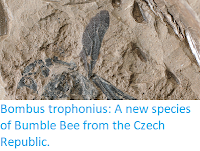
Bombus trophonius: A new species of Bumble Bee from the Czech Republic.

Bumble Bees, Bombini, are one of the most familiar groups of Bees, Apidae, in temperate regions, being large, robust, solitary, social or parasitic Bees (the parasitic Bumble Bees are brood parasites, that lay their eggs in the nests of other Bee species, like Cuckoos) covered with dense fur, found on every continent except Africa and Australia. They are thought to have derived from their nearest ancestors in the Late Cretaceous, although all 263 described living species appear to have derived from a more recent common ancestor and are all placed in a single genus, Bombus, leaving a long stem lineage (i.e. Bees more closely related to modern Bumble Bees than they are to any other group of Bees, but less closely related to them than any living Bumble Bee is to any other living Bumble Bee). However the fossil record of Bumble Bees is somewhat sparse compared to other Bee groups, with two Late Eocene species known, from Teller County in Colorado and the Isle of Wight in England, and one Late Miocene specimen known from Catalonia, Spain, this last specimen being the oldest species assigned to the living genus Bombus.

In a paper published in the journal ZooKeys on 19 October 2017, Jakub Prokop of the Department of Zoology at Charles University, Manuel Dehon and Denis Michez of the Laboratory of Zoology at the University of Mons, and Michael Engel of the Division of Entomology at the Natural History Museum, and Department of Ecology & Evolutionary Biology of the University of Kansas and Division of Invertebrate Zoology at the American Museum of Natural History, describe a new species of Bumble Bee from the Early Eocene Most Formation of Teplice District in the Czech Republic.

The fossils of the Most Formation has been studies since the nineteenth century, and are noted for their high quality Plant and Insect fossils, with Ants being the most abundant group. The fossils occur in a lucastrine (lake derived) clay, laid down a subtropical to temperate climate.

The new species is placed within the genus Bombus, making it both the oldest known Bumble Bee and the oldest member of the crown group, and given the specific name trophonius, in reference to the Greek hero Trophonius, who died in a cave while hiding with stolen treasure, was lost and forgotten, and was rediscovered and worshipped as a demigod after a boy followed a trail of Bees to his final resting place. The species is described from a single female specimen, preserved as a black film, with a forewing length of 14.6 mm.

Photograph of Bombus trophonius, from the Early Miocene of Bílina Mine in northern Bohemia, Czech Republic. Prokop et al. (2017).

See also...

http://sciencythoughts.blogspot.co.uk/2016/10/ceropegia-sandersonii-flower-mimicking.htmlhttp://sciencythoughts.blogspot.co.uk/2016/10/fossil-bees-nests-from-taung-child.html
http://sciencythoughts.blogspot.co.uk/2016/01/townsendiella-ensifera-new-species-of.htmlhttp://sciencythoughts.blogspot.co.uk/2014/07/nest-cells-of-leafcutter-bees-from.html
http://sciencythoughts.blogspot.co.uk/2014/05/two-new-species-of-orchid-bee-from.htmlhttp://sciencythoughts.blogspot.co.uk/2014/05/a-new-species-of-leafcutter-bee-from.html
Follow Sciency Thoughts on Facebook.

Monday, 9 January 2017

Endothermy in Ivory Palms.

Endothermy, the biological production of heat, is familiar in Mammals and Birds, but is also found in a variety of other Animals, such as Bumblebees, some Fish and even some Snakes. It is also known in Plants, where it is usually used to warm flowers rather than the whole Plant, enhancing the emission of scent molecules used to attract pollinators. One recently discovered example of this is the Ivory Palm, Phytelephas aequatorialis, an economically important Palm species found on the western side of the Andes in Ecuador, in which the male flowers have been shown to generate heat; this is unusual as most Flowering Plants in which this behaviour has been observed have flowers with both sets of sex organs, rather than flowers with different sexes, and it is unclear if endothermy is restricted to the male flowers in the Ivory Palm, or whether it occurs in the female flowers as well.

In a paper published in the journal Frontiers in Ecology and the Environment on 1 December 2016, Sylvain Pincebourde of the Institut de Recherche sur la Biologie de l’Insecte at the Université François–Rabelais de Tours, Rommel Montúfar and Erika Páez of the Facultad de Ciencias Exactas y Naturales at the Pontifica Universidad Católica del Ecuador, and Olivier Dangles, also of the Facultad de Ciencias Exactas y Naturales at the Pontifica Universidad Católica del Ecuador, and of the Institut de Recherche pour le Développement, describe the results of an investigation into the female flowers of the Ivory Palm.

Pincebourde et al. visited the Otonga Reserve in Ecuador in February and June 2015 to look for female flowers of the Ivory Palm. The male flowers of the Ivory Palm are large and obvious, forming inflorescences over a meter in length, but the female flowers are much smaller, reaching at most 30 cm. In addition the female flowers are found in the crown of the Palms, typically more than 10 m above the ground. The Palms flower several times per year, but the male flowers are typically open for about 24 hours and the female flowers for only a few days, so that at any one time flowering trees will be widely scattered in the landscape.

The male inflorescence of endemic ivory palm (Phytelephas aequatorialis). The orange material at the top of the image is the remnants of the bud integument. Pincebourde et al. (2016).

However, the Palms are important to local communities, who use its leaves as a roofing material and its seeds to make buttons and other handicrafts, and Pincebourde et al. were able gain the help of local people in finding female flowers of the Ivory Palm.

Initial examinations of these female flowers with infrared cameras proved disappointing; the did not appear to be emitting any heat. However further examination revealed that while the mature flowers produced no heat, the female buds were as much as 10–20°C above ambient air temperature. This led Pincebourde et al. to investigate the buds of the Ivory Palm more closely, revealing that buds of both sexes maintained a constant temperature of about 37°C (comparable to the body temperature of a Mammal or Bird), in an environment where the ambient air temperature ranged between 17°C and 28°C.

Photographs (left) and thermographic images (right) of a male flower bud (top) and female flowers with the bud integument remaining at the base of the flower (bottom) taken on 9 Feb 2015 (at 18:30) and 11 Feb 2015 (at 12:10), respectively. Air temperature was 23.4°C for the male bud and 22.5°C for the female inflorescence. Three female inflorescences at different phenological stages are shown: (a) late stage, (b) senescent, and (c) recently opened. Pincebourde et al. (2016).

The production of heat by the buds of a flower is unexpected; heat in flowers is typically used to help release scent molecules to attract pollinators, but a bud, which is an unopened flower, has no need to do this, requiring a different explanation. Rapid growth can lead to the generation of heat, but this seems unlikely in the case of the Ivory Palm, where a constant temperature is maintained (unlikely if the heat is simply the product of a metabolic process) and this temperature is roughly the same in buds of both sexes, despite the fact that the male buds grow faster and larger than the females.

Local people reported that the open flowers were visited by a wide range of Insects, including a variety of Beetles and Flies. However when Pincebourde et al. monitored  Buds of the Ivory Palm of both sexes they found that they were regularly visited by a type of Stingless Bee, Trigona sp. These Bees regularly flew around the bulbs, and often settled on the buds and walked along the groves at their tops. Pincebourde et al. suggest that this species may be involved in the pollination of the flowers, possibly using the heat identify the short lived male flowers before they open, in order to enter and gain pollen, then visit the slightly longer lived female flowers to get nectar.

See also...

http://sciencythoughts.blogspot.co.uk/2015/05/pathogenic-oomycete-chromists-from-new.htmlhttp://sciencythoughts.blogspot.co.uk/2014/11/fossil-coryphoid-palm-leaves-from.html
http://sciencythoughts.blogspot.co.uk/2014/11/the-impact-of-yellow-crazy-ant-on.htmlhttp://sciencythoughts.blogspot.co.uk/2014/10/the-conservation-status-of-madagascan.html
http://sciencythoughts.blogspot.co.uk/2013/06/three-new-species-of-palm-weevil-from.html
Follow Sciency Thoughts on Facebook.