Modern Southern African populations contain genetic diversity which records the deepest branching events known in the genetic history of extant Humans. The region also has a long archaeological record, with archaic Homo sapiens first appearing here around 260 000 years ago and Anatomically Modern Humans around 120 000 years ago. Because of this, the ancient Human populations of Southern Africa have been the subject of numerous archaeological and palaeogenomic studies, by scientists hoping to gain insights into population structures during the later stages of Human evolution. However, this interest in the most ancient Human genomes recoverable has left somewhat of a gap in the study of more recent, Holocene populations.
The Holocene has seen significant changes in technology and culture within Southern Africa. During the last 2000 year new populations have migrated into the area, bringing with them pastoralism and crop-farming. This began with the arrival of herders from East Africa, and was followed by farming populations from West Africa, who also brought the Bantu language group to the region. As well as setting up new communities with new ways of living, both of these groups contributed to the genetic structure of the original populations, so that all extant San and Khoe populations draw at least 9% of their genetic material from outside Southern Africa.
In a paper published in the journal Nature Ecology & Evolution on 19 September 2024, Joscha Gretzinger of the Department of Archaeogenetics at the Max Planck Institute for Evolutionary Anthropology, Victoria Gibbon of the Division of Clinical Anatomy and Biological Anthropology at the University of Cape Town, Sandra Penske also of the Department of Archaeogenetics at the Max Planck Institute for Evolutionary Anthropology, Judith Sealy of the Department of Archaeology at the University of Cape Town, Adam Rohrlach, also of the Department of Archaeogenetics at the Max Planck Institute for Evolutionary Anthropology, and School of Computer and Mathematical Sciences at the University of Adelaide, Domingo Salazar-García of the Department of Geological Sciences at the University of Cape Town, and the Departament de Prehistòria, Arqueologia i Història Antiga at the Universitat de València, and Johannes Krause and Stephan Schiffels, again of the Department of Archaeogenetics at the Max Planck Institute for Evolutionary Anthropology, present the results of a study in which they obtained genetic samples from a series of individuals from the Oakhurst rockshelter in South Africa, and compared these to other genetic samples from historic and living populations in South Africa.
The Oakhurst Rock Shelter is located 7 km from the southern coast of South Africa, close to the town of George in Western Cape Province. It was first excavated in the 1930s, and has yielded a remarkable sequence of archaeological remains, now known to represent about 12 000 years of accumulation. The Early Holocene layers here have yielded an assemblage of macrolithic tools which has been named the 'Oakhurst Complex' in reference to the site, which has been discovered at many sites across South Africa. Around 8000 years ago, this Oakhurst Assemblage was replaced by a set of microlithic tools, which have been named the Wilton Assemblage, which persisted throughout the remainder of the Middle and Late Holocene, with minor variations. Around 2000 years ago, ceramics also begin to appear at the site.
As well as the numerous cultural artefacts, the Oakhurst Rock Shelter has also yielded 46 sets of Human remains, adult and juvenile, deposited throughout the archaeological sequence, including the oldest dated set of Human remains to have yielded DNA in South Africa, which are 10 000 years old. Gretzinger et al. obtained genetic material from 13 individuals from the Oakhurst Rock Shelter, all of which have been radiocarbon dated from their bone collagen, yielding ages of between 10 000 and 1300 years; nine of these dates are from previous studies, while four are new dates obtained by Gretzinger et al.. The generic sex was determined for all thirteen individuals, with the mitochondrial haplogroup obtained for nine individuals and the Y chromosome haplogroup for five.
Because mitochondrial DNA is found in the mitochondria, organelles outside the cell nucleus, it is passed directly from mother to child without being sexually recombined each generation, enabling precise estimations of when individuals shared common ancestors, at least through the female line. It is also possible to trace direct ancestry through the male line, using DNA from the Y chromosome, which is passed directly from father to son without sexual recombination.
Gretzinger et al. next created a haplotype population tree including ancient DNA from the nine Oakhurst individuals with mitochondrial DNA haplotypes, as well as samples from other archaeological sites in Africa, and modern populations. Most of the samples used were from previous studies, and are publicly available, however, some of the sequences were obtained from San skeletal material held by the University of Cape Town, and used only with permission of the San communities from which they were obtained. Access to this data is only available to other researchers with the permission of the University of Cape Town Skeletal Repository Committee and the relevant San communities.
This recovered the Oakhurst individuals as being on the deepest branching limb of the living Human tree, which also includes living San populations, but closest to other ancient individuals from South Africa than to any living population. They also note that they recovered an ancient divide between San populations living north and south of the Kalahari, and that all the ancient South African populations, including the Oakhurst individuals, are on the same branch as the San populations from south of the Kalahari.
Maximum likelihood tree showing genetic affinities between ancient and present-day southern Africans, generated using TreeMix of genome sequences from present-day and ancient populations, excluding populations with evidence of asymmetrical allele sharing with non-Africans indicative of recent gene flow. Branches of ancient individuals/groups are truncated for better readability. Gretzinger et al. (2024). Looking at the wider genomes, Gretzinger et al. found that San and Khoekhoe populations split into three principle groups, with the Kx`a-speaking Ju|’Hoan and !Xuun forming a northern cluster, Khoe-Kwadi-speaking Nama, and Tuu-speaking ‡Khomani and Karretjiemense forming a southern cluster (Karretjiemense is an Afrikaans word meaning 'people of the cart', but is how these people self-identify), while the Tuu-speaking Taa, Kx`a-speaking ǂHoan, and Khoe-Kwadi-speaking Gǀui and Gǁana form a central group. Eight of the Oakhurst individuals lie within the southern cluster, as do four other Later Stone Age skeletons with published genomes from South Africa, although the oldest individual in the dataset show a slightly greater affinity for the northern cluster. Notably, within the southern cluster, the Oakhurst individuals showed the greatest affinity to populations still living close to the area today, with the youngest individual, OAK007, dated to 1344 years before the present, showing the greatest affinity for living populations, sharing more and longer identical by descent segments with the Karretjiemense and ‡Khomani than with any other tested population.
Comparison of the genomes of the Oakhurst individuals to other, previously published, ancient African genomes, Gretzinger et al. found that all South African Later Stone Age genomes were closer to one-another that to those of any other ancient African. The youngest individual, OAK007, was most closely related to two other Later Stone Age individuals, from St. Helena and Faraoskop, both of which have been dated to about 2000 years before the present. Together, these three individuals form a sister group to two further individuals from Ballito Bay on the eastern coast of KwaZulu-Natal, thought to be of similar age. Older genomes from Oakhurst become steadily less closely related to these individuals as they get older, as well as less closely related to the genomes of historical San samples from Sutherland, Western Cape Province. However, the genome of a 1200-year-old pastoralist from South Africa clustered with Later Stone Age genomes from Malawi, while those of four Iron Age farmers from South Africa clustered most closely with Later Stone Age genomes from Cameroon.
Next Gretzinger et al. looked for potential ingression of non-San genetic sequences into the Oakhurst individuals, finding no trace of affinity to populations in either East of West Africa, and a consistent grouping with southern rather than northern San groups, the genetic gulf between which groups appears to have been widening steadily since their split around 20 000 years ago, before the drying of the Lake Makgadikgadi palaeo-wetland, which once covered most of central Botswana.
All of the Oakhurst individuals dating to between 10 000 and 1344 years before the present, form part of a single clade (group with shared common ancestry), which also includes individuals from St. Helena, Faraoskop, and Ballito Bay dating to between 2200 and 1300 years before the present. However, the genomes of individuals from South Africa from between 1300 and 1200 years before the present show a significant discontinuity with earlier individuals, with a second discontinuity observed between 1200 and 400 years before the present. Gretzinger et al. attribute these discontinuities to the influxes of first pastoralists from East Africa and then farmers from West Africa into the region. However, they find no trace of West African ancestry in three individuals from Sutherland dating to the late nineteenth century, while about 11% of their genome appears to be of East African ancestry, a proportion similar to that seen in living ‡Khomani individuals from the Northern Cape Province, who typically have genomes comprising about 9% East African genetic material.
Based upon this, Gretzinger et al. observe that no evidence of any genetic influx from outside of modern South Africa recorded at Oakhurst Rock Shelter between 10 000 and 13 000 years before the present, a remarkable period of genetic continuity lasting almost 9000 years. Despite this, the Oakhurst individuals show no signs of being genetically isolated, The level of conditional nucleotide diversity (the extent to which each member of a pair of chromosomes differs from its partner, used as a measure of inbreeding within a population( maintained within the Oakhurst samples is lower than that found in Later Stone Age population from Malawi, Kenya and Cameroon, but comparable to other Later Stone Age populations from Western Cape and KwaZulu-Natal, and greater than is seen in ancient hunter gatherer populations from Serbia, Japan, and Brazil, as well as modern San and Khoe populations. This is non consistent with a model of long-term isolation, instead indicating to the presence of a much larger population of Later Stone Age hunters in South Africa before about 1300 years before the present, when other groups are generally accepted to have begun to arrive in the region, and a subsequent dramatic reduction in the size of that population.
Reconstructing the demographic history of South Africa over the past 2000 years is complicated, with at least two significant prehistoric population influxes, and substantial genetic exchange with both other parts of Africa and other continents following the establishment of the first European settlements in about 1650. To try to address this, Gretzinger et al. created a model using genomes from Later Stone Age hunter-gatherers in South Africa, the Luxmanda archaeological site in Tanzania, which has been dated to about 3000 years before the present, and modern Mende populations from West Africa.
They then developed a best-fit model which enabled them to group populations into primarily West Africa or Primarily East African (excluding populations with a substantial amount of genetic material from both sources), in order to estimate dates for the admixtures of the West and East African components. They found that San and Khoe populations began to absorb genes from East Africa substantially before those from West Africa, with an estimated date of 1068 years before the present. This is consistent with the East African ancestry recovered the 1200-year-old pastoralist remains from Kasteelberg, on the southwest coast of South Africa near St. Helena Bay, and the estimated date of admixture of 1228 years before the present recovered from the nineteenth century Sutherland material.
The arrival of West African genes in South Africa appears to have been considerably more recent, with living Bantu-speaking groups such as the Herero, Tswana, and Kgalagadi, producing an estimated admixture date around 808 years before the present, while 400-year-old remains attributed to Iron Age farmers from KwaZulu-Natal yielded an estimated admixture date around 832 years before the present. Living San and Khoe groups yielded a more recent estimated admixture date, of about 578 years before present. Gretzinger et al. suggest that this may reflect either several waves of West African arrivals, or a continuous flow, with an initial admixture of San and Khoe genetic material into the ancestors of modern Bantu-speaking groups and a subsequent flow of West African genes into the ancestors of modern San and Khoe populations.
All groups show considerably more Later Stone Age ancestry on their X chromosomes than on their autosomal (non-sex determining) chromosomes, with this signal being stronger in San and Khoe populations than the Bantu-speaking groups. This implies that in most cases, the contribution from Later Stone Age hunter-gatherers was from the female side. The extent to which this is true appeared to vary between living populations, with the living Damara (a Khoekhoe-speaking people from northwestern Namibia) having had about 1.4 female Later Stone Age hunter-gatherers in their ancestry for each male, the ǂHoan (a Kxʼa language-speaking group from Botswana) having about 2.28 Later Stone Age hunter gatherer females per male in their ancestry, the Shua (a Khoe-speaking group from central Botswana) having about 4 Later Stone Age hunter gatherer females per male in their ancestry, the Haiǁom (a Khoekhoe speaking group from Namibia) having about 5.2 Later Stone Age hunter gatherer females per male in their ancestry. This also applies to South Africa Bantu-speaking groups (for whom the overall contribution of Later Stone Age hunter gatherer genetic material is lower), with about 2.1 females per male having contributed genetic material to the extant population.
This female bias can also be seen in the historical Sutherland genomes and the 1200-year-old pastoralist remains from Kasteelberg, although, surprisingly, not to the four Iron Age KwaZulu-Natal individuals, who have a higher proportion of Later Stone Age hunter gatherer genetic material on their autosomal chromosomes than on their X chromosomes, indicating a higher proportion of male Later Stone Age hunter gatherer ancestors than female ones. This is different to the situation seen in all other groups in South Africa and Botswana for which a trend could be determined, and may reflect a change in the way different groups were integrating in the past 400 years compared to the nature of such interactions during the arrival of the first farmers into the region.
Gretzinger et al. finally note a recent admixture of male northwest European DNA into San/Khoe and mixed groups from Colesberg and Wellington. The estimated date for these ingressions is 199 years before the present, despite the known arrival of Dutch and British migrants into the region from the mid-1600s onwards, something which led to a collapse in San and Khoe genetic, linguistic and cultural diversity. In addition to severely disrupting existing population structures, the European arrivals introduced a range of new populations into the region, all of which have contributed to modern population structures to some extent. As an example, Gretzinger et al. note that mixed-ancestry South Africans from Colesberg drew an average of 24.4% of their ancestry from South Asia, 2.8% from East Asia, 8.2% from Northern Europe, and about 35.5% from Later Stone Age hunter gatherers. Some San and Khoe groups also have a significant proportion of European ancestry, with the Karretjiemense drawing an average of 5.61% of their ancestry from Europe, the ‡Khomani on average 9.45%, and the Nama on average 6.83%. This suggests that southern San populations were particularly affected by intermixture with Europeans, with these groups having a higher proportion of European ancestry that other San or Khoe populations, comparable to that of the mixed-ancestry South Africans sampled. Thus, the modern populations most closely related to the Oakhurst individuals appear to be particularly affected by genetic ingression from other populations.
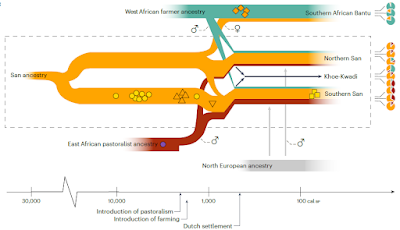
Demographic changes in the San and Khoe populations of southern Africa: Summary of the inferred population history of the San and Khoe in southern Africa. Sex symbols indicate male- and female-biased reproduction. Note that pastoralism and farming both appeared in present-day South Africa at about the same time, 2,000 years ago. Gretzinger et al. (2024).
The question of population continuity within Later Stone Age communities in Southern Africa has engaged archaeologists for over a century. In the past two decades, the application of genetic methodology to archaeological problems has helped to unravel the demographic histories of Stone Age populations in Europe, Asia, and North Africa, revealing episodes of large-scale migration in these regions, during which indigenous populations were either replaced by or absorbed into the new population. These biological replacements of populations also appear to have been vectors for the spread of new technologies. In South Africa, in contrast, there appears to have been a surprisingly long period of genetic continuity, with on detected influx of genetic material from elsewhere for at least 9000 years, from the beninning of the Holocene till around 1200 years ago, during which time the Southern San remained isolated from Northern and Central San populations as much as from other populations elsewhere in Africa.
This implies that the cultural changes seen at the Oakhurst Rockshelter, such as the transition from the Oakhurst to the Wilton technocomplex, were a result of entirely local inovation. It has previously been observed that there have been slight fluctuations in craniofacial size in Later Stone Age populations in coastal South Africa, something which has been interpreted as a sign of genetic discontinuity, something which Gretzinger et al.'s results contradict. Since the population was not a small isolated one which might be subject to strong effects from genetic drift, it seems likely that these variations were driven by changes in the local environment.
The 9000 years of genetic and cultural isolation experienced by Later Stone Age hunter gatherers in South Africa seems to have ended quite abruptly, with the spread of herding communities from East Africa shortly followed by the arrival of farming communities from West Africa. Most parts of South Africa do not record any genetic trace of these arrivals before about 1300 years ago. However, there is evidence for changes in settlement patterns and other cultural behaviours in this coastal South Africa from about 2000 years ago, which have been interpreted as a response to the arrival of herding in the area. In Europe, a similar cultural shift is seen at the Neolithic-Mesolithic boundary, with a genetic admixture between the incoming farming population and the extant hunter gatherer population not being recorded for about 2000 years after the cultural shift. This implies that in Europe at least, farming and hunter gatherer populations were able to live alongside one-another for a long period of time before beginning to intermix, something which may also have been true in South Africa. Alternatively, pastoralism may have been culturally transmitted from East Africa to Southern Africa long before the spread of East African populations into the region.
However, from about 1200 years ago onwards, there has been substantial migration into Southern Africa from other regions, and substantial ingression of new genetic material into all populations, with the effect that all living San and Khoe populations are admixed with one or both of East African Pastoralist and West African Farmer ancestry. This process was accelerated by the arrival of European settlers in the mid-seventeenth century, which led to widespread population collapse among hunter gatherer populations in Southern Africa. Combined with a loss of oral traditions, these events have greatly obscured the prehistoric population structure of southern Africa.
Genetic methods such as those used by Gretzinger et al. provide a way to study these ancient population structures, showing that the San and Khoe inhabitants of South Africa are the direct decendants of the Early Holocene inhabitants of the region, despite considerable disruption to their lifestyle and population structure by later migrants to the region.
See also...


.jpg)
.jpg)
.jpg)

1.jpg)


%20(1)%20(1).png)


%20(1)%20(1).png)


%20(1).png)


