Showing posts with label Rove Beetles. Show all posts

Saturday, 6 April 2024

Cretafrica orapensis: A new species of Mycetoporine Rove Beetle from the Cretaceous Orapa Diamond Mine deposits of Botswana.

Rove Beetles, Staphylinidae, are considered to be the most specious group of Animals alive today, with 66 928 described species in 35 subfamilies. The group appeared around the beginning of the Jurassic, with the majority of the extant subfamilies having appeared by the end of that period, and with significant ongoing diversification through the Cretaceous. The subfamily Mycetoporinae contains about 444 described species in 16 genera. It has a rather limited fossil record, with four known species from the Early Cretaceous of Russia and China, Cuneocharis elongata and Ryvkinius gracilis from the Daya Formation, and Undiatina pilosa from the Semyon Formation, all from Russia, and Glabrimycetoporus amoenus from the Yixian Formation of China, and several specimens assigned to the genera Lordithon and Mycetoporus from the Eocene Florissant Formation of the United States.

In a paper published in the journal Insect Systematics & Evolution on 29 March 2024, Sandiso Mnguni of the Evolutionary Studies Institute and Centre of Excellence in Palaeosciences at the University of the Witwatersrand, and Ian James McKay and Shaw Badenhorst, also of the School of Geosciences at the University of the Witwatersrand, describe a new species of Mycetoporine Rove Beetle from the Cretaceous Orapa Diamond Mine deposits of Botswana.

The Opara Diamond mine exploits two diamondiferous kimberlite pipes, (igneous deposits in which material from deep within the Earth is extruded upwards though existing deposits) which cut through Late Cretaceous deposits, reaching the surface and forming a volcanic crater in the Turonian, about 93.1 million years ago. Mining operations here have formed a large oval pit, which, as well as the kimberlite pipes, has exposed a series of lacustrine sediments preserving fossil Plants and Insects.

A top view of the Orapa Diamond Mine showing the open pit left after the removal of the crater lake facies and kimberlite. June 2018. Ian James McKay in Mnguni et al. (2024).

The new species is given the name Cretafrica orapensis, where 'Cretafrica' is a combination of Cretaceous and Africa, and 'orapensis' means 'from Orapa'; Orapa itself means 'the resting place of Lions' in the Sesarwa language, a name originally given to a cattle post near the site where diamonds were discovered. The species is described from a single specimen, a well-preserved impression fossil, and both dorsal and ventral structures are superimposed, and thus visible on top of each other. A second, smaller Beetle is also preserved on the same slab, which is probably a Hydroscaphid Water Beetle.

The whole body of Cretafrica orapensis, holotype, BP./2/27480, Orapa Diamond Mine, nonpolarised light, scale bar is 1mm. Abbreviations: e, eye; h, hypomeron; ek, epipleural keel; ef, epipleural fold; ppt, paired paratergite; spt, single paratergite; ss, spiral structure. Mnguni et al. (2024).

The specimen is 4.92 mm long and 1.58 mm wide.  The head is elongated and triangular, with small oval eyes towards the rear. The antennae are poorly preserved, but probably have eleven segments and were located anterior to the eyes. Mandibles, maxillary and maxillary palps are visible, but poorly preserved. The pronotum (forepart of the thorax) is hard to interpret, as it is partially covered by sediment. The Elytra cover less than a third of the body, leaving six abdominal segments exposed. 

Finding a member of the Mycetoporinae at Orapa has significant implications for the history of the group. Four previous Lower Cretaceous specimens have been described from three different localities, though these were all on the eastern part of the Eurasian landmass. The discovery of a specimen from Southern Africa, significantly increases the geographical range of Early Cretaceous Mycetoporine Rove Beetles, indicating that the group must have been in existence for long enough to achieve a near global distribution by this time.

Global palaeogeographic reconstruction of the mid-Cretaceous (100 million years ago) showing the localities where fossil Mycetoporinae have been recovered. Abbreviations: Ob, Obeschayushchiy locality (Daya Formation), Russia; Se, Semyon Formation, Russia; Yi, Yixian Formation, China; and Or, Orapa, Botswana. Mnguni et al. (2024).

See also...

Tuesday, 26 March 2024

Paleothius mckayi: A new species of Rove Beetle from the Late Cretaceous of Botswana.

Rove Beetles, Staphylinidae, are considered to be the most specious group of Animals alive today, with 66 928 described species in 35 subfamilies. The group appeared around the beginning of the Jurassic, with the majority of the extant subfamilies having appeared by the end of that period, and with significant ongoing diversification through the Cretaceous. The subfamily Staphylininae contains 9071 described species in 411 genera, making it the third most diverse subfamilies of Rove Beetles, behind the Aleocharinae and Pselaphinae. The Staphylininae is in turn divided into eight extant tribes, the Arrowinini, Coomaniini, Diochini, Maorothiini, Othiini, Platyprosopini, Staphylinini, and Xantholinini, as well as the extinct Thayeralinini. The oldest Staphylinines, Tunicopterus sigara and Subcelytrinus antiquus from the Karatau Formation of Kazakhstan; and Sinostaphylius xiejiajieensis from the Jiuda Formation in China date from the Jurassic, with a further 27 species described from the Cretaceous, and 57 from the Cainozoic. 

In a paper published in the Journal of Entomological Science on 4 March 2024, Sandiso Mnguni of the Evolutionary Studies Institute and the Centre of Excellence in Palaeosciences at the University of the Witwatersrand, and Shaw Badenhorst, and Marion Kathleen Bamford, also of the Evolutionary Studies Institute at the University of the Witwatersrand, describe a new species of Staphylinine Beetle from the Cretaceous deposits of the Orapa Diamond Mine in Botswana.

The Opara Diamond mine exploits two diamondiferous kimberlite pipes, (igneous deposits in which material from deep within the Earth is extruded upwards though existing deposits) which cut through Late Cretaceous deposits, reaching the surface and forming a volcanic crater in the Turonian, about 93.1 million years ago. Mining operations here have formed a large oval pit, which, as well as the kimberlite pipes, has exposed a series of lacustrine sediments preserving fossil Plants and Insects.

A top view of the Orapa Diamond Mine showing the open pit left after the removal of the crater lake facies and kimberlite. June 2018. Ian James McKay in Mnguni et al. (2024).

The new species is placed in the genus Paleothius, which currently contains a single species, Paleothius gracilis from the Early Cretaceous of China, and is given the specific name Paleothius mckayi, in honour of  Ian James McKay (1963–2022), who was a palaeoentomologist and Geosciences Outreach Education Specialist at the University of the Witwatersrand, Johannesburg, South Africa, who spent many years describing fossil insects from the Orapa Diamond Mine, and also trained various undergraduate and postgraduate students, including Sandiso Mnguni, who went on to become the first black palaeoentomologist in South Africa.

The whole body of Paleothius mckayi, holotype, Orapa Diamond Mine, polarised light. Mnguni et al. (2024).

Paleothius mckayi is a narrow, slender and cylindrical Rove Beetle, measuring 7.70 mm in length (from tip of mandibles to tip of abdomen) and 0.80 mm in width (from exterior edge of left elytron to edge of right elytron). The last abdominal segment is seemingly covered with setae.

Paleothius mckayi is the first fossil Staphylinine Beetle from Africa, and the first from the Southern Hemisphere, with previous Cretaceous Staphylinine Beetles known from China, Myannmar, Russia, and the UK. This makes Botswana a significant extension to the range of the group at this time, though perhaps not a surprising one; the Staphylininae are estimated to have split from their sister group, the Paederinae in the Late Jurassic, about 156.6 million years ago (other estimates put the split between 180 and 145 million years ago), and a Paederine Rove Beetle has previously been discovered from the Orapa deposits. 

Global palaeogeographic reconstruction of the mid-Cretaceous (100 million years ago) showing the localities where the fossil Staphylininae have been recovered. Abbreviations: Bu, Burmese Amber, Myanmar; La, Laiyang Formation, China; Or, Orapa Diamond Mine, Botswana; Yi, Yixian Formation, China; Ma, Magadanskaia, Russia and Lu, Lulworth Formation, Middle Purbeck, UK. Mnguni et al. (2024).

See also...

Thursday, 29 December 2022

Yprezethinus grimaldii: A Pselaphine Rove Beetle from Early Eocene Cambay Amber.

The Indian Plate separated from Madagascar about 88 million years ago, and collided with Eurasia between 60 and 45 million years ago. Since this time, there has been significant floral and faunal exchange between India and Eurasia, but during the period of isolation, the wildlife of India should, at least in theory, have been closer to that of Madagascar and Africa. However, fossils of African affinities from India during this interval are actually quite rare, while many appear to be more closely related to groups from Europe.

Cambay Amber, from Gujarat State, India, has been dated to about 54.5 million years ago, making it Ypressian (Early Eocene) in age, i.e. dating from the period during which India was colliding with Eurasia. This deposit has yielded a rich assemblage of Insects and other small Arthropods, although the majority of these show Laurasian affinities, and the overall Insect assemblage resembling that of the slightly younger Baltic Amber of northern Europe. Groups with affinities to Eurasian faunas include Electrapine and Melikertine Bees, Lygistorrhinid Flies, and a variety of Termites, while Africa-linked groups include Scelembid Webspinners, and a Paleoamblypygid Whipspider.

In a paper published in the journal Palaeoentomology on 22 September 2022, Joseph Parker of the Division of Biology and Biological Engineering at the California Institute of Technology, and the Division of Invertebrate Zoology at the American Museum of Natural History, describes a new species of Pselaphine Rove Beetle from Cambay Amber, with clear affinities to species from tropical Africa.

The Beetle is assigned to a new species and genus, and given the name Yprezethinus grimaldii, where 'Yprezethinus' derives from 'Ypressian' plus 'Zethinus', a modern genus of Pselaphine Rove Beetle which it resembles, and 'grimaldii' honours the American palaeoentomologist David Grimaldi on the advent of his 65th birthday.

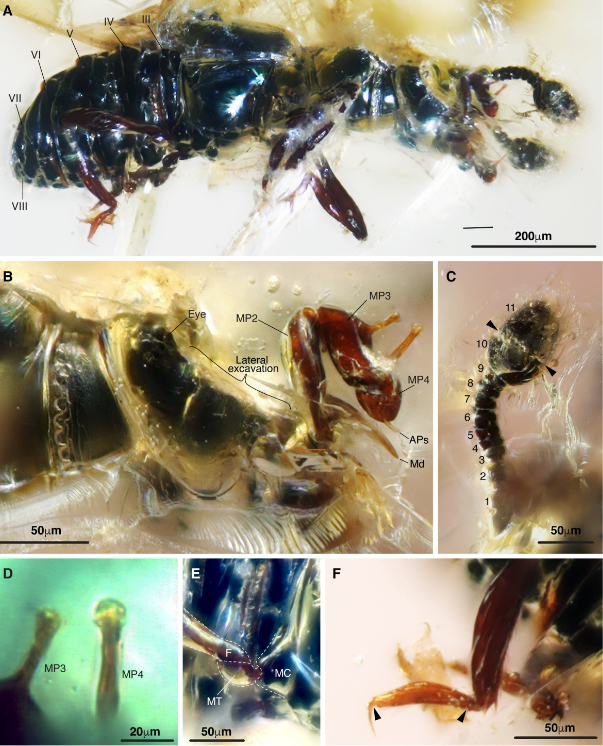
Yprezethinus grimaldii Holotype AMNH Tad-130. (A) Habitus with visible abdominal sternites labelled. (B) Head and pronotum with segments of maxillary palpomeres numbered MP2–MP4. Bythinoplectina-type lateral excavation, eye, apical  pseudosegment of maxillary palp, APs, and mandible, Md, indicated. (C) Right antenna with antennomeres numbered. Note the  club formed from tightly appressed, hemisphere-shaped antennomeres 10 and 11. D, Close-up view of apically globose tubercles  of maxillary palpomeres 3 and 4. (E) Proximal leg articulation, showing conically projecting metacoxa, MC, short metatrochanter, MT, and femur, F. (F) Right metatarsus, F with bythinoplectine-type enlarged third tarsomere spanning distance between arrowheads, and minute first visible tarsomere. Parker (2022).

Yprezethinus grimaldii is about 0.8 mm in length with a flattened body and a glossy black carapace. It is assigned by Parker to the subtribe Bythinoplectina, which is found today in leaf-litter in tropical forests, and considered to be closely related to the modern Zethinus, which is found in the tropical forests of West-Central Africa, from Côte d’Ivoire south to Angola. 

Interestingly, many modern Pselaphine Rove Beetles are considered to be Ant-associated, and while examples of them actually living in Ant's nests are rare, they certainly appear to do better in environments where the leaf-litter community is dominated by Ants. The oldest abundant Ant fossils come from Middle Cretaceous Amber from Kachin State, Myanmar ('Burmese Amber'), but these Ants are quite unlike modern Ants, and no members of any (modern) Ant-associated group are known from Kachin Amber. Cambay Amber represents one of the earliest known ecosystems dominated by this modern Ants, making the discovery of a potentially Ant-related Beetle here significant.

Many of the flying Insects from Cambay Amber appear to be more closely related to Eurasian than African groups. Pselaphine Rove Beetles are, in contrast, poor fliers, as are Webspinners (a group in which, in modern species at least, only the males can fly); Whipspiders are wingless Arachnids and do not fly at all. Thus the flying Insect assemblage at Cambay appears to have been replaced by species from Eurasia, while more terrestrial groups still show African affinities. 

See also...

Online courses in Palaeontology. 

Follow Sciency Thoughts on Facebook.

Follow Sciency Thoughts on Twitter.


Saturday, 6 October 2018

Gollandia planata: A new species of Rove Beetle from Cretaceous Burmese Amber.

Rove Beetles, Staphylinidae, are the largest extant Beetle group, with around 63 000 known species, and have been around since at least the Triassic. They are easily distinguished from other Beetles by their much reduced elytra (wing cases) that leave most of the abdomen exposed. Rove Beetles are found in all habitats where Beetles are found, and are a highly diverse group, both ecologically, and morphologically, though most species are elongated, between two and eight mm in length and predators on smaller Arthropods.

In a paper published in the journal ZooKeys on 17 August 2018, György Makranczy of the Department of Zoology at the Hungarian Natural History Museum, Shûhei Yamamoto of the Integrative Research Center at the Field Museum of Natural History, and Michael Engel of the Division of Entomology, Natural History Museum and Department of Ecology & Evolutionary Biology at the University of Kansas, and the Division of Invertebrate Zoology at the American Museum of Natural History, describe a new species of Rove Beetle from a piece of Cretaceous Burmese Amber.

Cretaceous ‘Burmese Amber’ has been extensively worked at several sites across northern Myanmar (though mostly in Kachin State) in the last 20 years. The amber is fairly clear, and often found in large chunks, providing an exceptional window into the Middle Cretaceous Insect fauna. This amber is thought to have started out as the resin of a Coniferous Tree, possibly a Cypress or an Araucaria, growing in a moist tropical forest. This amber has been dated to between 105 and 95 million years old, based upon pollen inclusions, and to about 98.8 million years by uranium/lead dating of ash inclusions in the amber. 

The new species is named Gollandia planata, where 'Gollandia' honours Susan Golland, exhibition developer at the Field Museum of Natural History, and 'planata' derives from the Greek πλατύς (platys), meaning 'wide' in reference to the pronotum (plate covering the back of the thorax), which is exceptionally wide.

Gollandia planata photographed with macro lens and three flash units. (3) Dorsal
view. (4) Ventral view. Makranczy et al. (2018).

The species is described from a single specimen from a piece of amber from Noije Bum Hill in the southwest Hukawng Valley of Kachin State, Myanmar. The specimen is well preserved, but caught within a dip in an internal layer in the amber (the amber is made up of successive layers of resin that have flowed over one-another), and was initially prepared (probably by local workers in the area) in such a way that this cannot now be rectified by polishing away the problematic layers.

The specimen is probably male, and is 3.29 mm in length, reddish brown in colour, with a dense coat of hairs on its abdomen and less on the forepart of the body. It has hindwings extended over the body and well preserved.

See also...

https://sciencythoughts.blogspot.com/2018/08/cretoparacucujus-cycadophilus-cycad.htmlhttps://sciencythoughts.blogspot.com/2018/08/scolytoplatypus-unipilus-new-species-of.html
https://sciencythoughts.blogspot.com/2018/07/markus-karenae-new-species-of-silinine.htmlhttps://sciencythoughts.blogspot.com/2018/04/copelatus-yaguarete-new-species-of.html
https://sciencythoughts.blogspot.com/2018/02/amplectister-tenax-new-species-of-clown.htmlhttps://sciencythoughts.blogspot.com/2018/01/cis-mooihoekite-new-species-of-minute.html
Follow Sciency Thoughts on Facebook.

Monday, 26 December 2016

Placukorna ipsa: A new species of Rove Beetle from a high altitude Pine Forest in Veracruz State, Mexico.

Rove Beetles, Staphylinidae, are the largest extant Beetle group, with around 63 000 known species, and have been around since at least the Triassic. They are easily distinguished from other Beetles by their much reduced elytra (wing cases) that leave most of the abdomen exposed. Rove Beetles are found in all habitats where Beetles are found, and are a highly diverse group, both ecologically, and morphologically, though most species are elongated, between two and eight mm in length and predators on smaller Arthropods.

In a paper published in the journal ZooKeys on 13 December 2016, Quiyari Santiago-Jiménez and Rosny Santiago-Navarro of the Museo de Zoología at Universidad Veracruzana, describe a new species of Rove Beetle from Veracruz State in Mexico.

The new species is placed in the The Tribe Placusini, which currently contains four genera, Placusa is global in distribution, Euvira is found throughout the Americas, Kirtusa is known only from Ecuador and Speiraphallusa only from Malaysia. It is deemed sufficiently different from all of these to be placed in a new genus, Placukorna, meaning 'a horn on the surface plane' in reference to a horn which grows from its final abdominal segment, and given the specific name 'ipsa', relating the Bark Beetles Ips and Pseudoips, which it was found living alongside.

Placukorna ipsa, male specimen in lateral view. Santiago-Jiménez & Santiago-Navarro (2016).

Specimens of Placukorna ipsa ranged from 2.5-3.0 mm in length, and were dark brown to black in colour, with yellowish brown limbs. The species was found living in the galleries (excavated chambers in wood) of Bark Beetles in a mixed Pine forest at an altitude of 3090 m, on the northeast face of the extinct Cofre de Perote volcano in Veracruz State.

See also...

http://sciencythoughts.blogspot.co.uk/2015/12/pella-tianmuensis-new-species-of.htmlhttp://sciencythoughts.blogspot.co.uk/2015/10/awas-gigas-new-species-of-rove-beetle.html
http://sciencythoughts.blogspot.co.uk/2015/03/a-new-species-of-rove-beetle-from.htmlhttp://sciencythoughts.blogspot.co.uk/2013/09/a-new-species-of-myrmecophilous-rove.html
http://sciencythoughts.blogspot.co.uk/2013/08/a-new-species-of-marsh-rove-beetle-from.htmlhttp://sciencythoughts.blogspot.co.uk/2012/12/a-rove-beetle-from-late-triassic-of.html
Follow Sciency Thoughts on Facebook.

Sunday, 20 December 2015

Pella tianmuensis: A new species of Myrmecophilic Aleocharine Rove Beetle from Zhejiang Province, China.

Aleocharine Rove Beetles are small Rove Beetles, Staphylinidae, found in terrestrial environments across the globe. Like other Rove Beetles they have greatly shortened elytra (the win cases of Beetles, formed from hardened and modified forewings that usually protect and cover the hindwings and abdomen) leaving much of the abdomen exposed. The largest Aleocharines are about 10 mm in length, but most are less than 5 mm and some as small as 1 mm. The majority of species are soil-dwelling predators, but many are Myrmecophiles, living in the nests of Ants.

In a paper published in the journal ZooKeys on 23 November 2015, Zhu-Qi Yan and Li-Zhen Li of the Department of Biology at Shanghai Normal University describe a new species of Aleocharine Rove Beetle from nests of the Ant in the West Tianmushan Natural Reserve in Zhejiang Province, China.

The new species is placed in the Myrmecophilous genus Pella and given the specific name tianmuensis, meaning 'from Tianmu' (Tianmushan means 'Tianmu Mountain'). The species is described from 17 male and 27 female specimens. They are 4.56–6.60 mm in length and dark reddish brown and black in colour with yellow markings on the elytra.

Pella tianmuensis in dorsal view. Scale bar is 0.5 mm. Yan & Li (2015).

See also...

http://sciencythoughts.blogspot.co.uk/2015/10/awas-gigas-new-species-of-rove-beetle.htmlAwas gigas: A new species of Rove Beetle from Guangxi Province, China.                  Rove Beetles, Staphylinidae, of the genus Awas are tiny Beetles with elongate heads and constricted waists found living in Ant's nests on the Malay Peninsula, in Taiwan and in continental China. The group is poorly understood, with three of the five described species being known only from a sngle specimen, and...

http://sciencythoughts.blogspot.co.uk/2015/03/a-new-species-of-rove-beetle-from.htmlA new species of Rove Beetle from Jalisco State, Mexico.                                                 Rove Beetles of the genus Megarthrus are Fungus-feeding Beetles distributed globally, but are most numerous and diverse in north-temperate regions. In...

Rove Beetles (Staphylinidae) are an unusual-looking group of Beetles, distinguished by their short wing cases, which makes them look rather unbeetle-like. They are a successful group, with over 46 000...
 
 
Follow Sciency Thoughts on Facebook.


Saturday, 10 October 2015

Awas gigas: A new species of Rove Beetle from Guangxi Province, China.

Rove Beetles, Staphylinidae, of the genus Awas are tiny Beetles with elongate heads and constricted waists found living in Ant's nests on the Malay Peninsula, in Taiwan and in continental China. The group is poorly understood, with three of the five described species being known only from a sngle specimen, and the remaining two from four and five individuals respectively.


In a paper published in the journal ZooKeys on 23 September 2015, Zi-Wei Yin, Jia-Wei Shen and Li-Zhen Li of the Department of Biology at Shanghai Normal University describe a new species of Awas Beetle from the Daoyao Shan Natural Reserve in Guanxi Province in southern China.


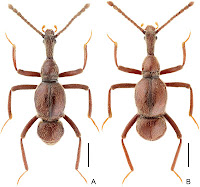
The new species is named Awas gigas, meaning 'large' on account of the body size of the genus, reaching slightly over 5 mm, which is far larger than any previously described species. The Beetle was first recorded in July 2014, when four specimens (two males and two females) where found in a nest made by Ants of the genus Pachycondyla nesting under decomposing wood in broad-leaved forest.The area was revisited in May 2015, and thirteen further specimens (one male, twelve female) were collected from several Ant's nests, all of members of the genus Pachycondyla.


Dorsal habitus of Awas gigas. (A) Male (B) Female. Scale bars are 1.0 mm. Yin et al. (2015).


See also...


http://sciencythoughts.blogspot.co.uk/2015/03/a-new-species-of-rove-beetle-from.htmlA new species of Rove Beetle from Jalisco State, Mexico.                                                 Rove Beetles of the genus Megarthrus are Fungus-feeding Beetles distributed globally, but are most numerous and diverse in north-temperate regions. In...
Rove Beetles (Staphylinidae) are an unusual-looking group of Beetles, distinguished by their short wing cases, which makes them look rather unbeetle-like. They are a successful group, with over 46 000...
Rove Beetles (Staphylinidae) are an unusual-looking group of Beetles, distinguished by their short wing cases, which makes them look rather...


Follow Sciency Thoughts on Facebook.