Six people have been confirmed dead, fifteen have been dug out alive, and one is still missing following a landslide at an illegal gold mine in the village of Buranga in Central Sulawesi, Indonesia, on Thursday 24 February 2021. The landslide is thought to have been caused by a combination of heavy rainfall associated with the the Northeast Monsoon, according to Fatmawati, a spokeswoman for the Badan Nasional Penanggulangan Bencana. Landslides are a common problem after severe weather events, as excess
pore water pressure can overcome cohesion in soil and sediments,
allowing them to flow like liquids. Approximately 90% of all landslides
are caused by heavy rainfall.
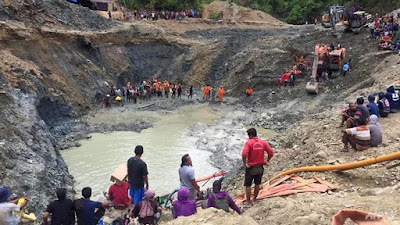
Rescue workers at an illegal gold mine in Central Sulawesi, following a landslide on 25 February 2021. AFP.
Indonesia's large size, mineral richness, and poor population make
unlicensed mining a widespread problem in the country, with illegal
mines typically dug with hand tools and located in remote locations
where authorities are unlikely to spot them (though some such operations
are larger and more blatant in nature). Such mines tend to take few
health and safety precautions, and are often dug by people with only a
limited understanding of the structural geology of the area, making
accidents extremely common, in many cases without help ever arriving due
to the hidden nature of the mines. Such mines also present an
environmental threat, producing waste which is often toxic, and
contributing to deforestation, which can destabilise hillslopes, placing
the miners at further risk.
The approximate location of the 25 February 2021 Central Sulawesi landslide. Google Maps. Monsoons
are tropical sea breezes triggered by heating of the land during the
warmer part of the year (summer). Both the land and sea are warmed by
the Sun, but the land has a lower ability to absorb heat, radiating it
back so that the air above landmasses becomes significantly warmer than
that over the sea, causing the air above the land to rise and drawing in
water from over the sea; since this has also been warmed it carries a
high evaporated water content, and brings with it heavy rainfall. In the
tropical dry season the situation is reversed, as the air over the land
cools more rapidly with the seasons, leading to warmer air over the
sea, and thus breezes moving from the shore to the sea (where air is
rising more rapidly) and a drying of the climate.

Sulawesi has two distinct Monsoon Seasons, with a Northeast Monsoon driven
by winds from the South China Sea that lasts from November to February
and a Southwest Monsoon driven by winds from the southern Indian Ocean from March to October. Such a double Monsoon Season is common
close
to the equator, where the Sun is highest overhead around the equinoxes
and lowest on the horizons around the solstices, making the solstices
the coolest part of the year and the equinoxes the hottest.
The winds that drive the Northeast and Southwest Monsoons in Southeast Asia. Mynewshub. Indonesia, and other countries of the western Pacific margin, are
experiencing a particularly wet year, due to a prevailing La Niña weather system over the Pacific. The La Niña weather system is the opposite of the El Niño weather
system, in which unusually cold surface temperatures spread across the
equatorial Pacific from the upwelling zone on the South American coast.
This traps warm water from the western Pacific, preventing it from
spreading east and warming the central Pacific. This leads to lower
evaporation over the (cooler) east Pacific, leading to low rainfall on
the west coast of South America, and higher evaporation over the
(warmer) west Pacific, leading to higher rainfall over East and
Southeast Asia and northern Australia.
The effects of a La Niña weather system in December-February. NOAA.
See also...


Follow Sciency Thoughts on Facebook.
Follow Sciency Thoughts on Twitter.


