Showing posts with label Illegal Mining. Show all posts

Monday, 17 November 2025

At least 32 miners killed in incident in Lualaba Province, Democratic Republic of Congo.

At least 32 people have died, with some sources giving a larger number of 49, following the collapse of a makeshift bridge at a mine in the Democratic Republic of Congo. The incident happened at the Kalando Cobalt Mine in Lualaba Province, Democratic Republic of Congo, on Saturday 15 November 2025, following an incursion at the mine by wildcat miners. The mine was closed at the time following heavy rains, which had led to concerns about the danger of landslides, but like many mines in the area is prone to incursions by informal miners, who take advantage of any suspension of regular activities. 

On this occasion the miners had entered the mine via bridge over a flooded trench to enter the site. However, soldiers who had been deployed to guard the mine fired upon these miners, injuring two and causing a panic which led to a large number of people trying to cross the bridge at once. While this was happening one of the walls of the open pit mine collapsed, with the subsequent landslide hitting the bridge.

The moment a landslide hit a bridge covered at a mine in Lualaba Province, Democratic Republic of Congo. AlJazeera

Informal artisanal mining is common in many parts of Africa, including the Democratic Republic of Congo, which like may other countries has granted concessions to mining companies in areas where small-scale artisanal mining has traditionally helped to supplement the incomes of subsistence farmers. However, little of the money from such projects tends to reach local communities, which often leads to ill feeling and attempts to continue mining clandestinely, often at night or under other unfavourable conditions, which can put the miners at greater risk.

Artisanal miners at the Kalando site that until 2018, they had been free to operate as they pleased, but since that time the site had been taken over by a company with links to the family of President Felix Tshisekedi, as well as Chinese business interests. The Congolese Government claims that it has tried to exclude untrained miners from the site precisely because it feared an incident of this type.

Cobalt is a critical component of lithium batteries, which are used in technologies such as mobile phones and electric cars. The Democratic Republic of Congo is the world's largest producer of cobalt, but the industry is notoriously unregulated, with repeated reports of widespread forced labour, often of children, of workers being exposed to hazardous chemicals, and environmental destruction. Most of the extracted cobalt is exported to China, where it is used to manufacture electrical goods. 

See also...

Thursday, 22 May 2025

Ten miners confirmed dead, and a further ten missing following landslide in West Papua Province, Indonesia.

The bodies of ten miners have been recovered, and further ten are missing, following a landslide in the remote Arfak Mountains of West Papua Province, Indonesia, following a landslide on Friday16 may 2025. The landslide, which occurred at about 9.00pm, and is believed to have been triggered by heavy rains associated with the onset of the southwest monsoon, and struck a camp being used by artisanal gold miners. A further four miners were injured by the event, and rescue efforts are being hampered by the remote location of the site, which is ten hours travel from the nearest town, and ongoing heavy rains in the area.

Rescue workers battling floodwaters while recovering a body from a mining camp hit by a landslide in the emote Arfak Mountains of West Papua Province, Indonesia, on 16 May 2025. Indonesia Search and Rescue Agency/AFP).

Indonesia's large size, mineral richness, and poor population make unlicensed mining a widespread problem in the country, with illegal mines typically dug with hand tools and located in remote locations where authorities are unlikely to spot them (though some such operations are larger and more blatant in nature). Such mines tend to take few health and safety precautions, and are often dug by people with only a limited understanding of the structural geology of the area, making accidents extremely common, in many cases without help ever arriving due to the hidden nature of the mines. Such mines also present an environmental threat, producing waste which is often toxic, and contributing to deforestation, which can destabilise hillslopes, placing the miners at further risk.

Monsoons are tropical sea breezes triggered by heating of the land during the warmer part of the year (summer). Both the land and sea are warmed by the Sun, but the land has a lower ability to absorb heat, radiating it back so that the air above landmasses becomes significantly warmer than that over the sea, causing the air above the land to rise and drawing in water from over the sea; since this has also been warmed it carries a high evaporated water content, and brings with it heavy rainfall. In the tropical dry seasons, the situation is reversed, as the air over the land cools more rapidly with the seasons, leading to warmer air over the sea, and thus breezes moving from the shore to the sea (where air is rising more rapidly) and a drying of the climate.

Diagrammatic representation of wind and rainfall patterns in a tropical monsoon climate. Geosciences/University of Arizona.

West Papua has two distinct Monsoon Seasons, with a Northeast Monsoon driven by winds from the South China Sea that lasts from November to February and a Southwest Monsoon driven by winds from the southern Indian Ocean from March to October. Such a double Monsoon Season is common close to the equator, where the Sun is highest overhead around the equinoxes and lowest on the horizons around the solstices, making the solstices the coolest part of the year and the equinoxes the hottest.

See also...

Tuesday, 14 January 2025

More than a hundred feared to have died in South African gold mine blocked off by authorities since November.

More than a hundred illegal miners are feared to have died in a mine at Stilfontein in North West Province, South Africa, after authorities blocked off an exit in August 2024. The operation was intended to flush the miners out of the mine, and involved removing a system of ropes and pullies from one entrance to the mine and thereby capture the miners as they escaped from the second entrance. However, local people have protested that the two shafts were not collected, and that miners had therefore been trapped underground with no means of escape other than a climb up a vertical shaft described as about 2 km deep.

The entrance to a mine in Stilfontein, South Africa, where over a hundred miners are feared to have died. AFP.

South Africa is home to some of the deepest gold mines in the world, but many of these mines are now reaching the end of their lives and are being closed down by their owners. This has led to an increasing number of unemployed miners close to an obvious source of income - the mines in which they formerly worked, and many have returned to these pits, along with migrants from other parts of Africa, in informal mining operations. These are seen as illegal by the South African government, which claims that as much as 10% of the gold mined in South Africa may come from unofficial operations, costing the economy billions of Rand each year, and that the illegal mining fuels a black market in smuggled minerals controlled by violent criminals.

The approximate location of the Stilfontein mine. Google Maps.

Miners descend into deep pits on ropes, and due to the length of the descent typically take supplies and equipment which enables them to stay underground for weeks or even months at a time. Entering such mines to try to arrest miners far more familiar with the environment is clearly an unattractive proposition to South African police officers, leading to operations such as the one at the Buffelsfontein, where mineshafts are blocked off by police to prevent family members sending food and water to the miners. Since the mine entrances were blocked off in August, about 1500 miners have emerged from one, leading the police to conclude that the operation was going successfully, but local people have been protesting that as many as 900 miners who had entered the second shaft were in fact trapped and could not escape. On Friday 10 January 2025 the High Court of South Africa agreed with a petition by Zinzi Tom, a local woman whose brother is one of those trapped in the mine, and ordered that a rescue mission be mounted.

Rescue work begining at the Buffelsfontein Mine in Stilfontein, South Africa. The Mail & Guardian.

On Monday 13 January, Mines Rescue Services, a commercial mine rescue company, began operations at the mine, lowering a cage into the shaft from a mobile crane, to bring out emaciated miners and the bodies of their less fortunate comrades. By the end of operations on Tuesday 14 January, 82 survivors and 36 bodies had been pulled from the shaft, in an operation which is likely to go on for days or even weeks. South African Police have been arresting survivors deemed fit enough to be charged, while others have been taken to a local hospital where they will be treated before also being arrested.

An emaciated miner being caried from the Buffelstein Mine in Stilfontein, South Africa, on 14 January 2024. Ihsaan Haffejee/Ground Up.

See also...


Saturday, 8 July 2023

Gas leak associated with illegal gold mining kills seventeen in South Africa.

At least seventeen people, including three children, have died following a gas leak thought to be associated with an illegal gold mine in Gauteng Province, South Africa, on Wednesday 5 July 2023. All of the dead are reported to have been found within a hundred metres of a building where four gas cylinders were found, within an area of tightly packed improvised houses in the informal settlement of Angelo in Boksburg, to the east of Johannesburg. Witnesses to the incident have described whole families dying, and people falling dead as they tried to flee the area, and South African rescue workers have described finding bodies scattered in the streets, and are still searching homes in the area for more victims. Three people are recovering in hospital, all of whom are described as being in a serious condition. 

Witnesses gather near the a police cordon in the settlement of Angelo, in Boksburg, South Africa, following a gas leak which killed seventeen people on 5 July 2023. Siphiwe Sibeko/Reuters.

The site where the leak occurred appears to have been used to process ore gathered illegally from a nearby mine site that had closed down. South Africa has a long history of strife over mining, largely relating to the exploitation of resources by large foreign companies and the relatively poor remuneration of mineworkers and communities that have lost land to mines, disputes that are intimately connected to the long term struggle against the Apartheid system in the country. However illegal mining is seen as a relatively new problem, driven by high unemployment and a contraction in the mining industry which has seen many experienced former mineworkers laid off, that authorities have yet to catch up with. As well as being a loss of revenue to the state, illegal mines do not comply with South Africa's environmental and health and safety laws, and can therefore present a threat to communities close to the operations, as well as miners employed at the sites, particularly if gold is being worked, since the quickest and cheapest way to separate gold from ore involves the use of (highly toxic) mercury and other harmful substances. Aggregates (sand and gravel) used in the building industry are also considered a problem, as indiscriminate mining can lead to the destruction of natural habitats and farmland, as well as hastening soil and river erosion.

The site is reported to have contained four gas cylinders, three upright on a rack, and one lying on its side (possibly having been dropped, which could have led to the gas leak), which have variously been described by local sources as containing nitrous oxide or 'nitrate' gas, which was apparently being used in the refining process. The exact method being used is unclear, but nitric acid is widely used in the purification of gold, but generally difficult for members of the public to get hold of, and other nitrogen compounds are sometimes mixed with hydrochloric acid to form a crude form of aqua regia to serve the same purpose (not recommended), and it is possible that the gas was being used in this way.

If the gas was nitrous oxide (which seems the more likely explanation, as nitrates are seldom gasses), then it could have been obtained from a medical supplier or user (probably illegally) where it would have been intended for use as an anaesthetic. Inhalation of small amounts of nitrous oxide is known to make people drowsy and hamper decision making processes, while larger concentrations are deadly. The gas is heavier than air, which would enable it to spread along the ground before dispersing, creating a deadly cloud within an environment such as the Angelo settlement.

See also...

Follow Sciency Thoughts on Facebook.

Follow Sciency Thoughts on Twitter


Wednesday, 22 March 2023

Eighteen students injured as primary school classroom collapses into sinkhole in Zimbabwe.

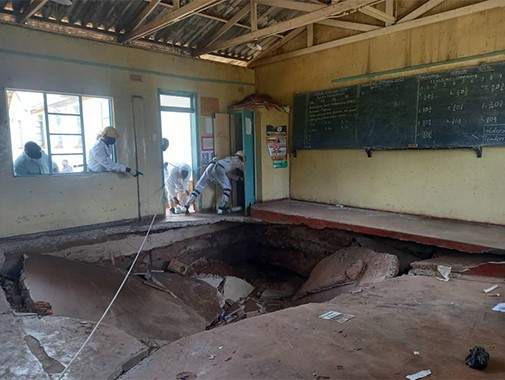
Eighteen children have been injured after a classroom collapsed into a sinkhole at a primary school in Zimbabwe on Thursday 16 March 2023. The incident happened at about 7.30 am local time, the Globe and Phoenix Primary School in the town of Kwekwe in Midlands Province, about 200 km from Harare, and affected a classroom where grade five students were being taught, which in Zimbabwe implies 10-11 year olds. The school, which has about 1500 pupils, has closed following the incident, with 900 of the pupils having been offered temporary places at the nearby Sally Mugabe Primary School, while the rest will attend classes in large tents erected in the grounds of the Globe and Pheonix School.

Members of the emergency services inspect a classroom which collapsed into a sinkhole in Kwekwe, Zimbabwe, on 16 March 2023. Zimbabwe Situation.

Sinkholes are generally caused by water eroding soft limestone or unconsolidated deposits from beneath, causing a hole that works its way upwards and eventually opening spectacularly at the surface. Where there are unconsolidated deposits at the surface they can infill from the sides, apparently swallowing objects at the surface, including people, without trace. 

However, on this occasion the hole is believed to have been caused by the a collapse within an old gold mine, which underlies the school and which has recently become a centre of activity for illegal miners. The Globe and Phoenix School takes its name from the Globe and Phoenix Mine, a gold mine which operated from the 1890s until 2007, when it  was closed down in 2007 by the Ministry of Mines and the Environmental Management Authority, following a series of safety problems, having originally been founded to educate the children of miners working at the mine.

While there is currently no official mining activity at the site (there are plans for such activity to restart in the future), the mine has become a target for informal miners, who work within many disused mines within Zimbabwe, a practice which is illegal but generally tolerated by the authorities, a country plagued by high unemployment and other economic problems, and is recognized as making a significant contribution to the economy, as such miners are able to sell their product locally rather than smuggling it out to avoid the attention of local authorities, as happens in many African countries. However, the informal nature of this industry makes it extremely dangerous, as few if any health and safety precautions are taken in such mines, and their are occasional reports of armed clashes between rival groups over lucrative sites.

This is particularly problematic at the Globe and Phoenix Mine, which was excavated using a gallery and pillar system, in which pillars of material were left as supports as a seem of gold ore was removed. These remaining pillars have a higher gold content than the unexcavated parts of the seem (which were deemed not economically useful by the original mining company), and are an obvious target for artisanal miners, weakening the structure of the mine, and leading to collapses. 

See also...

Follow Sciency Thoughts on Facebook.

Follow Sciency Thoughts on Twitter.


Thursday, 25 February 2021

Landslide kills at least six at illegal gold mine in Cenral Sulawesi.

Six people have been confirmed dead, fifteen have been dug out alive, and one is still missing following a landslide at an illegal gold mine in the village of Buranga in Central Sulawesi, Indonesia, on Thursday 24 February 2021. The landslide is thought to have been caused by a combination of heavy rainfall associated with the the Northeast Monsoon, according to Fatmawati, a spokeswoman for the Badan Nasional Penanggulangan Bencana. Landslides are a common problem after severe weather events, as excess pore water pressure can overcome cohesion in soil and sediments, allowing them to flow like liquids. Approximately 90% of all landslides are caused by heavy rainfall.


Rescue workers at an illegal gold mine in Central Sulawesi, following a landslide on 25 February 2021. AFP.

Indonesia's large size, mineral richness, and poor population make unlicensed mining a widespread problem in the country, with illegal mines typically dug with hand tools and located in remote locations where authorities are unlikely to spot them (though some such operations are larger and more blatant in nature). Such mines tend to take few health and safety precautions, and are often dug by people with only a limited understanding of the structural geology of the area, making accidents extremely common, in many cases without help ever arriving due to the hidden nature of the mines. Such mines also present an environmental threat, producing waste which is often toxic, and contributing to deforestation, which can destabilise hillslopes, placing the miners at further risk.

 
The approximate location of the 25 February 2021 Central Sulawesi landslide. Google Maps.

Monsoons are tropical sea breezes triggered by heating of the land during the warmer part of the year (summer). Both the land and sea are warmed by the Sun, but the land has a lower ability to absorb heat, radiating it back so that the air above landmasses becomes significantly warmer than that over the sea, causing the air above the land to rise and drawing in water from over the sea; since this has also been warmed it carries a high evaporated water content, and brings with it heavy rainfall. In the tropical dry season the situation is reversed, as the air over the land cools more rapidly with the seasons, leading to warmer air over the sea, and thus breezes moving from the shore to the sea (where air is rising more rapidly) and a drying of the climate.

 
Diagrammatic representation of wind and rainfall patterns in a tropical monsoon climate. Geosciences/University of Arizona.

Sulawesi has two distinct Monsoon Seasons, with a Northeast Monsoon driven by winds from  the South China Sea that lasts from November to February and a Southwest Monsoon driven by winds from the southern Indian Ocean from March to October. Such a double Monsoon Season is common close to the equator, where the Sun is highest overhead around the equinoxes and lowest on the horizons around the solstices, making the solstices the coolest part of the year and the equinoxes the hottest.

 
The winds that drive the Northeast and Southwest Monsoons in Southeast Asia. Mynewshub.

Indonesia, and other countries of the western Pacific margin, are experiencing a particularly wet year, due to a prevailing La Niña weather system over the Pacific. The La Niña weather system is the opposite of the El Niño weather system, in which unusually cold surface temperatures spread across the equatorial Pacific from the upwelling zone on the South American coast. This traps warm water from the western Pacific, preventing it from spreading east and warming the central Pacific. This leads to lower evaporation over the (cooler) east Pacific, leading to low rainfall on the west coast of South America, and higher evaporation over the (warmer) west Pacific, leading to higher rainfall over East and Southeast Asia and northern Australia.

 
The effects of a La Niña weather system in December-February. NOAA.

See also...


Follow Sciency Thoughts on Facebook.

Follow Sciency Thoughts on Twitter