Showing posts with label Chalcid Wasps. Show all posts

Sunday, 20 February 2022

Odontochrydium arabicum: A new species of Cuckoo Wasp from the Arabian Peninsula.

Cuckoo Wasps, Chrysididae, are a widespread and diverse group of Wasps, noted for their kleptoparasitic habits; that is to say that, like many Wasps they lay their eggs inside the paralized bodies of other Insects and Arachnids stored in nests, but unlike these Wasps they do not catch their own prey, but rather lay their eggs inside the victims of other parasitic Wasps, the Cuckoo Wasp larvae then eating both the prey and the larvae of the original Wasp. The genus Odontochrydium currently contains three species of Cuckoo Wasps, two from sub-Saharan Africa and one from southern India.

In a paper published in the journal Zootaxa on 18 February 2022, Ahmed Soliman of the Plant Protection Department at King Saud University and the Zoology Department at Al-Azhar University, Paolo Rosa of the Laboratoire de Zoologie at the Université de Mons, and Hathal Dhafer, also of the Plant Protection Department at King Saud University, describe a new species of Odontochrydium from the southern Arabian Peninsula.

The first reported example of a Wasp of the genus Odontochrydium was a female collected from the Asir region of Saudi Arabia in 2015, and identified as a member of the species Odontochrydium bicristatum, which is otherwise known only from East Africa. However, since this report other specimens collected in southern Saudi Arabia, Oman, and Yemen have come to light, including several males (which show greater differentiation between species than is seen in the females), leading Soliman et al. to conclude that the Arabian population is in fact a different species to the East African population.

The new species is named Odontochrydium arabicum, where the specific name 'arabicum' refers to the Arabian Peninsula. The species is described from ten specimens, four males and six females, collected from the Asir and Jazan regions of Saudi Arabia, the Dhofar Governate of Oman, and Yemen.

 
Odontochrydium arabicum, male, holotype. (A) Habitus, lateral view; (B) Habitus, dorsal view; (C) Habitus, ventral view. Scale bar is 1.0 mm. Soliman et al. (2022).

Males and females of Odontochrydium arabicum are bright green with copper shimmering when alive, but turn a dark metallic blue after death. Both sexes have covering of fine white hairs, and tiny pits. The eyes are also white. Adult Wasps reach about 5.2 mm in length.

 
Odontochrydium arabicum, female, paratype. (A) Habitus, lateral view; (B) Head, frontal view; (C) Mesosoma and T1, detail; (D) T2–T3. Scales is 1.0 mm. Soliman et al. (2022).

See also...


Follow Sciency Thoughts on Facebook.

Follow Sciency Thoughts on Twitter.


Thursday, 26 August 2021

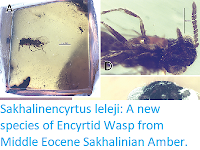
Sakhalinencyrtus leleji: A new species of Encyrtid Wasp from Middle Eocene Sakhalinian Amber.

The Encyrtidae are a large family of parasitoid Chalcid Wasps, primarily targeting members of the Hemiptera (True Bugs), although some target of Ticks and others are hyperparasites, with their larvae growing inside the parasitic larvae of other Wasps. The first known fossil species assigned to the family, Encyrtus clavicornis, was described from an Oligocene shale from Rott in Germany in 1938. Since this time a further eighteen species have been discovered, Archencyrtus rasnitsyni, Sugonjaevia sakhalinica, Kotenkia platycera, and Encyrtoides pronotatus, from Middle Eocene Sakhalinian Amber, Eocencyrtus zerovae, Eocencnemus sugonjaeviEocencnemus vichrenkoi, Eocencnemus gedanicus, Glaesus gibsoni, Rovnosoma gracile, Sulia glaesaria, Protocopidosoma kononovae, Dencyrtus vilhelmseni, Archaeocercus schuvachinae, Trjapitzion cylindrocerus, Ektopicercus punctatus, and Efesus trufanovi, from Late Eocene Baltic Amber, and Copidosoma archeodominica, from Miocene Dominican Amber.

In a paper published in the Journal of Hymenoptera Research on 24 August 2021, Serguei Simutnik and Evgeny Perkovsky of the I.I. Schmalhausen Institute of Zoology of the National Academy of Sciences of Ukraine, and Dmitry Vasilenko of the Borissiak Paleontological Institute of the Russian Academy of Sciences, and the Cherepovets State University, describe a new species of Encyrtid Wasp from Middle Eocene Sakhalinian Amber.

Sakhalinian Amber is mainly collected on a beach near the village of Starodubskoye, close to the mouth of the Naiba River in Dolinsk District on Sakhalinian Island in the Sea of Okhotsk in the Russian Far East. For a long time the age of this amber was uncertain, but in 1999 it was found in situ in strata of the Naibuchi Formation, making it Middle Eocene in origin, and older than the Baltic and Rovno ambers.

The new species is named Sakhalinencyrtus leleji, where 'Sakhalinencyrtus' implies an Encyrtid Wasp from Sakhalinian Amber, and 'leleji' honours Arkady Stepanovich Lelej for his expertise on the Hymenoptera. The species is described from a single male specimen preserved within a piece of Sakhalinian Amber, which also contains an undescribed female Ant.

 
(A) Piece of Sakhalinian Amber containing inclusions (B), (C) syninclusion of Mymaridae, female (B) dorso-lateral (C) ventral (D)–(F) Sakhalinencyrtus leleji holotype male: (D) antennae, head, mesosoma, ventral (E) antennae, head, frontal (F) antennae, head, and anterior part of metasoma, dorso-lateral. Simutnik et al. (2021).

The specimen is 0.9 mm in length, and brownish black in colour. The lower jaw is longer than the upper, the head is wider than the thorax. The eyes are small and almost circular, although details of the face are unclear as this has been deformed during preservation. The sockets in which the antennae are fitted are half way between the lower margin of the eyes and the margin of the mouth. The first segment of the antannae is extended and flattened, being four times as long as it is wide. The mesosoma (middle section of the body) is shorter than the metasoma (final section), and is not flattened. The forewing is glassy in appearance, with a row of hairs on its basal margin. 

 
Sakhalinencyrtus leleji, holotype male (A) head and mesosoma, dorsal (B) venation of fore and hind wings, dorsal (C) venation of fore and hind wings, metasoma and part of genitalia, ventral, cs, covering setae. Simutnik et al. (2021).

See also...


Online courses in Palaeontology.  

Follow Sciency Thoughts on Facebook.

Follow Sciency Thoughts on Twitter


Tuesday, 7 March 2017

Three new species of Fairy Wasp from tropical Africa.

Fairy Wasps, Mymaridae, are a large group of small Chalcid Wasps found in temperate and tropical regions around the world. The group includes both the smallest known insect (at 0.139 mm) and the smallest known flying insect (at 0.15 mm) with even the largest species typically under a millimetre in length, and are parasitoids, typically laying their eggs inside the eggs of other Insects. Fairy Wasps are thought to be the oldest group of Chalcid Wasps, with a fossil record dating back to the Early Cretaceous.

In a paper published in the journal ZooKeys on 22 February 2017, John Huber of Natural Resources Canada and Serguei Triapitsyn of the Entomology Research Museum at the University of California, Riverside, describe three new species of Fairy Wasp from the Republic of Congo, Nigeria and Gabon as part of a review of Fairy Wasps in tropical Africa.

The first new species described is placed in the genus Anaphes, and given the specific name quinquearticulatus, from the Latin words for 'five' and 'articulated' in reference to the antennae of the species, which have five funicle (stem) segments. The species is described from seven female specimens collected from the Republic of Congo. These range from 255 to 358 μm in length and are dark brown in colour with lighter limbs.

Anaphes quinquearticulatus, female specimen in dorsal view. Huber & Triapitsyn (2017).

The second new species described is placed in the genus Paranaphoidea and given the specific name africana, as it is the first member of the genus found on that continent. The species is described from a single female specimen from Osun State in Nigeria. This is 1.180 mm in length, excluding the head, and brownish in colour with yellow markings.

Paranaphoidea africana. Scale bar is 1 mm. Huber & Triapitsyn (2017).

The third new species described is placed in the genus Allanagrus, and given the specific name occidentalis, meaning 'west', all previously described members of this genus having come from East Asia and Australia. The species is described from a single female specimen from the Forêt de la Mondah in Gabon. The specimen is 450 μm in length and brown in colour with yellow markings.

Paranaphoidea occidentalis, part of mesosoma and metasoma, and wings. Scale bar is 200 μm. Huber & Triapitsyn (2017).

See also...

http://sciencythoughts.blogspot.co.uk/2017/02/poropoea-africana-new-species-of.htmlhttp://sciencythoughts.blogspot.co.uk/2017/02/poemenia-quercusia-new-species-of.html
http://sciencythoughts.blogspot.co.uk/2016/12/promecidia-abnormis-promecidia-chui-two.htmlhttp://sciencythoughts.blogspot.co.uk/2016/11/nesolinoceras-laluzbrillante-new.html
http://sciencythoughts.blogspot.co.uk/2016/08/indothrix-brevicornis-new-species-of.htmlhttp://sciencythoughts.blogspot.co.uk/2016/04/holopsenella-primotica-new-species-of.html
Follow Sciency Thoughts on Facebook.

Wednesday, 20 April 2016

Holopsenella primotica: A new species of Bethylid Wasp from Early Cretaceous Lebanese Amber.

Bethylid Wasps are a diverse group of Chrysid (Stinging) Wasps, found across the world today, but most abundant in the tropics. They are predominantly parasitoids, laying their eggs on Beetles, Butterflies, Moths or sometimes other Wasps, which they sting and bury alive for their larvae to consume from within, though some species are hunters, bringing a succession of prey animals to feed their young. Bethylids are thought to have been among the first Chrysids, making their origins important to our understanding of the group. However, while the Tertiary history of the group is well documented, relatively few Mesozoic species have been described, and those that have (and a number of undescribed Cretaceous Bethylids from France and New Jersey) appear to be relatively advanced members of the group.

In a paper published in the American Museum Novitates on 7 April 2017, Michael Engel of the Division of Invertebrate Zoology (Entomology) at the American Museum of Natural History, the Division of Entomology (Paleoentomology) at the Natural History Museum and the Department of Ecology and Evolutionary Biology at the University of Kansas, Jaime Ortega-Blanco, also of the Division of Entomology (Paleoentomology) at the Natural History Museum of the University of Kansas and of the Department d’Estratigrafia, Paleontologia i Geociències Marines at the Universitat de Barcelona, and Celso Avevedo of the Departamento de Ciências Biológicas at the Universidade Federal do Espírito Santo, describe a new species of Bethylid Wasp from Early Cretaceous Lebanese Amber.

The new species is named Holopsenella primotica, where 'Holopsenella' means 'complete wing'; the specimen apparently having all of the wing veins predicted for the earliest Bethylid Wasps, but which each modern group of Bethylids only retain some of, and 'primotica' means 'pertaining to happening early', refering to the specimens status both as one of the earliest known Bethylids chronologically, and apparently the most primitive known member of the group.

Microphotographs Holopsenella primotica, in Lebanese Early Cretaceous amber (scale bars = 1 mm). (A) Dorsal view. (B) Ventral view. (C) Lateral view. Engel et al. (2016).

Holopsenella primotica is described from a single female specimen 3.87 mm in length, preserved in a piece of transparent yellow-orange amber. Only the right side of the specimen is visible, the left side being obscured by fracturing of the amber which prevents safe polishing of that side of the piece.

See also...

http://sciencythoughts.blogspot.co.uk/2015/11/menopsila-dupeae-pemphredonine-wasp.htmlMenopsila dupeae: A Pemphredonine Wasp from the Late Cretaceous of northwest France.                                                     Pemphredonines are small Apoid Wasps (the group of Wasps from which Bees are thought to have arisen) found across the globe...
http://sciencythoughts.blogspot.co.uk/2015/11/xyelydid-sawflies-from-middle-jurassic.htmlXyelydid Sawflies from the Middle Jurassic of Inner Mongolia.                                            The Xyelydidae are an extinct group of Sawflies, Pamphilioidea, known from the Middle Jurassic to Early Cretaceous of Eurasia. They are possibly ancestral to other members of the group, though their relationships are poorly understood, though...
http://sciencythoughts.blogspot.co.uk/2014/03/two-new-species-of-helorid-wasps-from.htmlTwo new species of Helorid Wasps from the Middle Jurasic Jiulongshan Formation of Inner Mongolia.                                       Helorid Wasps are small, black, parasiotoid Wasps, with larvae that develop inside the bodies of the young of Green Lacewings. The group has a long fossil...
Follow Sciency Thoughts on Facebook.

Tuesday, 20 August 2013

A Chalcid Wasp from the Early Cretaceous of Brazil.

Chalcid Wasps are among the most widespread and numerous of all Insects, with over 22 000 described species to date, and estimates of up to half a million species in total. Chalcids are found in almost every habitat on every continent except Antarctica, though they are often overlooked due to their small size. Most Chalcids are parasitoids, laying their eggs in other invertebrates, with the larvae devouring their hosts from the inside as they grow, though a few species mature their young in galls on plants or inside seeds. The larvae of Chalcid Wasps are known to parasitize Butterflies, Moths, Beetles, True Flies, True Bugs, Spiders and even Nematodes. They have a fossil record dating back to the Middle Jurassic.

In a forthcoming paper in the journal Cretaceous Research available online since 14 June 2013, Nathan Barling of the School of Earth and Environmental Sciences at the University of Portsmouth, Sam Heads of the Illinois Natural History Survey at the University of Illinois at Urbana-Champaign and David Martill, also of the School of Earth and Environmental Sciences at the University of Portsmouth, describe a Chalcid Wasp from the Early Cretaceous Crato Formation of Brazil.

The new wasp is named Parviformosus wohlrabeae, where 'Parviformosus' means small and beautiful and 'wohlrabeae' honours Judith Wohlrabe of the University of Portsmouth, who discovered the specimen. Parviformosus wohlrabeae is a parasitoid Wasp 3.5 mm in length excluding the ovipositor (needle-like organ used to insert the eggs into their hosts) or 5.1 mm long if the ovipositor is included, making it the smallest Wasp yet discovered from the Crato Formation.

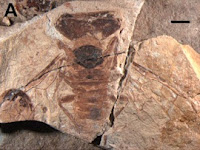
(A) Scanning electron micrograph of holotype of Parviformosus wohlrabeae in right lateral view. Scale bar is 1 mm. (B) Scanning electron micrograph of metasoma; 'x' highlights the dorsal ‘lip’ on metasomal segment 4, 'y' highlights contamination. Scale bar is 100 μm. (C) Scanningv electron micrograph of the detached ovipositor found in residue. Scale bar is 200 μm. Barling et al. (2013).


Parviformosus wohlrabeae is assigned to the Pteromalidae, a large diverse group of parasitoid Chalcid Wasps which have not previoulsy been described from the Mesozoic, the oldest until now having been a specimen in amber from the Late Eocene of Ukraine. It is also suggested that the specimen shows affinities with the Sycophaginae (Fig Wasps) due to the structure of its ovipositor, though it is at least 50 million years older than any known fossil Fig (or Fig Pollen).

Drawing of the holotype specimen of Parviformosus wohlrabeae in right lateral view with reconstruction of head. Abbreviations: Ct., contaminant; Cx.?, possible coxa; DC., damaged cuticle; E., eye; H., head; Tro.?, possible trochanter; Fm.?, possible femur; Lb., labial palpus; Msp.?, possible mesopleuron; Mst., mesothorax; Ms1-6., metasomal segments 1e6; Mlm., marginal lobe of mesosoma; MSc., mesoscutum; Nt.?, possible notaulus; OvP., ovipositor; Ppl., propleuron; Ppm., propodeum; Prt., prothorax; Pt., petiole; Sc., scutellum; LSc.?, possible lobe of scutellum; Tg.?, possible tegula; Wat., wing articulation; Wf., wing fragments. Dashed lines indicate inferred boundaries/edges of damage. Solid lines indicate clear boundaries/edges of damage. Dark grey area highlights petiole. Light grey area highlights damaged cuticle. Scale bar is 1 mm. Barling et al. (2013).


Follow Sciency Thoughts on Facebook.

Sunday, 20 January 2013

A new species of Chalcid Wasp from the Western Ghats of Kerala State, India.

Chalcid Wasps are among the most widespread and numerous of all Insects, with over 22 000 described species to date, and estimates of up to half a million species in total. Chalcids are found in almost every habitat on every continent except Antarctica, though they are often overlooked due to their small size. Most Chalcids are parasitoids, laying their eggs in other invertebrates, with the larvae devouring their hosts from the inside as they grow, though a few species mature their young in galls on plants or inside seeds. The larvae of Chalcid Wasps are known to parasitize Butterflies, Moths, Beetles, True Flies, True Bugs, Spiders and even Nematodes.

In a paper published in the Journal of Threatened Taxa on 26 May 2012, P.M. Sureshan of the Western Ghat Regional Centre of the Zoological Survey of India describes a new species of  Chalcid Wasp from the southern Western Ghats of Kerala State, India.

The new species is placed in the genus Cyrtoptyx, and given the specific name wayanadensis, after the Wayanad District where it was found. Cyrtoptyx wayanadensis is described from four female and one male specimens, found at an altitude of 834 m in the foot hills of Banasura peak. It is a 3-4 mm metalic blue Wasp with yellowish limbs and long, slender antennae. The host species for its larvae is unknown, but other members of the genus Cyrtoptyx are known to target Flies, Beetles, Butterflies and other Wasps.

Cyrtoptyx wayanadensis male (top) and female (bottom). Sureshan (2012).


Follow Sciency Thoughts on Facebook.