Showing posts with label Crato Formation. Show all posts

Saturday, 6 January 2024

Whip Scorpions and Camel Spiders from the Early Cretaceous Crato Formation of Brazil.

Whip Scorpions, Uropygi, are a highly distinctive group of Arachnids with large claws, robust, heavily sclerotized bodies and a long whip-like, post-abdominal flagellum, as well as the ability to squirt an offensive, vinegar-like liquid as a defence mechanism. There are about 126 extant species of Whip Scorpions, as well as eleven described fossil species, with the oldest coming from the Carboniferous. 

Camel Spiders, Solifugae, are large, Spider-like Arachnids, lacking the ability to produce silk, and having extremely enlarged chelicerae (fangs) and leg-like pedipalps which are held above the ground when moving. There are about 1209 extant species of Camel Spider, but only six known fossil species, the oldest of which again comes from the Carboniferous.

The Crato Formation outcrops on the northern flanks of the Chapada do Araripe, a plateau on the border between Ceará, Pernambuco andPiauí States in northern Brazil. In is noted for its exceptionally well-preserved fossils, which include Dinosaurs, Crocodiles, Fish, Pterosaurs, Crustaceans, Arachnids, Plants and most notably Insects, which are present in large numbers, often showing exceptional preservation. These Insects are of particular interest as they date from a time in the Early Cretaceous when Flowering Plants were rapidly diversifying, and relationships between Insect and Plant groups that would come to dominate the Earth’s terrestrial biology were being formed.

In a paper published in the journal PeerJ on 3 January 2024, William Santana, Allysson Pinheiro, Thiago Andrade Silva and Daniel Lima of the Museu de Paleontologia Plácido Cidade Nuvens at the Universidade Regional do Cariri describe a new species of Whip Scorpion from the Crato Formation, as well as a new specimen of the Crato Camel Spider Cratosolpuga wunderlichi.

The new Whip Scorpion species is placed in the genus Mesoproctus, and given the specific name rayoli in honour of Rafael Ribeiro Rayol a Brazilian federal attorney, who helped, along with the Brazilian Federal Police, helped recover a significant amount of fossil material from the Crato which was being smuggled out of the country (an ongoing problem for Brazilian palaeontology), including the specimens from which the species is described, as part of 'Operation Santana Raptor'.

Mesoproctus rayoli Holotype MPSC A4295. Ventral view. Scale bar is 30 mm. Santana et al. (2024).

Mesoproctus rayoli is described from two specimens, both recovered by Operation Santana Raptor the first of which is complete an measures 65.9 mm in length, while the second is incomplete, preserving only the forepart of the body. A third specimen in the collection of the Museum für Naturkunde Berlin, is also assigned to the species. This specimen was described as Mesoproctus sp. in 2002 in a paper by Jason Dunlop of the Museum für Naturkunde Berlin and David Martill of the University of Portsmouth, who collected the specimen legally in the 1990s. 

Mesoproctus rayoli Paratype MPSC A4205. Dorsal view. Scale bar is 10 mm. Santana et al. (2024).

The genus Mesoproctus was first designated by Jason Dunlop in 1998 to describe Mesoproctus rowlandi, from a single Crato specimen held in the collection of the Ulster Museum. The specimen described by Dunlop and Martill as Mesoproctus sp was substantially larger than the only known specimen of Mesoproctus rowlandiI, and neither were very well preserved, making it impossible for Dunlop and Martill to be sure that this was not an older specimen of the same species. The better preservation of Santana et al.'s specimens enables them to be confident that they do have a separate specimen, and that the Museum für Naturkunde Berlin specimen belongs to this.

Santana et al. also describe a new specimen of Cratosolpuga wunderlichi, a Camel Spider first described in 1996 by Paul Seldon, then of the University of Manchester and William Shear of Hampden-Sydney College, to describe a specimen from the Crato held by a private collector in Germany. Several other specimens of this species have subsequently been described, however, Santana et al.'s specimen shows several features which have not been seen before, including a styliform flagellum with a bulbous base on the chelicera, a structure present only in adult males. The specimen was collected at Santana do Cariri in Ceará State, Brazil, and donated to the Museu de Paleontologia Plácido Cidade Nuvens via the Projeto Força Tarefa, which encourages local children to collect and contribute fossils to the museum.

Cratosolpuga wunderlichi MPSC A6696. Dorsal view. Scale bar is 10 mm. Santana et al. (2024).

The new Arachnid specimens described by Sanatana et al. provide further insight into the nature of the Early Cretaceous Crato environment. They note that Whip Scorpions and Camel Spiders both favour arid environments, as do a number of other Arthropods and Plants found in these deposits. The theory that the Crato may have been arid is further supported by the presence of salt pseudomorphs and gypsum beds, which tend to form around hypersaline bodies of water in arid environments.

The study also emphasises the importance of both good law enforcement and community engagement programs in preserving the geological and palaeontological heritage of Brazil, and keeping material from important deposits such as Crato within the country, where they can be studied by local scientists and interpreted within the context of the environment where they were found.

See also...

Online courses in Palaeontology

Follow Sciency Thoughts on Facebook.

Follow Sciency Thoughts on Twitter.


Sunday, 4 June 2023

A Lotus from the Early Cretaceous Crato Formation of northeastern Brazil, and its implications for the origin of the group.

Angiosperms, or Flowering Plants, are the most numerous and diverse Plant group today, dominating almost all terestrial environments. The ealiest Angiosperm fossils appear an the Early Cretaceous, around the shores of the Tethys Ocean, with many Angiosperm groups appearing sudenly, in forms apparently not much different to today, making it impossible to tell how these groups are related without molecular data.

Lotuses, Nelumbonaceae, are aquatic Plants, superficially similar to Water Lilies, to which they were once thought to be related. They grow annually from submerged rhizomatous roots, producing large flar leaves with hydrophobic coatings which lie flat upon the water surface. Surprisingly, molecular analysis of Angiosperm relationships has revealed that Lotuses not closely related to Water Lilies, which are related to Magnolias, but instead are members of the Order Proteales (Proteas), most closely related to Plane Trees. This is particularly surprising as all other members of the Proteales are woody shrubs and trees, while Lotuses are aquatic annual herbs lacking any woody tissue. 

In a paper published in ths journal Scientific Reports on 2 June 2023, William Vieira Gobo of the Departamento de Paleontologia e Estratigrafa at the Universidade Federal do Rio Grande do Sul,  Lutz Kunzmann of the Abteilung Museum für Mineralogie und Geologie, Roberto Iannuzzi and Thamiris Barbosa dos Santos, also of the Departamento de Paleontologia e Estratigrafa at the Universidade Federal do Rio Grande do Sul, Domingas Maria da Conceição of the Museu dePaleontologia Plácido Cidade Nuvens at the Universidade Regional do Cariri, Daniel Rodrigues do Nascimento and Wellington Ferreira da Silva Filho of the Departamento de Geologia at the Universidade Federal do CearáJulien Bachelier and Clément Coifard of the Structural and Functional PlantDiversity Group at the Freie Universität Berlin, describe a new species of Lotus from the Early Cretaceous Crato Formation of Ceará State, Brazil.

The new species is described from pits to the southwest of Nova Olinda in the Araripe Basin of northeastern Brazil, and now in the collections of the Museum für Naturkunde in Berlin and the Senckenberg Forschungsinstitut und Naturmuseum in Frankfurt am Main. The authors acknowledge that there are currently unresolved issues concerning fossils from the Crato deposits, with the Brizilian government regarding all removal of the fossils from the country as illegal, and asking that collections in other parts of the world return them, but note that the Brazilian members of the team were invited by the German institutions to come and study the material. The Plant is named Notocyamus hydrophobus, where 'Notocyamus' means 'Southern Bean' in Greek, a refernce to the term 'Egyptian Bean' used by Teophrastos of Eresos to refer to Lotus seeds, and 'hydrophobus' refers to the hydrophobic leaves of Lotus Plants.

Notocyamus hydrophobus (holotype, MB. Pb. 2002/1047). (A) Overview of the whole plant, with roots, rhizome, leaves, and aggregate fruit in organic connection. A black arrow points to the part of the peduncle used to make the thin sections. (B) Details of higher-order venation. (C) Close-up of palinactinodromous venation and the marginal lamina attachment. (D) Close-up on the enlarged receptacle showing two globose fruitlets (presumed nutlets). Scale bars are 1 cm. Gobo et al. (2023).

The holotype specimen is about 30 cm high and about 25 cm wide, and comprises a rhizome with about 30 roots, 13 leaves, and a single fruiting body. Leaves are 60 to 95 cm long and 60 to 100 mm wide, and oval to eliptical in shape. They are attached to petiole stems 120-200 mm long and 5-10 mm wide. The cells of the leaves are discernable, larger on the upper side than on the lower with each cell bearing a single papilla (hair), agian larger above than below.

Notocyamus hydrophobus (paratype, SMF SM.B 16.522). (A) Isolated leaf. (B), (C) Close-ups of the pattern of venation. Note that abundant structures interpreted as galls occur along the lamina and petiole (arrows point to some of them). Scale bars are 5 mm. Gobo et al. (2023).

The fruiting body is borne on a peduncle stem 22.5 cm long and 4 mm wide. Notably, this peduncle has in inner pith layer surrounded by xylem (wood), a tissue not seen in any modern Lotus, but present in all other members of the Order Proteales. 

Notocyamus hydrophobus (holotype, MB. Pb. 2002/1047). (A)–(B) Transversal section of the peduncle. (A) Overview displaying homoxylic wood with abundant fbers interspersed with parenchymatous rays. Te dashed outline shows the rays connecting with primary xylem that form bundles near the pith. On the periphery, remains of the cambial zone occur in a discontinuous layer that is followed by new vascular increments. (B) Close-up of region near pith showing the primary xylem bundles and their connection with the rays. Abbreviations: pi. pith; px, primary xylem; sx, secondary xylem; r, ray; cz, cambial zone; vi, vascular increments; pxb, primary xylem bundles. Scale bars: (A) 1 mm; (B) 250 µm. Gobo et al. (2023).

The xylum tissue comprises an inner layer of 18 (or possibly 19) primary bundles, surrounded by a secondary homoxylic (vesselless) layer. No growth rings are present, and the whole is surrounded by an ounter layer thought to be the remains of the cambium (bark).

Notocyamus hydrophobus (holotype, MB. Pb. 2002/1047). Radial (A)–(G) and tangential (H) sections of the peduncle. (A) Overview of region adjacent to the pith (to the far right) showing vessels in the xylem followed by the secondary xylem with ray and fber cells (to the far left). (B) Primary xylem cells with helical thickenings and fbers of secondary xylem. (C) A vessel element with scalariform-like pits and simple perforation plates (arrows). (D) Close-up of a fiber showing simple (black arrow) and slit-like pits (white arrow). (E) Ray cells with slit-like pit apertures. (F) Overview of region near cambial zone (dashed outline) showing fber and ray cells in the secondary xylem followed by the layer that gives rise to the new vascular increments. (G) Fusiform and compressed cells from the cambial zone followed by tracheary elements with scalariform-like pits. (H) Ray cells in between fbers of secondary xylem. Abbreviations: v, vessels; px, primary xylem; r, ray; f, fber; cz, cambial zone; vi, vascular increments. Scale bars: (A), (F) 200 µm; (B), (C), (E), (G) 50 µm; (D) 25 µm; (H) 100 µm. Gobo et al. (2023).

The Crato Formation has not been dated precisely, but is thought to be slightly more than 120 million years old, which, if correct, would make Notocyamus hydrophobus the oldest known member of the Nelumbonaceae. Molecular dating techniques have suggested that the Nelumbonaceae branched from theit closest relatives, the Platanaceae (Plane Trees) between 83 and 123 million years ago. Since dates at the younger end of this range can be ruled out by other, more modern-looking fossil Lotuses it is not unreasonable to assume that the group dates from the earlier part of this bracket, or possibly a little older. Either way, the assumption that Notocyamus hydrophobus is a very early member of the group, still showing some similarities to non-Lotus relatives, is not unreasonable.

Reconstruction of Notocyamus hydrophobus in its likely environment. Rebecca Dart in Gobo et al. (2023).

See also...

Follow Sciency Thoughts on Facebook.

Follow Sciency Thoughts on Twitter.


Thursday, 27 February 2020

Preserved gum in an Early Cretaceous Welwitschiacean.

A wide variety of vascular plants produce fluid exudates such as resins and gums, with each group differing in chemical definitions. Due to similarity in physical appearance distinguishing exudates based on chemistry is vital, for example gums and resins are visually similar resulting in these terms being used interchangeably. However, their chemical definitions are very different; resins are composed of lipid-soluble terpenoids, while gums are complex, highly branched (non-starch) water-soluble polysaccharides. A common example of this misunderstanding is the Eucalyptus, which is known as a Gum Tree, but nuclear magnetic resonance analysis of the Eucalyptus exudate shows its composition to be polyphenolic and is therefore actually a kino (i.e. neither a gum nor a resin, bt closer in composition to resins). Differences between gum and resin can also be seen in the functional roles within the plant. The main roles of resins are to respond to wounding, as a defence against pathogens and to dissuade herbivory by Insects and other organisms. Gum is involved in food storage, structural support, and also for wound sealing, but there is no common role across taxa. Further confusion arises as some plants, e.g. Boswellia and Commiphora species, even produce exudates with a mixture of polysaccharide and resin components (the gum resins Myrrh and Frankincense respectively). Until now only fossilised plant resin (ambers) and latex filaments have been reported preserved in the fossil record. While the fossilisation of fluid exudates might seem unlikely, the fossilisation of resin is relatively common, and extends back some 320 million years to the Carboniferous, but chemically confirmed gums have never been reported.

In a paper published in the journal Scientific Reports on 25 February 2020, Emily Roberts of the School of the Environment, Geography and Geosciences at the University of Portsmouth, and the Department of Palaeontology at the University of Vienna, Leyla Seyfullah, also of the Department of Palaeontology at the University of Vienna, Robert Loveridge, also of the School of the Environment, Geography and Geosciences at the University of Portsmouth, Paul Garside of Conservation Research, at the British Library, and David Martill, again of the School of the Environment, Geography and Geosciences at the University of Portsmouth, describe the first known incidence of preserved gum in the fossil record, in a preserved Welwitschiacean leaf from the Early Cretaceous Crato Formation of Brazil.

The Early Cretaceous (approximately 120 million year old) Crato Formation utcrops on the northern flanks of the Chapada do Araripe, a plateaux on the border between Ceará, Pernambuco and Piauí States in northern Brazil. In is noted for the exceptionally well preserved fossils from the Nova Olinda Member, which include Dinosaurs, Crocodiles, Fish, Pterosaurs, Crustaceans, Arachnids, Plants and most notably Insects, which are present in large numbers, often showing exceptional preservation hese Insects are of particular interest as they date from a time in the Early Cretaceous when Flowering Plants were rapidly diversifying, and relationships between Insect and Plant groups that would come to dominate the Earth’s terrestrial biology were being formed.. Investigations of different groups of fossilized Animals from the Crato Formation show that they are preserved as various mineral replacements, and their preservation was microbially-mediated.

Stratigraphy of the Crato Formation. Stratigraphy of the Araripe Basin indicating the fossil bearing laminated limestones of the Nova Olinda Member of the Crato Formation. Roberts et al. (2020).

Amber has also previously been reported from the Crato Formation Lagerstätte, inside fossil plant remains and as isolated clasts, and is attributed to Conifers. The fossil leaves occur as compressions showing at least some three-dimensionality. An amber-coloured substance is visible in some of the fossil leaves of Welwitschiophyllum brasiliense from the Crato Formation.

Fossil Welwitschiophyllum leaves from the Crato Formation, Brazil showing three- dimensional preservation. (a) Complete Welwitschiophyllum leaf (UOP-PAL-MC0002). Showing three dimensionality. (b) A magnified view of Welwitschiophyllum (UERJ 14-P1) showing that the leaf is preserved three dimensionally with distinct parallel leaf tissues. Scale bars, (a) 10 mm (b) 5 mm. Roberts et al. (2020).

Welwitschiophyllum is considered a relative of the extant Gymnosperm Welwitschia mirabilis, the sole member of this Gnetalean genus. The Welwitschiaceae have a sparse macrofossil record, fossils assigned to this family, including Welwitschiophyllum, derive solely from the Crato Formation. However, the pollen record shows Welwitschiaceae were once a diverse and prevalent group that saw a decline with increasing Angiosperm pollen. Today, Welwitschia is restricted to the Namib Desert in Namibia and Southern Angola and has chemically confirmed gum in both the cone and in abaxial ducts within leaves.

Roberts et al. investigated this amber-coloured substance inside fossil Welwitschiophyllum leaves to test whether Welwitschiophyllum produced a resin (now fossilised as amber), or a gum like its presumed extant relative Welwitschia, using Fourier-transform infrared spectroscopy and Attenuated total reflectance spectroscopy. They report the first geochemical evidence for fossilised gum preserved inside Welwitschiophyllum leaves, and suggest areas for future investigation to understand how a roughly 120 million year old gum may have survived.

Fossils of Welwitschiophyllum occur as long detached leaves up to 850 mm in length with thin bands of an amber-like substance. These are particularly visible where the fossil surface has been abraded or removed. This substance in the Welwitschiophyllum leaves resembles amber in ducts, lying parallel to the long axis of the leaves. These ducts are inferred here as adaxial (upper leaf surface) due to the curvature of the leaf base. However, the absence of preserved cuticle and other anatomical features, means that their precise orientation cannot be confirmed. This constituent arrangement contrasts with the traumatic formation of gum in its presumed relative Welwitschia. Slight compaction of the specimens gives these ducts an ellipsoidal cross section, but they appear to have a repeating pattern showing a principal duct followed by a secondary duct ranging in diameter from 75 μm to 200 μm.

Fossil Welwitschiophyllum leaves with gum ducts from the Crato Formation, Brazil. (a) Complete elongate fossil leaf (UERJ 13-P1) showing a curved base and degraded fibrous apex, with a partially abraded surface (lighter part of fossil) exposing the internal leaf tissue and linear gum duct arrangement. (b) Detail from (a) (UERJ 13-P1) where the gum ducts appear as amber-brown structures within Welwitschiophyllum leaf tissue. (c) Transverse thin section through the fossil leaf (UERJ 14-P1) with arrowheads indicating the orange coloured gum ducts within the brown leaf tissue. The black line of tissue may be compressed remains of vascular tissue (below the leaf is the preserving sediment). (d) An oblique thin section of the leaf (UERJ 14-P1) showing the repeating pattern of the amber-coloured gum ducts. Scale bars, (a) 20 mm (b) 3 mm, (c) and (d) 500 μm. Roberts et al. (2020).

Analysis using Fourier-transform infrared spectroscopy and Attenuated total reflectance spectroscopy are commonly used on both living and fossil plants showing that complex biomolecules survive and are identifiable in the fossil record Fourier-transform infrared spectroscopy analyses compare living and fossil resin and gum samples. Additionally, Attenuated total reflectance spectroscopy analysis confirms that the amber-coloured substance in the fossil leaves, which was extracted and purified for testing, generated a spectrum closely matching those of published gum signatures and is remarkably similar to that of Welwitschia gum.

Thin section of a Welwitschiophyllum leaf. Thin section through the fossil leaf (UERJ 13-P1) showing amber-coloured gum ducts within brown leaf tissue. Scale bar, 500 μm. Roberts et al. (2020).

The discovery of in situ preserved plant gum is unusual because of its solubility in water. This is particularly striking in a formation thought to be deposited in a hypersaline lagoon setting. Solubility experiments were undertaken on Welwitschia gum to determine whether the increased salinity of the lagoon may have affected the solubility of the gum in any way. In the freshwater, brackish, normal marine, and hypersaline water tests the extracted gum dissolved within 49–59 minutes, showing that salinity does not affect solubility, and therefore the preservation (or not) of exposed gum.

Roberts et al.'s analyses of the amber-coloured substance inside the fossil Welwitschiophyllum leaves shows a distinct chemical spectrum that clearly differs from those of ambers and resins, but which closely compares to plant gum spectra. This means that the recovered substance from the Crato Formation fossil Welwitschiophyllum leaves is a preserved gum and not an amber formed from resin. The chemically detected presence of gum in ducts inside two separate fossil leaves confirms that this is not an isolated occurrence within these Crato Formation fossils.

Due to the soluble nature of gum, its preservation in the fossil record is unexpected. This is particularly notable here as the leaves containing gum were firstly deposited in a hypersaline lagoon, then later this deposit was exposed to continental weathering. Thus, water featured in both the formation and weathering of the Crato Formation, yet the gum persisted. The gum solubility experiments showed that in each case of differing salinities the extracted Welwitschia gum dissolved, so saline levels appear to have no bearing on gum preservation.

How the gum came to be preserved is currently not understood and further investigation is needed into the taphonomic and diagenetic processes surrounding these gum-preserving fossil leaves. We can speculate that there are at least two factors involved. Firstly, the nature of the microbially-mediated taphonomy and diagenesis in the Crato palaeo-lake setting has been shown to be critical in the preservation of labile structures in animals from the Crato Formation Konservat-Lagerstätte. Secondly, perhaps only in part, the coriaceous nature of the fossil leaves played a role. Both the surrounding duct tissue and the large amount of resistant embedding leaf tissues would have provided some protection from dissolution in water. In extant Welwitschia the outer walls of the epidermal cells are specialised with three layers, thickening and strengthening the epidermis, but the preservation of the fossil leaves prohibits epidermal comparison. The regular arrangement of ducts in Welwitschiophyllum suggests that they were formed through duct initiation, i.e. constituent, as opposed to the stress initiated response known as gummosis. Their formation was likely to be used for food storage or structural support, signifying that the hydrophilic gum was constituent within the fossil leaves.

Despite the very low preservation potential of a highly water-soluble exudate, the first preserved gum was recovered from the Early Cretaceous. This fossil gum presents a chemical signature remarkably similar to gum in extant Welwitschia and distinct from those of fossil resins. This shows that gum production in plants extends back into the fossil record by at least 120 million years. This is then the first report of a highly soluble biomolecule recovered from the Crato Formation and future work should focus on how this preserved gum survived. Furthermore, fossilised plants with observed internal ‘resins’ should be chemically confirmed in case further instances of gums or other types of plant exudate can be identified from the fossil record.

See also...

https://sciencythoughts.blogspot.com/2017/10/santanmantis-axelrodi-new-specimen-of.htmlhttps://sciencythoughts.blogspot.com/2017/07/parababinskaia-elegans-new-species-of.html
https://sciencythoughts.blogspot.com/2017/06/gondwanagaricites-magnificus-new.htmlhttps://sciencythoughts.blogspot.com/2015/06/preserved-feathers-in-enantiornithine.html
https://sciencythoughts.blogspot.com/2015/02/understanding-preservation-of-insects.htmlhttps://sciencythoughts.blogspot.com/2013/08/a-chalcid-wasp-from-early-cretaceous-of.html
Follow Sciency Thoughts on Facebook.

Friday, 6 October 2017

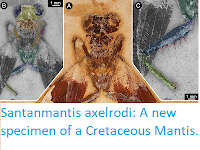
Santanmantis axelrodi: A new specimen of a Cretaceous Mantis.

Praying Mantises (Mantodea) are large carnivorous Insects related to Cockroaches and Termites. They are easily recognised for their large, highly modified forelegs, which are no longer used for locomotion but instead used to strike rapidly and snatch prey. Mantises are well known in popular culture for the habit, seen in the females of some species, of consuming the males during mating, although as a group they show a wide range of behavioural and physical adaptations. The oldest known fossil Mantis comes from the Late Jurassic of Mongolia, with the group diversifying during the Cretaceous and Early Tertiary. One important Mesozoic locality for Mantises is the Early Cretaceous Crato Formation of Brazil, a fossil lagerstatte known for its numerous exceptionally well preserved Insects. Two species of Mantis have been described from the Crato Formation, the rather Cockroach-like Raptoblatta waddingtonae, and the slightly more modern-appearing  Santanmantis axelrodi.

In a paper published in the journal PeerJ on 24 July 2017, Marie Hörnig of the Zoological Institute and Museum at Ernst-Moritz-Arndt Universität Greifswald, and Joachim Haug and Carolin Haug of the Biocenter, Department of Biology II and GeoBio-Center at Ludwig-Maximilians-Universität München, describe a new specimen of Santanmantis axelrodi from the Crato Formation.

The new specimen comprises the head, forewings and forepart of the thorax of the Insect, preserved in dorsal view. The specimen is confirmed as belonging to Santanmantis axelrodi on the basis of its wing venation, though its wings show it to be considerably larger than any previously described specimen with a forewing of 16 mm, compared to 10-13 mm in those specimens. Interestingly the specimen has preserved spines on its second pair of legs, something which is found in modern Mantises, and helps with prey capture, but which had not previously been seen in Santanmantis axelrodi.

New specimen of Santanmantis axelrodi. (A) Overview. (B) Colour-marked version of (A); dark blue: eyes, yellow: head capsule, brown: tergite of thorax segment 1 (pronotum), orange: prothoracic femur, purple: prothoracic tibia, dark green: mesothoracic coxa, indigo: mesothoracic trochanter, blue: mesothoracic femur, light green: mesothoracic tibia, red: spines. (C) Detail of appendage of thorax segment 2, same colour code as in (B). Hörnig et al. (2017)

See also...

http://sciencythoughts.blogspot.co.uk/2017/07/parababinskaia-elegans-new-species-of.htmlhttp://sciencythoughts.blogspot.co.uk/2017/06/gondwanagaricites-magnificus-new.html
http://sciencythoughts.blogspot.co.uk/2015/06/preserved-feathers-in-enantiornithine.htmlhttp://sciencythoughts.blogspot.co.uk/2015/02/understanding-preservation-of-insects.html
http://sciencythoughts.blogspot.co.uk/2014/05/a-new-species-of-praying-mantis-from.htmlhttp://sciencythoughts.blogspot.co.uk/2013/08/a-chalcid-wasp-from-early-cretaceous-of.html
Follow Sciency Thoughts on Facebook.

Friday, 21 July 2017

Parababinskaia elegans: A new species of Babinskaiid Lacewing from the Early Cretaceous Crato Formation of Brazil.

The Babinskaiidae are an extinct family of Lacewings (Neuroptera) best known from the Early Cretaceous Crato Formation of Brazil, as well as from the Zaza Formation of southern Siberia and Burmese Amber deposits from Kachin State, Myanmar. They are small Lacewings, with forewings 9-12.7 mm in length, differentiated from other groups by the venation of their forewings (very few specimens have preserved hindwings).

In a paper published in the journal Cretaceous Research on 15 June 2017, Vladimir Makarkin of the Federal Scientific Center of the East Asia Terrestrial Biodiversity of the Far Eastern Branch of the Russian Academy of Sciences, Sam Heads of the Illinois Natural History Survey at the University of Illinois at Urbana-Champaign, and Sonja Wedmann of the Messel Research Station of the Senckenberg Research Institute, describe a new species of Babinskaiid Lacewing from the Crato Formation, as part of a wider review of the group.

The new species is named Parababinskaia elegans, where ‘Parababinskaia’ means ‘beside-Babinskaia’ in reference to another genus which it resembles., and ‘elegans’ means ‘elegant’, in reference to the quality of the specimen from which it is described. The species is described from a single specimen from the collection of the Illinois Natural History Survey. This specimen is preserved in a slab of finely laminated limestone, and is almost complete, lacking only the legs and detail of the forewings missing (unusually the hindwings are extremely well preserved). 

Parababinskaia elegans; specimen as preserved (wetted with ethanol). Scale bar represents 2 mm. Jared Thomas in Makarkin et al. (2017).

See also...

http://sciencythoughts.blogspot.co.uk/2016/11/lasiosmylus-longus-new-species-of.htmlhttp://sciencythoughts.blogspot.co.uk/2016/08/paleosisyra-minor-new-species-of.html
http://sciencythoughts.blogspot.co.uk/2016/02/butterflies-of-jurassic-convergent.htmlhttp://sciencythoughts.blogspot.co.uk/2015/12/glenochrysa-minima-new-species-of-green.html
http://sciencythoughts.blogspot.co.uk/2014/07/a-silky-lacewing-from-eocene-of.htmlhttp://sciencythoughts.blogspot.co.uk/2014/05/a-new-species-of-osmylid-from-middle.html
Follow Sciency Thoughts on Facebook.

Sunday, 11 June 2017

Gondwanagaricites magnificus: A new species of Mushroom from the Early Cretaceous Crato Formation of Brazil.

Fungi are the second most diverse group of Eukaryotic organisms (organisms with their genetic material contained within a nucleus), found in almost every ecosystem on Earth, and with a fossil record dating back 1430 million years. However almost all Fungal fossils are of spores, and the vast majority of the remaining specimens are the sexual stages of Ascomycete Fungi (‘Microfungi’; Moulds and Rusts etc.). Basidiomycote Fungi (‘Macrofungi’) produce more obvious fruiting bodies, such as Mushrooms, and are the Fungi most familiar to the public. There are about 30 000 extant species of Basidiomycotes, and the group has a fossil record dating back 330 million years, with molecular clock data suggesting they split from the Ascomycetes between 500 million and 1.2 million years ago. However to date only ten fossil Mushrooms have been described, all preserved as inclusions in amber, with the oldest coming from Middle Cretaceous Burmese Amber, and examples also known from Cretaceous amber form New Jersey, Eocene Baltic Amber and Miocene Dominican Amber.

In a paper published in the journal PLoS One on 7 June 2017, Sam Heads, Andrew Miller, Leland Crane, Jarred Thomas and Danielle Ruffatto of the Illinois Natural History Survey at the University of Illinois at Urbana-Champaign, Andrew Methven of the Department of Biology at Savannah State University, Daniel Raudabaugh, also of the Illinois Natural History Survey, and of the Department of Plant Biology at the University of Illinois at Urbana-Champaign, and Yinan Wang of Arlington in Virginia, describe a new fossil Mushroom from the Early Cretaceous Crato Formation of Brazil.

The Crato Formation outcrops on the northern flanks of the Chapada do Araripe, a plateaux on the border between Ceará, Pernambuco andPiauí States in northern Brazil. In is noted for its exceptionally well preserved fossils, which include Dinosaurs, Crocodiles, Fish, Pterosaurs, Crustaceans, Arachnids, Plants and most notably Insects, which are present in large numbers, often showing exceptional preservation. These Insects are of particular interest as they date from a time in the Early Cretaceous when Flowering Plants were rapidly diversifying, and relationships between Insect and Plant groups that would come to dominate the Earth’s terrestrial biology were being formed.
 
The new Mushroom is named Gondwanagaricites magnificus, where ‘Gondwanagaricites’ means ‘Mushroom from Gondwana’ (Gondwana being an ancient supercontinent of which South America was a part in the Early Cretaceous), and ‘magnificus’ means ‘magnificant’. The species is described from a single specimen 10.0 mm in diameter and about 7.5 mm in height, on a 34.0 mm stipe (stem), with preserved gills but no spores. The specimen was found on a small slab thought to have come from one of the extensive quarry complexes near the town of Nova Olinda, with lithology consistent with the Nova Olinda Member of the Crato Formatiom, making it between 113 and 120 million years old, making it between 14 and 20 million years older than the previous oldest described fossil Mushroom. The specimen was formerly housed at the Illinois Natural History Survey, but has since been repatriated and is now housed at the URM Herbarium at the Universidade Federal de Pernambuco in Recife, Brazil. 

Gondwanagaricites magnificus. (A) Photomicrograph of holotype showing general habitus. (B) Interpretive drawing of (A) with major morphological features indicated. The red box indicates the position of preserved gills shown below. Heads et al. (2017).

 Scanning electron micrographs of the gills of Gondwanagaricites magnificus: Section of preserved gills (location indicated by red box above). Heads et al. (2017).

See also...
http://sciencythoughts.blogspot.co.uk/2016/03/helvella-sublactea-new-species-of.htmlhttp://sciencythoughts.blogspot.co.uk/2015/06/preserved-feathers-in-enantiornithine.html
http://sciencythoughts.blogspot.co.uk/2015/02/understanding-preservation-of-insects.htmlhttp://sciencythoughts.blogspot.co.uk/2015/02/four-new-species-of-mushroom-from.html
http://sciencythoughts.blogspot.co.uk/2013/08/a-chalcid-wasp-from-early-cretaceous-of.htmlhttp://sciencythoughts.blogspot.co.uk/2013/05/an-early-woodwasp-from-early-cretaceous.html
Follow Sciency Thoughts on Facebook.