Showing posts with label Coprolites. Show all posts

Tuesday, 7 March 2023

Coastal erosion exposes part of former coprolite mine on the Yorkshire Coast.

Two walkers on the coast at Speeton in North Yorkshire, England, have discovered a series of posts eroding out of a cliff that are thought to have been part of an nineteenth century mine. Terri-Leigh Broadhead contacted local archaeologist Trevor Brigham after discovering the posts while walking on the beach with her father. Brigham at first thought they might have been associated with an eighteenth century clay mine, but upon further investigation decided the posts are more likely to have been part of a nineteenth century 'coprolite' mine, which excavated phosphorus nodules for use in the fertilizer industry. 

Wooden support posts from a nineteenth century mine exposed on the coast at Speeton in North Yorkshire. Yorkshire Post.

Phosphate 'coprolites' were mined at a number of sites around the UK in the nineteenth century, following the discoveries that phosphorus (initially obtained from Bird guano in South America) was beneficial in improving the fertility of soils, and then that this could be obtained by treating phosphate nodules with sulphuric acid. At the time all such nodules were widely believed to be coprolites (fossil dung), following publications on the subject by the geologists William Buckland and John Henslow, although, while these mines did produce coprolites and other fossils, the majority of the material would have been non-coprolitic in origin.

Phosphate nodules form when phosphorus-rich organic material, such as Animal dung or bone, is buried in shallow marine settings, where sulphur-oxidising Bacteria will tend to break down other tissues, but phosphorus becomes trapped as phosphate. In environments where these settings are subjected to repeated intervals of sedimentation and erosion, this will lead to an unconformity (part of a geological sequence where there is an erosional surface marking a period of time not recorded) topped by a gravel bed with phosphate nodules. In some settings a sequence of these phosphate nodule-rich gravel beds can build up that is thick enough to be worth mining.

These phosphate nodule accumulations are often fossil-rich, as the remains of the Animals from which the phosphates are derived become trapped in the nodules, and some extremely famous fossil deposits are formed in this way, such as the Kem Kem Beds of Morocco. Victorian palaeontologists were aware of this, and like palaeontologists today, were very interested in phosphate nodules, but the bulk of the material recovered from phosphate mines such as Speeton would have been ground up and treated with acid to recover their phosphorus, which would then have been used as fertilizer to help feed the growing populations of Britain's new industrial cities.

See also...

Follow Sciency Thoughts on Facebook.

Follow Sciency Thoughts on Twitter.


Sunday, 21 April 2019

Silesaurus opolensis: Coprolites from the Late Triassic of Poland shed light on the diet of a Dinosauriform Archosaur.

Coprolites, fossil feces, can be highly useful tools to paleontologists, helping them to understand diversity and trophic relationships in ancient ecosystems, and on occasion specific animals. Coprolites can contain a variety of useful items, such as residues, microbiota and parasites, and since they often have high phosphorous levels, can mineralise rapidly after deposition, allowing the preservation of soft tissues within them that might escape preservation elsewhere - as long as those soft tissues have first survived passage through the coprolite-producers digestive system. The size and shape of coprolites can provide clues as to the animal which produced them, while examining the contents is generally accomplished by cutting them into thin sections, a destructive process which may miss some of the contents.

In a paper published in the journal Royal Society Open Science on 13 March 2019, Martin Qvarnström and Joel Vikberg Wernström of the Department of Organismal Biology at Uppsala University, Rafał Piechowski of the Institute of Paleobiology of the Polish Academy of Sciences, and the Department of Palaeobiology and Evolution at the University of Warsaw, Mateusz Tałanda, also of the Department of Palaeobiology and Evolution at the University of Warsaw, and Per Ahlberg and Grzegorz Niedźwiedzki, also of the Department of Organismal Biology at Uppsala University, describe the contents of a selection of coprolites from the Late Triassic of Krasiejów in Upper Silesia, Poland, which were scanned using propagation phase-contrast synchrotron microtomography at the European Synchrotron Radiation Facility in Grenoble, France, enabling a three dimensional reconstruction of their contents.

The Late Triassic deposits exposed at Krasiejów are about 30 m in depth, and include two fossiliferous layers, each about 1.0-1.5 m in depth. These appear to represent two separate ecosystems, with the lower one containing freshwater organisms such as Fish, Temnospondyl Amphibians, Crocodile-like Phytosaurs, and aquatic Invertebrates, while the other contains animals such as Lizard-like Sphenodonts, Silesaurid Dinosauriforms, predatort Rauisuchids, and armoured Aetosaurs. Both are thought to be Late Carnian in age (between 230 and 227 million years old).

Stratigraphic column of the Krasiejów, Upper Silesia, Poland, site. (a) Composite lithostratigraphic column compiled from exposures measured in the clay-pit with positions of bone-bearing intervals and layer with coprolites. (b), (c) Photographs of the lower (b) and upper (c) coprolite-bearing intervals. (d ) Three dimensional surface models of the studied coprolite specimens. Qvarnström et al. (2019).

Qvarnström et al. examined six coprolites from Krasiejów, three from the lower, aquatic-fauna horizon, and two from the higher, terrestrial fauna horizon, ranging from 31 to 54.5 mm in length, and 16 to 22 mm in width. These contained a variety of Arthropod fragments, including Beetle elytra, other Beetle fragments, parts of unidentified Insects, and other parts of less clear origins.

Coproliteand identified inclusions. (a) Carabid prosternum. (b) Beetle tibia. (c) Beetle tibia. (d ) Entire coprolite in semi-transparent with the identified inclusions as well as some of the indeterminable Arthropod/Insect remains (green). (e) Beetle elytra. (f ) Beetle elytra. (g) Elytron of a Polyphagan (?) Beetle. (h) Beetle elytra. (i) Fragmented large elytron. ( j) Wedge-shaped elytron. (k,l) Two Beetle pronotums. Qvarnström et al. (2019).

There is a clear correlation between the size of the coprolites and the size of the largest Arthropod fragments, although the largest fragments are far smaller than the coprolites. Qvarnström et al. suggest that this may be evidence that the coprolite-producer had a way of separating out larger fragments before they enter the lower digestive tract, possibly regurgitating them as pellets in the same way as modern Birds.

Coprolites  with inclusions. (a) Concretion (semi-transparent) with internal fragmentary coprolite with inclusions. (b) A selection of six Beetle elytra. (c) A part of an Insect appendage? (d ) Enigmatic curved inclusion with denticles on the concave side. (e) Abdomen of an unknown Arthropod. (f ) Semi-transparent coprolite with highlighted inclusions. (g) Two Beetle elytra. (h) Semitransparent coprolite with highlighted inclusions. (i) Thorax plate of unknown Insect. (j) Abdomen of an unknown Arthropod (same as in e). (k) Two Beetle elytra. (l ) Semi-transparent coprolite with highlighted inclusions. (m) A bilateral structure of unknown affinity. (n) Three beetle elytra. (o) A swirl-shaped inclusion maybe representing some inner Insect structure (cf. digestion). Qvarnström et al. (2019).

All of the coprolites are of similar size and shape, and have similar contents, leading Qvarnström et al. to conclude they were all made by the same type of animal, and the absence of any Fish or Plant fragments suggests that the coprorolite producer was an Insectivore rather than a more general carnivore or herbivore. The coprolites appear to have come from a medium-sized producer, they seem to large to have come from any insectivorous Cynodont, Archosaur, or Lepidosaur likely to have been in the area, while the Phytosaurs and Temnospondyls present all show adaptations for piscavory (a diet of Fish) and the Rauisuchians appear to be to large.

The Bird-like Silesaurid Dinosauriform Silesaurus opolensis, however, would seem to be a good candidate for the coprolite-producer, being about the right size, and showing a number of characteristics that could be interpreted as evidence for an insectivorous diet (though it has been previously interpreted as a herbivore). The teeth of this species are triangular, but blunt, and irregularly distributed on the jaw. These teeth lack any of the microwear generally associated with herbivory, nor do they have the course serrations generally associated with a diet of Plants. The jaws of the species lack the capacity for much movement, something that might be expected in an animal tackling tough plant material, and the front part of the jaw is toothless, apparently having been covered by some sort of slender beak, a structure that might be useful for picking out Insects in a complex environment.

The proposed coprolite producer Silesaurus opolensis and some anatomical characters. (a) Braincase in posterior view (oc, paroccipital process; nc, neural canal). (b) Dentary bone in lateral view (bk, beak). (c) Life reconstruction of head. Drawing by Małgorzata Czaja. Qvarnström et al. (2019).

See also...

https://sciencythoughts.blogspot.com/2019/04/antarctanax-shackletoni-new-species-of.htmlhttps://sciencythoughts.blogspot.com/2018/12/smok-sp-large-predatory-rauisuchian.html
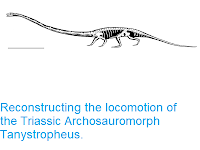
https://sciencythoughts.blogspot.com/2018/03/reconstructing-locomotion-of-triassic.htmlhttps://sciencythoughts.blogspot.com/2018/03/archosauromorph-remains-from-early.html
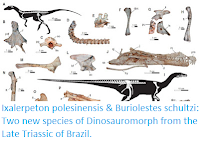
https://sciencythoughts.blogspot.com/2016/11/ixalerpeton-polesinensis-buriolestes.htmlhttps://sciencythoughts.blogspot.com/2016/03/teyujagua-paradoxa-archosauromorph-from.html
Follow Sciency Thoughts on Facebook.

Monday, 17 June 2013

Fossil Tapeworm eggs from the Permian.

Tapeworms (Cestoda) are parasitic Flatworms that live in the digestive tracts of Vertebrate hosts, attaching themselves to the intestine wall and absorbing nutrients through their skins. Adult Tapeworms engage in sexual reproduction, producing eggs which are passed out of the host in its feces. Juvenile Tapeworms often inhabit one or more intermediate hosts before reaching their final adult stage, growing in the gut till they reach a certain size, then migrating to other tissues where they form cysts, becoming dormant till the animal dies and is eaten by the next host in the life-cycle.

In a paper published in the journal PLoS One on 30 January 2013, a team of scientists led by Paula Dentzien-Dias of the Laboratório de Paleontologia e Paleoceanografia at the Instituto de Oceanografia at the Universidade Federal do Rio Grande, announce the discovery of a number of fossilized tapeworm eggs in a coprolite (fossil feces) from the Mid to Late Permian Rio do Rasto Formation in the
municipality of São Gabriel in southern Brazil.

The coprolite is interpreted to have come from a Shark, due to its distinctive spiral shape, which is still seen in the feces of modern Sharks. The eggs are smooth shelled, ovoid structures 145–155 μm long, grouped together in a 1 × 4 mm cluster. This arrangement is typical of modern Tapeworms, who periodically shed clusters of eggs inside cast off body segments (proglottids).

The cluster of eggs from the Permian Shark coprolite in thin section. Dentzien-Dias et al. (2013).

Some of the eggs appear broken, and one has a developing embryo preserved. This egg only possesses part of the outer capsule, but retains a multi-layered inner capsule surrounding the embryo. Dentzien-Dias et al. theorize that the outer capsule has undergone apoptosis as modern Tapeworm eggs do.

Cestode eggs. (Top) The perfect oval shape hole were formed after the filling were reaped out from the coprolite during the lamination, the arrows show the operculum. (Bottom left) Egg with a developing embryophore. (Bottom right). Partial reconstruction of egg in (Bottom left). Abbreviations: C = capsule or shell; E = embryophore (ochosphere); H= putative developing hooklets; I = inner envelope; M= oncospheral membrane; O= outer envelope; P = putative polar thickening; Op = operculum; S = somatic cells. Dentzien-Dias et al. (2013).


The coprolite contains pyrite inclusions, which suggests it almost certainly sank into anoxic waters; the fossil bed it was found in is thought to have formed at the bottom of a freshwater lake. Coprolites with pyrite and preserved Tapeworm eggs have previously been found at neolithic sites, supporting this method of preservation, but nothing remotely as ancient as this find, which is thought to be around 270 million years old. Since it is more-or-less impossible to tell modern Tapeworm eggs apart visually, no attempt at lower level classification of the eggs is made.

Spiral heteropolar coprolite with cestode eggs. Dentzien-Dias et al. (2013).

See also The effect of parasitic Nematodes on European Eels, Two new species of terrestrial Flatworm from Brazil, An invasive Serpulid Worm in the La Encrucijada Biosphere Reserve, MexicoBlue Flatworms invade Menorca and Evidence of fungal parasites modifying the behavior of ants from the Eocene Messel Shale.

Follow Sciency Thoughts on Facebook.