Showing posts with label Cestode. Show all posts

Thursday, 5 October 2017

Rhinebothrium reydai: A new species of Tapeworm from a Caribbean Stingray.

The Potamotrygonidae are a unique group of Freshwater Stingrays found in the rivers of South America. They were originally thought to have colonised the continent from the Atlantic, since they are found only in rivers that drain into that ocean. However genetic studies have suggested that these Rays are in fact more closely related to Pacific species, and that the species found furthest west (i.e. upstream) are more closely related to marine species than those further downstream, suggesting that the first colonists had come from the Pacific, and that the invasion of South America must therefore have occurred before the rise of the Andes Mountains. This was a surprising conclusion, and provoked scientists to look for more evidence. One place where this was found was in the Tapeworms (Cestoda) that infect the intestines of these Rays, which were found to follow the same genetic pattern, with species found furthest from the sea most closely related to their marine relatives.  Because these Rays appeared to have invaded the continent before the rise of the Andes, they were for a long time presumed to have no close relatives in the seas, however, recent studies of the Indo-Pacific Stingsay genus Himantura revealed that two species previously assigned to it were in fact more closely related to the Freshwater Stingrays of South America; so closely related, in fact, that they were placed in a new genus, Styracura within the family Potamotrygonidae, the first marine Rays assigned to this group.

In a paper published in the journal Zootaxa on 3 August 2017, Bruna Trevisan and Fernando Marques of the Laboratório de Helmintologia Evolutiva at the Universidade de São Paulo describe a new species of Cestode Tapeworm from the intestine of the Caribbean Whiptail Stingray, Styracura schmardae, one of the two species of marine Potamotrygonid.

Tapeworms are parasitic Flatworms that live in the digestive tracts of Vertebrate hosts, attaching themselves to the intestine wall and absorbing nutrients through their skins. Adult Tapeworms engage in sexual reproduction, producing eggs which are passed out of the host in its feces. Juvenile Tapeworms often inhabit one or more intermediate hosts before reaching their final adult stage, growing in the gut till they reach a certain size, then migrating to other tissues where they form cysts, becoming dormant till the animal dies and is eaten by the next host in the life-cycle. 

The new species is placed in the genus Rhinebothrium, which is found in a wide range of Batoids, and given the specific name reydai, in honour of Florian Reyda, an expert on Cestodes who took part in the expedition to the Caribbean coast of Panama that recovered the Stingrays from which this species was first discovered. The species was found living in five Stingrays caught off the coast of Almirante in Bocas Del Toro Province. The Worms were up to 7.4 mm in length with as many s 64 segmants, and were attached to the lining of the intestine by s scolex ('head') with four stalked, bilobed bothridia (suckers).

Scanning electron micrograph showing the scolex of Rhinebothrium reydai. Trevisan &Marques (2017).

See also...

http://sciencythoughts.blogspot.co.uk/2016/09/potamotrygon-albimaculata-potamotrygon.htmlhttp://sciencythoughts.blogspot.co.uk/2016/08/cratera-viridimaculata-new-species-of.html
http://sciencythoughts.blogspot.co.uk/2015/03/a-trematode-flatworm-from-intestines-of.htmlhttp://sciencythoughts.blogspot.co.uk/2014/07/a-new-species-of-liver-fluke-from.html
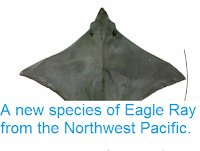
http://sciencythoughts.blogspot.co.uk/2014/01/deepwater-sharks-from-early-miocene-of.htmlhttp://sciencythoughts.blogspot.co.uk/2014/01/a-new-species-of-eagle-ray-from.html
Follow Sciency Thoughts on Facebook.

Monday, 17 June 2013

Fossil Tapeworm eggs from the Permian.

Tapeworms (Cestoda) are parasitic Flatworms that live in the digestive tracts of Vertebrate hosts, attaching themselves to the intestine wall and absorbing nutrients through their skins. Adult Tapeworms engage in sexual reproduction, producing eggs which are passed out of the host in its feces. Juvenile Tapeworms often inhabit one or more intermediate hosts before reaching their final adult stage, growing in the gut till they reach a certain size, then migrating to other tissues where they form cysts, becoming dormant till the animal dies and is eaten by the next host in the life-cycle.

In a paper published in the journal PLoS One on 30 January 2013, a team of scientists led by Paula Dentzien-Dias of the Laboratório de Paleontologia e Paleoceanografia at the Instituto de Oceanografia at the Universidade Federal do Rio Grande, announce the discovery of a number of fossilized tapeworm eggs in a coprolite (fossil feces) from the Mid to Late Permian Rio do Rasto Formation in the
municipality of São Gabriel in southern Brazil.

The coprolite is interpreted to have come from a Shark, due to its distinctive spiral shape, which is still seen in the feces of modern Sharks. The eggs are smooth shelled, ovoid structures 145–155 μm long, grouped together in a 1 × 4 mm cluster. This arrangement is typical of modern Tapeworms, who periodically shed clusters of eggs inside cast off body segments (proglottids).

The cluster of eggs from the Permian Shark coprolite in thin section. Dentzien-Dias et al. (2013).

Some of the eggs appear broken, and one has a developing embryo preserved. This egg only possesses part of the outer capsule, but retains a multi-layered inner capsule surrounding the embryo. Dentzien-Dias et al. theorize that the outer capsule has undergone apoptosis as modern Tapeworm eggs do.

Cestode eggs. (Top) The perfect oval shape hole were formed after the filling were reaped out from the coprolite during the lamination, the arrows show the operculum. (Bottom left) Egg with a developing embryophore. (Bottom right). Partial reconstruction of egg in (Bottom left). Abbreviations: C = capsule or shell; E = embryophore (ochosphere); H= putative developing hooklets; I = inner envelope; M= oncospheral membrane; O= outer envelope; P = putative polar thickening; Op = operculum; S = somatic cells. Dentzien-Dias et al. (2013).


The coprolite contains pyrite inclusions, which suggests it almost certainly sank into anoxic waters; the fossil bed it was found in is thought to have formed at the bottom of a freshwater lake. Coprolites with pyrite and preserved Tapeworm eggs have previously been found at neolithic sites, supporting this method of preservation, but nothing remotely as ancient as this find, which is thought to be around 270 million years old. Since it is more-or-less impossible to tell modern Tapeworm eggs apart visually, no attempt at lower level classification of the eggs is made.

Spiral heteropolar coprolite with cestode eggs. Dentzien-Dias et al. (2013).

See also The effect of parasitic Nematodes on European Eels, Two new species of terrestrial Flatworm from Brazil, An invasive Serpulid Worm in the La Encrucijada Biosphere Reserve, MexicoBlue Flatworms invade Menorca and Evidence of fungal parasites modifying the behavior of ants from the Eocene Messel Shale.

Follow Sciency Thoughts on Facebook.