Showing posts with label Crocodiloformes. Show all posts

Saturday, 17 March 2018

Woman killed by Crocodile in Zambezi District, Zambia.

A woman has died and a second has been badly injured in separate Crocodile attacks in the Zembezi District, of Northwestern Province, Zambia this week. Mijet Mapeni, 20, of Chakujimbula village, was attacked while fishing in the Makondo River, her body being found recovered later. Marjory Njapau, also 20, of Kadiombo village, was attacked while bathing in the Lunuyi stream, and suffered multiple injuries. She is currently being held in Zebezi District Hospital, where her condition is described as stable.

A Nile Crocodile, Crocodylus niloticus, by the Kafue Riverin Zambia. Hans Hillewaert/Wikimedia Commons.

Zambia is home to two Crocodile species, the Nile Crocodile, Crocodylus niloticus, and the Slender Snouted Crocodile, Crocodilus cataphractus, though the later is found only around Lake Bangweulu and the Luapula River in Northern and Luapula Provinces, so the Zambezi District attacks were almost certainly carried out by Nile Crocodiles. Nile Crocodiles are large animals, reaching about five meters in length, and are ambush predators capable of taking large prey, including, on occasion, Humans. The animals are thought to be at their most dangerous around September on the Zambezi, when the water is lowest, and females are guarding eggs buried in nests by the river.
 
 The location of Zambezi District, where two woman were attacked by Crocodiles this week. Google Maps.
 
Nile Crocodiles are considered to be of Least Concern under the terms of the  International Union for the Conservation of Nature’s Red List of  Threatened Species, but are still protected in many countries, including Zambia, due to historic hunting which decimated populations in many areas. However, the rising number of attacks on Humans by the animals has led to calls for regulated hunting to be introduced to control the population.
 
See also...
 
http://sciencythoughts.blogspot.co.uk/2018/03/crocodiles-and-tortoises-from-late.htmlhttp://sciencythoughts.blogspot.co.uk/2018/02/saltwater-crocodile-kills-man-in.html
 
http://sciencythoughts.blogspot.co.uk/2017/12/cholera-outbreak-kills-forty-one-in.htmlhttp://sciencythoughts.blogspot.co.uk/2017/12/artisanal-miers-allegedly-shot-after.html
http://sciencythoughts.blogspot.co.uk/2017/12/crocodile-kills-man-in-karonga.htmlhttp://sciencythoughts.blogspot.co.uk/2017/12/britisg-tourist-attacked-by-crocodile.html
Follow Sciency Thoughts on Facebook.

Crocodiles and Tortoises from the Late Pleistocene of Aldabra Atoll in the Seychelles

Understanding predator-prey relationships is a key part of reconstructing past ecosystems, yet this is often difficult to do. The most reliable ways to do this are to find traces of prey items within the digestive tracts of fossilised predators, but such fossils are extremely rare, so palaeontologists often look for other evidence, such as preserved material within copralites (fossilised feces) or bite marks on bones or shells. Testudines (Turtles and Tortoises) have been around since the Triassic, and their fossils often show signs of feeding traces from predatory animals. Thus fossil Testudines are known with damage assigned to the actions of a number of different predators, from Dinosaurs to Badgers, while modern Testudines are known to be predated by a wide range of Mammals, Crododylians, Birds, Sharks, Fish and even Crabs.

In a paper published in the journal Royal Society Open Science on 24 January 2018, Torsten Scheyer of the Palaeontological Institute and Museum at the University of Zurich, Massimo Delfino of the Dipartimento di Scienze della Terra at the Università di Torino, and the Institut Català de Paleontologia Miquel Crusafont at the Universitat Autònoma de Barcelona, Nicole Klein of the Steinmann Institut für Geologie, Paläontologie und Mineralogie at the Universität Bonn, Nancy Bunbury and Frauke Fleischer-Dogley of the Seychelles Islands Foundation and Dennis Hansen of the Zoological Museum and the Department of Evolutionary Biology and Environmental Studies at the University of Zurich, describe a series of Crocodylian and Tortoise remains from around a Late Pleistocene pool on Aldabra Atol in the Seychelles, and infer a predator-prey relationship between them.

Aldabra is currently home to about 100 000 Giant Seychelles Tortoises, Aldabrachelys gigantea, a population that was almost wiped out by Human predation in the nineteenth century, but which, like the Giant Tortoises of the Galapagos Islands, is thought to be largely immune from non-Human predation on account of the size and heavy armour of the Tortoises. Scheyer et al. record the discovery of a large number of disarticulated Tortoise shell fragments from the Late Pleistocene of Aldabra Atoll, which appear to have come from animals identical to the modern population, and are therefore assumed to be the same species. Many of these fragments show round puncture marks, thought most likely to have been caused by the bite of a large Crocodylian, as they are inconsistent with bite marks made by any known Mammal species (and no large Mammals are known from the Pleistocene of the Seychelles) but similar to bite marks made by living Crocodiles.

Overview of new Giant Tortoise material fromthe Late Pleistocene of Aldabra Atoll. (a) Large nuchal still sutured to first left peripheral in dorsal and ventral view; (b) small nuchal in dorsal and ventral view, note cervical scute in both nuchals; (c) larger costal fragment in ventral view; (d) a smaller costal fragment with sulcus in dorsal and ventral view; (e) smaller hyo- or hypoplastron fragment  in ventral and dorsal view; (f ) larger hyo- or hypoplastron fragment in ventral and dorsal view; (g) small shell fragment which might also pertain to a costal in purported dorsal view; (h–k) associated pelvic girdle elements; (h) distal part of an ilium in lateral and medial view; (i) fused pubes in angled anterodorsal view; (j) fused ischia in angled posterodorsal, angled posteroventral and posterior view; (k) fused pubes and ischia in natural articulated position in dorsal view. Scheyer et al. (2018).

Scheyer et al. also report the discovery of a number of Crocodile bones from the site. These are not  assigned to a specific species due to their fragmentary nature, but are thought likely to have come from Aldabrachampsus dilophus, an extinct species previously described from Pleistocene deposits on the island. The original material assigned to Aldabrachampsus dilophus was from an animal estimated to have been about 2-2.5 m in length, and therefore unlikely to have been able to tackle Tortoises which themselves could exceed a meter in length, but the new material appears to have come from an animal as large as 3.7 m  long, much more likely to have been capable of handling such prey. Scheyer et al. stop short of positively identifying Aldabrachampsus dilophus as the animal responsible for the attacks, however, as the islands are known to have previously been home to at least one other large Crocodylian, the Saltwater Crocodile, Crocodylus porosus, which was present in the Seychelles until wiped out by Human activity in the early nineteenth century.

 Overview of new Crocodylian material from the Late Pleistocene of Aldabra Atoll. (a) Larger left dentary fragment with alveoli d3–d8 preserved in dorsal, medial and lateral view; (b) small left dentary fragment with alveoli d4–d6 preserved in dorsal and ventral view; (c) skull roof fragment consisting mainly of the left postorbital and partial frontal and parietal fragments in dorsal and ventral view; (d) dorsal procoelous vertebra with neural arch preserving the postzygapophyses in left lateral, right lateral and anterior view; (e) strongly eroded vertebral centrum still preserving the prezygapophyses in dorsal, ventral, right lateral and anterior view; (f ) isolated left prezygapophysis in dorsal view; (g) posterior half of osteoderm in dorsal, ventral and posterior view. Scheyer et al. (2018).

Scheyer et al. further note that all of the observed damage to Tortoise shell scutes (plates) is from the area around the front aperture of the shell, and that none of the shells show signs of having become disarticulated by any means other than natural decay. This indicates that the Crocodiles were using the front aperture of the shell to gain access to meat of the Tortoise, but that they were incapable of actually breaking open the shells.

 Size comparison of Crocodylian and Giant Tortoise remains. (a) Image and interpretative drawing of larger left dentary fragment; broken bone surface area indicated by grey patch) scaled and fitted to lower jaw of extant Crocodylus niloticus. In addition, the outline of right dentary fragment of Aldabrachampsus dilophus has been added for comparison; (b) image and interpretative drawing of skull roof fragment consisting of the postorbital (broken bone surface area indicated by grey patch), and frontal and parietal fragments scaled and fitted to skull of extant Crocodylus niloticus. For comparison, the outline of the right squamosal of Albadrachampsus dilophus; (c) dorsal and ventral sides of the larger nuchal with interpretative drawings of sutures and scute sulci superimposed. Note equidistance of some of the feeding traces (marked by white arrowheads connected by thin white stippled line), whichmight indicate repeated bites of the same Crocodylian jaw portion; (d) larger nuchal scaled to fit a large male Aldabrachelys gigantea with a headwidth of 95.1 mm and a curved carapace length of 114.4 cm. This specimen has a cervical scute width of about 30 mm, comparable to the maximum width of the same element in the fossil. ce, cervical scute;m1–2, marginal scute 1–2; d3–d10, dentary alveolus 1–10; df, dental foramina; f, frontal; n, nuchal; p, parietal; p1, first peripheral; po, postorbital, sq, squamosal, v1, first vertebral scute. Scheyer et al. (2018).

The presence of Crocodylian bite marks around the front apertures of Giant Tortoise shells could indicate that the Crocodiles were ambushing the Tortoises at water holes, hiding beneath the water then seizing the Tortoises as they attempted to drink with their vulnerable heads and necks extended, which would be consistent with the hunting methods of modern Crocodiles.

 Possible Pleistocene trophic interaction scenario including Crocodylian and Giant Tortoise based on new fossil evidence. Hunting Crocodylian attracted by drinking Tortoise. The attack likely occurred frontally or fronto-laterally where the head, neck and soft tissue parts of the anterior shell aperture are exposed. Scheyer et al. (2018).

However it cannot be ruled out that the Crocodiles were simply scavenging the bodies of Tortoises that had died for other reasons (also consistent with the behaviour of modern Crocodiles), and that they were concentrating this scavenging around the front aperture as this was the only way in which they could gain access to the meat of the Tortoises.

Second possible Pleistocene trophic interaction scenario including Crocodylian and Giant Tortoise based on new fossil evidence. Decomposing tortoise carcass at breakdown stage 2 (putrid stage, with Dipterans and Ants) attracting scavenging Crocodylian and Coconut Crab. The spreading of the latter throughout the Indo-Pacific region has been proposed to have happened during the Pleistocene, and today this Crab is one of the most active decomposition agents on Aldabra Atoll. As in the previous scenario, the Crocodylian is hypothesised to approach the carcass from the front, at the point of easiest access to the viscera. Scheyer et al. (2018).

See also...

http://sciencythoughts.blogspot.co.uk/2018/02/saltwater-crocodile-kills-man-in.htmlhttp://sciencythoughts.blogspot.co.uk/2017/12/crocodile-kills-man-in-karonga.html
http://sciencythoughts.blogspot.co.uk/2017/12/britisg-tourist-attacked-by-crocodile.htmlhttp://sciencythoughts.blogspot.co.uk/2017/10/hypogeophis-pti-new-species-of.html
http://sciencythoughts.blogspot.co.uk/2017/09/woman-killed-by-crocodile-in-lusaka.htmlhttp://sciencythoughts.blogspot.co.uk/2017/02/understanding-origins-of-giant.html
Follow Sciency Thoughts on Facebook.

Wednesday, 21 February 2018

Saltwater Crocodile kills man in Philippines.

A man has died after being attacked by a Saltwater Crocodile, Crocodylus porosus. on Balabac Island in the Philippines on Monday 19 February 2018. The man, identified as Rebente Ladja, 37, was reported missing when he failed to return home after setting traps for Crabs in a Mangrove Forest near his home. A search party later found his remains close to a large Saltwater Crocodile, which is presumed to have killed and partially eaten him.

A Saltwater Crocodile, Crocodylus porosus. Molly Ebersold/Wikimedia Commons.

This is the latest in a string of Crocodile attacks in the region, with five recorded attacks on Balabac Island since 2012, including a 12-year-old niece of Mr Ladja who is presumed dead after being dragged into the water by a Crocodile last year and never recovered.

The approximate location of the 19 February 2018 Balabac Crocodile attack. Google Maps.

Crocodile attacks on Humans are relatively rare, but they are opportunistic ambush predators and will potentially attack anything going close to the water. Saltwater Crocodiles have a particularly poor reputation for such behaviour, being the largest species of Crocodile and notoriously aggressive. These Crocodiles are one of the few Crocodile species not considered vulnerable to extinction, being found from India to Australia  and inhabiting many areas that Humans shun, such as Mangrove forests and islands without fresh water.

See also...

http://sciencythoughts.blogspot.co.uk/2017/12/crocodile-kills-man-in-karonga.htmlhttp://sciencythoughts.blogspot.co.uk/2017/12/britisg-tourist-attacked-by-crocodile.html
http://sciencythoughts.blogspot.co.uk/2017/09/woman-killed-by-crocodile-in-lusaka.htmlhttp://sciencythoughts.blogspot.co.uk/2017/09/giant-saltwater-crocodile-shot-in.html
http://sciencythoughts.blogspot.co.uk/2017/09/british-tourist-killed-by-crocodile-in.htmlhttp://sciencythoughts.blogspot.co.uk/2016/05/gryposuchus-pachakamue-gavialoid.html
Follow Sciency Thoughts on Facebook.

Wednesday, 6 December 2017

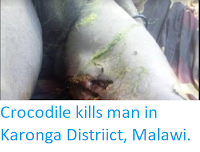
Crocodile kills man in Karonga Distriict, Malawi.

A 28-year-old man has been killed by a Crocodile in Karonga District in northern Malawi. Hussein Zibeli was apparently attempting to swim out to a boat where some friends were fishing, when he was seized by the animal and dragged under at about 8 pm local time on Thursday 30 November 2017. His body was later recovered, and an autopsy revealed he had died of a mixture of drowning and blood-loss. This is fairly typical of Crocodile attacks, with prey typically dragged under the water and drowned, but often not eaten immediately. This is at least the fifth Crocodile-related death in Malawi this year.

Wounds on the body of Hussein Zibeli, who was killed by a Crocodile on 30 November 2017. Nyasa Times.

Lake Malawi is home to a large population of Nile Crocodiles, Crocodylus niloticus. These are large animals, reaching about five meters in length, and are ambush predators capable of taking large prey, including, on occasion, Humans. The animals are thought to be at their most dangerous around in the dry season (December to March in Malawi), when the water is lowest, and females are guarding eggs buried in nests by the river.

 A Nile Crocodile on Lake Malawi. Birding for Pleasure.

Nile Crocodiles are considered to be of Least Concern under the terms of the  International Union for the Conservation of Nature’s Red List of  Threatened Species, but are still protected in many countries, including Malawi, due to historic hunting which decimated populations in many areas. However, the rising number of attacks on Humans, which is thought to have been driven by rapidly rising populations of both Humans and Crocodiles, combined with a sharp decline in the numbers of many natural prey species, has led to calls for regulated hunting to be introduced to control the population.

The approximate location of the 30 November 2017 Malawi Crocodile attack. Google Maps.

See also...

http://sciencythoughts.blogspot.co.uk/2017/12/britisg-tourist-attacked-by-crocodile.htmlhttp://sciencythoughts.blogspot.co.uk/2017/09/woman-killed-by-crocodile-in-lusaka.html
http://sciencythoughts.blogspot.co.uk/2017/09/giant-saltwater-crocodile-shot-in.htmlhttp://sciencythoughts.blogspot.co.uk/2017/09/british-tourist-killed-by-crocodile-in.html
http://sciencythoughts.blogspot.co.uk/2016/05/gryposuchus-pachakamue-gavialoid.htmlhttp://sciencythoughts.blogspot.co.uk/2015/02/dwarf-crocodile-remains-from.html
Follow Sciency Thoughts on Facebook.

Saturday, 2 December 2017

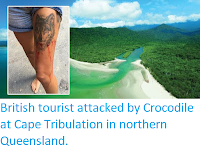
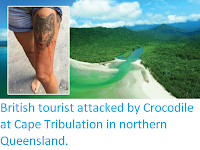
British tourist attacked by Crocodile at Cape Tribulation in northern Queensland.

A 24-year-old woman believed to be a British tourist was attacked by a Saltwater Crocodile, Crocodylus porosus, at Cape Tribulation in northern Queensland, Australia, on Wednesday 27 November 2017. The attack happened at about 6.00 om local time, when the Crocodile launched itself suddenly from a creek, and left the woman with a series of puncture wounds in her upper thigh. She received treatment at Mossman Hospital, and is not thought to be in a serious condition. 

Injuries sustained by a British woman in a Crocodile attack on 27 November 2017 (inset) and the area where the attack took place (main picture). Cairns Post/Facebook.

A two meter Saltwater Crocodile was later captured at the beach by the Department of Environment and Heritage Protection and will be offered for rehoming to a local zoo or wildlife park (Saltwater Crocodiles are protected in Queensland and killing one carries stiff penalties). The incident comes roughly eighteen months after another woman, Cindy Waldron, from New South Wales, was killed by a Crocodile while wading in the sea near Cape Tribulation, and has led to calls for a cull of the animals by some local politicians.

The approximate location of the 27 November 2017 Cape Tribulation Crocodile attack. Google Maps.

Saltwater Crocodiles are one of the few Crocodile species not considered vulnerable to extinction, being found from India to Australia  and inhabiting many areas that Humans shun, such as Mangrove forests and islands without fresh water. However they are protected in Queensland and other Australian states where they are present, as they are considered an important part of local aquatic ecosystems, and were hunted almost to extinction there between the 1940s and 1960s. They are large animals, reaching about seven meters in length, and are ambush predators capable of taking large prey, including, on occasion, Humans. This can lead to problems as they recolonise areas where they were previously exterminated and encounter Humans who are naïve to their habits, or areas where tourism provides a regular supply of Crocodile-unwary people.

See also...

http://sciencythoughts.blogspot.co.uk/2017/09/woman-killed-by-crocodile-in-lusaka.htmlhttp://sciencythoughts.blogspot.co.uk/2017/09/giant-saltwater-crocodile-shot-in.html
http://sciencythoughts.blogspot.co.uk/2017/09/british-tourist-killed-by-crocodile-in.htmlhttp://sciencythoughts.blogspot.co.uk/2016/05/gryposuchus-pachakamue-gavialoid.html
http://sciencythoughts.blogspot.co.uk/2015/02/dwarf-crocodile-remains-from.htmlhttp://sciencythoughts.blogspot.co.uk/2015/01/an-allodaposuchian-crocodylian-from.html
Follow Sciency Thoughts on Facebook.

Wednesday, 27 September 2017

Woman killed by Crocodile in Lusaka Province, Zambia.

A 57-year-old woman has been killed while on a fishing trip on the Zambezi River in Lusaka Province, Zambia. Sophia Njovu of the village of Muchingamire was dragged into the river by the animal on Saturday 23 September 2017, near Chiawa in Kafue District. This was the fifth Crocodile-related death in the country in the last two years. In a separate incident, a man was injured by another Crocodile while swimming in the Zambezi near Kanyachi in Chavuma District of Northwestern Province. Boyd Funga, 33, was attacked on Friday 22 September, and is being treated in the Chavuma Mission Hospital for injuries to his legs and chest.

The approximate location of the 23 September 2017 Chiawa Crocodile attack. Google Maps.

Zambia is home to two Crocodile species, the Nile Crocodile, Crocodylus niloticus, and the Slender Snouted Crocodile, Crocodilus cataphractus, though the later is found only around Lake Bangweulu and the Luapula River, so the Zambezi River attacks were almost certainly carried out by Nile Crocodiles. Nile Crocodiles are large animals, reaching about five meters in length, and are ambush predators capable of taking large prey, including, on occasion, Humans. The animals are thought to be at their most dangerous around September on the Zambezi, when the water is lowest, and females are guarding eggs buried in nests by the river.

A Nile Crocodile, Crocodylus niloticus, in South Luangwa National Park, Zambia. Hana Yariv/Wikimedia Commons.

Nile Crocodiles are considered to be of Least Concern under the terms of the  International Union for the Conservation of Nature’s Red List of  Threatened Species, but are still protected in many countries, including Zambia, due to historic hunting which decimated populations in many areas. However, the rising number of attacks on Humans by the animals has led to calls for regulated hunting to be introduced to control the population.

See also...

http://sciencythoughts.blogspot.co.uk/2017/09/giant-saltwater-crocodile-shot-in.htmlhttp://sciencythoughts.blogspot.co.uk/2017/09/british-tourist-killed-by-crocodile-in.html

http://sciencythoughts.blogspot.co.uk/2016/05/gryposuchus-pachakamue-gavialoid.htmlhttp://sciencythoughts.blogspot.co.uk/2015/02/dwarf-crocodile-remains-from.html
http://sciencythoughts.blogspot.co.uk/2015/01/an-allodaposuchian-crocodylian-from.htmlhttp://sciencythoughts.blogspot.co.uk/2014/03/a-new-species-of-crocodile-from-west.html
Follow Sciency Thoughts on Facebook.