Showing posts with label Weevils. Show all posts

Monday, 27 November 2023

Anchonidium selvanum: A new species of Weevil from northern Portugal.

The Weevil genus Anchonidium currently contains three valid species, all of which are found in Western Europe. Several from Africa and the Caucasus region which were previously assigned to the genus are now considered to be erroneous, and some of these have been reassigned to other genera.

In a paper published in the journal Alpine Entomology on 24 October 2023, Christoph Germann of the Naturhistorisches Museum Basel and the Naturhistorisches Museum Bern, and Carlo Braunert of the Musée National d’Histoire Naturelle de Luxembourg, describe a new species of Anchonidium from northern Portugal. 

The new species is named Anchonidium selvanum, where 'selvanum' refers to the ancient native Oak-forests of Portugal, which are referred to in Portuguese as 'la selva', which is the environment in which the Weevils were found. These Weevils are 2.1-3.3 mm in length, excluding the rostrum (snout) and auburn in colour. Their dorsal surface is covered with large punctures arranged in lines which run lengthwise along the body, the ventral surface has similar punctures, but more randomly arranged.

Anchonidium selvanum. (1) Male. (2) Female. (3) Male underside. Germann & Braunert (2023).

The distribution of all four species of Anchonidium follow mountain chains and river valleys in Portugal. Anchonidium braunerti is found in the Serra de Monchique south of the Rio Tajo, at altitudes of about 890 m above sealevel, on the upper parts of mountains where heather and mosses dominate, but where Oak forests were found on the lower slopes in the past but are now gone. Anchonidium spathiferum is found in the Serra da Estrela at altitudes of about 1290 m above sealevel, again in an environment dominated by heather and mosses, above slopes that were once covered by Oak woodland. Both of these species are considered rare. Only Anchonidium unguiculare is more widely distributed being found in Oak forests from Morocco to southern England. Anchonidium selvanum is still relatively common within its environment, the ancient Oak woodlands of the Serra do Marão and Serra do Alvão, at altidudes of between 750 m and 1180 m above sealevel.

Records from Anchonidium sensu stricto in Western Europe. Anchonidium unguiculare (blue dots), Anchonidium braunerti (green dot), Anchonidium spathiferum (red dot) and Anchonidium selvanum (yellow dots). Germann & Braunert (2023).

The Oak woodlands in which Anchonidium selvanum is found are a relic of ancient woodlands which once covered much of the mountains of Portugal, and which today are threatened by over-extraction of timber, and replacement of the Oaks by plantations of straighter, faster growing species valued by the timber industry, such as Eucalyptus and Mimosa trees from Australia or the Aleppo Pine. Pinus halepensis. Monocultural stands of these trees create a very different environment to ancient Oak wooklands, which is not a usable habitat for species which evolved in those woodlands. Worse still, all of these trees are addapted to survive periodic forest fires, which clear rival trees (and the wildlife dependant on those trees) from the environments where they are found. Their introduction has led to an increased fire frequency in mountainous areas of Portugal, presenting an additional threat to its indigenous wildlife. For this reason, Germann and Braunert conclude that Anchonidium selvanum should be regarded as a threatened species, but also that it can serve as a useful indicator species for the health of the woodlands in which it is found.

(Top) Habitat at type locality of Anchonidium selvanum at Bobal, 880 m above sealevel, Serra do Alvão. A small remaining part of the ancient Oak forest with Mosses, Lichens and a deep leaf litter layer at ground where the new species lives in remarkable densities. (Bottom) Remains and replantation of Oak forest in the Serra do Marão close to Ansiães. A good example for small remains of the ancient forests where only few individuals of Anchonidium selvanum were found. Carlo Braunert in Germann  Braunert (2023).

See also...

Follow Sciency Thoughts on Facebook.

Follow Sciency Thoughts on Twitter.


Monday, 6 August 2018

Scolytoplatypus unipilus: A new species of Bark Beetle from Gabon.

Bark Beetles, Scolytinae, get their name from their habit of living underneath the bark of trees, Some species are generalists, living on a variety of trees, generally targeting weak or dying trees, though others target specific species and are often able to infect healthy members of their host species. Many Bark Beetles can carry Fungal infections and other Plant pathogens, making them a serious pest in areas where forests of single species are grown for commercial purposes. They were formerly considered to be a separate family of Beetles (the Scolytidae), but recent genetic studies have shown them to be members of the True Weevil Family (Curculionidae).

In a paper published in the journal ZooKeys on 10 April 2018, Bjarte Jordal of the University Museum at the University of Bergen describes a new species of Bark Beetle from the Ipassa National Park in Gabon.

The new species is described from three female specimens captured in baited traps in the Ipassa National Park. The species is placed in the widespread genus Scolytoplatypus, and given the specific name unipilus, meaning 'single hair' as the species is has single hairs on its body, where other species in the genus have clusters of hairs. All three specimens are dark brown in colour, and range from 1.6 to 1.7 mm in length, making this species the smallest known African member of the genus.

Habitus, head and elytral declivity of Scolytoplatypus unipilus. Jordal (2018).

See also...

https://sciencythoughts.blogspot.com/2017/06/five-new-species-of-broad-nosed-weevil.htmlhttps://sciencythoughts.blogspot.com/2015/02/a-new-species-of-weevil-from-jiangsu.html
https://sciencythoughts.blogspot.com/2016/11/new-species-of-bark-beetle-from-central.htmlhttps://sciencythoughts.blogspot.com/2014/05/a-pine-cone-weevil-from-cretaceous.html
https://sciencythoughts.blogspot.com/2013/06/three-new-species-of-palm-weevil-from.html
Follow Sciency Thoughts on Facebook.

Monday, 12 June 2017

Five new species of Broad-nosed Weevil from Dominican Amber.

Weevils, Curculionidae, are one of the largest and most diverse groups of Beetles. They first appeared in the Early Cretaceous, becoming common and diverse by the end of that period. Broad-nosed Weevils, Entiminae, first appear in Early Eocene Fushan Amber from China. They have larvae which infest the roots of plants, a novel innovation on this group, which has allowed them to exploit a range of new environments, enabling them to diversify rapidly and spread widely during the Eocene.

In a paper published in the journal Paleontologica Electronica in May 2017, George Poinar of the Department of Integrative Biology at Oregon State University and Andrei Legalov of the Institute of Systematics and Ecology of Animals of the Siberian Branch of the Russian Academy of Sciences describe five new species of Entimine Weevil from amber mines in the northern part of the Dominican Republic.

Amber from the Dominican Republic is generally thought to be 15-20 million years old (i.e. Miocene in age), and is obtained from mines in the Cordillera Septentrional mountain range, where it is found as inclusions in turbiditic sandstones (marine landslip deposits). This secondary deposition makes it possible that the Amber is much older than the deposits in which it is found, possibly as old as 40 million years (Early Eocene). It was produced by a Leguminous tree, Hymenaea protera, which, based upon the ecology of the organisms found in the amber, is interpreted as having lived in moist tropical forests.

The first new species described is placed in the genus Diaprepes, which is still found in the Caribbean today, and given the specific name squamula, meaning scaly, in reference to the dense scaly covering of the Weevil. The species is described from a single specimen, 9.0 mm in length with a 0.6 mm snout, black in colour, with a dense covering of light, rounded scales. 

Ventral view of Diaprepes squamula, In Dominican amber. Scale bar is 1.0 mm. Poinar & Legalov (2017).

The second species described is placed in the genus Lachnopus, also still found in the Caribbean today, and given the specific name serraticrus, meaning ‘toothed-leg’, in reference to a pattern of prominent serrations on the Insect’s tibia. This species is also described from a single specimen, 7.4 mm in length with a 1.4 mm snout, black in colour with small, subcircular scales.

Lateral view of Lachnopus serraticrus in Dominican amber. Scale bar is 1.3 mm. Poinar & Legalov (2017). 

The third new species described is placed in the genus Apodrosus, another modern Caribbean genus, and given the specific name tinctocorpus, meaning ‘dyed body’ in reference to the colour of the body, which brown-black and lacks any markings. The species is described from a single specimen, 5.0 mm in length with a 0.8 mm snout, and small oval scales.

Lateral view of Apodrosus tinctocorpus in Dominican amber. Scale bar is 1.2 mm. Poinar & Legalov (2017).

The fourth new species is also placed in the genus Apodrosus, and given the specific name canalinasus, meaning ‘grooved-nose’ in reference to a distinctive furrow on the snout. The species is described from a single specimen, 4.5 mm in length, with a 0.8 mm snout, and covered in small oval scales.

Lateral view of Apodrosus canalinasus in Dominican amber. Scale bar is 0.8 mm. Poinar & Legalov (2017). 

The fifth new species described is placed in the genus Promecops, today found in the Caribbean, as well as in Central and South America, and given the specific name divarichela, meaning ‘spread-apart claws’, in reference to the free tarsal claws. The species is described from a single specimen 3.1 mm in length with a 0.4 mm snout, brown-black on colour and with curved, narrow scales.

Lateral view of Promecops divarichela in Dominican amber. Scale bar is 0.7 mm. Poinar & Legalov (2017).

See also...
 
http://sciencythoughts.blogspot.co.uk/2014/09/two-new-species-of-froghopper-from.html
http://sciencythoughts.blogspot.co.uk/2015/11/fossil-bee-flies-from-dominican.html

http://sciencythoughts.blogspot.co.uk/2014/08/a-new-species-of-pygmy-grasshopper-from.html
http://sciencythoughts.blogspot.co.uk/2015/02/a-new-species-of-weevil-from-jiangsu.html

http://sciencythoughts.blogspot.co.uk/2013/08/two-new-species-of-dustywing-from.html
http://sciencythoughts.blogspot.co.uk/2014/05/a-pine-cone-weevil-from-cretaceous.html


Follow Sciency Thoughts on Facebook.

Monday, 27 February 2017

Poropoea africana: A new species of Trichogrammatid Wasp from Gabon.

Trichogrammatid Wasps are among the smallest of Insects, with adults often smaller than a millimetre in length. They are parasitiods, with a larval stage that grows inside the eggs of other Insects, typically Beetles. In many species the males never emerge, mating with their own sisters within the egg, The adults are poor fliers, and largely just drift on winds, eventually settling and seeking eggs in which to deposit their larvae on foot. Members of the genus Poropoea are known from across Eurasia and North America, with some species known from Africa and Madagascar. They target Leaf-rolling Weevils, Attelabidae, which are often serious agricultural pests, which opens the possibility of using these Wasps as biological control agents.

In a paper published in the journal ZooKeys on 23 February 2017, Stefania Laudonia and Gennaro Viggiani of the Department of Agriculture at the University of Naples Federico II and Silvano Biondi of Vicenza, describe a new species of Trichogrammatid Wasp from the Ivindo National Park in Ogooué-Ivindo Province in north-eastern Gabon.

The new species is named Poropoea africana, in reference to the continent where it was found. It is described from two adult females that emerged from the eggs of the Weevil species Paratomapoderus brachypterus. These were 1.18 mm in length and black in colour with red eyes and yellow markings on their limbs. 

Poropoea africana, female specimen. Laudonia et al. (2017).

See also...

http://sciencythoughts.blogspot.co.uk/2017/02/poemenia-quercusia-new-species-of.htmlhttp://sciencythoughts.blogspot.co.uk/2016/12/promecidia-abnormis-promecidia-chui-two.html
http://sciencythoughts.blogspot.co.uk/2016/11/nesolinoceras-laluzbrillante-new.htmlhttp://sciencythoughts.blogspot.co.uk/2016/08/indothrix-brevicornis-new-species-of.html
http://sciencythoughts.blogspot.co.uk/2016/04/holopsenella-primotica-new-species-of.htmlhttp://sciencythoughts.blogspot.co.uk/2016/04/trieces-etuokensis-new-species-of.html
Follow Sciency Thoughts on Facebook.

Tuesday, 17 February 2015

A new species of Weevil from Jiangsu Province, China.

Weevils of the genus Orthotemnus were originally described from New Guinea, and have subsequently been recorded from Australia, the Seychelles, tropical Africa and the Russian Far East.

In a paper published in the journal ZooKeys on 19 January 2015, Youssef Mohamed Omar of the Faculty of Agriculture at Assiut University and the Institute of Zoology at the Chinese Academy of Sciences, Runzhi Zhang of the Institute of Zoology at the Chinese Academy of Sciences and Steven Davis of the Division ofEntomology at the Natural History Museum and Department of Ecology &Evolutionary Biology at the University of Kansas describe a new species of Orthotemnus from Jiangsu Province in China.

The new species is named Orthotemnus longitarsus, meaning ‘long tarsus’. The species is named from four male and four female specimens, all collected from under trees in a park in Zijingshan. The males are 3.29-3.40 mm in length, the females 2.58-2.80 mm. All are reddish brown in colour.

(Top) Female specimen of Orthotemnus longitarsus in lateral view. (Bottom) SEM image of male specimen of Orthotemnus longitarsus in lateral view. Omar et al. (2015).

See also…

http://sciencythoughts.blogspot.co.uk/2014/05/a-pine-cone-weevil-from-cretaceous.htmlA Pine Cone Weevil from Cretaceous Burmese amber.                                                      Pine Cone Weevils (Nemonychidae) are thought likely to be the oldest group of surviving Weevils (Curculionoidea), making their understanding their evolution important for our understanding of Weevils...

Straight Snouted Weevils (Brentidae) are wood-eating Beetles related to the True Weevils, found in temperate and tropical regions across the globe, though they are most diverse and numerous in the tropics. The classification of the group has changed dramatically a number of times in the last 20 years, and appears likely to change again.


Palm Weevils of the genus Anchylorhynchus are found from Panama to Argentina. They have a symbiotic relationship with Palms of the genera Butia, Cocos, Oenocarpus and Syagrus, with the adults acting...
Follow Sciency Thoughts on Facebook.

Friday, 30 May 2014

A Pine Cone Weevil from Cretaceous Burmese amber.


Pince Cone Weevils (Nemonychidae) are thought likely to be the oldest group of surviving Weevils (Curculionoidea), making their understanding their evolution important for our understanding of Weevils as a whole. Modern Pine Cone Weevils feed on pollen of Pines and related Gymnosperms (non-flowering Seed Plants), and it is possible that they may have played a role in the origin of Insect-pollination in Flowering Plants.

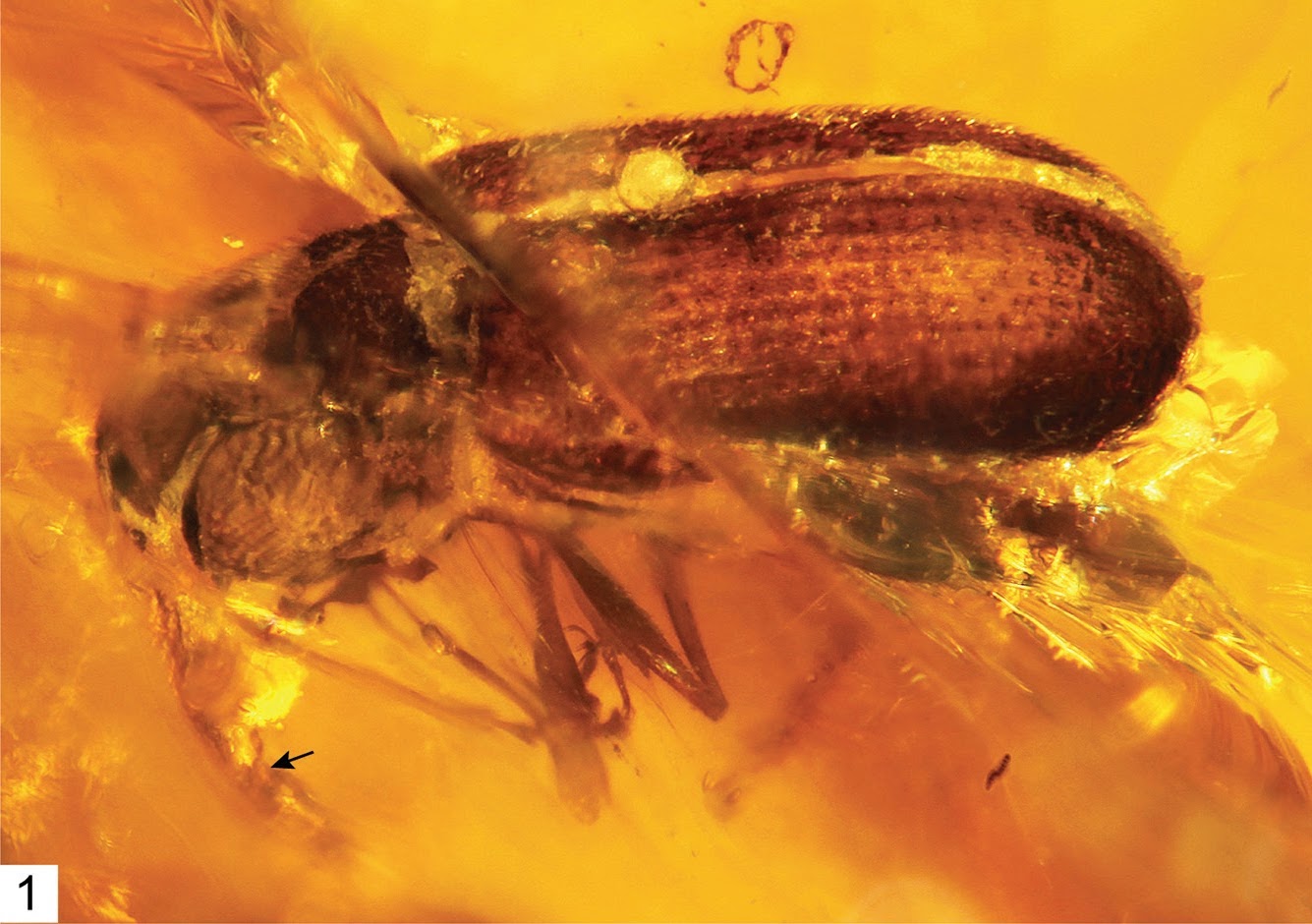
In a paper published in the journal ZooKeys on 28 April 2014, Steven Davis and Michael Engle of the Division of Entomology at the Natural History Museum, and Department of Ecology & Evolutionary Biology at the University of Kansas describe a fossil Pine Weevil preserved in Cretaceous amber from the Hukawng Valley in Kachin State in northern Myanmar, thought to be about 99 million years old.

The new species is given the name Burmonyx zigrasi, where ‘Burmonyx’ means ‘Burmese night’ and ‘zigrasi’ honours James Zigras, from whose collection the specimen came. Burmonyx zigrasi is a 2.2 mm Pine Cone Weevil, which was apparently brown in life. Its dorsal surface has a dense covering of setae (hairs).

Photomicrograph and line drawing of Burmonyx zigrasi. (Top) Photomicrograph in dorso-lateral view of specimen inclusion, arrow pointing to antennal scape. (Bottom) Line drawing of specimen (scale bar only applies to this figure). Davis & Engle (2014).

See also…


Straight Snouted Weevils (Brentidae) are wood-eating Beetles related to the True Weevils, found in temperate and tropical regions across the globe, though they are most diverse and numerous in the tropics. The classification of the group has changed dramatically a number of times in the last 20 years, and appears likely to change again.


Palm Weevils of the genus Anchylorhynchus are found from Panama to Argentina. They have a symbiotic relationship with Palms of the genera Butia, Cocos, Oenocarpus and Syagrus, with the adults acting...


Follow Scienct Thoughts on Facebook.

Tuesday, 4 June 2013

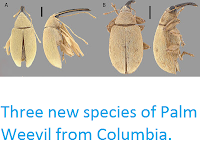
Three new species of Palm Weevil from Columbia.

Palm Weevils of the genus Anchylorhynchus are found from Panama to Argentina. They have a symbiotic relationship with Palms of the genera ButiaCocosOenocarpus and Syagrus, with the adults acting as pollinators and the larvae growing within non-developing fruit (these do not appear to be inherently different from the developing fruit, they are modified by the actions of the Weevils). The apparent damage that the Weevils do to some Palm fruit crops has led to attempts to control them, though this interrupts the Palm's reproductive cycle, halting production of fruit completely.

In a paper published in the journal Zootaxa on 4 April 2013, Bruno de Medeiros of the Museum of Comparative Zoology at the Department of Organismic and Evolutionary Biology at Harvard University, and Luis Núñez-Alvellaneda of the Grupo de Investigación de Palmas Silvestres Neotropicales at Universidad Nacional de Colombia, describe three new species of Palm Weevil from Palms of the genus Syagrus growing in the lowland rainforests of Columbia.

The first new species is named Anchylorhynchus pinocchio, in reference to the elongated rostrum (snout) of the males of the species. Anchylorhynchus pinocchio shows distinct sexual dimorphism (i.e. the males and females are different), which is unusual in Weevils. This species lives on the Palm Syagrus sancona in lowland rainforest and gallery forests of Cesanare Department, Columbia, at altitudes of between 150 and 500 m.

Anchylorhynchus pinocchio, (A) male and (B) female. Scale bars are 1 mm. De Medeiros & Núñez-Alvellaneda (2013).

The second new species is named Anchylorhynchus centrosquamatus, meaning 'central scales', in reference to the scales of the pronotum (front part of the thorax), which are directed towards the centre. The species was found living on the Palm Syagrus orinocensis in lowland rain forest or gallery forest at elevations ranging from 150 to 500 m.

Anchylorhynchus centrosquamatus. Scale bar is 1 mm. De Medeiros & Núñez-Alvellaneda (2013).

Anchylorhynchus centrosquamatus among flowers of Syagrus orinocensis in Vereda la Tigrana, Monterrey, Colombia. De Medeiros & Núñez-Alvellaneda (2013).

The final new species is named Anchylorhynchus luteobrunneus, meaning 'yellow and brown'; the species is variable in colouration, coming in yellow, brown and a mixture of the two. The species was found living on the Palm Syagrus sancona,  in lowland rainforests, gallery forest and piedmont forests in Casanare, Meta and Guaviare departments of Columbia, at elevations ranging from 100 to 1000 m.

Anchylorhynchus luteobrunneus, three different colour morphs. Scale bars are 1 mm. De Medeiros & Núñez-Alvellaneda (2013).


Follow Sciency Thoughts on Facebook.