Showing posts with label Essex. Show all posts

Friday, 29 March 2024

Swift-like Apodiform Birds from the Early Eocene London Clay of Walton-on-the-Naze in Essex, southern England.

The modern Avian Order Apodiformes includes the Swifts, Apodidae, Treeswifts, Hemiprocnidae, and Hummingbirds, Trochilidae. The morphological distinctness of this group of highly specialised fliers has made determining how they are related to other Bird groups difficult, although modern phylogenetic techniques have revealed that they are the sister group to the Owlet-Nightjars, Aegotheliformes. Although a number of fossil Apodiformes are known, with the oldest coming from the Early Eocene London Clay of southern England, the early history of the group is not well understood, as, in common with most Birds, the skeletons of Apodiformes tend to be small and delicate, not lending themselves to preservation, so that most fossils assigned are of isolated, and often fragmentary, bones.

The earliest known members of the group are Primapus lacki, which is known from a nearly-complete humerus from the London Clay at Bognor Regis in West Sussex, and the distal portion of a second humerus from the Isle of Sheppy in Kent, and Eocypselus vincenti, which was described from associated wing and pectoral girdle bones from Walton-on-the-Naze in Essex, with partial skeletons assigned to the same species described from the early Eocene Fur Formation  in Denmark. A second species of Eocypselus, Eocypselus rowei, has been described from the Early Eocene Green River Formation of Wyoming.

The classification of these early Apodiform Birds remains unclear. Primapus lacki has been assigned to the Aegialornithidae, an extinct group which also includes four species from the Middle Eocene-Early Oligocene Quercy fissure fillings of France, and which may be stem group Apodiformes or more closely related to Swifts than other members of the group. Eocypselus vincenti is sometimes considered to be an early member of the Hemiprocnidae, but more usually to an Apodiform stem group, the Eocypselidae.

In a paper published in the journal Ibis on 22 March 2024, Gerald Mayr of the Ornithological Section of the Senckenberg Research Institute and Natural History Museum Frankfurt, and Andrew Kitchener of the Department of Natural Sciences at National Museums Scotland, and the School of Geosciences at the University of Edinburgh, describe multiple new skeletons of Apodiform Birds from the Early Eocene London Clay at Walton-on-the-Naze in Essex, from the collection of the late Michael Daniels, an Edinburgh resident and amateur palaeontologist who passed away in 2021, leaving his collection to National Museums Scotland. From this material they describe three new species of Eocypselus, as well as new specimens of Eocypselus vincenti and Primapus lacki, which add significantly to our understanding of these Birds.

The first new species described is Eocypselus geminus, where 'geminus' means 'twin' in reference to the fact that this species closely resembles Eocypselus vincenti. It is described from a partial disarticulated skeleton, specimen NMS.Z.2021.40.116, which comprises a partial rostrum and mandible, the axis,  a furcula (wishbone) broken into three pieces, the right scapula, the right coracoid in a piece of matrix, a partial sternum, a partial left humerus, the left radius, the proximal portion of the right radius, the right phalanx proximalis  digiti majoris,  both carpometacarpi, fragments of the pelvis, a right tarsometatarsus lacking its proximal end, a few pedal phalanges and the anungual phalanx. A second specimen is also referred to this species, NMS.Z.2021.40.117, which comprises the left coracoid, the omal extremity of the right coracoid, the left humerus, the proximal portion of the right humerus, the left ulna, and the proximal portion of the right ulna. A mediolaterally narrow premaxilla found associated with this specimen belongs to a different, non-Apodiform species.

Eocypselus geminus from the early Eocene London Clay of Walton-on-the-Naze (Essex, UK). Mayr & Kitchiner (2024).

While Eocypselus geminus resembles Eocypselus vincenti closely, the two species can be distinguished on the basis that the processus procoracoideus of the coracoid projects less strongly towards the processus acrocoracoideus in Eocypselus geminus than in Eocypselus vincenti, the furcula of Eocypselus geminus has wider omal sections of the scapi clavicularum than that of Eocypselus vincenti, and the humerus of Eocypselus geminus, which has a stouter shaft and a dorsoventrally wider distal end than that of Eocypselus vincenti.

The second new species described is named Eocypselus paulomajor, where 'paulomajor' is intended to mean 'somewhat larger' in Latin, in reference to the size of the species, which is larger than Eocypselus vincenti. This species is described from a single specimen, NMS.Z.2021.40.118, which comprises a partial furcula, a left coracoid, and a left ulna.
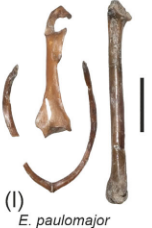
Eocypselus paulomajor from the early Eocene London Clay of Walton-on-the-Naze (Essex, UK). Mayr & Kitchiner (2024).

The third new species described is named Eocypselus grandissimus, where 'grandissimus' means 'the largest' in reference to the fact that this specimen is larger than all other members of the genus. It is described from a single specimen, NMS.Z.2021.40.119, which comprises a few vertebrae, both coracoids, both scapulae, the cranial portion of the sternum, the distal end of the right humerus, the proximal end of the left humerus, a partial left carpometacarpus, the distal end of the left femur, and one pedal phalanx. A distal left humerus associated with the specimen belongs to a non-Apodiform species.

Eocypselus grandissimus from the early Eocene London Clay of Walton-on-the-Naze (Essex, UK). Mayr & Kitchiner (2024).

A number of further specimens are referred to Eocypselus, but not to any particular species. All are of similar size to Eocypselus geminus and Eocypselus vincenti, but cannot be confidently be assigned to either species, and may potentially represent additional, undescribed, species. although without further, more complete, specimens to refer to, it would be impossible to be certain of this.

A new specimen of Primapus lacki is also described. This specimen, NMS.Z.2021.40.133, comprises the furcula, the right coracoid, the left and right humeri lacking distal ends, the left radius, a partial right carpometacarpus, and a single pedal phalanx.

Primapus lacki from the early Eocene London Clay of Walton-on-the-Naze (Essex, UK). Mayr & Kitchiner (2024).

Mayr and Kitchiner consider the Aegialornithidae and Eocypselidae to be stem-group Apodiform Birds, forming sister taxa to the crown group Apodiformes. Primapus lacki represents the earliest representative of the Aegialornithidae, a group which persisted at least 19 million years, into the Early Oligocene. In contrast, the Eocypselidae are known only from Early Eocene deposits, and appear to have been a short-lived group. The crown group Apodiformes are unknown in the Early Eocene, with the earliest known example being Scaniacypselus szarskii, thought to be an early Swift, from the Middle Eocene Messel Shale of Germany. 

See also...

Saturday, 14 December 2019

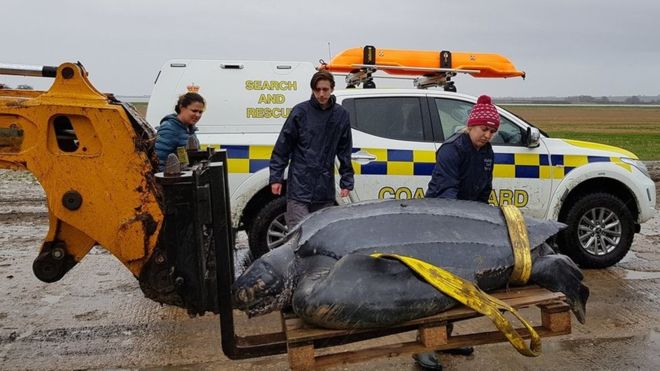
Learthback Turtle found on beach in Essex, England.

A Leatherback Turtle, Dermochelys coriacea, has been discovered on a beach in Essex, southeast England, this week. The Turtle, which is estimated to weigh about 250 kg, was discovered by a Dog-walker on a beach on Mundon Creek, part of the Blackwater River Estuary System, on the morning of Wednesday 11 December 2019. The UK Cetacean Strandings Investigation Programme was called in to investigate the Turtle, and was able to work with the local Coastguard and landowners to recover the body of the animal, for examination at the Natural History Museum in London. Leatherback Turtles are occasionally washed up on the warmer beaches of southwest England and the south coast of Ireland, but have not previously been recorded on the east coast of England, or elsewhere on the North Sea.

The body of a Leatherback Turtle, Dermochelys coriacea, which was recovered on the Essex coast this week. South Woodham Coastguard Rescue Team.

Leatherback Turtles are the larges species of Chelonian (Turtles and Tortoises) alive today. and have a distinctive leathery shell which makes them easy to identify. They are placed in a separate family to all other Turtles, the Dermochelyidae, which has no other living species, but a fossil record dating back to the Late Cretaceous. Modern Leatherback Turtles are found in tropical and warm temperate waters in the Atlantic and Pacific Oceans, as well as in the southwest Indian Ocean. They are considered to be Vulnerable under the terms of the International Union for the Conservation of Nature's Red List of Threatened Species, mostly due to a loss of suitable breeding grounds due to Human encroachment; unlike other Turtle species their flesh is generally considered to oily for consumption by Humans, limiting the impact of hunting on the species, although they are vulnerable to being caught as bycatch in fishing nets and becoming entangled in abandoned fishing gear. Other marine plastics are also a significant risk to the species, as items such as plastic bags can resemble Jellyfish, the main diet of these Turtles.

Leatherback Turtle, Dermochelys coriacea, washed up on a beach in Essex, southeast England, earlier this week. Harwich and Manningtree Standard.

See also...

https://sciencythoughts.blogspot.com/2019/10/florida-fish-and-wildlife-conservation.htmlhttps://sciencythoughts.blogspot.com/2019/01/police-seize-hundreds-of-turtles-from.html
https://sciencythoughts.blogspot.com/2018/12/basilemys-morrinensis-new-species-of.htmlhttps://sciencythoughts.blogspot.com/2018/11/large-numbers-of-cold-stunned-sea.html
https://sciencythoughts.blogspot.com/2018/11/leatherback-turtle-dies-in-aquarium.htmlhttps://sciencythoughts.blogspot.com/2018/10/sindh-wildlife-department-seizes.html
Follow Sciency Thoughts on Facebook.

Thursday, 26 September 2019

Fireball meteor over East Anglia.

Witnesses across southern England and parts of northwestern Europe have reported witnessing a fireball meteor at about 18.55 pm GMT on Tuesday 24 September 2019. The object first appeared over the county of Essex in England, and passed northeast disappearing somewhere over west Suffolk. The object was seen from the UK, the Netherlands, Belgium, and France, though the majority of the recorded sightings came from southern England. Many witnesses in London reported seeing the event despite thick cloud cover in the area at the time. A fireball is defined as a meteor (shooting star) brighter than the planet Venus. These are typically caused by pieces of rock burning up in the atmosphere, but can be the result of man-made space-junk burning up on re-entry. 

Fireball meteor seen in London through thick cloud cover on 24 September 2019. UK Meteor Observation Network/BBC.

Objects of this size probably enter the Earth's atmosphere several times a year, though unless they do so over populated areas they are unlikely to be noticed. They are officially described as fireballs if they produce a light brighter than the planet Venus. The brightness of a meteor is caused by friction with the Earth's atmosphere, which is typically far greater than that caused by simple falling, due to the initial trajectory of the object. Such objects typically eventually explode in an airburst called by the friction, causing them to vanish as an luminous object. However this is not the end of the story as such explosions result in the production of a number of smaller objects, which fall to the ground under the influence of gravity (which does not cause the luminescence associated with friction-induced heating).
 
Map showing areas where sightings of the meteor were reported, and the apparent path of the object (blue arrow). American Meteor Society.

These 'dark objects' do not continue along the path of the original bolide, but neither do they fall directly to the ground, but rather follow a course determined by the atmospheric currents (winds) through which the objects pass. Scientists are able to calculate potential trajectories for hypothetical dark objects derived from meteors using data from weather monitoring services.
 
See also...
 
https://sciencythoughts.blogspot.com/2019/09/fireball-meteor-over-northern-germany.htmlhttps://sciencythoughts.blogspot.com/2019/09/plane-crash-near-tavistock-in-devon.html
https://sciencythoughts.blogspot.com/2019/08/the-alpha-aurigid-meteors.htmlhttps://sciencythoughts.blogspot.com/2019/08/the-perseid-meteor-shower.html
https://sciencythoughts.blogspot.com/2019/07/possible-meteorite-lands-in-field-in.htmlhttp://sciencythoughts.blogspot.com/2019/07/the-delta-aquarid-meteors.html
Follow Sciency Thoughts on Facebook.

Wednesday, 20 May 2015

Evidence of Leprosy in from an early Anglo Saxon grave from Essex, England.


Leprosy is caused by the Bacterium Mycobacterium leprae; it is fatal, incurable without modern antibiotics and causes serious disfigurations prior to death, making it a particularly feared disease in areas where it is prevalent. The disease is thought to have originated in East Africa and was well known in the ancient Middle East, though medical diagnosis was not a precise science to the ancients, and all descriptions of Leprosy cannot be assumed to be the same disease. However the presence of Leprosy in burials from the second century BC onwards in Egypt and the first century AD onwards has been confirmed. The disease reached Europe in the Early Medieval period and remained for many centuries, however despite being carried to many corners of the globe by European settlers it died out in Europe prior to the development of modern medicine, making historical records of Leprosy in Europe also somewhat unreliable.

In a paper published in the journal PLoS One on 13 May 2015, Sarah Inskip of the Faculteit Archaeologie at Universiteit Leiden, Michael Taylor of the Department of Microbial and Cellular Sciences at the University of Surrey, Sonia Zakrzewski of the Department of Archaeology at the University of Southampton, Simon Mays of the Ancient Monuments Laboratory at the English Heritage Centre for Archaeology, Alistair Pike, also of the Department of Archaeology at the University of Southampton, Gareth Llewellyn and ChristopherWilliams of the Institute of Mass Spectrometry at Swansea University, Oona Lee, Houdini Wu, David Minnikin and Gurdyal Besra of the Institute of Microbiology and Infection at the University of Birmingham and Graham Stewart, also of the Department of Microbial and Cellular Sciences at the University of Surrey, describe the results of an investigation into a purported case of Leprosy from an Anglo Saxon burial at Great Chesterford in Essex.

The Great Chesterford site was first excavated in 1953-54 by Vera Evison on behalf of the Inspectorate of Ancient Monuments, after the remains were disturbed by gravel extraction in the area. The grave contained a young adult male orientated east-west with the head towards the west, buried in a slightly flexed position, with the hands placed on the left shoulder. The bones of the face and part of the left arm were missing, but otherwise the level of bone preservation was good. Some grave goods were present, including a spear, a knife and a buckle. The remains are now housed at the Department of Archaeology at the University of Southampton.

Grave sketch of inhumation 96 showing positioning of the skeleton and location of grave goods. (1 a) Spearhead, angular, split socket with transverse rivet. Length 27.4 cm. (b) Conical ferrule, two decorative grooves. Length 10.2 cm. (a) and (b) were found before the grave was identified, about 8cm above floor of grave to left of skull. (2) Knife, slender, type 1. Length 12cm. Position: Point up under vertebrae at leftwaist. (3) Oval buckle loop and tongue. Transverse ribbing on the loop visible near the tongue. Diameter 2.5 cm. Position: Top right of pelvis. (4) Bronze shoelace tag, flat band folded and riveted together, twodecorative lines. Length 2.1 cm. Position: Above right ankle. Council for British Archaeology in Inskip et al. (2015).

The skeleton shows a number of symptoms which may be indicative of Leprosy, including new bone growth on left and right tibiae and fibulae, with remodelled lamellar bone and nodular growth suggesting multiple periods of new bone growth and healing. The left tibia the infection appeared particularly severe, with porous and disorganized woven bone on the medial malleolus and on the medial and anterior aspect of the distal diaphysis, with lessons that appear to have been suffering active infection at the time of death. A small patch of remodelled bone was also present on the right ulna. The right foot is heavily remodelled, with signs of infection and bone destruction on thetarsometatarsal joints and the second, third and fifth metatarsals. The fourth right metatarsal is missing, and it is unclear if this occurred before or after death. On the left foot the first and second metatarsals show signs of infection with lesions that were probably active at the time of death.

Left tibia of GC96 showing evidence of inflammatory pitting and presence of both woven and remodelled lamellar bone on the subperiostealshaft. Inskip et al. (2015).

All of this is indicative of Leprosy, but not in itself sufficient for diagnosis, since the bone pathology is caused by the immune system’s reaction to infection rather than the infection itself. The most diagnostic bones for Leprosy are those of the face, which do show a pattern of infection unique to the disease, however these are missing in the Great Chesterford remains. Thus the remains are currently regarded as one of the earliest possible recorded cases of Leprosy from the UK, along with several other sets of early Anglo Saxon remains with indicative but not diagnostic symptoms of infection.

Inskip et al. first re-examined the bones and were able to confirm that the remains were male from the shape of the pelvis, and between about 25 and 35 years old at the time of death, based upon the fused epiphysis of the long bones (which does not occur until after growth has stopped) and the low level or wear on the teeth. Radiocarbon data suggests that the remains were buried between AD 415 and AD 545.

Next they were able to extract DNA from the infected bones. These DNA samples tested negative for the Bacterium Mycobacterium tuberculosis, which can also cause bone lesions, but positive for the Mycobacterium leprae strain 3I. This lineage has previously been recorded from Medieval graves in the UK, Denmark and Sweden; it is no longer found in Europe, but is present in the southwest United States, where it was presumably introduced by British settlers. Since the early Anglo Saxon settlers in England originated in Denmark and northern Germany, it is also likely that they brought this strain of Leprosy to the UK. The bones also produced traces of mycolic and mycocerosic acids, which are considered to be diagnostic of Leprosy.

Pencilling of second, third and fifth metatarsals with destructive lesions to the proximal joint surfaces possibly caused by leprosy. Inskip et al. (2015).

Inskipet al. also studied strontium and oxygen isotopes from the tooth enamel of the skeleton. These become fixed at about puberty, reflecting the isotopic content of the water consumed at this time, unlike bone where the isotope content varies with water consumed throughout the life of the individual, and are often used not just in archaeology but in the identification of modern remains by forensic scientists, in those working with war graves and similar sites. Neither the strontium or oxygen isotope ratios were consistent with the area around Great Chesterford, and while the strontium isotope ratios could reflect an origin from a wide area of southern England, the oxygen isotope levels could only have come from northeast Scotland or the region between the coast and the eastern edge of the Pennines – where the strontium isotope levels are different. Since both the oxygen and strontium isotope levels must match, this rules out an origin in the UK.

The oxygen isotope levels are also consistent with southern Norway, eastern Denmark, eastern France and central Germany. The strontium isotope ratios are inconsistent with those from southern Norway, but consistent with those from eastern Denmark. Data on strontium isotope ratios is not available for central Germany or eastern France. Thus the isotope data suggests the man grew up somewhere on the continent rather than in the UK, but insufficient data is available to say exactly where. This appears to support the idea that Leprosy could have been brought to the UK by early Anglo Saxon settlers.

See also…

The science of palaeoparasitology involves the study of parasite remains from palaeontological and archaeological sites. This rarely involves the recovery...
 
 
Biological organisms often produce a variety of mineralized tissues, such as bones, teeth and shells...
 
The Taíno people are thought to have colonized the Caribbean Islands by island hopping from northern South America from about 500 BC onwards, reaching Jamaica by around 645-898 AD. They were skilled agriculturalists, introducing crops such as Cassava and Maize from South America and changing the...
 
Follow Sciency Thoughts on Facebook.

Thursday, 30 April 2015

Magnitude 1.9 Earthquake in Essex, southern England.

The British Geological Survey recorded a Magnitude 1.9 Earthquake at a depth of 6 km slightly to the northeast of the village of North Fambridge in Essex, England, slightly before 5.20 pm British Summertime (slightly before 6.20 pm GMT) on Thursday 23 April 2015. There are no reports of any damage or injuries associated with this event, though it is likely to have been felt locally.
 
 The approximate location of the 23 April 2015 Essex Earthquake. Google Maps.
 
Earthquakes become more common as you travel north and west in Great Britain, with the west coast of Scotland being the most quake-prone part of the island and the northwest of Wales being more prone  to quakes than the rest of Wales or most of England. However, while quakes in southern England are less frequent, they are often larger than events in the north, as tectonic presures tend to build up for longer periods of time between events, so that when they occur more pressure is released.
The precise cause of Earthquakes in the UK can be hard to determine; the country is not close to any obvious single cause of such activity such as a plate margin, but is subject to tectonic pressures from several different sources, with most quakes probably being the result of the interplay between these forces.
Britain is being pushed to the east by the expansion of the Atlantic Ocean and to the north by the impact of Africa into Europe from the south. It is also affected by lesser areas of tectonic spreading beneath the North Sea, Rhine Valley and Bay of Biscay. Finally the country is subject to glacial rebound; until about 10 000 years ago much of the north of the country was covered by a thick layer of glacial ice (this is believed to have been thickest on the west coast of Scotland), pushing the rocks of the British lithosphere down into the underlying mantle. This ice is now gone, and the rocks are springing (slowly) back into their original position, causing the occasional Earthquake in the process.
 
(Top) Simplified diagram showing principle of glacial rebound. Wikipedia. (Bottom) Map showing the rate of glacial rebound in various parts of the UK. Note that some parts of England and Wales show negative values, these areas are being pushed down slightly by uplift in Scotland, as the entire landmass is quite rigid and acts a bit like a see-saw. Climate North East.
Witness accounts of Earthquakes can help geologists to understand these events, and the structures that cause them. If you felt this quake, or were in the area but did not (which is also useful information) then you can report it to the British Geological Survey here.
 
See also...
 
http://sciencythoughts.blogspot.co.uk/2015/04/magnitude-22-earthquake-near.htmlMagnitude 2.2 Earthquake near Peterborough in Cambridgeshire, England. The British Geological Survey recorded a Magnitude 2.2 Earthquake at a depth of 8 km about 10 km to the south of Peterborough in...
http://sciencythoughts.blogspot.co.uk/2015/03/homes-evacuated-after-sinkhole-opens-up.htmlHomes evacuated after sinkhole opens up in Swanley, southeast England.                        Two homes have been evacuated in the town of Swanley in Kent, southeast England after a sinkhole opened up on Thursday 26 March 2015 swallowing...
National geological surveys have traditionally produced two dimensional geological maps showing the outcropping of rock formations, combined with data...
Follow Sciency Thoughts on Facebook.