Showing posts with label Flaviviruses. Show all posts

Wednesday, 24 July 2024

Local transmission of Dengue Fever recorded in Iran for the first time.

The transmission of Dengue Fever within Iran has been demonstrated for the first time in June 2024, according to a press release issued by the World Health Organization on 22 July 2024. The Ministry of Health and Medical Education of Iran reported to cases of the disease had been confirmed by Polymerase Chain Reaction testing at the Pasteur Institute in Bandar Abbas, both in patients from the city of Bandar-Lengheh in Hormozgan Province who had never travelled outside of Iran, and who can therefore be confirmed to have acquired the infection within the country. By 17 July 2024 twelve cases had been confirmed in Bandar-Lengheh among people who had no history of travel outside the country.

This development is not entirely unexpected, as the number of imported cases within Iran has remained steady at about 20 per year between 2017 and 2023, and the Aedes aegypti and Aedes albopictus Mosquitoes, which act as vectors for the disease, are both present in Sistan and Balouchistan, Hormozgan, Bushehr, Khuzastan, and Gilan provinces. In 2024 the number of cases in the country has risen sharply, with 137 reported between 15 May and 10 July.

Dengue is a viral infection transmitted to humans through the bite of infected Mosquitoes and is found in tropical and sub-tropical climates worldwide, mostly in urban and semi-urban areas. The primary vectors that transmit the disease are Aedes aegypti Mosquitoes and, to a lesser extent, Aedes albopictus.  These mosquitoes are also vectors of Chikungunya, Yellow Fever and Zika viruses. Dengue is widespread throughout the tropics, with local variations in risk influenced by climate parameters as well as social and environmental factors.

Colour print of the Dengue Mosquito Aedes aegypti (then called Stegomyia fasciata, today also Stegomyia aegypti). To the left, the male, in the middle and on the right, the female. Above left, a flying pair in copula. Emil August Goeldi (1905)/Wikimedia Commons.

Infection with the Dengue Virus can cause a wide spectrum of disease. Ranging from subclinical disease (people may not know they are even infected) to severe flu-like symptoms in those infected. Although less common, some people develop Severe Dengue, which can be any number of complications associated with severe bleeding, organ impairment and/or plasma leakage. Severe Dengue has a higher risk of death when not managed appropriately. Severe Dengue was first recognised in the 1950s during Dengue epidemics in the Philippines and Thailand. Today, Severe Dengue affects most Asian and Latin American countries and has become a leading cause of hospitalisation and death among children and adults in these regions.

Dengue is caused by a Virus of the Flaviviridae family of positive-strand RNA Viruses and there are four distinct, but closely related, serotypes of the Virus that cause Dengue (Dengue Fever Virus-1, Dengue Fever Virus-2, Dengue Fever Virus-3 and Dengue Fever Virus-4). Recovery from infection is believed to provide lifelong immunity against that serotype. However, cross-immunity to the other serotypes after recovery is only partial, and temporary. Subsequent infections (secondary infection) by other serotypes increase the risk of developing Severe Dengue.

A transmission electron micrograph showing Dengue Virus virions (the cluster of dark dots near the centre). Centers for Disease Control and Prevention/Wikimedia Commons.

Dengue has distinct epidemiological patterns, associated with the four serotypes of the Virus. These can co-circulate within a region, and indeed many countries are hyper-endemic for all four serotypes. Dengue has an alarming impact on both human health and the global and national economies. Dengue Fever Virus is frequently transported from one place to another by infected travellers; when susceptible vectors are present in these new areas, there is the potential for local transmission to be established.

The incidence of Dengue has grown dramatically around the world in recent decades. A vast majority of cases are asymptomatic or mild and self-managed, and hence the actual numbers of dengue cases are under-reported. Many cases are also misdiagnosed as other febrile illnesses.

One modelling estimate indicates 390 million Dengue Virus infections per year, of which 96 million manifest clinically (with any severity of disease). Another study on the prevalence of dengue estimates that 3.9 billion people are at risk of infection with dengue viruses. Despite a risk of infection existing in 129 countries, 70% of the actual burden is in Asia.

The number of dengue cases reported to the World Health Organization increased over 8 fold over the last two decades, from 505 430 cases in 2000, to over 2.4 million in 2010, and 5.2 million in 2019. Reported deaths between the year 2000 and 2015 increased from 960 to 4032, affecting mostly younger age group. The total number of cases seemingly decreased during years 2020 and 2021, as well as for reported deaths. However, the COVID-19 pandemic might have also hampered case reporting in several countries.

The overall alarming increase in case numbers over the last two decades is partly explained by a change in national practices to record and report Dengue to the Ministries of Health, and to the World Health Organization. But it also represents government recognition of the burden, and therefore the pertinence to report Dengue disease burden.

Before 1970, only 9 countries had experienced Severe Dengue epidemics. The disease is now endemic in more than 100 countries in the World Health Organization regions of Africa, the Americas, the Eastern Mediterranean, South-East Asia and the Western Pacific. The Americas, South-East Asia and Western Pacific regions are the most seriously affected, with Asia representing about 70% of the global burden of disease.

Not only is the number of cases increasing as the disease spreads to new areas including Europe, but explosive outbreaks are occurring. The threat of a possible outbreak of Dengue now exists in Europe; local transmission was reported for the first time in France and Croatia in 2010 and imported cases were detected in 3 other European countries. In 2012, an outbreak of Dengue on the Madeira islands of Portugal resulted in over 2000 cases and imported cases were detected in mainland Portugal and 10 other countries in Europe. Autochthonous cases are now observed on an annual basis in few European countries.

Iran forms part of the World Health Organization's Eastern Mediterranean Region, which is considered to be at high risk to Dengue Fever epidemics, with many countries having fragile healthcare systems due to conflict and political instability, while other countries where healthcare systems are considered to be stronger are sufferering increased rains due to climate change, leading to a proliferation of the Aedes aegypti and Aedes albopictus Mosquitoes which act as vectors for the disease. 

The countries of the World Health Organization's Eastern Mediterranean Region. Ă–zturk et al. (2024).

Iran is particularly threatened by the presence of both types of Mosquito and a climate favourable to the spread of the disease, as well as a large numbers of visitors from countries where the disease is endemic. The discovery that the disease is being transmitted in the country at this time is particularly alarming as it comes shortly before the annual Arba'in Pilgrimage, which this year will take place in August, with potentially millions of Shiite Muslims from around the world visiting the Shrine of Husayn ibn Ali in the city of Karbala in central Iran.

See also...

Sunday, 13 August 2023

Sharp rise in the number of Dengue Fever cases in Bangladesh.

From 1 January to 7 August 2023, the Ministry of Health and Family Welfare of Bangladesh reported a total of 69 483 laboratory-confirmed Dengue Fever cases and 327 related deaths, with a case fatality rate of 0.47%, according to a press release issued by the World Health Organization on 11 August 2023. Of these, 63% of cases and 62% of the deaths were reported in the month of July 2023. Although dengue is endemic in Bangladesh, the current Dengue Fever surge is unusual in terms of seasonality and the early sharp increase in comparison to previous years, where the surge started around -late June. The case fatality rate so far this year is relatively high compared to previous years for the full-year period. The pre-monsoon Aedes survey shows that the density of Mosquitoes, and the number of potential hotspots is at the highest level in the past five years. 

The higher incidence of Dengue Fever is taking place in the context of an unusual episodic amount of rainfall, combined with high temperatures and high humidity, which have resulted in an increased Mosquito population throughout Bangladesh. 

Between 1 January and 7 August 2023, a total of 69 483 Dengue Fever cases including 327 related deaths (a case fatality rate of 0.47%) were reported by the Ministry of Health and Family Welfare. As of 30 June 2023, a total of 7978 cases and 47 deaths were reported, however, the cases started surging rapidly from late June and in the month of July alone 63% of cases (43 854) and 62% of deaths (204) were reported.

The number of cases and deaths are higher compared to similar periods in the past five years. Dengue Fever cases started to rise in May 2023 and have been continuing since then, and the peak is unlikely to have been reached. The reported number of Dengue Fever cases this year is the highest compared to the same periods recorded since 2000.

Number of Dengue Fever cases in Bangladesh (A) and deaths (B) reported by epidemic week from 2018 to 2023, as of 5 August (epidemiological week 31) 2023. World Health Organization.

Cases have been reported from all 64 districts of Bangladesh. Cases in Dhaka Division started to increase in epidemic week 17 (23-29 April 2023) and in all eight divisions since epidemic week 26 (25 June to 1 July 2023).  The most affected area in the Dhaka Division is Dhaka City, accounting for 52.8% of cases and 78.9% of deaths. Other affected divisions include Chattogram Division (13.2% of cases and 9.2% of deaths), Dhaka Division excluding Dhaka City (11.6% of cases and 2.8% of deaths), and Barisal Division (10.5% of cases and 4.3% of deaths). The Sylhet Division has the lowest number of cases (560) and no deaths reported so far.

As of 7 August 2023, the reported case fatality rate is 0.47%, which is higher compared to previous years. The overall case fatality rate is higher in females than in males (0.72% compared to 0.32%) with females having four times higher case fatality rate than males among those aged 21-40 years (0.71% compared to 0.18%). The older age group recorded a higher case fatality rate compared to the younger age group (1.87% in the age group over 60 years compared to 0.74% in the age group between 41 to 60 years and 0.34% in those aged 40 years and below).

Dengue cases, deaths, and case fatality rate in Bangladesh for 2018, 2019, 2021, 2022 and 2023. World Health Organization. 

Dengue is a Viral infection transmitted to humans through the bite of infected Mosquitoes and is found in tropical and sub-tropical climates worldwide, mostly in urban and semi-urban areas. The primary vectors that transmit the disease are Aedes aegypti mosquitoes and, to a lesser extent, Aedes albopictus.

Dengue Fever is caused by a Positive Single-strand RNA Virus of the Flaviviridae family and there are four distinct, but closely related, serotypes of the Virus that cause Dengue Fever (Dengue Fever Virus-1, Dengue Fever Virus-2, Dengue Fever Virus-3 and Dengue Fever Virus-4). Recovery from infection is believed to provide lifelong immunity against that serotype. However, cross-immunity to the other serotypes after recovery is only partial, and temporary. Subsequent infections (secondary infection) by other serotypes increase the risk of developing Severe Dengue Fever.

A transmission electron micrograph showing Dengue Virus virions (the cluster of dark dots near the centre). Centers for Disease Control and Prevention/Wikimedia Commons.

Dengue Fever Virus-2 was the predominant circulating serotype in Bangladesh until 2018, when it was replaced by Dengue Fever Virus-3, which has remained the predominant serotype since 2019.  However, Dengue Fever Virus-2 has been identified as the primary circulating serotype in the 2023 outbreak, and this may result in more severe Dengue Fever infections and hospitalizations as a result of a second infection with a heterologous (similar but not identical) serotype. Of the 66 serotyped samples in the month of June 2023, Dengue Fever Virus-2 comprised 51.5% of cases and Dengue Fever Virus-2 comprised 43.9%.

There is no specific treatment for Dengue Fever; however, the timely detection of cases, identifying any warning signs of severe dengue infection, and appropriate case management are key elements of care to lower case fatality rates to less than 1%.

Dengue Fever was first recorded in the 1960s in Bangladesh (then known as East Pakistan) and was known as 'Dacca Fever'. Since 2010 cases of Dengue Fever have appeared to coincide with the rainy season from May to September and higher temperatures. Bangladesh’s climate conditions are becoming more favourable for the transmission of Dengue Fever and other vector-borne diseases including Malaria and Chikungunya Virus due to excessive rainfall, waterlogging, flooding, rise in temperature and the unusual shifts in the country’s traditional seasons. 

See also...


Follow Sciency Thoughts on Facebook.

Follow Sciency Thoughts on Twitter.


Saturday, 7 May 2022

Outbreak of Yellow Fever declared in Uganda.

On 6 March 2022, the World Health Organization received notification from the Uganda Ministry of Health of four suspected yellow fever cases, according to a press release. As of 25 April 2022, a total of seven suspected cases tested positive for yellow fever antibodies by plaque reduction neutralization test. However, further investigations identified only one laboratory confirmed case of yellow fever reported from Wakiso district, Central Region. The Ministry of Health declared an outbreak, and a rapid response team was deployed to the affected districts. Due to the potential of epidemic spread in Uganda and the risk of spread to neighboring countries, the World Health Organization assesses the risk to be high at the national and regional levels.

Cases presented with symptoms including fever, vomiting, nausea, diarrhoea, intense fatigue, anorexia, abdominal pain, chest pain, muscle pain, headache, and sore throat. None of the cases presented with severe yellow fever symptoms of acute jaundice. Six of the seven cases were female.

Yellow Fever is a Flavivirus (the group of RNA Viruses that also includes the West Nile, Zika and Hepatitis C Viruses) transmitted to humans by the bites of infected Aedes and Haemagogus Mosquitoes.. The Virus causes a mild fever, accompanied loss of apatite, nausea and muscle pains, which passes within about 15 days. However, in about 15 % of cases a more severe infection attacks the liver and kidneys, which can lead to their failure, and therefore the death of the patient.  It originated in tropical Africa and but was carried to South America and the Caribbean during the trans-Atlantic slave trade. Outbreaks of the disease have also been recorded in parts of tropical Asia and the Pacific in recent years, and many countries in tropical regions require visitors to carry a certificate proving they have been vaccinated against the Virus.

 
The Yellow Fever Virus. Erskine Palmer/Centers for Disease Control and Prevention/Wikipedia.

Forty countries globally, 27 in Africa and 13 in Central and South America are classified as high-risk for yellow fever. Since September 2021, 13 countries in the World Health Organization African Region have reported probable and confirmed yellow fever cases and outbreaks, including an ongoing outbreak under close investigation in neighbouring Kenya. These outbreaks are occurring in large geographic areas of the Western, Central and Eastern regions of Africa. They have affected areas that have previously conducted large-scale mass vaccination campaigns but with persistent and growing gaps in immunity due to lack of sustained population immunity through routine immunization and/or secondary to population movements (newcomers without history of vaccination). These reports indicate a resurgence and intensified transmission of the yellow fever virus.

After the Uganda Ministry of Health declared a yellow fever outbreak in the country they activated the Public Health Emergency Operation center. They are also deploying a rapid response team to affected districts where all cases were reported to determine the extent of the outbreak, identify the at-risk population, conduct a risk assessment, initiate risk communication and community engagement activities and implement integrated vector control measures.

Yellow fever vaccine has not been introduced into the Uganda routine immunization schedule; however, the country has an imminent plan to introduce it in mid-2022, followed by phased mass vaccination campaigns. Pending the evolution of the situation and response planning, a request maybe submitted to the International Coordinating Group on Vaccine Provision for preventive yellow fever vaccination in areas as indicated by ongoing investigations.

Uganda is endemic for yellow fever and is classified as a high-risk country in the Eliminate Yellow Fever Epidemics (EYE) Strategy. The country has history of outbreaks reported in 2020 (Buliisa, Maracha and Moyo districts), 2019 (Masaka and Koboko districts), 2016 (Masaka, Rukungiri, and Kalangala districts) and in 2010 when ten districts were affected in Northern Uganda.

The confirmed case is reported from Wakiso District, close to the greater Kampala metropolitan area. The district also includes Entebbe, where the international airport is located.

Uganda has not introduced the yellow fever vaccine into routine immunization and the estimated overall population immunity is low (4.2%), and attributable to past reactive vaccination activities supported by International Coordinating Group in focal districts including Yumbe, Moyo, Buliisa, Maracha, Koboko, Masaka, and Koboko, in limited scope in the Greater Kampala area, Masaka, Rukungiri, and Kalangala districts.

Epidemic spread of yellow fever is a risk in Uganda as there could be onward amplification if the virus is introduced in crowded urban areas that are known hubs for travel. There is the risk for further amplification and international spread because of frequent population movements (e.g., between Uganda, Democratic Republic of Congo and South Sudan), coupled with the low population immunity in some neighbouring countries.

The recurrent outbreaks indicate the ongoing risk of zoonotic spill over of yellow fever and risk for disease amplification in both rural and densely settled urban areas in the largely unimmunized population. Despite the yellow fever vaccine being highly effective (99% effective within 30 days of vaccination), the risk of breakthrough cases exists.  These cases should be investigated to identify and address possible causes of vaccine failure.

See also...


Follow Sciency Thoughts on Facebook.

Follow Sciency Thoughts on Twitter.


Tuesday, 29 December 2020

Yellow Fever reported in Senegal.

The World Health Organization has reported an outbreak of Yellow Fever in Senegal, West Africa, with seven cases reported since October 2020. The first case, in a 40-year-old female patient from Kidira in the east of the country, was reported on 18 October, and confirmed by tests carried out at the Institut Pasteur de Dakar on 29 October. On 31 October an eight-year-old boy, also from Kidira, was also reported to have contracted the Virus and subsequently died of the disease. On 5 November a second death occurred in Kidira, this time a 23-year-old patient. A fourth case, this time in a fifteen-year-old male patient, was reported from Kidira on 16 November. A further three cases have been reported in Matam, Tambacounda and Kedougou, although no further fatalities have been reported.


Senegal, West Africa. Google Maps.

Yellow Fever is a Mosquito-born Flavivirus (the group of RNA Viruses that also includes the West Nile, Zika and Hepatitis C Viruses). The Virus causes a mild fever, accompanied loss of apatite, nausea and muscle pains, which passes within about 15 days. However, in about 15 % of cases a more severe infection attacks the liver and kidneys, which can lead to their failure, and therefore the death of the patient.  It originated in tropical Africa and but was carried to South America and the Caribbean during the trans-Atlantic slave trade. Outbreaks of the disease have also been recorded in parts of tropical Asia and the Pacific in recent years, and many countries in tropical regions require visitors to carry a certificate proving they have been vaccinated against the Virus.

The Yellow Fever Virus. Erskine Palmer/Centers for Disease Control and Prevention/Wikipedia.

Senegal has caried out a national program of vaccinations against Yellow Fever since 2005, however the country, particularly the eastern regions, is still considered to be a high risk for the disease, due to the persistence of the disease in wild Primates, and there are concerns that the vaccination program may have been disrupted this year by the Covid-19 epidemic.

See also...


Follow Sciency Thoughts on Facebook.

Follow Sciency Thoughts on Twitter.


Friday, 25 December 2020

Outbreak of Yellow Fever reported in Guinea.

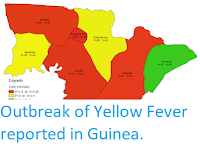
The World Health Organisation has reported an outbreak of Yellow Fever in Guinea, with 52 suspected cases of the disease reported between 6 November and 15 December 2020, fourteen of which subsequently died. Fifty of the reported cases are from the Koundara Health District, one from the Dubreka Health District, and one from the Kouroussa Health District. Tests carried out at the Nongo Laboratory of Viral Haemorrhagic Fevers in Conakry confirmed Yellow Fever in eight of the patients from Koundara, plus both the Debreka and Kouroussa patients. Further tests carried out at the Institut Pasteur de Dakar confirmed Yellow Fever in eight Koundara patients.

 
Geographic distribution of suspected and confirmed cases of yellow fever per 100,000 inhabitants by sub-prefecture, in the health district of Koundara, 30 November 2020. World Health Organisation.

Yellow Fever is a Mosquito-borne Flavivirus (the group of RNA Viruses that also includes the West Nile, Zika and Hepatitis C Viruses). The Virus causes a mild fever, accompanied loss of appatite, nausea and muscle pains, which passes within about 15 days. However, in about 15 % of cases a more severe infection attacks the liver and kidneys, which can lead to their failure, and therefore the death of the patient.  It originated in tropical Africa and but was carried to South America and the Caribbean during the trans-Atlantic slave trade. Outbreaks of the disease have also been recorded in parts of tropical Asia and the Pacific in recent years, and many countries in tropical regions require visitors to carry a certificate proving they have been vaccinated against the Virus.

 
The Yellow Fever Virus. Erskine Palmer/Centers for Disease Control and Prevention/Wikipedia.

Guinea is considered to be a high-risk endemic country for Yellow Fever, and is carrying out a national program of vaccinations, as well as requiring all visitors to the country aged nine months or above to be vaccinated. However, it is currently estimated that only about 40% of the population has been vaccinated to date, with vaccination rates particularly low in the Koundara Health District where only about 16% of the population has been reached; all of confirmed Yellow Fever cases from Koundara were from patients that had not been vaccinated.

See also...


Follow Sciency Thoughts on Facebook.

Follow Sciency Thoughts on Twitter.


Wednesday, 25 November 2020

Outbreak of Yellow Fever in Nigeria.

The World Health Organization has reported an outbreak of Yellow Fever, which has hit five states in Nigeria. The first case of sickness was reported in the Ute Okpu Community in the Ika North-East local government area of Delta State on 24 July, with the patient dying on the 28th. By 10 November 2020, at total of 65 cases had been reported in the state, with 33 fatalities, with death typically occurring a week after the first syptoms were reported, and being proceded by fever, vomiting (with or without blood), bleeding, seizures, and unconsciousness. The patients, who are mostly from farming communities, were tested for Yellow Fever, Lassa Fever and  Severe Acute Respiratory Syndrome Coronavirus 2, though all tested negative for the latter two conditions. In Early Novermber the first of a cluster of deaths was recorded in Enugu State, where 10 of 13 cases have died; patients here were tested for Yellow Fever, Lassa Fever, Cerebrospinal Meningitis and  Severe Acute Respiratory Syndrome Coronavirus 2, and again tested negative for all diseases other than Yellow Fever. The disease has now also been confirmed in Bauchi State, where eight patients have tested positive since 8 November, though no fatalities have been recorded,  Benue State, where three cases have been reported, and Ebonyi State, where is a single case has been reported.

 
Geographic distribution of affected states and local government areas in Nigeria. World Health Organization.

Yellow Fever is a Mosquito-born Flavivirus (the group of RNA Viruses that also includes the West Nile, Zika and Hepatitis C Viruses). The Virus causes a mild fever, accompanied loss of apatite, nausea and muscle pains, which passes within about 15 days. However, in about 15 % of cases a more severe infection attacks the liver and kidneys, which can lead to their failure, and therefore the death of the patient.  It originated in tropical Africa and but was carried to South America and the Caribbean during the trans-Atlantic slave trade. Outbreaks of the disease have also been recorded in parts of tropical Asia and the Pacific in recent years, and many countries in tropical regions require visitors to carry a certificate proving they have been vaccinated against the Virus.

The Yellow Fever Virus. Erskine Palmer/Centers for Disease Control and Prevention/Wikipedia.

Yellow fever can be prevented through vaccination, but uptake of this is considered to be dangerously low in Nigeria.  To this end the Nigerian Federal Ministry of Health and World Health Organisation have initiated a program to encourage immunisation within the country, with around 54% of the country vaccinated between 2004 and 2019. There are currently 30 million doses of the vaccine available in Nigeria, with Delta and Bauchi states among those been targetted for the next phase of immunisation. 

Yellow Fever re-emerged in Nigeria in 2017, with cases subsequently reported in all 36 states and the Federal Capital Territory. The World Health Organisation regards Nigeria as a high risk country for Yellow Fever, as the disease is able to spread epizotically (in wildlife), with Human infections being essentially a spillover from an unseen epidemic.

See also...


Follow Sciency Thoughts on Facebook.

Follow Sciency Thoughts on Twitter.