Showing posts with label Bangladesh. Show all posts

Wednesday, 8 April 2026

More than 100 dead in outbreak of Measles in Bangladesh.

More than 100 people have died of suspected Measles in an outbreak of the disease in Bangladesh. Cases started appearing in mid-March 2026, since when more than 7500 suspected cases have been reported, with more than 4600 people hospitalised, almost all of whom are young children, with about one third of those affected being under nine months old. Over 900 cases have been laboratory-confirmed, including 16 of those who lost their lives.

A patient being treated for Measles at the Dhaka Medical College in Bangladesh. Drik Picture Library/Getty Images.

Measles is a human disease caused by a Virus in the Paramyxovirus family. The Virus infects the respiratory tract, then spreads throughout the body. It can lead to major epidemics with significant morbidity and mortality, especially among vulnerable people. Among young and malnourished children, pregnant women, and immunocompromised individuals, including those with HIV, cancer or treated with immunosuppressives, Measles can cause serious complications, including severe diarrhoea, blindness, encephalitis, pneumonia, and death.

Thin-section transmission electron micrograph revealing the ultrastructural appearance of a single Viron, of the Measles Virus. The measles Virus is a Paramyxovirus, of the genus Morbillivirus. It is 100-200 nm in diameter, with a core of single-stranded RNA, and is closely related to the Rinderpest and Canine Distemper Viruses. Two membrane envelope proteins are important in pathogenesis. They are the F (fusion) protein, which is responsible for fusion of virus and host cell membranes, viral penetration, and hemolysis, and the H (hemagglutinin) protein, which is responsible for adsorption of virus to cells. Centers for Disease Control and Prevention/Wikimedia Commons.

Transmission is primarily person-to-person by airborne respiratory droplets that disperse rapidly when an infected person coughs or sneezes. Transmission can also occur through direct contact with infected secretions. Transmission from asymptomatic exposed immune persons has not been demonstrated. The Virus remains contagious in the air or on contaminated surfaces for up to two hours. A patient is infectious from four days before the start of the rash to four days after its appearance. There is no specific antiviral treatment for Measles, but most people recover within 2-3 weeks.

An effective and safe vaccine is available for prevention and control. The Measles-containing-vaccine first-dose is given at the age of nine months, while the Measles-containing-vaccine second dose is given at the age of 15 months. A 95% population coverage of Measles-containing-vaccine first-dose and Measles-containing-vaccine second dose is required to stop measles circulation.

In areas with low vaccination coverage, epidemics typically occur every two to three years and usually last between two and three months. However, their duration varies according to population size, crowding, and the population’s immunity status.

The Measles outbreak in Bangladesh this year is thought to have been linked to the recent political instability in the country, as well as the Covid-19 pandemic. Bangladesh typically runs a major Measles vaccination campaign every four years. However, the 2020 campaign is thought to have been disrupted by the diverting of staff and resources to deal with the impacts of the Covid-19 pandemic, and the 2024 campaign was cancelled amid the political turmoil which led to the removal of the country's president, Sheikh Hasina, and the installation of an interim government under the economist Muhammad Yunus, which made repairing the country's economic and political systems a priority.

Following elections in February 2026, a new government was sworn in, led by Tarique Rahman of the Bangladesh National Party. This new government has launched a major new Measles vaccination campaign in response to the epidemic, beginning with 30 identified hotspots in 20 of the country's 64 districts, targeting 1.2 million children between the ages of six months and five years who have not received the vaccination. 

See also...


Sunday, 23 November 2025

At least ten dead and more than 100 injured following Magnitude 5.5 Earthquake in central Bangladesh.

The United States Geological Survey recorded a Magnitude 5.5 Earthquake at a depth of about 10 km, roughly 30 km to the northeast of the Bangladeshi capital, Dhaka, slightly after 10.35 local time (slightly after 4.35 am GMT) on Saturday 22 November 2025. At least ten people, including at least one child, have died as a result of the event, with more than 100 injured. Most of those killed or injured appear to have been struck by debris falling from buildings in densely populated urban areas; three people were reportedly killed in a single incident when they were struck by a falling balcony. The event was felt across Bangladesh, as well as neighbouring areas of India.

Debris which fell from buildings into a crowded street in Dhaka, Bangladesh, during an Earthquake on 22 November 2025. Reuters.

Earthquake activity in northern Bangladesh is influenced by the uplift of the Tibetan Plateau, due to the impact of India into Eurasia to the south. The Indian Plate is moving northwards at a rate of 5 cm per year, causing it to impact into Eurasia, which is also moving northward, but only at a rate of 2 cm per year. The collision of the Indian and Eurasian plates has led to the formation of the Himalayan Mountains, the Tibetan Plateau, and the mountains of southwest China, Central Asia and the Hindu Kush.

Block diagram showing how the impact of the Indian Plate into Eurasia is causing uplift on the Tibetan Plateau. Jayne Doucette/Woods Hole Oceanographic Institution.

Eastern Bangladesh is also in an area particularly prone to Earthquakes; much of nearby Myanmar lies on the Burma Plate, a small tectonic plate caught between  the Eurasian Plate to the northeast, the Indian Plate to the west and southwest and the Sunda Plate to the southeast. As these larger plates move together the Burma Plate is being squeezed and fractured, with a major fault line, the Kabaw Fault, having formed across much of the north of the country, along which the Burma Plate is slowly splitting. Most Earthquakes in the region are caused by movement on this fault.

The movement of the Burma and surrounding plates. Sheth et al. (2011).

The central part of Bangladesh is potentially affected by both tectonic systems, but is rather less prone to earthquake events, with only six Earthquakes of Magnitude 5.5 or greater since 1950. This may help to explain the level of deaths and injuries associated with this event, although building safety has been a long standing political issue in Bangladesh, marked by events such as the Tazreen Factory Fire in 2012, in which at least 112 people died in a fire at a nine-story factory building with insufficient fire escapes, and the Rana Plaza collapse in 2013, in which an eight story commercial building collapsed, killing 1134 people. Since 2013, the Bangladesh Accord on Fire and Building Safety2018 Transition Key Accord, and most recently the Readymade Sustainability Council, have sort to get international garment manufacturing companies operating in Bangladesh to sign up to fire and building safety protocols, but there remains little general building regulation.

See also...

Sunday, 13 August 2023

Sharp rise in the number of Dengue Fever cases in Bangladesh.

From 1 January to 7 August 2023, the Ministry of Health and Family Welfare of Bangladesh reported a total of 69 483 laboratory-confirmed Dengue Fever cases and 327 related deaths, with a case fatality rate of 0.47%, according to a press release issued by the World Health Organization on 11 August 2023. Of these, 63% of cases and 62% of the deaths were reported in the month of July 2023. Although dengue is endemic in Bangladesh, the current Dengue Fever surge is unusual in terms of seasonality and the early sharp increase in comparison to previous years, where the surge started around -late June. The case fatality rate so far this year is relatively high compared to previous years for the full-year period. The pre-monsoon Aedes survey shows that the density of Mosquitoes, and the number of potential hotspots is at the highest level in the past five years. 

The higher incidence of Dengue Fever is taking place in the context of an unusual episodic amount of rainfall, combined with high temperatures and high humidity, which have resulted in an increased Mosquito population throughout Bangladesh. 

Between 1 January and 7 August 2023, a total of 69 483 Dengue Fever cases including 327 related deaths (a case fatality rate of 0.47%) were reported by the Ministry of Health and Family Welfare. As of 30 June 2023, a total of 7978 cases and 47 deaths were reported, however, the cases started surging rapidly from late June and in the month of July alone 63% of cases (43 854) and 62% of deaths (204) were reported.

The number of cases and deaths are higher compared to similar periods in the past five years. Dengue Fever cases started to rise in May 2023 and have been continuing since then, and the peak is unlikely to have been reached. The reported number of Dengue Fever cases this year is the highest compared to the same periods recorded since 2000.

Number of Dengue Fever cases in Bangladesh (A) and deaths (B) reported by epidemic week from 2018 to 2023, as of 5 August (epidemiological week 31) 2023. World Health Organization.

Cases have been reported from all 64 districts of Bangladesh. Cases in Dhaka Division started to increase in epidemic week 17 (23-29 April 2023) and in all eight divisions since epidemic week 26 (25 June to 1 July 2023).  The most affected area in the Dhaka Division is Dhaka City, accounting for 52.8% of cases and 78.9% of deaths. Other affected divisions include Chattogram Division (13.2% of cases and 9.2% of deaths), Dhaka Division excluding Dhaka City (11.6% of cases and 2.8% of deaths), and Barisal Division (10.5% of cases and 4.3% of deaths). The Sylhet Division has the lowest number of cases (560) and no deaths reported so far.

As of 7 August 2023, the reported case fatality rate is 0.47%, which is higher compared to previous years. The overall case fatality rate is higher in females than in males (0.72% compared to 0.32%) with females having four times higher case fatality rate than males among those aged 21-40 years (0.71% compared to 0.18%). The older age group recorded a higher case fatality rate compared to the younger age group (1.87% in the age group over 60 years compared to 0.74% in the age group between 41 to 60 years and 0.34% in those aged 40 years and below).

Dengue cases, deaths, and case fatality rate in Bangladesh for 2018, 2019, 2021, 2022 and 2023. World Health Organization. 

Dengue is a Viral infection transmitted to humans through the bite of infected Mosquitoes and is found in tropical and sub-tropical climates worldwide, mostly in urban and semi-urban areas. The primary vectors that transmit the disease are Aedes aegypti mosquitoes and, to a lesser extent, Aedes albopictus.

Dengue Fever is caused by a Positive Single-strand RNA Virus of the Flaviviridae family and there are four distinct, but closely related, serotypes of the Virus that cause Dengue Fever (Dengue Fever Virus-1, Dengue Fever Virus-2, Dengue Fever Virus-3 and Dengue Fever Virus-4). Recovery from infection is believed to provide lifelong immunity against that serotype. However, cross-immunity to the other serotypes after recovery is only partial, and temporary. Subsequent infections (secondary infection) by other serotypes increase the risk of developing Severe Dengue Fever.

A transmission electron micrograph showing Dengue Virus virions (the cluster of dark dots near the centre). Centers for Disease Control and Prevention/Wikimedia Commons.

Dengue Fever Virus-2 was the predominant circulating serotype in Bangladesh until 2018, when it was replaced by Dengue Fever Virus-3, which has remained the predominant serotype since 2019.  However, Dengue Fever Virus-2 has been identified as the primary circulating serotype in the 2023 outbreak, and this may result in more severe Dengue Fever infections and hospitalizations as a result of a second infection with a heterologous (similar but not identical) serotype. Of the 66 serotyped samples in the month of June 2023, Dengue Fever Virus-2 comprised 51.5% of cases and Dengue Fever Virus-2 comprised 43.9%.

There is no specific treatment for Dengue Fever; however, the timely detection of cases, identifying any warning signs of severe dengue infection, and appropriate case management are key elements of care to lower case fatality rates to less than 1%.

Dengue Fever was first recorded in the 1960s in Bangladesh (then known as East Pakistan) and was known as 'Dacca Fever'. Since 2010 cases of Dengue Fever have appeared to coincide with the rainy season from May to September and higher temperatures. Bangladesh’s climate conditions are becoming more favourable for the transmission of Dengue Fever and other vector-borne diseases including Malaria and Chikungunya Virus due to excessive rainfall, waterlogging, flooding, rise in temperature and the unusual shifts in the country’s traditional seasons. 

See also...


Follow Sciency Thoughts on Facebook.

Follow Sciency Thoughts on Twitter.


Saturday, 6 August 2022

Sharp rise in the number of Dengue Fever cases reported in Rohingya Refugee Camps in the Cox's Bazar District of Bangladesh.

Rohingya Refugee Camps in the Cox's Bazaar District of Bangladesh are experiencing an acute surge in dengue cases as compared to the previous four years (2018 to 2021), according to a press release issued by the World Health Organization on 3 August 2022. As of 24 July, a total of 7687 confirmed cases and 6 deaths have been reported in 2022, with 93% (7178) of the cumulative number of cases being reported since the start of the surge at the end of May. Dengue is endemic in Bangladesh, but a similar surge has not been observed in the larger Cox’s Bazar district outside of the Rohingya Refugee Camps nor at the national level with case numbers and trends within expected levels of incidence for the same period. As dengue is recurrent in this part of the country, the population may be at risk of secondary infection, which puts them at higher risk for severe disease.
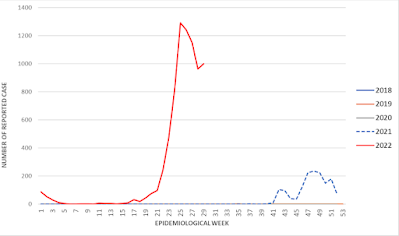
Rapid diagnostic test-confirmed cases of Dengue Fever in Rohingya Refugee Camps in Cox’s Bazar District, Bangladesh by notification date, 1 January 2018 to 24 July 2022. World Health Organization.

From 1 January to 24 July 2022, a total of 7687 cases of Dengue, confirmed by rapid diagnostic test (RDT), and six deaths (case fatality rate, 0.08%) have been reported from the  Rohingya Refugee Camps in the Ukhia Upazila and Teknaf Upazila (sub-districts) of Cox’s Bazar, with the former sub-district being the most affected of the two. An acute surge of cases began during the week commencing 23 May, and peaked the week ending 26 June, with 93% (7178) of the cumulative number of cases being reported between 23 May and 24 July. A decreasing trend in reported Dengue cases was observed following the peak.

Cases of reported Dengue in  Rohingya Refugee Camps are significantly higher as compared to similar periods over the past four years; 2018 (4 cases), 2019 (7 cases), 2020 (3 cases), and 2021 (1530 cases and 3 deaths with a surge from October to December).  However, at a national level and in the larger Cox’s Bazar district, case numbers have been within expected endemic levels of incidence; by comparison to the Dengue case from the camps, the larger Cox’s Bazar district reported approximately 121 cases from 1 January to the end of June.

Camps located in Ukhia Upazila are predominantly affected by the outbreak. Camp 3 accounted for over 50% of all reported cases and Camps 4 and 1W each account for less than 10% of cases as of 24 July 2022. More than two-thirds of cases (67%) were among persons 15 years and older with males accounting for 60% of cases. The majority of cases (81%) were hemodynamically stable, i.e. not showing any warning signs for Severe Dengue Syndrome (such as Dengue Hemorrhagic Fever or Dengue Shock Syndrome) nor having any coexisting conditions, while approximately 15% of cases were mild and required observation and admission to primary health facilities. Severe Dengue with signs of Dengue Hemorrhagic Fever and Dengue Shock Syndrome was observed in 0.3% of cases and required admission to Cox’s Bazar District Hospital located within the camp. Among patients admitted to the hospital, 1% required blood transfusion. Previous Dengue infection was reported in 1% of current cases.

Serotyping results from 10 samples processed at the Institute of Epidemiology, Disease Control and Research reference laboratory in the capital Dhaka identified Dengue Fever Virus-3 (5 samples) and Dengue Fever Virus-2 (3 samples). Two samples had inconclusive results.

Dengue is endemic in Bangladesh with recurrent outbreaks. The Rohingya Refugee Camps in Cox’s Bazar district previously experienced an acute Dengue outbreak from October to December 2021 during which 1530 cases, including 3 deaths, were reported. Case numbers began to decline at the beginning of 2022, and by the end of February, the event was under control until the resurgence of cases in May 2022.

Dengue is a viral infection transmitted to humans through the bite of infected Mosquitoes and is found in tropical and sub-tropical climates worldwide, mostly in urban and semi-urban areas. The primary vectors that transmit the disease are Aedes aegypti mosquitoes and, to a lesser extent, Aedes albopictus These mosquitoes are also vectors of Chikungunya, Yellow Fever and Zika viruses. Dengue is widespread throughout the tropics, with local variations in risk influenced by climate parameters as well as social and environmental factors.

Dengue causes a wide spectrum of disease. This can range from subclinical disease (people may not know they are even infected) to severe flu-like symptoms in those infected. Although less common, some people develop Severe Dengue, which can be any number of complications associated with severe bleeding, organ impairment and/or plasma leakage. Severe Dengue has a higher risk of death when not managed appropriately. Severe Dengue was first recognised in the 1950s during Dengue epidemics in the Philippines and Thailand. Today, Severe Dengue affects most Asian and Latin American countries and has become a leading cause of hospitalisation and death among children and adults in these regions.

Dengue is caused by a Virus of the Flaviviridae family and there are four distinct, but closely related, serotypes of the Virus that cause Dengue (Dengue Fever Virus-1, Dengue Fever Virus-2, Dengue Fever Virus-3 and Dengue Fever Virus-4). Recovery from infection is believed to provide lifelong immunity against that serotype. However, cross-immunity to the other serotypes after recovery is only partial, and temporary. Subsequent infections (secondary infection) by other serotypes increase the risk of developing Severe Dengue.
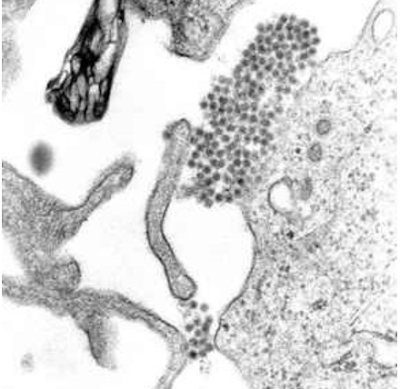
A transmission electron micrograph showing Dengue Virus virions (the cluster of dark dots near the centre). Centers for Disease Control and Prevention/Wikimedia Commons.

Dengue has distinct epidemiological patterns, associated with the four serotypes of the Virus. These can co-circulate within a region, and indeed many countries are hyper-endemic for all four serotypes. Dengue has an alarming impact on both human health and the global and national economies. Dengue Fever Virus is frequently transported from one place to another by infected travellers; when susceptible vectors are present in these new areas, there is the potential for local transmission to be established.

The incidence of Dengue has grown dramatically around the world in recent decades. A vast majority of cases are asymptomatic or mild and self-managed, and hence the actual numbers of dengue cases are under-reported. Many cases are also misdiagnosed as other febrile illnesses

One modelling estimate indicates 390 million Dengue Virus infections per year, of which 96 million manifest clinically (with any severity of disease). Another study on the prevalence of dengue estimates that 3.9 billion people are at risk of infection with dengue viruses. Despite a risk of infection existing in 129 countries, 70% of the actual burden is in Asia.

The number of dengue cases reported to the World Health Organization increased over 8 fold over the last two decades, from 505 430 cases in 2000, to over 2.4 million in 2010, and 5.2 million in 2019. Reported deaths between the year 2000 and 2015 increased from 960 to 4032, affecting mostly younger age group. The total number of cases seemingly decreased during years 2020 and 2021, as well as for reported deaths. However, the data is not yet complete and COVID-19 pandemic might have also hampered case reporting in several countries.

The overall alarming increase in case numbers over the last two decades is partly explained by a change in national practices to record and report Dengue to the Ministries of Health, and to the World Health Organization. But it also represents government recognition of the burden, and therefore the pertinence to report Dengue disease burden.

Before 1970, only 9 countries had experienced Severe Dengue epidemics. The disease is now endemic in more than 100 countries in the World Health Organization regions of Africa, the Americas, the Eastern Mediterranean, South-East Asia and the Western Pacific. The Americas, South-East Asia and Western Pacific regions are the most seriously affected, with Asia representing about 70% of the global burden of disease.

Not only is the number of cases increasing as the disease spreads to new areas including Europe, but explosive outbreaks are occurring. The threat of a possible outbreak of Dengue now exists in Europe; local transmission was reported for the first time in France and Croatia in 2010 and imported cases were detected in 3 other European countries. In 2012, an outbreak of Dengue on the Madeira islands of Portugal resulted in over 2000 cases and imported cases were detected in mainland Portugal and 10 other countries in Europe. Autochthonous cases are now observed on an annual basis in few European countries.

The largest number of dengue cases ever reported globally was in 2019. All regions were affected, and Dengue transmission was recorded in Afghanistan for the first time. The American region alone reported 3.1 million cases, with more than 25 000 classified as severe. Despite this alarming number of cases, deaths associated with Dengue were fewer than in the previous year. High number of cases were reported in Bangladesh (101 000), Malaysia (131 000) Philippines (420 000), Vietnam (320 000) in Asia.

In 2020, Dengue affected several countries, with reports of increases in the numbers of cases in Bangladesh, Brazil, Cook Islands, Ecuador, India, Indonesia, Maldives, Mauritania, Mayotte (France), Nepal, Singapore, Sri Lanka, Sudan, Thailand, Timor-Leste and Yemen. Dengue continues to affect Brazil, India, Vietnam, the Philippines, Cook Islands, Colombia, Fiji, Kenya, Paraguay, Peru and, Reunion islands, in 2021. 

The COVID-19 pandemic is placing immense pressure on health care and management systems worldwide. The World Health Organization has emphasised the importance of sustaining efforts to prevent, detect and treat vector-borne diseases during this pandemic such as Dengue and other Arboviral diseases, as case numbers increase in several countries and place urban populations at highest risk for both diseases. The combined impact of the COVID-19 and dengue epidemics could have devastating consequences on the populations at risk.

The virus is transmitted to humans through the bites of infected female Mosquitoes, primarily the Aedes aegypti Mosquito. Other species within the Aedes genus can also act as vectors, but their contribution is secondary to Aedes aegypti.

After feeding on an Dengue Fever Virus-infected person, the virus replicates in the Mosquito midgut, before it disseminates to secondary tissues, including the salivary glands. The time it takes from ingesting the Virus to actual transmission to a new host is termed the extrinsic incubation period. The extrinsic incubation period takes about 8-12 days when the ambient temperature is between 25-28°C. Variations in the extrinsic incubation period are not only influenced by ambient temperature; a number of factors such as the magnitude of daily temperature fluctuations, Virus genotype, and initial viral concentration, can also alter the time it takes for a Mosquito to transmit Virus. Once infectious, the Mosquito is capable of transmitting Virus for the rest of its life.

Mosquitoes can become infected from people who are viremic with Dengue Fever Virus. This can be someone who has a symptomatic Dengue infection, someone who is yet to have a symptomatic infection (they are pre-symptomatic), but also people who show no signs of illness as well (they are asymptomatic).

Human-to-Mosquito transmission can occur up to 2 days before someone shows symptoms of the illness, up to 2 days after the fever has resolved. Risk of Mosquito infection is positively associated with high viremia and high fever in the patient; conversely, high levels of Dengue Fever Virus-specific antibodies are associated with a decreased risk of Mosquito infection. Most people are viremic for about 4-5 days, but viremia can last as long as 12 days.

The primary mode of transmission of Dengue Fever Virus between Humans involves Mosquito vectors. There is evidence however, of the possibility of maternal transmission (from a pregnant mother to her baby). While vertical transmission rates appear low, with the risk of vertical transmission seemingly linked to the timing of the Dengue infection during the pregnancy. When a mother does have a Dengue Fever Virus infection when she is pregnant, babies may suffer from pre-term birth, low birthweight, and fetal distress.

Rare cases of transmission via blood products, organ donation and transfusions have been recorded. Similarly, transovarial transmission (i.e. the transmission of the Virus from a female Mosquito to her young) of the Virus within Mosquitoes have also been recorded. 

The Aedes aegypti mosquito is considered the primary vector of Dengue Fever Virus. It could breed in natural containers such as tree holes and Bromeliads, but nowadays it has well adapted to urban habitats and breeds mostly in man-made containers including buckets, mud pots, discarded containers and used tyres, storm water drains etc., thus making Dengue an insidious disease in densely populated urban centres. Aedes aegypti is a day-time feeder; its peak biting periods are early in the morning and in the evening before sunset. Female Aedes aegypti frequently feed multiple times between each egg-laying period leading to clusters of infected individuals. Once a female has laid her eggs, these eggs can remain viable for several months in dry condition, and will hatch when they are in contact with water.

Colour print of the Dengue Mosquito Aedes aegypti (then called Stegomyia fasciata, today also Stegomyia aegypti). To the left, the male, in the middle and on the right, the female. Above left, a flying pair in copulaEmil August Goeldi (1905)/Wikimedia Commons.

Aedes albopictus, a secondary Dengue vector and, has spread to more than 32 states in the USA, and more than 25 countries in the European Region, largely due to the international trade in used tyres (a breeding habitat) and other goods (e.g. lucky Bamboo). It favours breeding sites close to dense vegetation including plantations which is linked to increased risk of exposure for rural workers such as those in Rubber and Palm Oil plantation, but it is also found to be established abundantly in urban areas. Aedes albopictus is highly adaptive. Its geographical spread is largely due to its tolerance of colder conditions, as an egg and adult. Similar to Aedes aegyptiAedes albopictus is also a day biter and it has been implicated as the primary vector of Dengue Fever Virus in a limited number of outbreak, where Aedes aegypti is either not present, or present in low numbers.

While majority of Dengue cases are asymptomatic or show mild symptoms, it can manifest as a severe, flu-like illness that affects infants, young children and adults, but seldom causes death. Symptoms usually last for 2–7 days, after an incubation period of 4–10 days after the bite from an infected Mosquito. The World Health Organization classifies Dengue into 2 major categories: Dengue (with or without warning signs) and Severe Dengue. The sub-classification of Dengue with or without warning signs is designed to help health practitioners triage patients for hospital admission, ensuring close observation, and to minimise the risk of developing Severe Dengue.

See also...

Follow Sciency Thoughts on Facebook.

Follow Sciency Thoughts on Twitter.


Saturday, 23 April 2022

Sillago muktijoddhai & Sillago mengjialensis: Two new species of Sillago from Bangladesh.

Sillagos, Sillago spp., are inshore Perciform Fish widespread in the IndoPacific region. They form an important part of many food webs, feeding on Crustaceans and Molluscs in coastal waters or estuarine areas of rivers with open sandflats and muddy substrates, and in turn being fed upon by larger Fish, Marine Mammals, and Seabirds. Understanding the population structure of these Fish has proven difficult, as the genus contains a large number of very similar-appearing species, often identifiable only by the structure of their swim bladders, with the recent application of genetic profiling to the group suggesting that even this is not reliable, and that the group may contain more cryptic species (species which cannot easily be told apart by physical examination) than previously realised.

In a paper published in the journal Fishes on 18 April 2022, Shilpi Saha of the Fisheries College at the Ocean University of China, and the Department of Zoology at Jagannath University, Na Song and Zhengsen Yu, also of the Fisheries College at the Ocean University of China, Mohammad Abdul Baki, also of the Department of Zoology at Jagannath University, Roland McKay of the Chillagoe Museum, Jianguang Qin of the School of Biological Sciences at Flinders University, and Tianxiang Gao of the Fishery College at the Zhejiang Ocean University, describe two new species of Sillago from Bangladesh.

The new species are described from specimens obtained from fishermen at locations in Cox’s Bazar, Sundarbans, Patharghata, Maheshkhali and Saint Martin’s Island. These Fish are typically caught using beach seine nets in this area.

The first new species described is named Sillago muktijoddhai, were 'muktijoddhai' refers to the muktijoddha freedom fighters who fought for Bangladesh's independence from Pakistan from 1971 to 1979. 

Sillago muktijoddhai is elongated in shape, slightly steep anteriorly, and tubular posteriorly. The upper jaw is slightly protracted and crescentic, with minute villiform teeth on both jaws in one row. The back edge of the preopercle is slightly denticulated, and the opercle has one fragile spine posterodorsally. Gill rakers on the first arch are pointed and gradually become short towards the end. The body is covered with moderate-sized, overlapping ctenoid scales. The cheek scales cycloid, arranged in two rows.

There are two distinctly separate dorsal fins. The first dorsal fin is higher than the second, originating above the pectoral-fin base; its second spine is the longest, and the length of the succeeding spines decrease gradually. The base of the second dorsal fin is long, beginning at the midbody and not reaching the caudal-fin base when depressed. The anal fin originates slightly posterior to the anus, not reaching the caudal-fin base when depressed. The two disconnected pelvic fins are wide, roughly three-cornered, and shorter than the pectoral fin.

The body of Sillago muktijoddhai is greenish dorsally and light yellowish ventrally with black dots on the side below the lateral line. The cheek has black dots gathered on the anteroventral part of the eyes. The dorsal fins are hyaline, and small dark spots exist on the fin membrane, but those on the second dorsal fin form two or three distinct rows. The pectoral and pelvic fins are light yellowish. The anal fin is light yellowish with black spots. The caudal fin is light yellowish, dusky, and with a white edge; the lobes are truncated or emarginated.

Sillago muktijoddhai from the Bay of Bengal, Bangladesh. Saha et al. (2022).

The second new species is named Sillago mengjialensis, where 'mengjialensis' means 'from Mèngjiālā', where Mèngjiālā is the Chinese name for Bengal, in reference to the fact that the species was discovered as part of a collaborative project between scientists from China and Bangladesh.

The body of Sillago mengjialensis is elongated, somewhat conical anteriorly, and cylindric posteriorly. The back edge of the preopercle is slightly toothed. The opercle only has one weak spine posterodorsally. The gill rakers on the first arch are pointed and gradually become small towards the end. The body is covered with moderate-sized, overlapping ctenoid scales. The cheek scales are cycloid, arranged in two rows.

There are two disconnected dorsal fins. The first dorsal fin is higher than the second, originating above the pectoral fin base; its second spine is the longest, and the length of the succeeding spines decreases gradually. The base of the second dorsal fin is long, beginning at the midbody, and not reaching the caudal-fin base when depressed. The anal fin originates slightly posterior to the anus, not reaching the caudal-fin base when depressed. Two disconnected pelvic fins are large, roughly trigonal in shape, and smaller than the pectoral fin.

The body of Sillago mengjialensis is light olive greenish dorsally and silver ventrally with black spots on the sides below the lateral line. The cheek has black spots gathered on the anteroventral part of the eyes. The dorsal fins are hyaline with small dark spots on the fin membrane adjacent to the ray. The pectoral and pelvic fins are light yellowish. The anal fin is light yellowish to whitish with black dots. The caudal fin light yellowish, dusky, and has a white margin; the lobes are truncated or emarginated.

 
Sillago mengjialensis from the Bay of Bengal, Bangladesh. Saha et al. (2022).

See also...


Follow Sciency Thoughts on Facebook.

Follow Sciency Thoughts on Twitter.