Showing posts with label Glassmaking. Show all posts

Thursday, 5 December 2024

The beads of Mozambique Island.

Mozambique Island, on the northern coast of the African country of the same name, was the first place where Portuguese explorers, having rounded the Cape of Good Hope, encountered the trade networks of the Indian Ocean. At this time the island was ruled by a Muslim sheikh, with merchants using the island as a base from which to trade with the African interior or wider Indian Ocean needing his permission to do so, with all such merchants needing to be Muslims themselves. The island was quickly brought under Portuguese rule, with a Captain appointed to rule the island on behalf of the Portuguese Crown, and became a crucial stopover on the journey between Lisbon and Goa. While the Portuguese Captain in theory had control over all commerce occurring in the port, in practice many commodities were not regulated, and the island gained as a reputation as place where fortunes could be made with little interference from the Portuguese authorities.

During the Early Modern Era, beads were extensively used by European traders as a means of currency, being both a portable, high value item, and a desirable commodity which they could control the supply of. This certainly appears to have been the case on Mozambique Island, where large numbers of beads, many of them apparently derived from shipwrecks off the coast of the island, are today collected from the island's sandy beaches and made into necklaces, which are then sold to tourists.

In a paper published in the journal World Archaeology on 22 November 2024, Tânia Manuel Casimiro of História, Territórios e Comunidades at Nova University Lisbon, Yolanda Duarte of Archaeology at Eduardo Mondlane University, and Jéssica Iglésias, also of História, Territórios e Comunidades at Nova University Lisbon, present the results of an analysis of the origin of beads from Mozambique Island, and the implications of this for the history of the island.

Today, beads are collected by shovelling sand from the beaches into 25-50 kg bags and taking these to a flat, clean surface, where the sand can be sifted through for beads. No permit is needed for this activity, and no attention paid to the archaeological context of the beads by the collectors. However, some of the necklaces made by the bead-gatherers have been obtained by local people with an interest in the island's heritage, and it is from such collections that Casmiro et al. gained the beads used in their study.

Process for recovering the beads. Casmiro et al. (2024).

Casmiro et al. examined a sample of 12 166 beads, recording the material they were made from, as well as their style. Many of the glass beads were apparently Venetian, with Venice being a major manufacturing centre for beads used as colonial trade goods from the sixteenth century onwards, although Casmiro et al. note that many 'Venetian' beads were in fact made in other European cities in imitation of the Venetian style. However, such beads are clearly of European origin, easily distinguished from Indian beads (also very common around the Indian Ocean) which tend to be carved from a mineral such as carnelian or agate. Because of the way in which the beads were obtained, it was not possible to date them by context, although it was possible to build up a limited chronology for beads from the sixteenth to nineteenth century, with a few beads coming from outside this period.

Strings of beads sold to tourists on Mozambique Island. Casmiro et al. (2024).

The majority of the beads (10 626) were made of glass. Most of these were of a single colour, with examples of white, black, blue, green, yellow, orange, and red beads being found, along with some which combine a several colours. These glass beads also vary greatly in shape, with tubular, oblate, cylindrical, ellipsoidal, spherical, bicone, and barrel-shaped beads all present. After glass beads, the most common were stone beads,  followed by coral, shell, bone, ivory, and plastic.

A 'Venetian' glass chevron bead transformed into a pendant. Casmiro et al. (2024).

The most common glass beads (7789 examples) are seed beads, small spherical beads at most a few millimetres across, which have been manufactured in Europe since at least the fifteenth century. Another common type are Green Heart Beads (540 examples), cylindrical glass beads made up of layers of different glass, with the innermost being green, giving a shimmering, multi-hued effect, which were produced in Venice between the fifteenth and eighteenth centuries.

(Top) Glass Heart Beads. (Bottom) Seed beads. Casmiro et al. (2024).

Hudson's Bay Beads (235 examples), sometimes also known as White Heart Beads, or Cornaline d’Aleppo, were made in Venice between 1830 and the early 1900s. These again were cylindrical beads with multiple layers, this time having an inner layer of white or yellow glass.

Hudson's Bay Beads. Casmiro et al. (2024).

Chevron beads (11 examples) were elongate beads made by building up multiple layers of glass onto a central star-shaped moulded cane. These beads were invented in the late fifteenth century by craftswoman Marietta Barovier of Murano, and made at a number of glassworks in Murano and Venice, and probably elsewhere, although it is not generally possible to tell where an individual bead was made.

Chevron beads from Mozambique Island. Casmiro et al. (2024).

A-Speo beads (186 examples) were made by drawing out a thick glass straw, which was then chopped into short segments. These segments were then placed on a metal rod, and placed in a furnace to melt them into a rounded shape (the name 'a-speo' derives from the Italian phrase for 'to skewer'). This technique was probably invented in Venice or Murano, but was practiced in many areas of Europe. 

A-speo beads from Mozambique Island. Casmiro et al. (2024).

Skunk beads (14 examples), were made in Venice (and probably other European bead-making centres) in the eighteenth and nineteenth centuries, by adding small globules of glass to an a larger glass bead of a different colour, to give a speckled effect. These were most commonly black with added white speckles, hence the name 'skunk beads', but other colour patterns were also produced. 

Skunk beads from Mozambique Island. Casmiro et al. (2024).

Tubular beads (12 examples) were first made in Venice in the fifteenth century, but due to their ease of manufacture, continued to be made at centres across Europe for the next six centuries. Padre, or Pekin Glass, beads were made in Venetian and Czech workshops in the nineteenth century, in imitation of blue glass beads from China, themselves made as a cheaper substitute for jade beads.

(Top) Tubular beads and (bottom) Pekin Glass beads from Mozambique Island. Casmiro et al. (2024).

Millefiori beads are glass with complicated floral patterns, made since Roman times. They are manufactured by producing glass canes with a flower-shaped cross-section, which are then cut into thin slices, which are in turn incorporated within blown glass products, including beads. The name millefiori derives from the Italian for 'thousand flowers'.

Millefiori beads from Mozambique Island. Casmiro et al. (2024).

Eye beads (2 examples), which superficially resemble eyes, have been made around the Mediterranean Basin, the Middle East, and South Asia for thousands of years, often as a charm against the Evil Eye. The earliest forms were made of clay, but the manufacture of glass eye beads can be traced back to about 1500 BC.

'King' or 'Golo' beads (2 examples) were made in Europe in the nineteenth and twentieth centuries as a high value trade item for African markets. There were large, striped, biconed beads which came in a range of colours, though green beads with yellow, black, and red stripes were the most common.

Dog Teeth, or ruffled beads (two examples) were made in Venice in the late nineteenth and early twentieth centuries, mostly for trade with Nigeria. These are black beads with an irregular shape, and a 'ruffle' of white marks (or 'teeth') around their centre.

A single Nueva Cadiz bead was found on Mozambique Island. These were squared, tubular beads in a distinctive blue colour, made originally in Venice for trade with the Americas, but which were subsequently made in a number of other European cities. These beads are very common at sites on the Atlantic coast of Africa, but surprisingly rare at sites on the Indian Ocean.

The single Nueva Cadiz bead found on Mozambique Island. Casmiro et al. (2024).

Bohemian beads (1147 examples) were made in the modern Czech Republic, where they developed a range of distinct techniques of their own, notably pressed glass. These beads often have vertical and horizontal lines, circular incisions, coloured bands, phytomorphic and zoomorphic decorations.

Bohemian beads from Mozambique Island. Casmiro et al. (2024).

Russian blue beads (183 examples) were a distinctive type of Bohemian bead produced in the eighteenth centuries. These beads were multifaceted with six, seven, or eight sides, and typically a transparent blue, although amber, green, and clear examples are also known.

Russian blue beads from Mozambique Island. Casmiro et al. (2024).

Vaseline beads (1 example), sometimes also called uranium beads because of the uranium used to tint the glass green, were large faceted of shaped beads made in Bohemia in the late  nineteenth and early twentieth centuries.

Haj beads (5 examples) were made in Bohemian the early twentieth century for export to the city of Mecca, where they were sold to pilgrims, often becoming heirloom objects within their families. Two of the examples found on Mozambique Island had moon-and-star symbols, while the remaining three had the name of the Prophet Mohammed written upon them.

Dutch opalescent beads (9 examples), sometimes known as moon beads, were glass beads made to resemble pearls by adding ash to the glass, made in the Netherlands, Bohemia, Germany, and Venice, in the eighteenth and nineteenth century.

Dogon beads (187 examples) are large, chunky beads with a rough texture, which were produced in Amsterdam and possibly Germany in the seventeenth and eighteenth centuries, principally for trade with the Dogon people of southern Mali, but were also traded to other areas of Africa.

Dogon beads from Mozambique Island. Casmiro et al. (2024).

Prosser beads (9 examples), sometimes known as Kakamba Prosser Beads after a town in what is now the Republic of Congo where they were popular. These were made in the nineteenth century by a French craftsman called Jean-Félix Bapterosses, who modified a technique developed by the Prosser Brothers of London to cold-press glass and porcelain buttons, instead producing disk-shaped opalescent beads.

While the majority of the examined beads were glass, stone beads were also common, with 996 in the collection. The most abundant stone types are jet and carnelian, with agate and garnet beads also quite common. Stone beads have been manufactured around the world, which can make it difficult to determine the origin of individual beads, although most stone beads found around the Indian Ocean originate from India or Southeast Asia. This potentially makes these beads the oldest on Mozambique Island, with some examples likely to have reached the island before the first Europeans.

Stone beads from Mozambique Island. Casmiro et al. (2024).

Three beads from Mozambique Island were identified as being of Chinese origin, although details of these are not given. China began to export large volumes of beads in the early twentieth century, something it does to this day, and has produced beads from porcelain, wood, cinnabar, cloisonné, enamelled metal, stones, and glass, among other materials.

Filigree is a form of intricate metalwork consisting of tiny beads and twisted threads soldered together, made in the Islamic world largely between the fifteenth and seventeenth centuries. Fifty five silver elements from Mozambique Island are probably derived from filigree jewellery, most likely originating from Mauritania.

Beads derived from Animal materials such as shell, bone, ivory, and coral were also quite common (469 examples), although it is difficult to assess where these came from, as these materials are available, and have been worked, across much of the globe.

Plastic beads (8 examples) are clearly of twentieth century origin, since the first plastic (Bakalite) was invented by the Belgian-American chemist Leo Hendrick Baekelandin 1909. Plastic beads are cheap and easy to manufacture, and are produced in many countries. The low number of these on Mozambique Island suggests that they may never have been a commercial import, but may have been brought to the island by people wearing them, or possibly even have floated there on ocean currents.

Finally, five items were found in the collection that probably did not start out as beads, but which had been repurposed as such. These were a black glass button or pendant, two jet buttons, a rectangular piece of jet with three diagonal incisions of unknown origin, and what appeared to be the bottom half of a Frozen Charlotte doll (a type of rigid doll, typically made out of china, made between about 1850 and about 1920, mostly in Germany for the US market).

Casmiro et al.'s study revealed the presence of a wide range of beads, made from a variety of substances, on Mozambique Island. Despite this variety, about 90% of the beads were glass, and of European origin. Glass trade beads have been considered to be powerful symbols of European colonial influence, which seems to be particularly relevant on Mozambique Island, a vital trade hub within the Portuguese Empire. The beads of the same designs as those found on Mozambique Island have been found at other sites around the world, although overwhelmingly in colonial contexts.

Glass beads were, of course, made before the fifteenth century, and it can sometimes be hard to differentiate these from later beads, but none of the glass beads found on Mozambique Island appear likely to be this old. The stone, and animal-derived, beads found on the island may date to before the arrival of Europeans in the area, although such beads continue to be made until the present day, making it hard to be certain of their age. Mozambique Island is known to have been a trading hub before the arrival of the Portuguese, but it appears to have become much more important once integrated into the global Portuguese network.

Curiously, the high abundance of European beads on Mozambique Island is in contrast to the situation in South Africa, where European beads are unusual at archaeological sites, but beads from India quite common. It has been suggested that this South African preference for Indian beads may have been established before the arrival of European traders, and that with South African customers unwilling to switch, European traders may instead have imported beads from India to cater for this market.

Casmiro et al. also note that the beads once brought to Africa by Europeans to trade for commodities such as slaves, ivory, and gold, have now taken on a new role in places such as Mozambique Island, being traded back to European tourists as a means of gaining hard currency, a much needed twenty first century trade commodity.

See also...

Wednesday, 26 July 2023

A La Tène period glassworks from central Moravia; the oldest glassworks in Europe north of the Alps.

The Amber Road was an ancient trade route connecting the Baltic to northen Italy via what is now Poland, the Czech Republic, Slovakia, Hungary, and Austria. The Němčice archaeological site, discovered in 2002, lies on this route between the ancient settlements of Roseldorf in Lower Austria and Nowa Cerekwia in Lower Silesia. Surface surveys at the site have yielded more than 2000 Celtic coins, as well as glass bracelets and beads, and bronze artefacts, including amulets and anthropomorphic and zoomorphic figurines associated with the La Tène culture (a widespread Celtic culture which appeared in Gaul around 500 BC and spread across northern Europe as far as England, Slovakia, central Italy, the Balkan Peninsula, and Ukraine. Subsequent excavations have discovered several sunken huts connected by corridors, three square features interpreted as sanctuaries, and site for the production of tools and materials.

In a paper published in the journal Antiquity on 29 June 2023, Ivan Čižmář of the Institute of Archaeological Heritage Brno, and Jana Čižmárová of the Moravian Museum, provide a description of the Central Agglomeration Nĕmčice nad Hanou: Interdisciplinary Research of a Key Site of the La Tène Period in Moravia Project, which aims to achieve a better understanding of this site, and its importance within Central Europe in the second and third centuries BC.

(A) Location of Nĕmčice in the Central Danube region; (B) aerial view of the site from the south-east. Ivan Čižmář in Čižmář & Čižmárová (2023).

Excavations at the Nĕmčice site in 2021 and 2022 appear to have progressed as far as is likely to be possible using non-destructive techniques, and future work should concentrate on analysis of the material collected.

The most important find at Nĕmčice is the glass workshop, the oldest known such site in Europe north of the Alps; the La Tène people were known for their glass working skills, but this is the first time that a La Tène glass workshop has been found this far north. The initial surface surveys suggested that there might be a glass workshop in the northern part of the Nĕmčice site, where numerous apparently rejected glass beads and part-finished glass items were found within an area about 40 m in diameter. This unusual concentration of this material had led archaeologists to suspect that glass was being manufactured at Nĕmčice, but until now direct evidence had been missing.

Evidence of glass production and secondary processing from Nĕmčice. Ivan Čižmář in Čižmář & Čižmárová (2023).

By targeting excavations on the centre of this area, and carrying out non-destructive analysis of glass items from the site, it has been possible to locate the site of the workshop, determine the methods being used, and compare the glass to other La Tène glassware from across Europe.

Two of the sunken hut structures at the site were investigated, yielding a number of La Tène ceramic items interpretted as coming from stage LT C2; a morphometric and qualitative analysis of these items should enable comparison to ceramics from Staré Hradisko, a La Tène site in Moravia which has produced LT C2-D1 ceramics dating from roughly 150-50 BC, enabling a better understanding of ceramic development over this time, and the establishment of a better ceramics based dating system for the La Tène culture, which could be applied to other sites. 

Aerial photograph of the excavation in 2021, with sunken hut. Ivan Čižmář in Čižmář & Čižmárová (2023).

The gathering and study of environmental samples, such as bone, plant fragments, charcoal, and pollen, should also allow comparison to other La Tène sites in Moravia, with the aim of building up a dataset for La Tène sites in the region,

Further study of the site intends not just to understand the site as part of a broader European La Tène culture, but also as a space used by the people who lived there. The three large square structures found within the site were clearly important to these people. Similar large square enclosures have also been found at Roseldorf in Lower Austria, where they have been interpreted as being ritual spaces. If this interpretation if correct, then the Nĕmčice site was not just a centre of trade and manufacturing, but also a seat of power and ritual centre.

Aerial photograph of uncovered sanctuary. Ivan Čižmář in Čižmář & Čižmárová (2023).

Čižmář and Čižmárová envisage the Nĕmčice site as having been part of a well-organized trade network along the Amber Road. The existence of such a network shows that this part of Europe was undergoing somewhat of an economic boom during this period, probably driven at least in part by increasing contact with the prosperous states of the Mediterranean Basin, but also by indigenous Central European advances.

See also...


Follow Sciency Thoughts on Facebook.

Follow Sciency Thoughts on Twitter.


Saturday, 29 October 2022

Understanding the traditional glassmaking industry of Bida, west-central Nigeria.

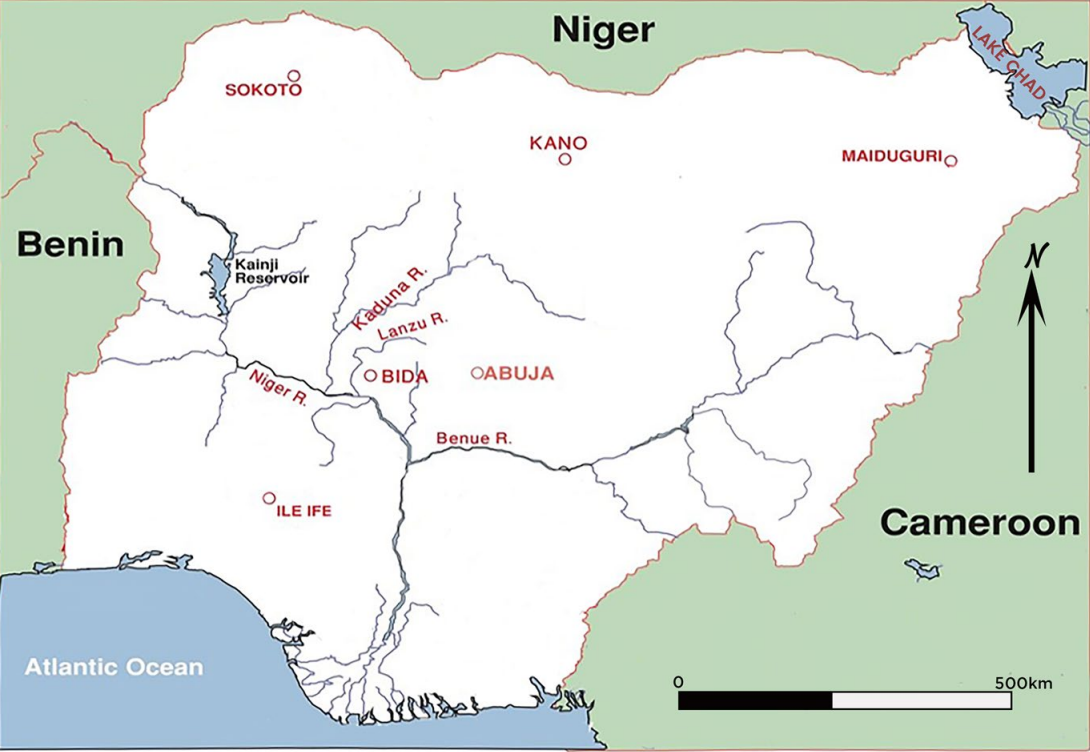
The city of Bida sits on the Lanzu River in west-central Nigeria, close to where that river flows into the Niger in an area bordered by the Sahel region to the north and savanna grasslands to the south. The people of the city belong to the Nupe ethnic group, and attribute the founding of the city to the legendary hero Tsoede, who is said to have ruled over a Nupe kingdom in the area. While culturally distinct, the Nupe civilisation clearly shows influences from neighbouring groups, particularly the Yoruba polities to the south and then Hausa and Fulani of the Sahel Region. The people are predominantly Muslim, speak a language similar to Yoruba, and practice many crafts common to other groups in the region. One notable such craft is glassmaking, practised largely by a Nupe subgroup called the Masagá.

Although fully accepted as part of the wider Nupe community, the Masagá claim to be descended from migrants from Egypt, who settled in Bida during the reign of Tsoede, bringing with them the their glassmaking skills.

All glass produced in the area today is made from recycled imported glass. This practice began in the late nineteenth century, when European-manufactured glass bottles first reached the area. However, the Masagá are known to have manufactured raw glass prior to the arrival of this new material, with their own oral tradition claiming that they brought both their skills and their tools with them when they migrated from Egypt.

This locally produced glass is referred to by the Masagá as 'bikini', while recycled European glass is called 'kwálaba', which can be literally translated as 'bottle'. The word kwálaba could possibly be related to the Arabic قالب (qulab), which implies a mould used to shape glass, but this in itself does not prove the Egyptian ancestry claim. The terms bikini and kwálaba represent important methodological differences, with bikini representing a two-step process in which glass as a raw material is made in one workshop then delivered to a second workshop to be crafted into end products, while kwálaba represents a single step process, in which pre-made glass is molded into new forms. However, in recent decades, the process has become simplified, with both steps being carried out in a single workshop, called an 'estwa', and, since 1969, the process of making bikini ceasing altogether.

In a paper published in the journal African Archaeological Review on 20 October 2022, Lesley Lababidi of Lagos, Nigeria, Abidemi Babatunde Babalola of the University of Cambridge and the British Museum, Bernard Gratuze of the Institut de Recherche sur les ArchéoMATériaux Centre Ernest-Babelon at the Université d’Orléans, Joëlle Rolland of Paris, France, and Emmanuel Véron and  Aurélien Canizares of Conditions Extrêmes et Matériaux: Haute Température et Irradiation at the Université d’Orléans, present the results of a study which aimed to understand the processes involved in the making of bikini glass by reconstructing that process and carrying out laboratory analysis of both the material produced by this reconstruction and recovered from archaeological sites. 

Map of Nigeria showing the location of Bida. Lababidi et al. (2022).

The production of glass artefacts involves two steps; primary production (making glass) and secondary production (making things out of that glass. The primary production phase begins with the sourcing of materials needed to make glass, including silica in the form of sand or rock, a fluxing agent, typically an alkali metal such as sodium or potassium, and alumina or lime to act as a stabilising agent. The secondary phase can involve the manufacture of a wide range of glass objects, and may be carried out at the same location as the primary phase, or a separate location, sometimes far away. This process typically involves remelting the previously made glass, although in some cases artefacts are made by working glass cold. 

Primary glass making in North Africa has been studied fairly extensively by archaeologists, but relatively little attention has been paid to traditions of glassmaking south of the Sahara, although the practice is known to have been carried out at Ile-Ife in southwest Nigeria since at least the fourteenth century AD. 

Secondary glassmaking has an even longer history in sub-Saharan Africa, with examples of recycled glass known from Chibuene in southern Mozambique, an important Indian Ocean trading port, dating back to the sixth-tenth century AD. Recyling of glass also appeared at Gao in Mali between the ninth and twelfth centuries AD, where glass beads from the Islamic world were used as a source of material, something which may also have happened at Igbo-Ukwu in Anambra Stats, Nigeria. Similar secondary production may also have been carried out at Mkokotoni on the coast of Tanzania, where imported beads have been found alongside beads of apparent local manufacture, at a site dated to the early second millennium AD. Secondary production of glass is also thought to have occurred in Southern Africa from the tenth to fifteenth centuries, and possibly as late as the nineteenth century.

Thus the secondary production of glass from imported sources appears to have been a widespread if fairly minor industry in sub-Saharan Africa from the middle of the millennium AD to the middle of the second millennium AD, and to have become increasingly common in the second half of the second millennium AD, as more glass from European sources became available.

To date, very little archaeological investigation has been carried out in the Nupeland area, none of which has produced any evidence for glassmaking. However, historical records for the practice do exist, and go back to 1856, when Thomas Jeferson Bowen, an American Christian missionary, recorded that bikini glass was manufactured at three towns in the area. Subsequent observations of glassmaking in Nupeland were made by the German explorer Leo Frobenius in 1912, the British anthropologist Fred Nadel in the 1940s, and the Swiss travel-writer René Gardi in 1969.

Thus there is a continuous historical record of the manufacture of bikini glass from local materials dating back to the mid-nineteenth century, with this practice clearly differentiated from the practice of making glass from recycled European bottles. However, the increased availability of European glass in a variety of colours appears to have led to the demise of bikini glass making, as the recycling process was both easier than primary manufacture and could produce a wider range of finished items.

Thus, while there is a historical record of bikini glassmaking, and this was still happening within living memory, this practice has now ceased. Lababidi et al. therefore set out to try to recreate the process by which this glass was manufactured, starting with a series of interviews with older members of the Masagá community, followed by an attempt to recreate this technique, and eventual chemical testing of the newly manufactured bikini glass, and a comparison of this to historic glass.

A series of visits to Bida were made by Lesley Lababidi between 2015 and 2019. During this time she spoke to Masagá elder Alhaji Abdulazeez Yanko, the only person who could be found who remembered observing the manufacture of Bikini glass. Alhaji Abdulazeez Yanko recalled that this last happened during the reign of Muhammadu Bakudu Ndayako, who was Estu (king) of Bida between 1935 and 1962. 

Lababidi also carried out interviews with traditional rulers of the Masagá glassmakers’ community, executives of the Masagá Glassmakers Cooperative Society, craftsmen, religious leaders, and others involved in the glassmaking process. Work on reconstructing the processes used by Masagá glassmakers to produce Bikini glass and analysis of historic glass samples to determine their constituents, both of which could potentially be seen as infringing on the secrets of their community, were carried out with the express permission of the current Etsu, His Royal Highness Alhaji (Dr.) Yahaya Abubakar, CFR. Some of the data collected during this process has been edited to make a documentary, The Lost Legacy of Bida Bikini, which can be viewed here.

Both forms of glass produced by the Masagá, bikini and kwálaba, are made in a workshop called an estwa, which is traditionally found at the entrance to each household of a family belonging to the community. There are currently only seven of these estwas remaining, although interviews produced the claim that there were ninety nine such estwas in Bini in the early twentieth century (although Lababidi et al. caution that this might be a symbolic number rather than an exact count). Each estwa was a circular, mud-built structure 3-3.5 m in diameter and about 6 m high, with three doors and several triangular ventilation holes. The furnaces within the estwas can be used for primary glass production or secondary manufacture of glass items, although it is possible that historically, when the number of estwas was larger, that some specialised in primary production and others in secondary manufacture.

The process of primary glass manufacture requires the combination of a number of different materials in the correct proportions, and the available manpower to keep a set of bellows running 24-hours-per-day. Masagá glassmaking is carried out in a furnace called an enaa within the estwa workshop. This is constructed within a pit dug for the purpose, with the sand excavated during this process serving as a raw material for glassmaking. This pit is lined with a type of red clay known as agun zuru, which is gathered from the River Chanchanga (a tributary of the River Kaduna, which in turn flows into the Niger), considered to be very resilient to high temperatures. The location of the source of this clay is not close to Bina, with the material being shipped in by boat.

The pit of an enaa is 40-100 cm in depth, and covered by a dome approximately 74 cm high, with the diameter of the dome corresponding to that of the pit. The dome has an opening at the top through which smoke escapes, and through which firewood, raw materials, and an iron rod used to test the glass are inserted. There is a second opening at the base of the dome, through which the bellows are inserted. Once constructed, the furnace is given a day to dry, then heated by inserting firewood, igniting this fuel, then pumping air in using the bellows. Any cracks which appear at this stage are patched by the addition of new clay.

Schematic diagram of the profile (a) and aerial view (b) of the bikini furnace. Lababidi et al. (2022).

The bellows, known as gurru, are of a the bowl bellows type common in West Africa, in which a pair of clay pots with leather coverings are used, with the leather covering of each being attached to a stick used to pump it up and down vertically. In this case the material used to make the pots is a white clay sourced from Maiduguri, roughly 838 km to the northeast of Bida, while the covering is made from goatskin leather, generally produced in Sokoto in the northwest of Nigeria. The traditional bikini making process is reported to have involved eight bellows-operators, each working a three-hour shift each day, sitting on a low bench and pumping the bellows, to give a 24 hour cover. Lababidi et al.'s research suggested that the bikini glassmaking process typically requires about five days of pumping time.


Bikini furnace for production of raw glass, with bellows, bellows operator, and the worker who inserts firewood. Lababidi et al. (2022).

The firewood used is of a type known as sanche, which grows beside the banks of the rivers Niger and Kaduna close to Bida. This is a red coloured wood reputed to retain march gasses, which burns smoothly, giving a steady heat throughout the glassmaking process. Charcoal is never used.

Lababidi et al. used local sand from Bida in their reconstruction. This is a red silica sand with a high iron oxide and alumina content, which may account for the black colour of bikini glass. This was mixed with soda, ash and water to form the glass. Soda and potash can be sourced from the area around Lake Chad, from Sokoto, or from Kano, but the Masagá were unwilling to provide exact details of the source they used. 

The subject of materials used appears to have been a sensitive one in general for the Masagá, who used terms for things included in the glassmaking process interchangeably during interviews, implying that they were either unable to distinguish between materials such as potash, clay and sand (unlikely), or that they were reluctant to discuss such matters with outsiders. Fred Nadel also recorded this reluctance to discuss materials being used by the Masagá, but also observed that sodium carbonate rather than potash was used as a fluxing agent, something which was supported by the chemical analysis of bikini glass carried out by Lababidi et al.

Based upon this analysis, plus the re-enactment of the process carried out by Lababidi et al., they conclude that the first step involved in the creating of bikini glass is the mixing of local sand, clay, sodium carbonate, and firegang (material recovered from previous firings of the furnace, called 'tswanbi' in Nupe), which are then pounded to an even constituency using a large pestle and mortar. This material is sieved to remove any large pieces, then mixed with water to form a paste, which is shaped into bricks resembling loaves of bread, which are dropped through the entrance at the top of the heated furnace. The furnace is kept hot for a further five days, with the consistency of the glass being periodically checked by scooping out samples with a L-shaped blade attached to an iron rod; it is considered to be complete when this blade is covered by a reddish glaze that hardens as it cools. Once this stage has been reached, heating of the furnace is ceased and it is allowed to cool for 3-5 days, before being dismantled to retrieve the finished glass.

Raw bikini glass (a) and tswanbi (b). Lababidi et al. (2022).

During secondary glassworking, the bikini is typically mixed with recycled glass (kwálaba), to produce objects such as beads or bangles. This can be done in the same furnace as the glassmaking, but is more generally accomplished in a cylindrical furnace, 50-55 cm high, constructed from local red clay on the workshop floor without a pit. This furnace is again fed through the a hole at the top, this whole being square in shape, with an indentation at each corner which can be used to support an iron rod.

Profile (a) and aerial view (b) of the Masaga glass working furnace. Lababidi et al. (2022).

The jewellery furnace is run at a lower temperature than the glassmaking furnace, and fuelled with small branches rather than the larger logs used in the latter. This furnace is often used by several glassworkers at the same time, often with each making different products. Individual glassmakers specialise in the making of a particular product, such as beads or bangles, but will be able to make that item in a variety of sizes and colours, in response to the needs of customers.

The Masagá secondary glass working furnace from Bida, Nigeria. Lababidi et al. (2022).

The most common, and distinctive, item produced by the Masagá glassworkers is the glass bracelet. These are made in single piece with no seams, and have a flat shape, often including ellipse-shaped air bubbles. These bracelets bear a remarkable similarity to those made by the Celtic La Tène culture, which flourished in central Europe from about 450 BC, until the area was taken over by the Roman Empire, which had its own, distinctive glassworking techniques. 

Fragments of bikini bracelets made during the reenactment. Lababidi et al. (2022).

Lababidi et al.'s reconstruction of the bikini glassmaking process has provided insights into how this process was accomplished, although much about the process remains mysterious. The exact materials and used and their proportions are unclear, and this is clearly something the Masagá glassmakers are deeply reluctant to discuss.

In order to address this gap in their knowledge, Lababidi et al. carried out a variety of chemical analysis tests on samples of Bikini glass at the Université d’Orléans. The samples analysed, including several beads and a sample of cullet (unworked glass), were donated by a Masagá glassmaker from his personal collection, and are thought to have originated from the last batch of bikini made in the 1960s. The tests were also carried out on glass from Lababidi et al.'s reconstructed glass, to give a point of reference.

Lababidi et al.'s tests suggest that bikini is a soda lime-silica glass, containing approximately 11.9–16.3% sodium oxide, 5.23–7.34% calcium oxide, plus small amounts of magnesia, potash, and phosphorus, and  fairly high amounts of alumina, iron, and titanium oxides. The composition of the beads was more variable than that of the cullet, suggesting that varying proportions of kwálaba (recycled glass) had been introduced to produce beads of different colours. 

The proportion of strontium to calcium can vary within a single bead, suggesting that the process by which the beads was made involves softening the glass to enable it to be worked, rather than completely melted. 

Lababidi et al. also analysed a greenish glaze which formed on the inside of the furnace. Unlike the bikini, this appeared to be a potash glass, which they believe formed from a reaction between potash derived from the wood burned in the furnace and minerals in the clay from which the furnace was constructed.

The production of seamless glass bracelets by the La Tène Celts is an ancient craft, long lost in Europe. The manufacture of similar bracelets by the modern Masagá glassmakers of Nupeland has the potential to shed light upon this lost craft. At the time when this craft was developed in Europe, glass-blowing had not been developed, and while glassmaking was practised in Greece, Egypt, and the Near East, this was largely confined to the making of beads. The craft of the La Tène glassmakers was refined over the centuries in which it was practised, with new decorative techniques being developed, and new materials, imported from Egypt and the Levant, being incorporated. This craft disappeared with the rise of the Roman Empire, which brought with it a the new technology of glass-blowing. Glass bracelets are still occasionally made in Europe to this day, but invariably with seams produced by soldering the glass; the ancient craft has been completely lost.

The comparison between the ancient La Tène bracelets and those produced by modern Masagá glassworkers was first made by the German archaeologist Théa Elisabeth Haevernick in the 1960s, who subsequently worked with René Gardi, the Swiss travel writer, who filmed the Masagá glassworking process, with the specific intention of comparing it to the lost La Tène craft. 

The process by which seamless glass bracelets are made is very different from modern European glassworking traditions based around glass-blowing technologies, and subsequently very difficult for glassworkers trained in that tradition to master. 

Bikini glass is known to have been manufatured in Bida since at least the mid-nineteenth century. However, this is long after the appearance of European glass in the area, and has no archaeological record within the city, requiring the development of a typification process to understand the history of the industry. Doing this has the potential to shed light on the history of the Masagá glassworkers, but the wider indigenous glassmaking history of sub-Saharan Africa.

The closest site to Bida where glassmaking does have an archaeological history is the Yoruba city of Ile-Ife in southwest Nigeria. Archaeological excavations at the  Igbo-Olokun site in Ile-Ife have revealed evidence of glassworking going back to the eleventh century, but how this relates to the modern glass industry of Bida is unclear. The breaking up of the furnace used by Lababidi et al. to produce their Bikini glass revealed that the inside of the furnace had become covered by a greenish glaze, which when the furnace was broken open produced distinctive concave fragments. Similar fragments have been recovered from the  Igbo-Olokun archaeological site, suggesting that a similar glassmaking process may have been used here. Similar fragments have been found at Ayelabowo, another ancient glass workshop excavated at Ile-Ife, but not at other archaeological sites within the city. The origin of these fragments has until been unclear, and they have simply been referred to as 'vitrified production debris'. Lababidi et al.'s work suggests that these fragments were in fact the remains of furnaces similar to those used by the modern Masagá glassmakers.

Glass-making furnace remains. (a) Fragments from Igbo-Olokun, Ile-Ife. (b) Fragments from the reproduction at Bida. Lababidi et al. (2022).

Chemical analysis of the furnace remains from Bida and presumed furnace remains from Igbo-Olokun produced similar results, with both apparently being glazes formed by the chemical interaction of the potash from burned wood with minerals from a clay furnace. This suggests that a similar technology was used at both sites, probably with the destruction of the furnace at the end of each glassmaking process, although some of the Igbo-Olokun material does appear to show a higher layer of vitrification, with ash trapped between layers of glaze, possibly indicating re-use of the furnace.

Several circular pits were excavated at Ile-Ife, including three conjoined pits of different depths, with the deepest being about 1 m deep and the shallowest about 40 cm. These pits have previously been thought to be associated with the glassmaking process, but evidence as to how has been lacking. The similarity between these pits and the one produced by the Bida glassmaking reconstruction provides support for this hypothesis.

It was charcoal from the bottom of the shallowest pit that yielded the eleventh century date, the oldest date yielded from the site, and therefore the oldest date at which glassmaking in the city can be confidently asserted, although there are other known pits at the site which have not been completely excavated yet, as well as the potential to uncover new pits as excavations continue, so it is possible that earlier evidence may be found in the future. 

These pits are different from structures associated with the glassmaking industry elsewhere in the world, such as the large workshops of South Asia, or the tank-furnaces of the Levant, and it is possible that similar structures elsewhere in sub-Saharan Africa have been overlooked, and that re-examination of old archaeological reports may produce evidence of more widespread African glassmaking.

The possible transfer of a glassmaking technology between Ile-Ife and Bida raises some interesting questions. Traditionally, the Masagá have been considered to have migrated from Egypt in the eighteenth century, something they themselves believe. This is a narrative commonly encountered in sub-Saharan African history; that technologies have not been developed locally, but introduced by travellers from North Africa, the wider Mediterranean region, or even Europe. However, there is no actual evidence to support this, and the glassmaking technology of Bida is quite different from anything practised in Egypt. 

The Nupe and the Yoruba are neighbouring communities with long a long history of interaction, and many shared cultural traits and technologies. In the eleventh-to-twelfth centuries many craftsmen from the wider Yoruba community, as well as neighbouring communities, were recruited to Ile-Ife, some of whom stayed, while others returned to their homes, often taking with them new skills. It is quite possible that glassmaking was introduced to Nupeland at this time, although in the absence of of any archaeological evidence this is an untestable hypothesis, and all that can be asserted is a similarity between modern glassmaking in Bida and the archaeological evidence from Ile-Ife.

See also...

Follow Sciency Thoughts on Facebook.

Follow Sciency Thoughts on Twitter.


Wednesday, 9 December 2020

Glassmaking in early Umayyad Spain.

The processes of innovation and transfer of skills are fundamental concerns in the study of past technologies. The advent of ancient technologies and the adoption of new ones are often explained by analogy to evolutionary theory. Mutation of technological traditions and innovation are often recognised during major transitional periods and cross-cultural contacts as a result of complex sociohistorical scenarios. Thus, the transformation of ancient technologies into medieval technologies may be seen as a direct consequence of wider geoeconomic and social processes leading to what would become the medieval world system. The principal changes in the primary production of glass during the early Middle Ages was the introduction of plant ash to replace mineral soda as the fluxing agent, along with the concurrent decentralization and multiplication of primary glassmaking installations that operated on a significantly smaller scale. This transition took place simultaneously in Carolingian Europe and the Islamic Mediterranean and may be related to the formation of cultural identities.

Investigations into the transformation of ancient glassmaking have focused on the eastern Mediterranean, on Egypt and the Levant, because of the region’s long history of primary glass production. The supply of glass to the central and western Mediterranean regions relied on imports from the east, and from the late antique period onward increasingly on the recycling of Roman glass. Relatively little is known about medieval and early Islamic glassmaking in the Iberian Peninsula. The earliest archaeological evidence of the primary production of new plant ash glasses in Iberia dates to the turn of the first millennium AD. In contrast, Arab sources attribute the invention of glassmaking in al-Andalus to the beginning of the ninth century AD. Essential for understanding the changes in the Iberian glass industry and economy in the wake of the Arab conquest is the characterisation of glasses from the transitional period in the eighth and ninth centuries, when the Iberian Peninsula became fully integrated into the Umayyad Empire that maintained close cultural, commercial, and technological links with both the Islamic Near East and Christian Europe. The glass finds recovered from ˇSaqunda, an old suburb (Rabad) of Cordoba, date to this precise chronological window. 

Cordoba had been chosen as the seat of government soon after the Arab conquest of Hispania in 711 AD, and it became the capital of the newly independent Umayyad Emirate in 756 AD. The Umayyad Amir ‘Abd al-Rahman I (731 to 788 AD) expanded and embellished his new capital city, first and foremost with the construction of the Great Mosque and the Alcazar. Spurred by rapid population growth, the urban area expanded to the south bank of the Guadalquivir river to the Rabad of Šaqunda. Šaqunda was created ex novo around the middle of the eighth century with no pre-Islamic occupation, and hence no residual material, and it was literally razed to the ground a mere 70 years later in connection with a popular uprising in 818 AD. A ban of building in this part of the city imposed by the Amir al-Hakam I (770–822 AD) remained in effect until modern times; thus, excavations begun in 2001 unearthed an early Islamic suburb almost untouched by later developments. The finds from Šaqunda represent the earliest substantial glass assemblage from Islamic Iberia, providing a glimpse into the circulation and consumption of glass between the middle of the eighth century and the first quarter of the ninth century AD, along with the innovation of a new lead glassmaking recipe.

In a paper published in the Proceedings of the National Academy of Sciences of the United States of America on 22 June 2020, Nadine Schibille and Jorge De Juan Ares of the Institut de recherche sur les archéomatériaux at the Université d’Orléans, María Teresa Casal García of the Centro de Ciencias Humanas y Sociales at the Consejo Superior de Investigaciones Científicas, and Catherine Guerrot of the Bureau de Recherches Géologiques et Minières, present the results of a study which conducted high-resolution analyses of major, minor, and trace elements as well as lead isotopic compositions of the glass finds retrieved during three excavation campaigns at Šaqunda in 2001, 2002, and 2005, in order to explore questions of supply and to unravel the phenomena of transmission and innovation.

The fact that an excavated area of 22 000 m² yielded fragments of only 78 different glass objects illustrates the relative scarcity of vitreous materials, especially compared with Roman and Visigothic times. The glass from Šaqunda also differs from earlier assemblages in terms of functionality and typology. Whereas large open tableware constitutes the bulk of Visigothic assemblages, these are largely absent in Šaqunda, being replaced by closed forms, such as unguentaria, bottles, and beakers. A surprisingly large number of glass bangles (nine specimens) was recovered, making them the oldest Islamic glass bracelets known in al-Andalus. Thus, the formal repertoire of the Islamic glass assemblage from Šaqunda represents a clear departure from earlier traditions in the Iberian Peninsula.

 
Typology of the glass samples from Šaqunda (Cordoba). Note that the epigraphy of the silver stained vessel (MIR 051) was re-traced for visibility. Yasmina Cáceres Gutiérrez in Schibille et al. (2020).

Schibille et al.'s sampling strategy included all identifiable objects to capture the early Islamic glass assemblage in its entirety. Compositionally, the assemblage from Šaqunda encompasses a mix of natron-type and some soda-rich plant ash glasses, as well as high-lead samples. The bulk of the assemblage (48 specimens) adheres to the ancient natron glass recipe, and virtually all of these samples show elevated levels of transition metals, clearly indicating a significant contribution of recycled material. The glasses nonetheless can be attributed to distinct natron-type glass groups, depending on the proportion of primary glasses in the recycled material. One subset of natron glass has high titanium, zirconium, and manganese concentrations that are consistent with a glass type known as Foy 2.2, a recycled variant of the Egyptian Foy 2 family. Another subpopulation is closely related to Levantine glass that contains lower heavy element levels.

Three samples stand out due to their high titanium and zirconium levels, indicative of an Egyptian provenance. One of these samples is a silver-stained (luster) fragment with characteristics similar to Egypt 2 but with a lower lime concentration. The overall group structure of the natron glasses demonstrates on the one hand extensive recycling of older glass groups and on the other hand the importation of early Islamic natron-type glasses from Egypt. However, this import appears to relate only to isolated, finished objects and not to the trade of raw glass en masse. In contrast, raw glass chunks indicative of bulk imports and regional secondary working have been recovered from numerous late antique and Visigothic Iberian sites. 

Three of the six soda-rich plant ash glasses of the Šaqunda assemblage date to the eighth or early ninth century AD, making them the oldest plant ash glasses so far identified in al-Andalus. The plant ash glasses are highly variable in terms of both the plant ash component and the silica source, severely limiting the historical and archaeological interpretation. However, what Schibille et al. can say is that the three early samples match contemporaneous Mesopotamian glasses, specifically glass from Samarra and/or al-Raqqa. This illustrates the medieval longdistance exchange of glass objects from Mesopotamia. The three 10th-century plant ash samples have very different compositional signatures, characterised by elevated silica-related elements such as alumina, titanium, and zirconium, that are consistent with early Islamic plant ash glasses produced in the Iberian Peninsula.

The most significant experimental result was the identification of a large number of high-lead glasses (15 specimens) at Šaqunda with a very homogeneous composition. Of a distinct dark-yellow or greenish-yellow color, these glasses contain mostly lead and silica, with significant levels of alumina and lime as well as some iron and potash, with all other elements usually below 1%. Different types of high-lead glasses appeared in the 9th to 10th century AD across Europe and the Islamic world, including lead silica glasses in the strict sense consisting of very high lead (lead oxide 60% or higher) and silica as the main constituents, as well as potash lead (several variants) and soda ash lead glasses with lower lead oxide contents (lead oxide typically between about 20% and 60%) and considerable amounts of alkali and alkaline earth elements. Even though the Šaqunda samples appear to be related to Islamic lead silica glasses (except one fragment), they have slightly lower lead and higher alkali and alkaline earth concentrations. Compared with Islamic soda ash lead glasses from the Iberian Peninsula, the Šaqunda samples have somewhat higher lime and potash contents but lower overall alkali concentrations as a consequence of the substantially lower soda content.

To date, no other glass finds with comparable characteristics have been identified in the Iberian Peninsula, the wider Islamic world, or central Europe; however, the lead glass from Šaqunda shares compositional features with monochrome and bichrome lead glazes from Cordoba dating to the second half of the ninth century. In fact, archaeological remains from Pechina (Almería), the earliest glazed-ware workshop in al-Andalus dating to the second half of the ninth century, revealed the use of prefused ground lead glass as the glazing mixture that was applied to the ceramic surface to obtain a transparent lead glaze. This suggests a technological and material link between the production of Andalusian lead glass and lead glazes, whereby the tradition of lead glass production precedes the Islamic glazing technologies by roughly half a century. No lead-glazed ceramic is known from the Visigothic or early Islamic periods in the Iberian Peninsula before the second half of the ninth century.

The high-lead glasses from Šaqunda form a dense cluster, and it can be assumed that they have a common origin. They are not the simple mixture of quartz and lead oxide that is thought to underlie Islamic high-lead silica glasses from the Near East, nor do they represent a typical Andalusian soda ash lead glass, as they do not contain sufficient soda. Furthermore, they are comparatively rich in alumina, iron, antimony, and barium. In this respect, the high-lead glasses from Šaqunda show similarities with high-lead smoothers that emerge from the archaeological record in the ninth century AD. These smoothers have been found in France and numerous medieval sites across Europe from the British Isles to Russia and have been shown to represent a mixture of slag from silver mining in Melle (France) and a component. No such additional element was introduced to the high-lead glasses from Šaqunda, as they do not contain significant amounts of alkali and alkaline earth elements. contributing soda, potash, and alumina.

Data on lead slag from various medieval European sites show a high compositional variability that depends on the primary ore, the addition of secondary reactants (total charge), and the stage of the smelting process at which the slag was extracted. The major and minor element compositions of the lead glass from Šaqunda are well within the compositional range of published data for lead slags. The presence of high barium and low silver levels in the Šaqunda samples corroborates the use of lead slag. Barite is associated with the lead ore and dissolves in the slag during the smelting process, while the metal phase absorbs most of the silver. The separation of the metallic lead phase during smelting thus gave rise to a lead slag rich in barium and silicates but low in silver that could then be used for glassmaking.

In contrast to these findings, one exceptional sample from Šaqunda is made of soda ash lead glass, a type of glass that has been identified only in the Iberian Peninsula, mainly in 10th century contexts. The main ingredients of this type of glass are lead, silica, and soda-rich plant ash containing high soda, moderate magnesia and potash, and relatively low lime concentrations. Compared with the high-lead glasses, it has significantly lower alumina, iron, and barium levels but is enriched in chlorine, silver, tin, and bismuth. This combination of characteristics suggests the use of litharge from silver cupellation, the separation of silver from argentiferous lead instead of the use of lead slag.

In the past, Roman lead-glazed ceramics have been linked to the use of recycled litharge from the silver mines in southern Spain. Silver mining in the southern Iberian Peninsula intensified in the early Islamic period, possibly due to rising demands generated by a new monetary system. Given the mining activities in the region around Cordoba during both the Roman and Islamic periods, Schibille et al. hypothesised that the lead raw material used in the production of the high-lead glasses from Šaqunda was locally sourced, indicative of the emergence of a local glass production. The use of waste products (slag, litharge) from ancient mining activities for glassmaking cannot be excluded but seems unlikely. While copper and lead recycling was a common practice during the early caliphal period in al-Andalus, silver and lead mining was firmly established in the early Islamic period. For example, Islamic lighting devices and 8th- to 10th-century silver coins were found in some of the galleries of the mines of Los Pedroches. The primary production of glass was certainly a new development, as there is no archaeological or analytical evidence of glassmaking in the Iberian Peninsula before the Islamic conquest.

To test our model that the lead in the glass from Šaqunda was derived from a specific mining district in al-Andalus, the lead isotopic signatures of five glass samples were determined and compared with the isotopic composition of ore deposits in the Iberian Peninsula, especially those from the Pyrite Belt in the southwest and from areas in the central Iberian zone, such as the Alcudia Valley, the Ossa Morena zone, Los Pedroches, and Linares. The lead glasses from ˇSaqunda have very homogeneous lead isotope ratios within the limit of analytical error, implying a common source of lead. Despite the small number of samples and the difficulties in affiliating a lead isotopic signature to a specific mining district, the lead component can be undoubtedly identified as Andalusian. After evaluating the isotopic data from the Iberian Peninsula, only ore samples from the mining district of Linares La Carolina (Jaén) and Los Pedroches, located just northeast and north of Cordoba, were identified as a close isotopic match. After evaluating the isotopic data from the Iberian Peninsula, only ore samples from the mining district of Linares La Carolina (Jaén) and Los Pedroches, located just northeast and north of Cordoba, were identified as a close isotopic match. A few samples from the Alcudia Valley also have compatible isotopic signatures, but the overlap is only marginal. Lead from these areas was also used for 10th-century metallic objects from Madınat al-Zahrā’, about 7.5 km west of Cordoba. The isotopic signatures from the Los Pedroches and Linares mines cannot be separated, and thus it is impossible to assign the lead glasses from Šaqunda to one or the other. The major difference is that Linares was exploited for its lead ores, whereas the Villanueva del Duque mines in Los Pedroches north of Cordoba were mined for silver. There is substantial archaeological and textual evidence of silver mining in the early Islamic period, possibly in connection with the establishment of a new silver-based monetary system. The extent of lead mining is less clear due to extensive recycling of metallic lead. Therefore, Schibille et al. believe it more likely that lead slag generated during silver processing was used for the production of the high-lead glass from Šaqunda, although the use of byproducts of lead mining cannot be excluded.

 
Areas of historic lead and silver mining districts north of Cordoba (Šaqunda) with matching lead isotope fingerprints. Schibille et al. (2020).

Historical sources attribute the invention of a new type of glassmaking in al-Andalus to the ninth century AD. According to an 11th-century text by Ibn Ḥayyan, for instance, Abū l-Qāsim ‘Abbās b. Firnās (809 to 887 AD) was the first to 'extract glass out of stone (الحجارة)'. What the term الحجارة designates is not entirely clear and may indeed refer to a somewhat unusual ingredient. What is certain from the Šaqunda assemblage is that Abū l-Qāsim ‘Abbās b. Firnās cannot have been responsible for the development of lead glass recipes. Schibille et al.'s analytical and isotopic data demonstrate that this unusual type of glass was produced in al-Andalus in the first quarter of the ninth century, possibly as early as the second half of the eighth century, when Ibn Firnās was but an infant. This is shortly after the Abbasid uprising in the east and after Umayyad al-Andalus had become an independent emirate.

The compositional makeup of the glass assemblage of Šaqunda illustrates the demise of glass supplies from the eastern Mediterranean, the concurrent increase in recycling practices, and eventually the innovation of a new glassmaking recipe based on the use of lead waste (slag) from silver and lead mining. Following the shortage of fresh glass imports in the seventh and eighth centuries, when only few glass objects from the Near East and Egypt found their way to the Iberian Peninsula, local craftsmen apparently started experimenting with lead slag that forms a glassy mass during the smelting process. The glass tends to be strongly coloured (dark amber and bottle green) and probably poses some challenges during its transformation into artifacts. This may explain why the production of this type of slag glass was short-lived. No other glass objects of the same composition have been identified elsewhere, with the exception of lead glazes from the Emiral period (roughly 850 to 875 AD). Schibille et al.'s results from Šaqunda thus show that the innovations in glassmaking predate the introduction of translucent lead-glazed ceramics in Iberia in the second half of the ninth century by more than half a century.

The ninth century seems to have been an exceptionally creative period in the development of local technological traditions. The high-lead glasses from Šaqunda appear to be among the earliest examples of lead glass produced anywhere in Europe and the Islamic world. The new glass manufacturing technique derived from a waste product of metallurgical processes was subsequently refined by using litharge rather than slag as starting material and the addition of some alkali to the batch. The use of litharge offers a cleaner option and enables the production of nearly colourless glass. The discovery of considerable quantities of soda ash lead glass from Cordoba is a good indication that the production center of this type of glass is likewise in this region, and that the high-lead glasses from the Rabad of Šaqunda may have been a direct precursor of the soda ash lead glassmaking tradition.

In parallel to these developments, another type of glass appears in the archaeological record of al-Andalus. The eighth- to ninth-century plant ash glasses from Šaqunda are the earliest Islamic soda-rich plant ash glasses identified in the Iberian Peninsula to date. These plant ash glasses correspond to Mesopotamian compositional groups, confirming that Islamic plant ash glassmaking was still not firmly established anywhere else in the Islamic world. Historical sources inform us of the presence of merchants from Egypt and Khurasan in Cordoba in the 10th century; thus, the import of Mesopotamian plant ash glasses is not unexpected.

The earliest analytical evidence of potentially Iberian plant ash glass production dates to the 10th century. It is noteworthy that there are four plant ash glasses dated to the eighth to ninth century among the samples from Cordoba; however, without any trace element data and more details about the archaeological context and dating of the samples, the attribution of these glasses remains uncertain. The first mention of a glass workshop is in relation to 11th-century Sevilla, and during the Taifa period, Málaga, Murcia, and Almería were known as glassmaking centers. The shift toward Islamic soda ash glassmaking varies according to the geographical region. While there is evidence for a certain degree of continuity in plant ash glassmaking technologies between pre-Islamic and Abbasid Mesopotamia, the first soda ash glass in the Levant dates to the end of the eighth century, and in Egypt this change appears not to have occurred before the 10th century. It seems unlikely that soda-rich plant ash glassmaking was introduced to the western Mediterranean before it was established in the Levant and Egypt. Therefore, Schibille et al.'s results strongly suggest that the production of lead glass preceded the production of plant ash glasses in al-Andalus. The manufacture of lead glass is technologically less challenging than that of alkali silica glass, because high-lead glass softens and melts at lower temperatures. This means that a more homogeneous melt can be achieved, and that the material can be worked in furnaces that reach lower temperatures.

The cultural and technological connection between the eastern and western Islamic worlds is manifest in the trade of finished objects, as well as the movement of technological and artistic ideas. Accordingly, a chronological delay is usually apparent in the adoption of forms and decorative techniques in al-Andalus and the Maghreb compared with oriental prototypes. By the 10th century, the glassmaking tradition was well established in the Iberian Peninsula. Soda ash lead glasses as well as Iberian plant ash glasses have been identified among the glass assemblages from 10th- to 12th-century Vascos, from 11th-to 13th-century Murcia, and from the Christian territories in the north of Spain in Gauzón.

The quantity and quality of glass finds in the Iberian Peninsula have had highs and lows. The development of a local glassmaking tradition was indirectly related to the wider processes of Islamisation and may have been conditioned by the geopolitical transformations from a single, universal caliphate under the Umayyads of Damascus to its partial fragmentation after the Abbasid revolution in 750 AD and the establishment of the three competing caliphates (Abbasid, Fatimid, and Umayyad) in the 10th century. The compositional data of the glass finds from Šaqunda can be viewed as an indicator of the wider social and cultural transformations in relation to manufacturing traditions and exchange systems. There is no conclusive evidence for a technological transfer from the eastern Mediterranean to al-Andalus before the 9th or 10th century; instead, the eighth- to ninth-century glass assemblage from Šaqunda reflects the transformation of the glass industry from a centralised production and distribution model to a decentralized system of multiple primary production locations, using new raw materials and new manufacturing technologies. The invention or innovation of lead glass may have been a fortuitous side effect of silver mining and processing, the proliferation of which coincided with the adoption of a monometallic silver-based monetary system.

The simple transformation of lead slag into glass objects as reflected by the glass finds from Šaqunda represents the first stage of a lengthy trajectory toward the development of a local glass industry. There evidently followed a period of adaptation during which the working properties of the lead-rich material were improved by introducing a fluxing agent and using litharge instead of slag. This suggests a close connection between metallurgy and glass production in early Islamic al-Andalus. The well-documented glass workshops from Murcia at Puxmarina and Belluga that were active in the 12th century seem to have combined primary and secondary workshops for the entire production cycle from the raw materials to the finished products, including possibly even the processing of lead. Evidence from the 9th- and 10th-century ceramics workshop at Pechina (Almería) and San Nicolás (Murcia) also suggests close interactions between the production of glass and glazes. Thus, the advent of lead glasses in Šaqunda signals the technological, economic, and cultural emancipation of early Umayyad Iberia.

See also...


Follow Sciency Thoughts on Facebook.

Follow Sciency Thoughts on Twitter.