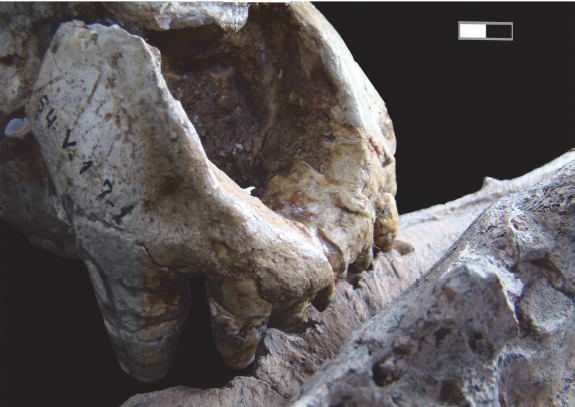
Tapirs are large tropical, forest dwelling, herbivorous mammals related to Horses and Rhinoceroses. They have an unusual distribution, being found in South and Central America, as well as in Southeast Asia. The oldest known Tapirs in the fossil record lived in North America during the early Eocene, around 55.4 million years ago. These early Tapirs are thought to have been essentially similar to modern Tapirs, though they probably lacked the small fleshy trunk that Tapirs have today.
In a paper published in the journal Acta Palaeontologica Polonica on 25 July 2011, Elizete Holanda of the Programa de Pós−Graduação em Geociências at the Universidade Federal do Rio Grande do Sul and the Setor de Paleontologia at the Museu de Cięncias Naturais at the Fundação Zoobotânica do Rio Grande do Sul, and Ascanio Rincón of the Lab. Biología de Organismos Centro de Ecología at the Instituto Venezolano de Investigaciones Científicas, describe two partial fossil Tapirs from the Pleistocene of Venezuala.
The first fossil described comes from the El Breal de Orocual tar pits near Maturin City in Monagas State in the northwest of the country. Tar pits are essentially oil deposits identical to those worked by oil drills in other parts of the world, but exposed at the surface. When oil deposits are exposed in this way the lighter fractions (crude oil is made up of a mixture of different oils, known as 'fractions' due to the process used to separate them, fractional distillation) such as petroleum evaporate off, leaving the heavier fractions, known as tar, or asphalt, behind. These form oily pools in which animals can become trapped. The El Breal de Orocual pits have previously produced 24 different Mammal taxa, and are currently thought to be Plio-Pleistocene in age.
The specimen comprises an incomplete right maxilla and mandible (upper and lower jaw bones). These are on the slender side compared to modern Tapirs, but this is a variable trait within known species and cannot for this reason be considered diagnostic. For this reason the specimen is assigned to the modern genus Tapirus, but not classified to species level.

Tapirus sp., El Breal de Orocual, Plio−Pleistocene. (A) Right maxilla in lateral (A1) and occlusal (A2) views. (B) Mandible in labial (B1) and occlusal (B2) views. Scale bars are 30 mm. Holanda & Rincón (2011).
If the Plio-Pleistocene data currently assigned to the El Breal de Orocual tar pits is correct (they were previously thought to be younger), then this specimen will represent the oldest known Tapir from South America. Tapirs are thought to have originated in North America in the Late Eocene; the oldest known fossils are North American and of early Miocene age, and Tapirs are Perissodactyls, related to Horses and Rhinoceroses that are also thought to have originated in the Eocene of North America. It has been suggested that Tapirs could have reached South America as early as the Late Miocene, but it is more likely that they arrived during the Great American Biotic Interchange, when the formation of the modern Isthmus of Panama allowed animals to migrate between North and South America from the Pliocene onwards.
The second specimen is from Zumbador Cave in eastern Falcón State, where a rich collection of Late Pleistocene bones has been found within a cave set it limestone of the Middle Miocene Capadare Formation, apparently having been carried there by the action of a river. This specimen is assigned to the modern species Tapirus terrestris, and comprises a partial skull, and incomplete left dentary (jawbone), an incomplete thoracic (back) vertebrae, an incomplete left humerus and femur (foreleg bones), a right astragalus (ankle bone) and part of the right pelvis.

Tapirus terrestris, Zumbador Cave, Pleistocene. (A) Incomplete skull in lateral (A1), posterior (A2), and dorsal (A3) views. (B) Left dentary in lingual view; a, height of the sagittal crest. Holanda & Rincón (2011).

Tapirus terrestris, Zumbador Cave, Pleistocene. (A) Thoracic vertebra in right lateral view. (B) Left humerus in posterior view. (C) Left radius in anterior view. (D) Incomplete right pelvis in lateral view. (E) Left femur in anterior view. (F) Right astragalus in dorsal view. Scale bars 30 mm. Holanda & Rincón (2011).
While a Late Pleistocene fossil of a modern species is not surprising, this represents the first known fossil of Tapirus terrestris. It is also outside the current range of the species, which is known from modern Venezuela, but largely south of the Orinoco.

The localities where the Venezuelan Tapir fossils were found. Holanda & Rincón (2011).
See also…


Follow Sciency Thoughts on Facebook.