Showing posts with label Haryana State. Show all posts

Tuesday, 11 October 2022

Contaminated medicine linked to the deaths of 66 children in The Gambia.

The deaths of 66 children in The Gambia, West Africa, have been linked to contaminated medicines from India.  The children, who all died of acute kidney failure, had all consumed cough syrups produced by Maiden Pharmaceuticals, a company based in Haryana State, India. Another 81 children are being treated in hospitals for kidney problems linked to the products.

Musa Kayateh, one of 66 children in The Gambia who died after consuming medicine products products produced by Indian company Maiden Pharmaceuticals. Kayateh Family/BBC.

The contamination was not detected immediately as The Gambia does not have a laboratory capable of testing pharmaceuticals, with doctors initially suspecting a range of illnesses, including Malaria and Meningitis. Only after samples were sent to a laboratory in neighbouring Senegal was it discovered that four paracetamol-based cough syrups produced by Maiden Pharmaceuticals, Promethazine Oral Solution, Kofexmalin Baby Cough Syrup, Makoff Baby Cough Syrup, and Magrip N Cold Syrup, all contained diethylene glycol, a sweat-tasting chemical which has been linked to several previous poisoning incidents.

Medicines seized by authorities in The Gambia following the discovery that they were contaminated with diethylene glycol. Milan Berckman/AFP.

Following the discovery Police and Red Cross workers in The Gambia carried out a door-to-door search for these drugs, eventually confiscating over 16 000 products. The World Health Organization has issued a global alert for these drugs, as, while they were only ever officially exported to The Gambia, there is a danger that they may have reached other countries, particularly those in West Africa, by informal routes. 

Opposition politicians and families of the deceased children have questioned the delays in tracing the cause of the deaths, claiming that the government should have reacted more quickly once children began to die. The Gambian government has defended its actions by pointing out that the deaths did not immediately show up against a high child mortality rate in the summer months, already made worse by  extensive flooding this year, with an associated jump in the number of cases of water-borne diseases. The Gambian government has now announced plans to open an laboratory capable of carrying out quality assays on medicines.

Flooding in Banjul, The Gambia, in August 2022, triggered by the heaviest rains in 50 years. The Standard Newspaper.

In India, the Central Drugs Standard Control Organisation (India's national regulatory body for cosmetics, pharmaceuticals and medical devices) and Haryana State Government have began an investigation into the activities of Maiden Pharmaceuticals, with samples of the four cough syrups having been sent to the regional pharmaceuticals testing lab in Chandigarh. Maiden Pharmaceuticals has previously been accused of selling substandard medicines by several Indian states, including Bihar, Gujarat, Jammu and Kashmir, and Kerala, and its products have been banned in Vietnam over similar concerns.

Paracetamol-based cough syrups have been phased out in India, following an incident in 2020 in which 17 children died of diethylene glycol poisoning in Jammu and Kashmir State. They have been replaced with liquid paracetamol suspensions, in which diethylene glycol is easier to detect. 

See also...

Follow Sciency Thoughts on Facebook.

Follow Sciency Thoughts on Twitter.


Sunday, 2 January 2022

Landslide at quarry in Haryana State, India, kills at least four.

At least four people have died, three required hospital treatment, and there are fears that several more may be buried under rubble, following a landslide at a quarry in the Bhiwani District of Haryana State, India, on Saturday 1 January 2022. The incident happened at about 8.00 am local time, while the men were in vehicles driving from one part of the site to another. The landslide is thought to have been triggered by blasting with explosives. Three of the deceased have been named as Sanjay Kumar from Jind, Toffan Singh from Jharkand, and Vijender Kumar from Toshan.

 
Rescue workers at a quarry in Haryana State, India, following a landslip which killed at least 4 people on 1 January 2022. Manoj Dhaka/Hindustan Times.

Mining had been restarted at the quarry on Friday 31 December 2021 (the day before the incident), following a two month closure imposed by the National Green Tribunal, which had heard evidence that mining was being carried out at the mine in an unsafe and unscientific manner, with the mine having been sunk to a depth that was safer than had been permitted and no dust suppression measures in place. Mining was reinstated following a meeting of the tribunal on Thursday 30 December, but it is unclear if any new evidence was presented, not what measures had been taken to alleviate the concerns of safety inspectors.

 
Rescue workers at a quarry in Haryana State, India, following a landslip which killed at least 4 people on 1 January 2022. Press Trust of India.

See also...


Follow Sciency Thoughts on Facebook.

Follow Sciency Thoughts on Twitter. 


Monday, 20 December 2021

Looking at the use of potters wheels by the Indus Civilisation of northwest India.

The invention of he wheel is considered to be one of the most significant milestones in Human history. Wheels are useful not just as a mode of transport, but in a wide range of manufacturing processes, including spinning yarns, lathing wood, and the manufacture of ceramics. The origin of these technologies is obscure, and they were probably arrived at independently by several different civilisations. The possibility that potter's wheels were used by the ancient Indus Civilisation of northwestern India (which lasted roughly from 2500 BC to 1900 BC) was first suggested by Ernest Mackay in 1938, and has been debated by archaeologists ever since. Opinions in the field fall into two main camps, with the first arguing that spinning wheels appeared very early in the history of this culture, and were a feature of the ceramics it produced throughout its history, while the other argues that the use of wheels in the manufacture of ceramics was rare and very limited, probably restricted to the finishing stages of pottery items made by other methods.

In a paper published in the Journal of Anthropological Archaeology on 26 October 2021, Alessandro Ceccarelli of the Department of Archaeology and McDonald Institute for Archaeological Research at the University of Cambridge, Patrick Quinn of the Institute of Archaeology at University College London, Ravindra Singh of the Department of Ancient Indian History, Culture, and Archaeology at Banaras Hindu University, and Cameron Petrie, also of the Department of Archaeology and McDonald Institute for Archaeological Research at the University of Cambridge, present the results of a study which examined pottery fragments from Indus Civilisation archaeological sites in Haryana State, northwest India, in order to try to understand the techniques used in their manufacture.

In order to assess pottery methods used by the Indus Civilisation, Ceccarelli et al. first examined the tools and techniques used by these ancient potters. Unfortunately, almost no tools associated with the manufacture of pottery have been found at Indus Civilisation sites, meaning that Ceccarelli et al. were obliged to make deductions about the types of tool used by the examination of traces on the pottery itself. This was made more complex by a variety of different terms being used to describe similar processes in different publications, although by concentrating only on wheel-driven pottery Ceccarelli et al. were able to avoid much of this confusion, focussing on the differences between wheel finished pottery.

A variety of different wheels, including slow wheels, fast wheels, kick-wheels, tournettes, and turntables (there is some degree of overlap between these terms) can be used in finishing, enabling the potter to rotate the item so that it can be worked from any angle, without the need to pick it up. In wheel throwing, soft clay is placed upon a wheel and spun rapidly, enabling the potter to use rotational kinematic energy to help form the material into the desired item. This can, again, be achieved using a variety of different wheels, so that the important factor for the archaeologist trying to decipher this technology is not the nature of the tools used, but rather the way in which they were used.

A number of different lines of evidence have been taken as indicators of wheel throwing by Indus Civilisation potters, including parallel striations on finished pottery, concentric markings on the base of pottery items, and high levels of symmetry, which are hard to achieve by other techniques. These features are present on many small and medium sized pottery items from Indus Civilisation sites, particularly Mohenjo-Daro, Harappa, and Nausharo, and have been used to suggest the use of footdriven double or Persian wheels. However, no such wheels have ever been found at any Indus Civilisation site, and not every site associated with the culture has produced pottery with these traces.

More recent studies of pottery at third millennium BC archaeological sites across the area that includes Iran and northwest India have revealed the use of a wide range of pottery techniques. Many of these, such as those from Godin Tepe and Shahr-i Sokhta in Iran, and Kalibangan in Rajasthan, appear to have used wheels for finishing, but not throwing, pottery, with the initial formation of ceramics being done largely by coiling.

Traditionally, archaeologists have tended to see the development of pottery making techniques as a linear process, with methods seen as more advanced and efficient steadily replacing older, less efficient, methods. However, studies of ceramic making in Bronze Age Greece have revealed a more complex pattern, with technologies seen by modern archaeologists as 'primitive' and 'advanced' frequently being used alongside one-another. This discovery of different pottery making methods being used in close proximity to one-another has been interpreted as having profound social significance, with implications about the ways in which information was passes between different groups in Ancient Greece.

Nevertheless, the throwing of pottery on fast wheels is still generally considered to have revolutionised pot-making across the Agean and Levantine regions, enabling the rapid production of much more standardised pottery than was previously possible. Thus, it is still assumed that communities began with hand-made clay objects, then adopted wheels for the finishing process, before finally switching to throwing pots on wheels, even if the speed at which different communities adopted these techniques varied.

When examining Indus Civilisation material, Ceccareli et al. considered two possibilities; material showing signs of different manufacturing techniques might be the result of different communities of craftsmen living in the same area using different techniques to make similar objects, or it might be the result of craftsmen using different techniques to make different items (bottles, jars, dishes, bowls, etc.).

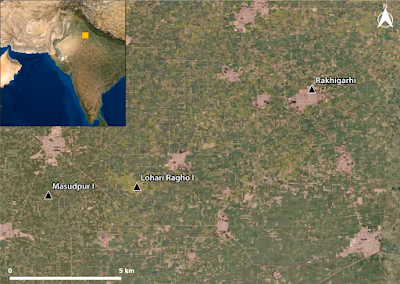
To this end, material from two sites was examined, both in Haryana State, India; Lohari Ragho I, which was occupied during the pre-urban and urban periods, and Masdupur I, which was occupied during the urban and post-urban periods. A total of 27 502 pottery fragments were recovered from Lohari Ragho I, and 16 752 from Masdupur I. About 88% of the material from Lohari Ragho I was made from fine-paste ceramic material, and about 52% of that from Masdupur I, while about 44% of the material from Masdupur I appeared to represent course ceramic material, such as building materials, organic-rich-paste vessels, and terracotta cakes. 

 
Location of the studied sites in Haryana State, northwest India. Alessandro Ceccarelli in Ceccarelli et al. (2021).

Multiple ceramic fabrics were found at both localities, although Ceccareli et al. concentrated on the fine-paste material, due to the friable nature of the course material. These were sorted into material showing signs of rotational shaping during manufacture, and material that showed signs of other manufacturing techniques.

A lot of the material, from both sites, showed signs of initial forming by coiling, with 38% of the material from Lohari Ragho I, and 32% of the material from Masdupur I showing signs of multiple techniques being used during formation.
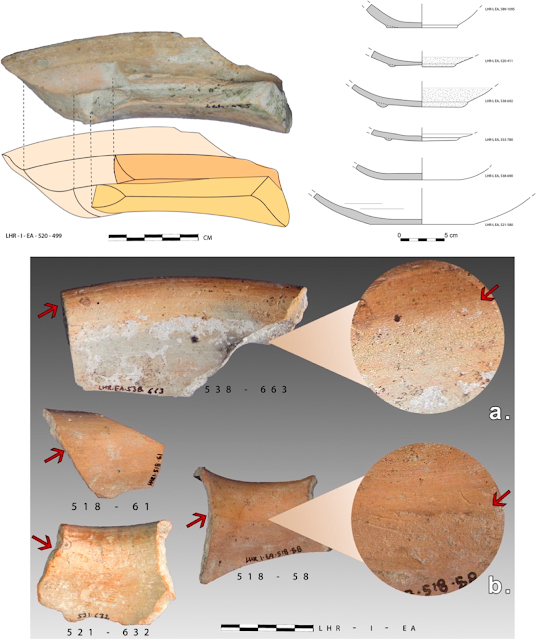
 
Top left: Schematic representation of preliminary forming techniques, e.g. coiling, applied neck, assembled necks and rims, and smoothing via rotational kinetic energy (sherd LHR-EA-520–499). Top right: Most recurrent types of bases: applied coils, disc, and rounded or flat (LHR-EA sherds number 1095, 411, 692, 780, 690, and 580). Below: Evidence for rotational motion and use of rotational kinetic energy, and possible evidence for the partial use of rotational devices limited to rims. The presence of grooves is mostly found on the neck and rim, while the resto of the inner wall seems scraped, suggesting a specific use of rotational kinetic energy in certain finishing phases of the manufacturing process (sherds LHR-EA-538–663, 518–61, 518–58, 521–623). Ceccareli et al. (2021).

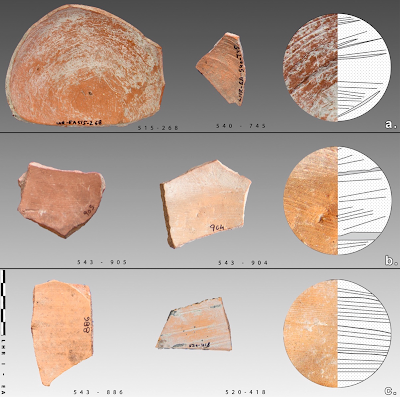
One of the most common techniques, at both Lohari Ragho I and Masdupur I, was the forming of the basic shape of the pottery by coiling, followed by the smoothing of the surface by some form of scraping. This method has previously been observed at the Indus Civilisation sites of Farmana, Masudpur I and Masudpur VII. Some of this material showed signs of being smoothed on a rotational device, which results in the presence of parallel striations, whereas other material showed no evidence of this.

 
Evidence for secondary forming techniques, such as scraping on sherds from LHR-EA. The uneven surface topography and the macro-traces on internal and external surfaces suggest different secondary forming and finishing technique, likely without the use of rotational kinetic energy or rotational devices. Sherds (a) LHR-EA-515,268, 540–745; (b) LHR-EA-543–905, 543–904; (c) LHR-EA-543–886, 520–418. Ceccareli et al. (2021).

At Lohari Ragho I, 10 368 pottery fragments (38% of the total 27 502 fragments recovered) showed signs of having been initially formed by coiling, with 7881 fragments (28% of the total), showing signs of smoothing by scraping, and 9404 fragments (34% of the total), showing signs of having been rotated during their manufacture.

At Masdupur I 8639 fragments (52% of the total) showed signs of coiling, with 5901 fragments (30% of the total) showing signs of smoothing by scraping without rotation. A selection of 846 fragments were chosen for a more detailed analysis, of which 693 were fine-paste ceramics from which evidence of the finishing method could be determined; of these 305 showed signs of the use of rotational motion, while 382 were clearly made and finished without any rotation being employed.

 
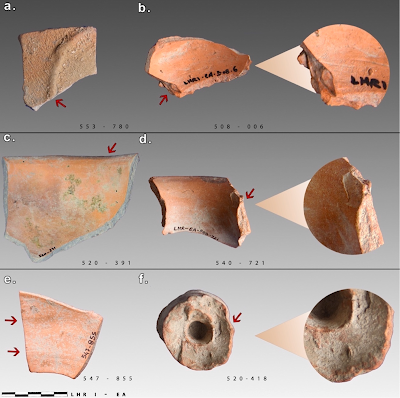
Evidence for the use of coils at various stages of ceramic production on sherds from Lohari Ragho I Trench EA. Arrows point to macroscopic features that could be used to determine the use of forming methods, including the possible use of coils (e.g. breakage patterns, surface topography, and coil joints). Sherds from LHR-EA: (a) 553–780; (b) 508–006; (c) 520–391; (d) 540–72; (e) 547–855; (f) 520–418. Ceccareli et al. (2021).

Based upon this, the fragments were divided into two groups. Group A comprised samples thought to have been made without the use of rotational devices. These fragments typically show numerous striations, but these are not parallel, it is also often possible to see signs of the original coiling on the surface, particularly on the inner surface of the pot. 

The second group, Group B, showed abundant parallel scape-marks, consistent with the use of a rotational device being used in their manufacture. These are present on fragments from all parts of pottery vessels; however, while the fragments from the upper parts of vessels are typically thin walled and show no signs of any other form of working, those from the lower part of vessels are usually thicker, and show signs of coiling and non-rotational scraping as well as rotational finishing, suggesting that the tops and bottoms of these vessels were made separately. Ceccareli et al. note that even where vessels show signs of rotational working across their entire surface, this cannot be taken as proof that no other technique were used during manufacture.

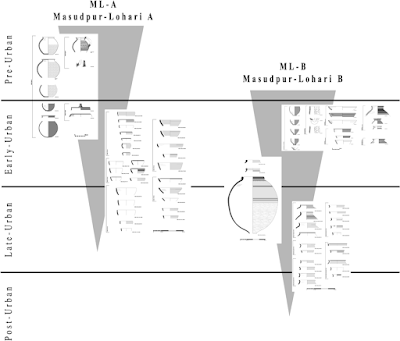
Working from these two groups, Ceccareli et al. suggest the presence of two separate ceramic traditions dominating the manufacture of ceramics at the two sites, which they name Indus Masudpur-Lohari A and Indus Masudpur-Lohari B.

The first of these traditions, Indus Masudpur-Lohari A, comprises vessels with a red colouration, made from a clay paste rich in limestone fragments, with little or no evidence of rotational working being used in manufacture. The quality of these vessels is variable, but does include high-quality items, although the walls and rims of the vessels are often irregular, showing variability in the manufacturing process. The outer side of the vessels tend to be smoother, and either red in colour or painted, the inner surfaces are less well finished. Where the pottery is broken, the interior of the clay is red throughout, suggesting complete oxidation has been accomplished during firing. The objects made in this way are mostly bowls, jars, and jugs. Decoration on the outside of these vessels typically includes incised grooves and black lines of paint. Pottery items similar to these have also been reported from Sothi, Siswal, and Kalibanghan.
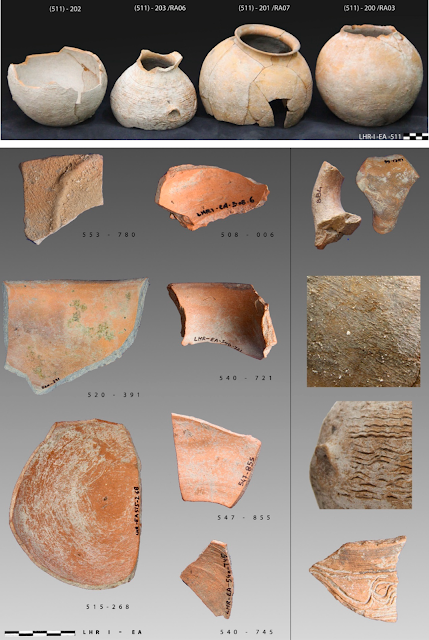
 
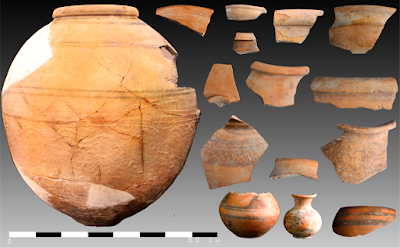
Above: some rusticated vessels of Indus Masudpur-Lohari A tradition, or Indus Masudpur-Lohari A, such as globular and elliptical jars Samples LHR-EA-511–202, 203, 201, 200. Below: examples of fragments of Indus Masudpur-Lohari A vessels. Ceccareli et al. (2021).

The second tradition, Masudpur-Lohari B, comprises vessels that appear to have been originally formed by coiling, then finished on a wheel. These vessels show parallel striations typical of wheel-working across their entire surfaces, although it does appear that their upper parts were made separately to their lower parts. The clay from which these vessels was made shows only small inclusions. These vessels were typically decorated with a red slip (layer of liquified clay applied over the outer surface of a pottery item), as well as black paint markings. Vessels made in this tradition include dishes, bowls, jars, and goblets. Similar items have been found at Rakhigarhi, Girawad, Masudpur I/VII, and Mitathal, as well as some items from Farmana.

 
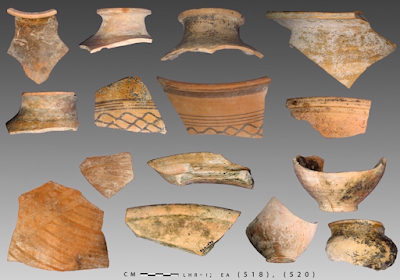
Fragments of Indus Masudpur-Lohari B pottery, or Indus Masudpur-Lohari B from Lohari Ragho I: Wheel-finished storage Jars, dishes and medium jars. Ceccareli et al. (2021).

The presence of two different ceramic-making traditions both present across a wide area of northwestern India in the third millennium BC has implications for our understanding of the culture of this civilisation, and the way in which new innovations, such as the potter's wheel, spread through this culture. Only one of the two traditions present appears to have adopted the wheel as a way of finishing hand-made items, and neither shows evidence for throwing pots on wheel, in contrast with earlier interpretations of pottery making in the Indus Civilisation. 

 
Examples of vessels of the Indus Masudpur-Lohari B tradition, or Indus Masudpur-Lohari B from Masudpur-I. Ceccareli et al. (2021).

The two different traditions suggest the presence of two different pottery-making communities being present over a wide geographical area for a time period of several centuries, although Indus Masudpur-Lohari A does appear to originate before Indus Masudpur-Lohari B, and disapear slightly earlier. Furthermore, the two technologies are similar enough that they do appear to have a common origin. The presence of two similar, but distinct, cultural traditions over such a long period of time implies two groups that were making a conscious effort to maintain their cultural identities, even though these cultures appear to have had a common origin. 

 
Dominant ceramic traditions identified at Lohari Ragho I and Masudpur-I. The figure shows a schematic impression, and not a numerical representation, of the suggested continuity of the ML-A and ML-B traditions over the Pre-Urban, Early-Urban, Late-Urban and Post-Urban periods of the Indus Civilisation. Ceccareli et al. (2021).

The presence of multiple ceramics-making traditions has previously been noted at other sites in Harappa and Gujarat, as well as other sites across northwestern India and Pakistan, but this is the first time that their continued co-existence for such a long period has been documented, something Ceccareli et al. suggest might be linked to different social units with their own rolls within society consciously maintaining their separate technical traditions for a long period of time.

See also...


Follow Sciency Thoughts on Facebook.

Follow Sciency Thoughts on Twitter.


Sunday, 19 May 2019

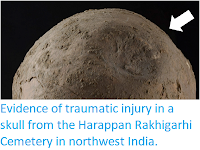
Evidence of traumatic injury in a skull from the Harappan Rakhigarhi Cemetery in northwest India.
The Bronze Age Harappan civilizartion dominated a huge area of what is now Pakistan and northwest India between 3300 and 1700 BC, with roots going back as far as 5500 in the Ghaggar Basin. Despite its longevity and the huge area it covered, the Harappan civilization is much less well understood than the contemporary civilisations of Egypt and Mesopotania, at least in part because its written language has never been deciphered. This has led to considerable speculation about the nature of Harappan society, with some experts arguing that the Harappan cities show clear evidence of central planning, which implies that the civilisation was essentially imperial in nature, whilst others note that the absence of any extensive military structures suggests that the society may have been more egalitarian in nature, arising from large numbers of people working together out of common purpose (though this is at odds with the clear differentiation of residential areas seen in the cities). One curious phenomenon that has been observed at many Harappan excavation sites is a high prevalence of head injuries in burials, though the cause of these is uncertain.

In a paper published in the Journal of Archaeological Science: Reports on 16 November 2018, Hyejin Lee of the Lab of Bioanthropology, Paleopathology and History of Diseases at the Seoul National University College of Medicine, and the Ministry of National Defense Agency of KIA Recovery & Identification, Pranjali Waghmare of the Department of Archaeology at Deccan College, Yongjun Kim and Jong Ha Hong, also of the Lab of Bioanthropology, Paleopathology and History of Diseases at the Seoul National University College of Medicine, Yogesh Yadav and Nilesh Jadhav, aslo of the Department of Archaeology at Deccan College, Dong Hoon Shin, again of the Lab of Bioanthropology, Paleopathology and History of Diseases at the Seoul National University College of Medicine, and Vasant Shinde, again of the Department of Archaeology at Deccan College, describe a skull showing evidence of traumatic head injury from a Harappan cemetery at Rakhigarhi in Haryana State, India, and discuss the implications of this.

Rakhigarhi was one of the largest cities of the Harappan civilisation, and is located about 150 km to the northwest of the modern city of New Dehli. The city's cemetery has produced numerous Human remains, as well as extensive red-ware pottery, something typical of Harappan sites, and has been dated to between 2616 and 2273 years BC. Most of the bodies in the cemetery are interred with a north-south alignment, with their heads to the north.

The skull in this study comes from one of ten individuals excavated from two trenches dug by archaeologists from Deccan College and the Institute of Forensic Science at Seoul National University in 2016. These include seven primary burials, in which the skeleton is more-or-less intact, plus three secondary burials (i.e. reburials) of partial skeletons; in all cases the skull is present. The sample includes two children (under 14 years) of indeterminate sex, two young adults (21-35 years in age), two of which were male and one female, and a middle aged (36-50 years old) woman, the subject of this study, and four adult specimens of indeterminate age, two of which were probably male and two of which were of uncertain sex (these four less well preserved skeletons comprise all three reburials, plus the least well preserved primary burial).

The middle aged female skull is the only skeleton in the group in which any injury could be confidently detected. The skull is well preserved, with only minimal post-mortem damage, and is confidently considered to be female on the basis of its morphology. The skull has a depression fracture on the left frontal part of the cranium, apparently caused by a blow with a round-tipped object, this appears to have completely healed after the injury, and is therefore not thought to have been the cause of death.

The cranium of BR12. Note depression fracture (indicated by arrow) at the left frontal part of cranium. Lee et al. (2019).

The precise cause of injuries is generally impossible to determine, but studies of modern injuries have found that, on the balance of probability, skull injuries below the hat brim line are more likely to be the result of accidents, and skull injuries above the hat brim line are more likely to be the result of interpersonal violence. The injury to the Rakhigarhi skull, like many injuries seen in Harappan skulls, is clearly above the hat brim line, and is therefore thought likely to have been caused by a violent blow delivered by another Human with some sort of weapon. Lee et al. suggest that this high instance of injuries apparently caused by deliberate violence is evidence of systematic violence within Harappan society, and that therefore that society was not as peaceful and egalitarian as has sometimes been suggested.

See also...

https://sciencythoughts.blogspot.com/2018/08/britain-returnd-looted-sumerian.htmlhttps://sciencythoughts.blogspot.com/2016/08/identifying-cloths-of-otzi-iceman.html
https://sciencythoughts.blogspot.com/2015/06/interpreting-life-history-of-egtved-girl.htmlhttps://sciencythoughts.blogspot.com/2014/06/does-catalhoyuk-mural-depict-volcanic.html
https://sciencythoughts.blogspot.com/2014/05/the-death-of-ramesses-iii.htmlhttps://sciencythoughts.blogspot.com/2014/04/a-7000-year-old-copper-awl-from-jordan.html
Follow Sciency Thoughts on Facebook.

Thursday, 11 January 2018

Leopard attacks kill three children in Madhya Pradesh State, India.

Three children have died in Leopard attacks in Madhya Pradesh State in India this week. The first two attacks occurred in the Chhindwara District on Sunday 7 January 2018, although there were two separate incidents, they occurred only 3 km appart, leading local people to suspect that they may have been carried out by a the same animal. The first incident happened in the village of Mohli Mata in the afternoon, when a Leopard killed a three-year-old girl and escaped with her body. Six hours later a ten-year-old boy, named as Harish Tekam, was killed in the village of Jholidhana in Raisen District, and again was carried away.  The third attack happened on Wednesday 10 January in the village of Jhirpani, when a 12-year-old boy, was killed and again carried off. In a separate incident, a 60-year-old man, Lakshmi Chand, was injured in an attack by a Leopard while herding Cattle in the Morni Forest in Haryana State.

A Leopard in the Pench National Park in Madhya Pradesh State, India. Taj Hotels.

Leopards, unlike most animals., are natural predators of Humans and will often attack us if the opportunity arises. They are also extremely flexible in their habitat requirements, and can adapt to live in Human-modified environments quite readily. Humans will generally do their best to avoid this, and in areas where Leopards are found tend to take precautions, such as building secure barriers around villages or killing the Leopards. In India, rising populations of both Humans and Leopards means that the two species are increasingly coming into conflict.  Since many people in India are also reluctant to kill any animals, problem animals, even ones which are known to have devoured Humans, are generally relocated to forest areas rather than being killed themselves.

See also...

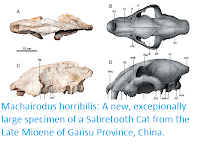
http://sciencythoughts.blogspot.co.uk/2017/11/panthera-leo-gigantic-lion-from-middle.htmlhttp://sciencythoughts.blogspot.co.uk/2016/12/machairodus-horribilis-new-excepionally.html
http://sciencythoughts.blogspot.co.uk/2014/11/a-pantherine-big-cat-from-late-miocene.htmlhttp://sciencythoughts.blogspot.co.uk/2014/10/a-new-species-of-leopard-cat-from-brazil.html
http://sciencythoughts.blogspot.co.uk/2014/09/the-newton-abbott-lynx.htmlhttp://sciencythoughts.blogspot.co.uk/2014/04/the-origin-and-diversification-of.html
Follow Sciency Thoughts on Facebook.

Monday, 24 November 2014

A fossil Pelican from the Latest Pliocene of Haryana State, India.


Pelicans are large aquatic Birds found on fresh, brackish and marine waters on every continent except Antarctica. They have fully webbed feet, and distinctive pouches beneath their bills, which help them to capture and swallow quite large prey. They have a fossil record dating back to the Oligocene, with representatives known from every continent they now inhabit. In the nineteenth century Sir Proby Thomas Cautley amassed a large collection of Pelican fossils from the Siwalik Hills in what was then British India. However the stratigraphic and geographic origins of the specimens are not well recorded (Cautly did not actually collect them himself) so it is unclear if the specimens date from the Miocene, Pliocene or even Pleistocene and whether they were excavated in modern India or Pakistan.

In a paper published in the journal PLoS One on 3 November 2014, Thomas Stidham of the Key Laboratory of Vertebrate Evolution and Systematics at the Institute of Vertebrate Paleontology and Paleoanthropology of the Chinese Academyof Sciences, Kewal Krishan, Bahadur Singh and Abhik Ghosh of the Department of Anthropology at Panjab University and Rajeev Patnaik of the Department of Geology at Panjab University describe the discovery of a new Pelican fossil from Khetpurali in Haryana State in India.

The specimen comprises a single tarsometatarsus (lower leg bone – Bird fossils often consist only of leg or foot bones, as these are denser than other Bird bones), from the Tatrot Formation, dated to about 2.8 million years ago (i.e. the end of the Pliocene). The same section has previously produced Crocodile, Fish and Crab fossils, and has been interpreted as a floodplain pond environment.

Tarsometatarsus tentatively referred to Pelecanus sivalensis. (A) dorsal; (B) medial; (C) plantar; (D) lateral; (E) distal; and (F) proximal views. The arrow in (E) indicates the concave notch in the medial side of trochlea II that is a Steganopodes synapomorphy. The scale bar is 1 cm, with one scale bar for parts (A–D) and one for (E–F). Abbreviations: df—distal foramen; f—small pneumaticforamen; ie—intercondylar eminence; mc—medial crest of the hypotarsus; mf—fossa for metatarsal I; mr—ridge medial to the dorsal pneumaticforamen that is part of the extensor retinaculum attachment; pf—dorsal pneumatic foramen where the proximal foramina would be in other taxa;pl—lateral plantar opening of the proximal foramen; pm—medial plantar opening of the proximal foramen; r—ridge on the medial hypotarsal crestthat bounds a concave area to its medial side; tc—tendinal canal opening; tg—tendinal groove.Stidhamet al. (2014).

Two fossil Pelican species have previously been described from the Siwalik Hills, Pelecanus sivalensis and Pelecanus cautleyi. Unfortunately neither of these species are described from specimens that include the tarsometatarsus, making it impossible to assign the new specimen to species level, although it is thought likely to belong to the smaller species, Pelecanus sivalensis.

See also…

Galliform Birds (Pheasants, Chickens etc.) are a successful and widespread group today, with over 300 described species from around the world. Their fossil record dates back to the Early Eocene, when the first members of the group appeared in North America. Members of modern groups first appear in the Late Oligocene, and the group become particularly common in Pleistocene deposits. The earliest Galliformesare thought to have been closely related to the early Anserformes (Ducks and...


Birdlife International published an assessment of the conservation status of 350 newly described Bird Species for International Union for the Conservation of Nature's Red List of Threatened Species on 24 July 2014, the first such assessment by the organization...


The Phorusrhacid ‘Terror Birds’ were large, carnivorous flightless Birds that appear to have held the role of top terrestrial predators in South America throughout much of the Cenozoic. They are known to have colonized parts of North America, during the Great American...


Follow Sciency Thoughts on Facebook.