Showing posts with label Iguanadontids. Show all posts

Saturday, 10 June 2023

Iani Smithi: A new species of Rhabdodontomorph Iguanodontian Dinosaur from the Cretaceous Cedar Mountain Formation of Utah.

The Cenomanian (Earliest Late Cretaceous) Mussentuchit Member of the Cedar Mountain Formation, which outcrops in central Utah, is one of the most abundant Late Cretaceous bonebeds known from anywhere in the world, with more than 100 species described to date, including Tyrannosaurids, Dromaeosaurs, Velociraptors, Troodontids, Therizinosaurs, Titanosauromorphs, Thescelosaurids, Pachycephalosaurids, Neoceratopsians, Nodosaurids, Hadrosaurids, and non-Hadrosaurid Iguanodontians, as well as a number of less well defined specimens.

In a paper published in the journal PLoS One on 7 June 2023, Lindsay Zanno, Terry Gates, and Haviv Avrahami of Paleontology Research at the North Carolina Museum of Natural Sciences, and the Department of Biological Sciences at North Carolina State University, Ryan Tucker of the Department of Earth Sciences at Stellenbosch University, and Peter Makovicky of the Department of Earth and Environmental Sciences at the University of Minnesota, describe a new species of Rhabdodontomorph Iguanodontian Dinosaur from the Cedar Mountain Formation.

The new species is described upon the basis of a single partial skeleton (specimen NCSM 29373) comprising a largely complete, disarticulated skull; cervical, dorsal, sacral, and caudal vertebrae; associated ribs and haemal arches; and portions of the right and left pectoral girdle, left pelvic girdle, right forelimb, and right hindlimb. The elements of the briancase are incompletely fused, leading Zanno et al. to conclude that the specimen is immature. The specimen was recovered from an exposure of the Mussentuchit Member in Emery County, Utah, 1 m above the boundary with the Ruby Ranch Member, and 7 m below Mussentuchit Ash Zones 1, which has been dated to 99.490 million years before the present. The new species is named Iani smithi, where 'Iani' refers to the Roman god Ianus (or Janus), who presides over boundaries, in reference to the fact that the mid-Cretaceous was a time of biological transition in western North America, and 'smithi' honours Joshua Aaron Smith for his contributions to the discovery and conservation of paleontological resources in the region, particularly early explorations by the North Carolina Museum of Natural Sciences.

Location of holotype locality for Iani smithi (NCSM 29373). (A) Global map showing location of Mussentuchit Member outcrop in central Utah, western North America, and a stratigraphic section at the quarry with dated ash horizons; and (B) graphical representation of preserved skeletal elements of the holotype specimen (NCSM 29373). Preserved elements are coloured on the left facing skeletal whether they derive from the right or left side of the body. Exact positions of chevrons and ribs unknown due to poor preservation. See text and figures for specific positioning and completeness of elements. Abbreviations: MAZ1–4, Mussentuchit Ash Zones 1–4. Zanno et al. (2023).

Most of the skull is present, but the missing elements include the nasal and maxilla bones, so that the length and shape of the face of Iani smithi can only be estimated from the length of the mandible. This mandible comprises fragmentary predentary, complete pair of dentaries, right surangular, partial splenial, and several isolated dentary teeth. The rear part of the premaxila is thickened and shows the alveoli (sockets) of three premaxilary teeth. Premaxilary teeth are unusual in Ornithopod Dinosaurs, with most groups having lost them early in their history, but they are known in several other Rhabdodontomorphs.

Three-dimensional reconstruction of the skull of Iani smithi (NCSM 29373). (A) right lateral and (B) medial views of skull with left facial bones removed; skull reconstruction with all preserved elements (some mirrored) in (C) caudal, (D) dorsal, (E) ventral, and (F) rostral views. Scale bar 5 cm. Zanno et al. (2023).

The dentition of Iani smithi appears similar the other Rhabdodontomorphs, and non-Rhabdodontomorph early-branching Ornithopods such as Tenontosaurus and Qantassaurus. All of the teeth on the left dentary are still present, although the crowns of the middle teeth are damaged. Five teeth are still present in the left dentary, and thirteen loose teeth were found with the skeleton, interpretted as eight maxillary teeth, five dentary teeth, and a tooth of indeterminate origin. A single predentary tooth is present.

Predentary, dentary, and surangular of Iani smithi (NCSM 29373). Predentary in (A) right lateral, (B), rostral (right half mirrored and combined to show approximate shape of complete element), (C) ventral, and (D) dorsal views. Right dentary in (E) lateral view; left (pathological) dentary in (F) medial, (G) lateral, (H) dorsal, and (I) ventral views; right surangular in (J), lateral and (K), medial views. Abbreviations: a.co, estimated coronoid articulation; ad, accessory denticle; a.pd, predentary articulation; a.sr, surangular articulation; de, dentary; dp, dorsal process; dpa, dentary parapet; f, foramen; lg, lateral groove; mkc, Meckelian canal; ml, midline; path, pathological bone; pd, primary denticle; pathological bone; pr?, prearticular?; prd, peripheral denticle; sb, surangular boss; te, teeth; tr, exposed tooth root; vp, ventral process. Colour annotation: white, depressions/fossae/grooves; green, articular surfaces; blue circles, foramina; light blue lines, marginal contours; peach dashed lines, ridges/internal contours; light purple, dentition. Scale bar 5 cm. Zanno et al. (2023).

Portions of at least seven cervical (neck) vertebrae are present, although the atlas vertebra (which connects the spine to the skull) is absent. The axis (second vertebra) is present, and is compressed dorsoventrally, somewhat eroded ventrally, and approximately 150% longer than wide. At least eight unfused neural arches from the dorsal part of the spine are preserved, along with two partially fused dorsal vertebrae are preserved in variable states of damage and distortion. The dorsal vertabrae appear to be shorter and more gracile towards the head. Six sacral neural arches and four isolated sacral centra are present, showing the sacrum to have been unfused. The first seven caudal (tail) vertebrae are also present. 

Sacral vertebrae of Iani smithi (NCSM 29373). Neural arch of S1 in (A) dorsal and (D) cranial views; (B) sacral neural arches 1–6 in left lateral view; (C) neural arch of S6 in caudal view; (E) neural arch of S2 in cranial view; (F) neural arch of S4 in cranial view; (G) neural arch of S5 in cranial view; (H) neural arch of S4 in caudal view; Sacral centrum S1? in (I) left lateral, (J) caudal, and (L) cranial views; Sacral centra S2?–5? in (K) left lateral and (N) ventral views; (M) sacral centrum S2? In cranial view; (O) sacral centrum S5? in caudal view. Abbreviations: ipodf, infrapostdiapophyseal fossae; ns, neural spine; pop, postzygapophysis; prz, prezygapophysis; vk, ventral keel. Colour annotation: white, depressions/ fossae/grooves; green, articular surfaces; blue circles, foramina; light blue lines, marginal contours; peach dashed lines, ridges/internal contours. Scale bar 5 cm. Zanno et al. (2023).

At least fourteen dorsal ribs are present, these being more robust and strongly bowed than in other Rhabdodontomorphs. Both scapulae are preserved, these being stout and robust, but within the range of other Rhabdodontomorph species. An incomplete right humerus is present, with most of the proximal portion preserved, with the exception of most of the deltopectoral crest, but the distal portion is missing. The right ulna is well preserved and undistorted. A portion of a radius is also present, though this is highly eroded and lacks both ends, making it unclear which side it came from. Four elements of a manus (hand) are present; these are poorly preserved and somewhat compressed, making identification difficult, although they may be two metacarpals and penultimate and ultimate (ungual) phalanges of digits 1, 2, or 3. Few early-branching Ornithopods have well preserved manus, making comparison between these elements difficult. The shaft and distal end of the left ischium are preserved; the shaft is generally straight, but has a twist towards the distal end. The right femur is preserved, generally in good condition, but with some erosion in the region between the greater and lesser trochanters. 

Pelvic girdle and hind limb of Iani smithi (NCSM 29373). Right ischium in (A) dorsal, (B) ventral, and (C) medial views. Right femur in (D) medial, (E) lateral, (F) proximal, and (G), distal views. Abbreviations: fh, femoral head; ft, fourth trochanter; lc, lateral condyle; mc, medial condyle; op, obturator process. Colour annotation: white, depressions/fossae/grooves; green, articular surfaces; blue circles, foramina; light blue lines, marginal contours; peach dashed lines, ridges/internal contours. Scale bar 10 cm. Zanno et al. (2023).

Zanno et al. carried out several phylogenetic analyses, using a number of different matrices, which consistantly found that Iani smithi is closely related to the Rhabdodontomorphs and the non-Rhabdodontomorph Tenontosaurus, with all analyses bar one placing Iani smithi within the Rhabdodontomorphs.

Hypothesized evolutionary relationships of Iani smithi. Strict consensus tree of the Poole Matrix using (A) maximum parsimony optimality, and (B) Bayesian inference, and strict consensus tree of the Dieudonné et al. Matrix using (C) maximum parsimony optimality, and (D) Bayesian inference. Rhabdodontomorph taxa in green. Bremer support values (left) and posterior probabilities (right) shown. Grey names reflect taxa outside the illustrated clade for a particular analysis, or in the case of Dryosauridae (an ad hoc combined Operational Taxonomic Units with variable composition using different analytical approaches). Zanno et al. (2023).

See also...

Online courses in Palaeontology. 

Follow Sciency Thoughts on Facebook.

Follow Sciency Thoughts on Twitter.


Tuesday, 4 June 2019

Fostoria dhimbangunmal: An opalised Iguanodontian from the Cretaceous of New South Wales.

Opal is an amorphous form of silica containing as much as 21% water, It is made up of tiny spheroids of crystalline silica some 150 to 300 nm in diameter, with random alignments to one another. Light passing through these crystaloids is refracted as by a prism, leading to the 'opalescent' sheen which gives the mineral its value. Opal is formed by water percolating through silica rocks, where it dissolves some of the mineral forming a silica-rich solution. This can accumulate in any cracks or gaps in the rock, where if it reaches a high enough concentration it can precipitate out as opal. The Cretaceous Griman Creek Formation of northern New South Wales and southern Queensland is noted for the occurrence of opalisedvertebrate fossils, replacement fossils formed when opal forms in gaps in the rock left by the dissolution of bone or earlier replacement material. However, these are rare and are not always spotted in areas where the opal is mined using mechanised equipment, which also means that the material that is recovered is often fragmented.

In a paper published in the Journal of Vertebrate Paleontology on 3 June 2019, Phil Bell, Tom Brougham, Matthew Herne, and Timothy Frauenfelder of the University of New England, and Elizabeth Smith of the Australian Opal Centre describe a new species of non-Hadrosaurid Iguanodontian Dinosaur from a bone-bed within the Griman Creek Formation exposed in a mine targeting the Sheepyard Opal Field, approximately 40 km southwest of the town of Lightning Ridge in central northern New South Wales.

To date only a single Iguanodontian Dinosaur has been described from Australia, the possible Rhabdodontomorph Muttaburrasaurus langdoni from the Early Cretaceous Mackunda Formation in central Queensland, though a number of trackways attributed to Iguanodontians are known from Cretaceous Australian deposits, suggesting more members of the group were present.

The new species is named Fostoria dhimbangunmal, where 'Fostoria' honours Robert Foster, the miner who discovered the bone bed from which the material assigned to the species came, and 'dhimbangunmal' means 'Sheep Yard' in the language of the Yuwaalaraay, Yuwaalayaay, and Gamilaraay peoples. The material comes from a bone bed which was partially excavated for its opal content before the fossil nature of the material was recognised. The material is therefore somewhat fragmented, though it appears to have come from at least four disarticulated skeletons.

Chronostratigraphy and map of the Surat Basin in Australia showing the approximate extent of the Eromanga Sea (blue) during the Albian. Lightning Ridge is indicated by an open square in the main image. Inset showing location of the ‘Sheepyard’ opal field near Lightning Ridge (star). Fostoria dhimbangunmal comes from a monodominant bone bed (triangle) in the uppermost part (Cenomanian) of the Griman Creek Formation. Bell et al. (2019).

The material referred to the species comprises a partial skull roof and braincase, right quadrate, four partial and complete scapulae (three of which are left, with the single right specimen being different in size to any of the left scapulae, hence the estimate that there are at least four individuals present), a left humerus, a probable left radius, a right ischium, portions of left and right femora, a left tibia, a probable partial left fibula, and a number of partial metatarsals, pedal phalanges and vertebrae.

Fostoria dhimbangunmal, forelimb and girdle elements. Left scapula in (A) lateral; (B) medial; and (C) anterior views. Left humerus in (D) posterior; (E) medial; and (F) anterior views. (?) Left radius in (G) medial; (H) lateral; and (I) proximal views. Abbreviations: ac, acromion ridge; c, sutural contact for coracoid; df, deltoid fossa; dp, deltopectoral crest; gl, glenoid fossa; gr, medial groove associated with coracoid foramen; mr, medial ridge; r, ridge; sg, supraglenoid fossa. Scale bars equal 2 cm. Bell et al. (2019).

See also...

https://sciencythoughts.blogspot.com/2018/04/diluvicursor-pickeringi-small-bodied.htmlhttps://sciencythoughts.blogspot.com/2017/10/matheronodon-provincialis-new-species.html
https://sciencythoughts.blogspot.com/2017/09/burianosaurus-augustai-new-species-of.htmlhttps://sciencythoughts.blogspot.com/2016/10/savannasaurus-elliottorum.html
https://sciencythoughts.blogspot.com/2016/10/queensland-miner-killed-in-trench.htmlhttps://sciencythoughts.blogspot.com/2016/04/datonglong-tianzhenensis-new-non.html
Follow Sciency Thoughts on Facebook.

Sunday, 29 October 2017

Matheronodon provincialis: A new species of Rhabdodontid Dinosaur from the Late Cretaceous of Provence, southern France.

The Rhabdodontids are a group of Iguanadontid Ornithischian Dinosaurs known only from the Late Cretaceous of southern Europe. They were predominantly large, robust animals, though dwarf species are known from the Haţeg Basin of Romania, deposits interpreted as having been laid down on a relatively small island, which contain dwarfed species of a number of Dinosaur groups. Most Iguanadontids resemble the related Hadrosaurs, in that they developed ever larger batteries of small, closely packed crushing teeth over time, interpreted as an adaptation to precessing hard, woody, plant material. However, the Rhabdodontids differ from this pattern in that they showed both a reduction in tooth number, and enlargement of the individual teeth, over time, suggesting a different feeding strategy.

In a paper published in the journal Scientific Reports on 26 October 2017, Pascal Godefroit of the Directorate ‘Earth and History of Life’ at the Royal Belgian Institute of Natural Sciences, Géraldine Garcia of the Université de Poitiers, Bernard Gomez of the Laboratoire de Géologie de Lyon, Koen Stein of the Chemistry Department at the Vrije Universiteit Brussel, Aude Cincotta, also of the Directorate ‘Earth and History of Life’ at the Royal Belgian Institute of Natural Sciences and the Department of Geology at the University of Namur, Ulysse Lefèvre, again of the Directorate ‘Earth and History of Life’ at the Royal Belgian Institute of Natural Sciences, and of the Department of Geology at Liège University, and Xavier Valentin, also of the Université de Poitiers, and of the Palaios Association, describe a new species of Rhabdodontid Dinosaur from the Begudian Sandstones of the Aix-en-Provence Basin in the Bouches-du-Rhône Department, Provence region of southern France.

The new species is named Matheronodon provincialis, where 'Matheronodon' means 'Matheron's Tooth', in honour of Philippe Matheron, the nineteenth century French geologist and palaeontologist who was the first person to describe Dinosaurs from the Provence region, and 'provincialis' means 'from Provence'. The species is described from a single right maxilla (upper jawbone) and a number of detached teeth.

Right maxilla of Matheronodon provincialis in dorsal (a), lateral (b), medial (c), and ventral (d) views. (e) Close-up of the second and third maxillary crowns. Godefroit et al. (2017).

Matheronodon provincialis shows extreme reduction in tooth number, with only eight teeth present on each side of the upper jaw, and presumably a similar number on the lower jaw. These teeth are greatly elongated, reaching 5 cm in length, and extremely thin and blade-like, with a ridge-pattern that favoured sharpening as the teeth wore down, making the species particularly extreme even for a Rhabdodontid in this regard. Godefroit et al. note that Hadrosaurs and non-Rhabdodontid Iguanadontids are typically associated with floras dominated by Conifers, plants which produce abundant woody material requiring considerable processing before it can be swallowed. The areas where Rhabdodontids are found, in contrast, had become dominated by Monocots such as Sabalites and Pandanites. These plants produce little woody material, but have large fibrous leaves, difficult to remove with crushing teeth, but presumably easier to process with the shear-like teeth seen in Rhabdodontids.

Reconstruction of Matheronodon provincialis showing large, blade-like teeth. Lukas Panzarin/Royal Belgian Institute of Natural Sciences.

See also...

http://sciencythoughts.blogspot.co.uk/2017/09/burianosaurus-augustai-new-species-of.htmlhttp://sciencythoughts.blogspot.co.uk/2016/04/datonglong-tianzhenensis-new-non.html
http://sciencythoughts.blogspot.co.uk/2015/12/morelladon-beltrani-styracosternan.htmlhttp://sciencythoughts.blogspot.co.uk/2015/11/probrachylophosaurus-bergei-new-species.html
http://sciencythoughts.blogspot.co.uk/2015/10/ugrunaaluk-kuukpikensis-new-species-of.htmlhttp://sciencythoughts.blogspot.co.uk/2014/04/a-new-species-of-rhabdodontid-dinosaur.html
Follow Sciency Thoughts on Facebook.

Saturday, 19 December 2015

Morelladon beltrani: A Styracosternan Iguanodontid from the Early Cretaceous of Spain.

Hadrosaurs, or Duck Billed Dinosaurs, were dominant herbivores in many ecosystems across the Northern Hemisphere in the Late Cretaceous, but the wider group of Iguandodontids from which they arose, the Styracosternans, first appeared in the Late Jurassic and were themselves important components of many faunas, particularly in Europe.

In a paper published in the journal PLoS One on 16 December 2015, José Miguel Gasulla of the Unidad de Paleontología at the Universidad Autónoma de Madrid, Fernando Escaso, Iván Narváez and Francisco Ortega of the Grupo de Biología Evolutiva at the Universidad Nacional de Educación a Distancia and José Luis Sanz, also of the Unidad de Paleontología at the Universidad Autónoma de Madrid, describe a new species of Styracosternan Iguanodontid from the Early Cretaceous Arcillas de Morella Formation at Mas de la Parreta Quarry in Morella in Castellón Province, Spain.

The new species is named Morelladon beltrani, where 'Morelladon' means 'Morella-tooth' and 'beltrani' honours Víctor Beltrán for 'his involvement and collaboration in the localization of the different fossil sites at the Mas de la Parreta Quarry'. The species is described from a single specimen, comprising fourteen teeth, all but one being to worn to be of any value to the study, plus six almost complete dorsal vertebrae, a dorsal centrum, several fragments of dorsals neural spines, two dorsal ribs fragments, a nearly complete sacrum, two haemal arches, an ilia, an incomplete pubes and ischia, and the right tibia.

Dorsal vertebrae series of Morelladon beltrani in left lateral (A) view. Interpretive drawing of in left lateral (B) view. Abbreviations: ns, neural spine; poz, postzygapophysis; pre, prezygapophysis; rec, vertical recess; tp, transverse process. Gasulla et al. (2015).

The specimen is not sufficiently complete for a full reconstruction, but appears to have been a medium sized Iguanodontid. The neural spines (spines on the tops of the vertebrae) of Morelladon beltrani are greatly extended and flattened, leading Gasulla et al. to conclude that it may have supported a sail or similar structure on its back.

See also...

http://sciencythoughts.blogspot.co.uk/2015/11/probrachylophosaurus-bergei-new-species.htmlProbrachylophosaurus bergei: A new species of Brachylophosaurin Hadrosaur from the Late Cretaceous of northern Montana. Hadrosaurs were large, herbivorous Ornithischian Dinosaurs, commonly referred to as...
http://sciencythoughts.blogspot.co.uk/2015/10/ugrunaaluk-kuukpikensis-new-species-of.htmlUgrunaaluk kuukpikensis: A new species of Hadrosaurid Dinosaur from the End Cretaceous of Alaska.                                  The Prince Creek Formation of Northern Alaska is noted for the...
http://sciencythoughts.blogspot.co.uk/2014/04/a-new-species-of-rhabdodontid-dinosaur.htmlA new species of Rhabdodontid Dinosaur from the Late Cretaceous of Hungary.         The Rhabdodontids are a group of Iguanadontid Ornithischian Dinosaurs known only from the Late Cretaceous of southern Europe. To date three genera have been described; the first being Rhabdodon from France and Spain, which has given its name to...
Follow Sciency Thoughts on Facebook. 
 

Wednesday, 16 April 2014

A new species of Rhabdodontid Dinosaur from the Late Cretaceous of Hungary.

The Rhabdodontids are a group of Iguanadontid Ornithischian Dinosaurs known only from the Late Cretaceous of southern Europe. To date three genera have been described; the first being Rhabdodon from France and Spain, which has given its name to the group.  Mochlodon suessi was originally used to describe a small tooth from Austria thought to belong to a juvenile; this genus is now generally considered to be invalid, though a number of other fragmentary specimens from Austria have been referred to the species as Rhabdodon suessi. Finally a number of specimens from the Haţeg Basin of Romania have been referred to the genus Zalmoxes; these Romanian specimens are exceptionally small, and are thought to represent an example of island dwarfism, a phenomenon observed in other Dinosaurs from Haţeg.

In a paper published in the journal PLoS One on 21 September 2012, Attila Ősi and Edina Prondvai of the Lendület Dinosaur Research Group at Eötvös Loránd University, Richard Butler of the GeoBio-Center, Ludwig-Maximilians-Universität München and David Weishampel from the Center for Functional Anatomy and Evolution at Johns Hopkins University describe a new Rhabdodontid Dinosaur from the Late Cretaceous Csehbánya Formation at the Iharkút continental vertebrate-bearing site of western Hungary.

The new material is assigned to the genus Mochlodon; it is more extensive than the Austrian material, and though still fragmentary, is evidently similar enough to be placed in the same genus, and distinct enough from the French and Spanish material to merit being placed in a separate genus, leading Ősi et al. to conclude that the genus Mochlodon should be resurrected and treated as valid. However the Hungarian material is distinct enough from the Austrian material that Ősi et al. place it in a new species, Mochlodon vorosi, after Attila Vörös, the founder of the Paleontological Research Group of the Hungarian Academy of Sciences.

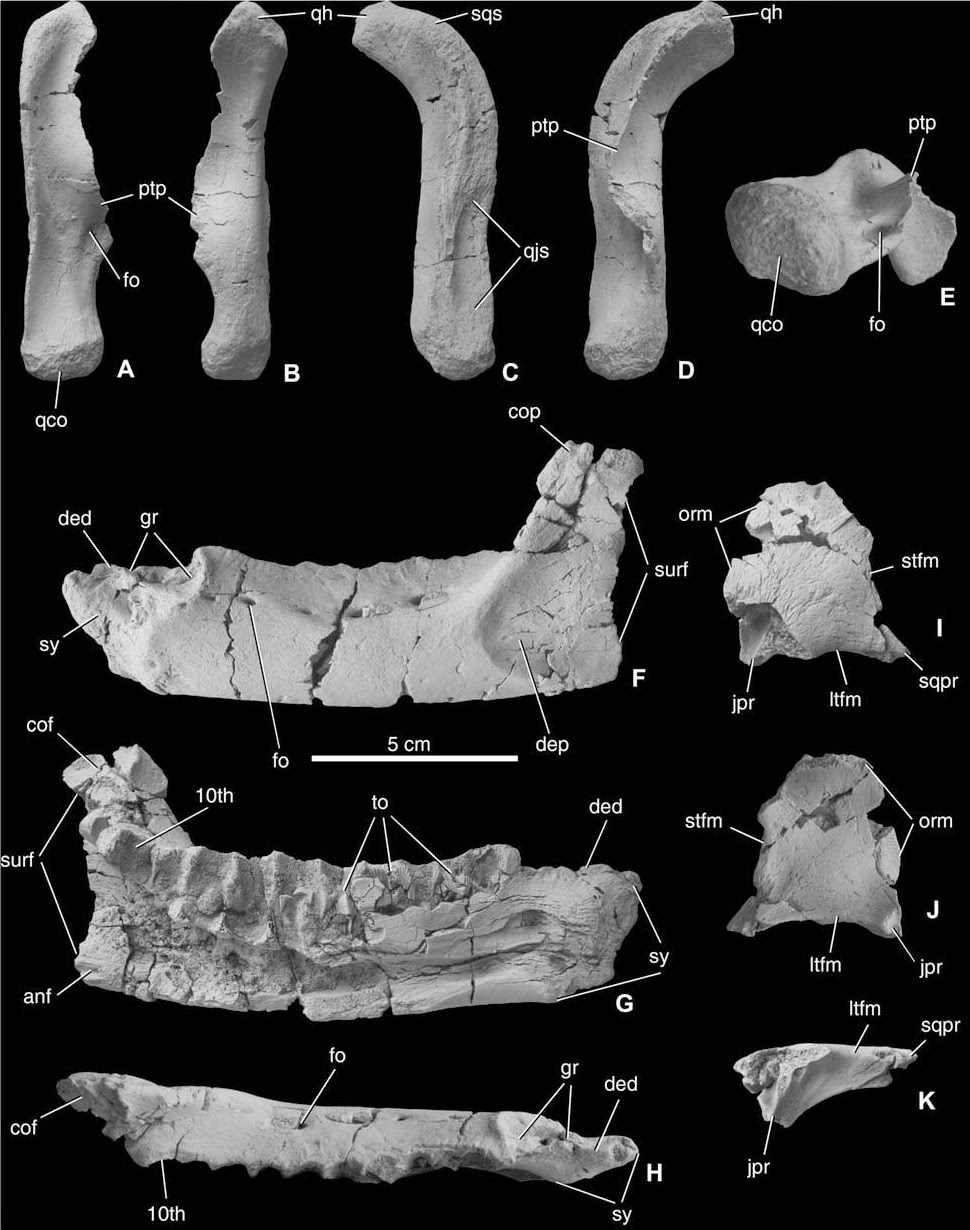
The material assigned to Mochlodon suessi includes, beside the original tooth, a right dentary (jawbone), as well as another tooth and a number of fragmentary limb bones. Mochlodon vorosi is described principally from another dentary. The dentary of Mochlodon suessi has a depression beneath the coronoid process that was thought to be a developmental feature in an immature Dinosaur, however this feature is more developed in Mochlodon vorosi, which, although also small, is apparently a mature animal. From this Ősi et al. conclude that the depression is a valid diagnostic feature for the genus, and that Mochlodons, despite being continent dwellers, were considerably smaller than Zalmoxes, reaching around 150-200 cm in length, and therefore raising questions about the island dwarf interpretation of Zalmoxes.

Cranial remains of Mochlodon vorosi  from the Upper Cretaceous Csehbánya Formation, Iharkút, western Hungary. (A) Right quadrate in cranial, (B) caudal, (C) lateral, (D) medial, (E) distal views; (F) left dentale in lateral, (G) medial, (H) occlusal views; (I) left postorbital in dorsal, (J) ventral, (K) lateral views. Anatomical abbreviations: anf, articular surface for angular; cof, articular surface for coronoid; cop, coronoid process; ded, dorsal edg of the dentary; dep, depression; fo, foramen; gr, groove; jpr, jugal process; ltfm, margin of lateral temporal fenestra; orm, orbital rim; ptp, pterygoid process; qco, quadrate condyles; qh, quadrate head; qjs, articular surface for quadratojugal; sqpr, squamosal process; sqs, articular surface for squamosal; stfm, margin of supratemporal fenestra; surf, articular surface for surangular; sy, symphysis; to, tooth; 10th, 10th alveolus. Ősi et al. (2012).

In addition to the first dentary from which the diagnosis was made, a further four complete dentaries (two left and two right) as well as six fragmentary specimens are referred to Mochlodon vorosi, confirming that the initial specimen was not atypical. In addition a left postorbital, two right quadrates, 38 loose teeth, four isolated vertebrae, a compressed sacrum, three coracoids, a fragmentary scapula, a fragmentary and an intact humerus, an ulna, two femora, a fragmentary femur, one complete and two fragmentary tibias and two phalanges are referred to the species. While these are scattered bones from numerous individuals, they do serve to re-affirm Ősi et al.’s estimate of the size of Mochlodon vorosi.

Comparison of histology-based adult body sizes of Mochlodon, Zalmoxes and Rhabdodon represented by the silhouettes of the animals. Ősi et al. (2012).

See also…

Follow Sciency Thoughts on Facebook.