Showing posts with label Jianchang County. Show all posts

Tuesday, 3 January 2023

Confuciusornis shifan: A new species of Confuciusornithid Bird from the Early Cretaceous Jehol Biota.

The Confuciusornithids are a group of Birds known from the Early Cretaceous Jehol Biota. Unlike earlier Jurassic Birds, they have both a pygostyle (short tail made from fused bones) and a beak, key features we associate with modern Birds, although they are not closely related, being considered to be the sister group to the Ornithothoraces, the group which comprises both the Euornithes ('True Birds'; the group to which all modern Birds belong) and the Enatiornithes ('Opposite Birds'; the most commonly preserved group of fossil Birds from the Cretaceous, which were generally toothed rather than beaked). Although these Birds are only known from a single fossil lagerstatten, thousands of individual specimens with a temporal range of about 15 million years (the Jehol Biota comprises three succeeding formations, the Dabeigou, Yixian and Jiufotan), which have been assigned to five genera and eleven species (although some of these assignments are debatable), giving us a degree of understanding of the group.

In a paper published in the journal Communications Biology on 21 December 2022, Renfei Wang of the College of Earth Sciences at Jilin University, and the Key Laboratory for Evolution of Past Life in Northeast Asia at the Paleontological Museum of Liaoning, Dongyu Hu, also of the Key Laboratory for Evolution of Past Life in Northeast Asia at the Paleontological Museum of Liaoning, Meisheng Zhang, also of the College of Earth Sciences at Jilin University, Shiying Wang, again of the Key Laboratory for Evolution of Past Life in Northeast Asia at the Paleontological Museum of Liaoning, Qi Zhao of the Key Laboratory of Vertebrate Evolution and Human Origins at the Institute of Vertebrate Paleontology and Paleoanthropology of the Chinese Academy of Sciences, Corwin Sullivan of the Department of Biological Sciences at the University of Alberta, and the Philip J. Currie Dinosaur Museum, and Xing Xu, once again of the Key Laboratory for Evolution of Past Life in Northeast Asia at the Paleontological Museum of Liaoning, and the Key Laboratory of Vertebrate Evolution and Human Origins at the Institute of Vertebrate Paleontology and Paleoanthropology, and of the Center for Vertebrate Evolutionary Biology at Yunnan University, describe a new species of Confuciusornithid Bird from the Xiaotaizi Village exposure of the Jiufotang Formation in  Jianchang County, Liaoning Province.

The new species is placed in the genus Confuciusornis, and given the specific name shifan, which means 'paragon of all teachers', and is an honorific applied to Confucius, and also refers to the 70th anniversary of the opening of Shenyang Normal University (瀋陽師範大學 or Shenyang Shifan Daxue). The species is described from a single specimen, PMoL-AB00178, which is a nearly complete and mostly articulated skeleton, preserved on a single slab.

Confuciusornis shifan holotype (PMoL-AB00178). (a) Photograph. (b) Schematic line drawing. cav caudal vertebra, cev cervical vertebra, fu furcula, ga gastralia, lc left coracoid, ldIII left manual digit III, lfe left femur, lh left humerus, lil left ilium, lis left ischium, lm left manus, lp left pes, lra left radiale, lr left radius, ls left scapula, lt left tibiotarsus, lu left ulna, lul left ulnare, ma mandible, pu pubis, py pygostyle, r rib, rc right coracoid, rdcIII claw of right manual digit III, rfe right femur, rfi right fibula, rh right humerus, ris right ischium, rm right manus, rp right pes, rra right radiale, rr right radius, rs right scapula, rt right tibiotarsus, ru right ulna, rul right ulnare, sk skull, sy synsacrum, tv thoracic vertebra. Arrow indicates the position from which the histological section of the right femur was taken. Scale bars is 2 cm. Wang et al. (2022).

Examination of the skeleton of Confuciusornis shifan indicates that it is an adult specimen, with all neurocentral sutures are closed without any trace, the sacral vertebrae are completely fused together to form a synsacrum, and nearly all of the compound bones (e.g., the metacarpus, tibiotarsus, and metatarsus) are fully formed. Examination of a cross section of the right femur revealed four lines of arrested growth (indicative of seasonal pauses in growth, similar to tree rings), which is considered indicative of having reached the final adult size in a Confuciusornithid.

Osteohistological section of Confuciusornis shifan holotype (PMoL-AB00178). Sample was taken from the midshaft of the right femur. ICL inner circumferential layer, OCL outer circumferential layer. Arrows indicate lines of arrested growth. Scale bar is 100 μm. Wang et al. (2022).

Despite this, Confuciusornis shifan is small for a Confuciusornithid Bird, with an estimated body mass of 174 g (around the size of a large Thrush or small Dove), with only one species, Changchengornis hengdaoziensis, having a smaller adult specimen (with an estimated body mass of 138 g).

The pygostyle is one of the defining features of modern Birds, but was absent in the long-tailed Birds of the Jurassic, with the Cretaceous-Recent Birds which share this characteristic being considered to comprise a single clade, the Pygostylians. In more advanced members of the group, such as the Sapeornithids, Pengornithid Enantiornithines, and Ornithuromorphs, this is a short, plough-shaped structure, but in earlier members of the group, including the Confuciusornithids, Jinguofortisids, and the majority of Enantiornithines, the pygostyle was longer and rod-shaped. It has generally been assumed that this longer pygostyle comprises a larger number of bones than the pygostyle of modern Birds, although the structure is seldom preserved well enough to be able to count the co-ossified bones which make it up. However, the pygostyle of Confuciusornis shifan is perforated (thought to be the result of incomplete fusion between adjacent neural arches), which leaves the intervertebral foramina (gaps between vertebrae) visible. The specimen has ten intervertebral foramina, implying a minimum of eleven vertebrae are fused, more than has previously been recorded in any Confuciusornithid Bird (the previous record-holder was a juvenile specimen of Confuciusornis sanctus with eight), and significantly more than is known from any non-Confuciusornithid Pygostylian Bird, with 5-6 being typical in even early members of the group.

Selected axial elements of Confuciusornis shifan holotype (PMoL-AB00178). (a) Cervical vertebrae. (b) Synsacrum. (c) Pygostyle. sy synsacrum. Arrows in (b) and (c) indicate the longitudinal ridge on the ventral surface of the synsacrum and the positions of foramina along the pygostyle, respectively. Scale bars are 0.5 cm in (a) and (c) and 1 cm in (b). Wang et al. (2022).

This has interesting implications for the evolution of the Avian tail. Both Confuciusornis shifan and Confuciusornis sanctus have seven free caudal (tail) vertebrae in addition to the fused vertebrae of the pygostyle, giving Confuciusornis shifan a total caudal vertebrae count of eighteen. Five to eight free caudal vertebrae seems to be typical of early Pygostylian Birds, with 5–6 in Jinguofortisids, 6–8 in Enantiornithines, and 5–7 in early Ornithuromorphs (modern Birds have 5-6). The exception appears to be the Sapeornithids, which are thought to have about 12. Since the pygostyle typically comprises another 5-6 vertebrae, this means that most Pygostylian Birds have a total of no more than 14 caudal vertebrae, with the exception of the Confuciusornithids and Sapeornithids, which have about 18. This is still less than in the non-Pygostylian Birds, with Archaeopteryx having 21-23 free caudal vertebrae, and Jeholornis having 27. This implies a general tendency towards a reduction of the number of caudal vertebrae in Pygostylian Birds, with exceptions in groups such as the Confuciusornithids and Sapeornithids, and possibly the Enantiornithines (which had a long pygostyle, presumably made up of a higher number of fused vertebrae, although no actual data is available). It is known that at least some of the long-pygostyled Birds used this structure to support large, ornamental tail feathers, whereas the shorter plough shaped pygostyles of more advanced groups are used to support retractable tail fans, which greatly increase aerodynamic lift and maneuverability. 

Typical Confuciusornithids have long wings with strongly asymmetrical flight feathers, strut-like coracoids, a keeled sternum, and enlarged major manual digits, all features which have been used to argue that they were strong flyers, although some functional analyses have suggested that their capabilities would have been more limited, and it is generally accepted that their flight capacity would have been weaker than modern Birds, or even Early Cretaceous Ornithothoracines.

Although clearly closely related to Confuciusornis sanctus, Confuciusornis shifan shows some flight adaptations dissimilar to those seen in other Confuciusornithids. Typical Confuciusornithids have an elongated forearm, giving an increased wing-area, a useful adaptation to long-distance flight. Confuciusornis shifan is significantly smaller than most Confuciusornithids, and shows enlargement of many of the skeletal processes to which muscles would have attached. This would have given greater control over the tips of the wings during flight, increasing maneuverability during flight.

Selected limb elements of Confuciusornis shifan holotype (PMoL-AB00178). (a) Left carpometacarpus. (b) Right carpometacarpus. (c) left alular metacarpal of the confuciusornithid specimen PMoL-AB00150. (d) Right tarsometatarsus. Carpometacarpi are in palmar view, and tarsometatarsus is in cranial view. cb cushion-like bone, ep extensor process, pp pisiform process. Roman numerals in (d) identify metatarsals. Black arrow in (c) indicates the cranial distal condyle of the alular metacarpal; black and white arrows in (d) indicate the ridge-like process on metatarsal IV and the dorsal tubercle on metatarsal III, respectively. Scale bars are 0.25 cm. Wang et al. (2022).

See also...

Online courses in Palaeontology. 

Follow Sciency Thoughts on Facebook.

Follow Sciency Thoughts on Twitter.


Monday, 20 November 2017

Versperopterylus lamadongensis: A new species of Anurognathid Pterosaur from the Early Cretaceous of Liaoning Province, China.

The Anurognathid Pterosaurs are small, short-tailed Pterosaurs known from the Jurassic of Asia, Europe, and possibly North America. They has proportionally large eye-sockets, which has been taken as evidence of a nocturnal or crepuscular lifestyle, and spaced, pointed teeth, suitable for catching Insects or possibly Fish, which has led to suggestions that they may have had a lifestyle similar to that of modern Bats.

In a paper published in the Geological Society London Special Publications on 8 September 2017, Junchang Lü of the Institute of Geology of the Chinese Academy of Geological Sciences, and the Key Laboratory of Stratigraphy and Palaeontology of the Ministry of Land and Resources of China, Qingjin Meng, Baopeng Wang and Di Liu of the Beijing Museum of Natural History, Caizhi Shen, also of the Institute of Geology of the Chinese Academy of Geological Sciences, and the Key Laboratory of Stratigraphy and Palaeontology of the Ministry of Land and Resources of China, and Yuguang Zhang, also of the Beijing Museum of Natural History, describe a new species of Anurognathid Pterosaur from the Early Cretaceous Jiufotang Formation of Jianchang County in Liaoning Province, China (part of the Jehol Biota).

The new species is named Versperopterylus lamadongensis, where 'Versperopterylus' means 'Dusk-wing', in reference to the presumed Bat-like habits of Anurognathid Pterosaurs, and 'lamadongensis' means 'from Lamadong', in reference to the location where the specimen was found. The species is described from a single specimen, preserved on a slab, which is partially disarticulated, but almost complete, lacking only one humerus, some fingers from the left hand and some cervical (neck) vertebrae.

Photograph (a) and line drawings (b) of Versperopterylus. Abbreviations: cav, caudal vertebrae; csk, crushed skull; co, coracoids; dv, dorsal vertebrae; dr, dorsal ribs; f, femur; fot, fourth toe; fi, fibula; ft, first toe; h,, humerus; lj, lower jaw; mc, maniual claw; mcI-IV, metacarpals I–IV; mttI-IV, metatarsals I–IV; mttv, metatarsal V; pt, pteroid; rd, radius; sc, scapula; ti, tibia; ul, ulna. Lü et al. (2017).

The specimen is estimated to have had a wing-span of about a metre. It had an exceptionally small skull, which was wider than it was long, though this is somewhat crushed, obscuring any detail. The upper jaw appears to have had about 12 teeth. One of its toes appears to have been reversed in life, which is likely to have been an adaptation for gripping, which in turn strongly suggests an arboreal (tree-dwelling) life-style.

Artists interpretation of Versperopterylus as a living animal. Zhao Chuang in Lü et al. (2017).

See also...

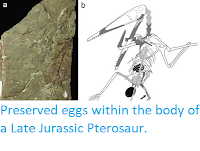
http://sciencythoughts.blogspot.co.uk/2015/11/preserved-eggs-within-body-of-late.htmlhttp://sciencythoughts.blogspot.co.uk/2015/04/azhdarchid-pterosaur-cervical-vertebra.html
http://sciencythoughts.blogspot.co.uk/2014/12/a-three-dimensionally-preserved.htmlhttp://sciencythoughts.blogspot.co.uk/2014/05/a-fossil-pterosaur-from-early_8.html
http://sciencythoughts.blogspot.co.uk/2014/05/a-fossil-pterosaur-from-early.htmlhttp://sciencythoughts.blogspot.co.uk/2013/10/a-giant-pterosaur-from-middle.html
Follow Sciency Thoughts on Facebook.

Saturday, 25 July 2015

Zhenyuanlong suni: A large feathered Dromaeosaur from the Jehol Biota.


Dromaeosaurid Dinosaurs are among the closest non-Avian relatives of the Birds and show many similarities to the earliest members of that group, making understanding Dromaeosaurs important for understanding the origin of Birds. In particular many Dromaeosaur specimens from the Early Cretaceous of Liaoning Province, China, have been shown to possess extremely Bird-like feather coats, and in several cases feathered wings which may have allowed them to fly. This is particularly interesting as the Liaoning specimens are not thought to represent a tight monophyletic group (i.e. a group of species more closely related to one-another than anything else), but rather a diverse group of Dromaeosaurs with exceptional preservation, part of the Jehol Biota of exceptionally well preserved Early Cretaceous fossils, suggesting that feathers were also present in Dromaeosaurs from other locations even if they have not been preserved. The smallest and most numerous Liaoning Dromaeosaurs are placed in the genus Microraptor and may (or may not) represent several species of small (cat-sized) Dinosaurs fully capable of flight, while the largest, Tianyuraptor, is a much larger animal with reduced fore-limbs highly unlikely to have been capable of supporting it in flight. Unfortunately Tianyuraptor is known only from a single specimen lacking feathers; it is impossible to determine whether this species was truly featherless from a single specimen, nor to speculate about what sort of feathers it may have possessed.

In a paper published in the journal Nature Scientific Reports on 16 July 2015, Junchang Lü of the Institute of Geology of the Chinese Academy of Geological Sciences and the Key Laboratory of Stratigraphy and Paleontology of the Ministry of Land and Resources of China and Stephen Brusatte of the School of GeoSciences at the University of Edinburgh, describe a new species of Dromaeosaur from the Yixian Formation of Jianchang County in Liaoning Province.

The new species is named Zhenyuanlong suni, honouring Zhenyuan Sun who discovered the specimen; the suffix ‘-long’ means ‘Dragon’ in Chinese, making ‘Zhenyuanlong suni’ ‘Zhenyuan Sun’s Dragon’. The specimen comprises an almost complete specimen preserved on in two dimensions on three separate blocks, with only the end part of the tail missing. The specimen is 126.6 cm in length, but it is thought to have been about 165 cm long in life. Not all of the vertebrae fused in adult Dinosaurs are fully fused in this specimen, leading Lü and Brusatte to conclude it was a subadult at the time when it died.

The holotype of the large-bodied Liaoning Dromaeosaurid Zhenyuanlong suni. Lü & Brusatte (2015).

Like Tianyuraptor, Zhenyuanlong suni has relatively small forelimbs for the size of its body, however unlike Tianyuraptor an extensive feather coating is preserved on all of Zhenyuanlong suni except its hindlimbs (these are preserved on a separate block which does not contain any feathers, making it hard to assess whether feathers were originally present on the hindlimbs; feathered hindlimbs are common in both smaller Dromaeosaurs and early Birds). Notably these show layered feathers similar to those seen in modern Birds and Microraptor.

The integument of the large-bodied, short-armed Liaoning Dromaeosaurid Zhenyuanlong suni. (A) Overview of the skeleton with regions of integument indicated with grey highlight; (B) proximal tail; (C) left forearm; (D) right forearm; (E) closeup of coverts on right forearm. Lü & Brusatte (2015).

Without a full biomechanical analysis (which has not been carried out for Zhenyuanlong suni at the time of writing) it is impossible to say whether or not it was capable of flying or gliding, but the combination of a large body size and small forelimbs makes this seem somewhat unlikely, leading to support for the alternative theory that feathered wings were first developed for some other purpose in Bird-like Dinosaurs and later co-opted for flight in Birds and possibly some small Dromaeosaurs. This is not uncommon as evolution does not plan ahead, and major biological revolutions often come about when organs or metabolic pathways adapted to one purpose are then used for another.

See also…

The Dromaeosaurid (a type of small Theropod Dinosaur closely related to Birds and Troodontids) Saurornitholestes langstoni was first...


In December 2000 Xing Xu, Zonghe Zhou and Xioalin Wang of the Institute of Vertebrate Paleontologyand Paleoanthropology of the Chinese Academy of...


Dromaeosaurs were small Therapod Dinosaurs, thought to have been the group most closely related to...

Follow Sciency Thoughts on Facebook.

Wednesday, 2 July 2014

Two new species on Enantiornithine Birds from the Jehol Biota.

The deposits of the Jehol Group in northeastern China have yielded a spectacular number of fossil Birds and closely related non-Avian Theropod Dinosaurs over the past three decades. The most numerous and diverse group of Birds in this assemblage are the Enantiornithines, toothed Birds related but not ancestral to the modern Neornithine Birds, with about 27 separate species described from numerous specimens. 

In a paper published in the journal Vertebrata PalAsiatica on 21 January 2014, Wang Min of the Key Laboratory of Vertebrate Evolution and Human Origins at the Institute of Vertebrate Paleontology and Paleoanthropology of the Chinese Academy of Sciences and the University of Chinese Academy of Sciences, Zhou Zhong-He and Jingmai O’Connor, also of the Key Laboratory of Vertebrate Evolution and Human Origins and Nikita Zelenkov of the Borissiak Palaeontological Institute of the Russian Academy of Sciences describe two new species of Enantiornithine Birds from the Jehol Biota.

The first new Bird species is named Parabohaiornis martini, where ‘Parabohaiornis’ means ‘similar to Bohaiornis’ (a previously described species of Enantiornithine Bird) and ‘martini’ honours the late Larry Martin, a distinguished palaeontologist and expert on avian evolution. Parabohaiornis martini is described from two specimens, from the Jiufotang Formation at Lamadong in Jianchang County in Liaoning Province.

The first specimen of Parabohaiornis martini is complete and partially articulated, and appears to be from a subadult, as not all the bones are fully fused. The second appears to be from a fully mature individual, but lacks the head and the wings below the elbow joint.

Photograph and line drawing of Parabohaiornis martini. Abbreviations: alm. alular metacarpal; al 1, 2. alular digit phalanx 1, 2; cav. caudal vertebrae; co. coracoid; cv. cervical vertebrae; dr. dorsal rib; dt. distal tarsal; fe. femur; fi. fibula; fu. furcula; ga. gastralia; hu. humerus; il. ilium; is. ischium; ma 1, 2, 3. major digit phalanx 1, 2, 3; mam. major metacarpal; mi 1. minor digit phalanx 1; mim. minor metacarpal; mt I–IV. metatarsal I, II, III, IV; pd. pedal digits; pt. proximal tarsals; pu. pubis; py. pygostyle; r. radius; ra. radiale; sc. scapula; sem. semilunate carpal; sk. skull; sr. sternal rib; st. sternum; sy. synsacrum; ti. tibia; tv. thoracic vertebrae; u. ulna; ul. ulnare. Wang et al. (2014).

Parabohaiornis martini is a medium sized, robust Enantiornithine Bird with three robust conical teeth on each premaxilla and four more on each maxilla. 

Photograph and line drawing of the second specimen of Parabohaiornis martini. Abbreviation: fv. vertebrae of fish; other abbreviations follow the top image. Wang et al. (2014).

The second new species is named Longusunguis kurochkini, where ‘Longusunguis’ means ‘long-claw’ and ‘kurochkini’ honours the late Evgeny Kurochkin, a distinguished palaeontologist and expert on fossil Birds. Longusunguis kurochkini is described from a single specimen, again from the Jiufotang Formation at Lamadong. The specimen is complete and articulated, though the head is detached. It also appears to be a subadult.

Longusunguis kurochkini is a medium-sized Enantiornithine Bird with robust conical teeth and long, curved claws.

Photograph and line drawing of Longusunguis kurochkini. Abbreviations: par. parapophyses; pot. posterior trochanter; other abbreviations follow the top image. Wang et al. (2014).

Parabohaiornis martini and Longusunguis kurochkini appear to be closely related, as well as also being closely related to the previously described Bohaiornis, Shenqiornis, Sulcavis and Zhouornis. Wang et al. suggest that these Birds should be grouped together to form a separate family within the Enantiornithine, which they name as the Bohaiornithidae.

All members of the Bohaiornithidae appear quite similar, being roughly medium sized (for Enantiornithine Birds), robust conical teeth and strong feet with long, curved claws. This suggests that they occupied a distinct ecological niche, though the exact nature of this was impossible to determine. 

The tough elongate feet of the Bohaiornithidae are typical of ground-living Birds today, but this seems unlikely due to their curved claws. Claws like those seen in the Bohaiornithidae are seen in the modern Raptors, as well as in Birds that habitually climb of tree-trunks. However tree-trunk climbing Birds typically have a number of specialized features on their hindlimbs, none of which are present in the Bohaiornithidae. Nor do they appear well suited for hunting like Raptors, as the proportions of their feet are quite different, and their teeth appear adapted for a durophagous diet.

See also…


The dominant group of Birds during much of the Cretaceous Period were the Enatiornithine, toothed Birds related, but not ancestral, to modern Birds. The largest known species of Enatiornithine from the...


The two surviving groups of Archosaurs, Crocodilians and Birds, show very different reproductive strategies.  Crocodilians have paired ovaries and produce large clutches of small eggs, which mature slowly prior to being laid, and make a relatively small investment in parental care. Birds have only a single ovary, a modification not seen in any other Amniote (Reptile or Mammal) with eggs...


Birds derived from small Theropod Dinosaur ancestors in the Middle Jurassic, and appear to have reached similar levels of diversity in the Cretaceous to that seen today. However the dominant group of Birds in the Cretaceous were the Enatiornithines, a group of toothed Birds related to but not ancestral to modern Birds (Ornithuromorpha), which died out...


Follow Sciency Thoughts on Facebook.