Showing posts with label Enatiornithine Birds. Show all posts

Monday, 19 June 2017

An Enantiornithine Bird Hatchling preserved in Cretaceous Burmese Amber.

Most Dinosaurs, including Mesozoic Birds, are known only from replacement fossils of bones, teeth, and other hard tissues, with a few rare sites such as the lithographic deposits of the Jehol or Crato biotas, or even rarer examples of Dinosaurs mummified before lithification, preserving additional details such as plumage and soft tissues. One type of deposit with potential for excellent preservation of plumage and soft tissues is amber, the preserved resin of ancient trees, which frequently preserves whole body fossils of Insects and other small animals. However Amber fragments, by their nature, tend to be very small, whereas Dinosaurs, for the most part, were extremely large, limiting the potential for the preservation of even Avian Dinosaurs in amber. To date, the known catalogue of Dinosaur specimens preserved in amber runs to a few feathers, a pair of Enantiornithine Bird wings and the tip of the tail of a small non-Avian Coelurosaurian Theropod.

In a paper published in the journal Gondwana Research on 6 June 2017, Lida Xing of the State Key Laboratory of Biogeology and Environmental Geology and School of the Earth Sciences and Resources at the China University of Geosciences, Jingmai O'Connor of the Key Laboratory of Vertebrate Evolution and Human Origins at the Institute of Vertebrate Paleontology and Paleoanthropology of the Chinese Academy of Sciences, Ryan McKellar of the Royal Saskatchewan Museum, the Biology Department at the University of Regina, and the Department of Ecology & Evolutionary Biology at the University of Kansas, Luis Chiappe of the Dinosaur Institute at the Natural History Museum of Los Angeles County, Kuowei Tseng of the Department of Exercise and Health Science at the University of Taipei, Gang Li of the Institute of High Energy Physics of the Chinese Academy of Science, and Ming Bai of the Key Laboratory of Zoological Systematics and Evolution of the Institute of Zoology of the Chinese Academy of Sciences, describe a preserved Hatchling Enantiornithine Bird from a piece of amber from the Angbamo site at Tanai Township in Myitkyina District of Kachin Province in northern Myanmar.

Middle Cretaceous ‘Burmese Amber’ has been extensively worked at several sites across northern Myanmar (though mostly in Kachin State) in the last 20 years. The amber is fairly clear, and often found in large chunks, providing an exceptional window into the Middle Cretaceous Insect fauna. This amber is thought to have started out as the resin of a Coniferous Tree, possibly a Cypress or an Araucaria, growing in a moist tropical forest. This amber has been dated to between 105 and 95 million years old, based upon pollen inclusions, and to about 98.8 million years by uranium/lead dating of ash inclusions in the amber. 

The preserved Hatchling is not intact, having apparently only partly covered by resin initially, with part of the body therefore left exposed to the actions of the elements, and scavengers, and hence lost; the whole subsequently covered by additional layers of resin, and eventually preserved as amber. The remains are preserved in a block of amber approximately 86 mm x 30 mm x 57 mm and weighing 78.16 g. This block has been split into two sections during preservation; this split having unfortunately passed through part of the jaw, causing some loss of material. The remains comprise the head and most of the neck of the Bird, as well as a partial wing and the feet, and some additional plumage and soft tissue.

Overview of specimen in right lateral view. (A) Amber specimen; (B) x-ray μCT reconstruction; (C) illustration of observable plumage and skin sections. Two halves of amber piece have been positioned side by side (A) or separated by dashed line (C), and body regions scanned separately have been arranged in preservational position (B). For clarity in (C), only rachises of apical remiges indicated; and only rachises and rami of basal remiges, coverts, contours, and neoptile plumage indicated. Scale bars represent 10 mm. Xing et al. (2017).

The Bird appears to have two basic types of plumage, soft down feathers similar to those seen in modern Bird chicks, combined with longer fibrous feathers similar to those seen in many Dinosaurs, as well as some developed flight feathers on the wing. The skeleton is consistent with that of other preserved early-development Enantiornithine chicks, lending confidence to the diagnosis of this bird as an Enantiornithine. The developmental strategy in this Bird appears to have been different to that in modern Birds, in that it was apparently both arboreal (tree-dwelling) and precocial (able to move about immediately upon hatching). Modern Birds almost invariably follow one of two strategies; with tree-nesting species tending to need a period of care before leaving the nest (though many species do leave the nest before they can fly) and ground-nesting Birds producing precocial offspring that become active almost immediately.

See also...

http://sciencythoughts.blogspot.co.uk/2016/12/preserved-plumage-in-immature.htmlhttp://sciencythoughts.blogspot.co.uk/2015/06/preserved-feathers-in-enantiornithine.html
http://sciencythoughts.blogspot.co.uk/2015/01/bird-eggs-from-late-cretaceous-colonial.htmlhttp://sciencythoughts.blogspot.co.uk/2014/07/two-new-species-on-enantiornithine.html
http://sciencythoughts.blogspot.co.uk/2014/06/a-subadult-enantiornithine-bird-from.htmlhttp://sciencythoughts.blogspot.co.uk/2014/06/preserved-ovarian-follicles-in-mesozoic.html


Follow Sciency Thoughts on Facebook.

Sunday, 7 June 2015

Preserved feathers in an Enantiornithine Bird from the Early Cretaceous Crato Formation of Brazil.


While feathers have been known in fossil Birds from the Mesozoic since the nineteenth century, they remain extremely rare, with the vast majority of known specimens coming from a single source, the Early Cretaceous Jehol Biota of northwest China, and the remainder coming from a few other locations in Asia and Europe. To date no Bird with preserved feathers has been described from the supercontinent of Gondwana, which comprised the modern continents of South America, Africa, Antarctica, Madagascar, India, Australia and New Zealand, forming an amalgamated landmass covering much of the Southern Hemisphere during the late Mesozoic.

In a paper published in the journal Nature Communications on 26 May 2015, Ismar de Souza Carvalho of the Departamento de Geologia at the Universidade Federal do Rio de Janeiro, Fernando Novas of the Museo Argentino de Ciencias Naturales ‘Bernardino Rivadavia’, Federico Agnolín and Marcelo Isasi of the Museo Argentino de Ciencias Naturales ‘Bernardino Rivadavia’ and the Fundación de Historia Natural ‘Félix de Azara’ at the Universidad Maimónides, Francisco Freitas of Geopark Araripe and José Andrade of the Departamento Nacional da Produção Mineral describe a fossil Bird from the Early Cretaceous Crato Formation of Brazil which possesses the first known feathers in any Mesozoic Bird from the Southern Hemipshere.

The specimen is very small, about 6 cm in total length, and has large orbits and poor mineralization of the ends of the long bones, for which reason it is thought to be a juvenile. It is not assigned to a species or genus, but is recognized as an Enantiornithine, a member of a group of Mesozoic Birds related to but not ancestral to the modern Neornithine Birds, with a set of distinct features not found in any post-Mesozoic Birds, including most notably the retention of a bony snout with teeth rather than an keratinous beak.

Main slab and interpretative drawing of the Crato Bird specimen. (a) Main slab. (b) Interpretative drawing of the skeleton and feathers. (c) Reconstructed cross-section at the level of distal vanes of the feathers. (d) Reconstructed cross-section at mid-length of the rachis. (e) Reconstructed cross-section of the calamus. al, alula; cd, free caudal vertebrae; dv, dorsal vertebrae; fr, frontals; lc, left coracoid; lcp, left carpometacarpus; lf, left foot; lh, left humerus; lr, left radius; ls, left scapula; lu, left ulna; mx, maxilla; pub, pubes; py, pygostyle; ra, rachis; rc, right coracoid; rh, right humerus; rr, right radius; rt, right tibiotarsus; rtmt, right metatarsals; ru, right ulna; sp, colour spots; v, vanes. Dark grey represents the vanes, light grey represents the scapus. Scale bar is 10 mm. De Souza Carvalho et al. (2015).

One distinctive feature of the Jehol Bird is the presence of a pair of enlarged ‘ribbon feathers’ on the tail. All modern Birds, and some Enantiornithines, posses a tail comprising a fan of feathers, but other Enantiornithines, as well as Confuciusornithids (another group of Mesozoic Birds) posses tails comprising a single pair of elongate ‘ribbon feathers’. These are morphologically distinct from any feathers, with a wide flattened middle part with a line down it, interpreted variously as a central rachis (vein) surrounded by fused and undifferentiated vanes, or an flattened and expanded rachis with a central groove. To date no fossil exhibiting this has preserved the feathers in a way in which this could be resolved, but the ribbon-feathers of the Crato Bird are preserved in relief, allowing examination of their structure, which does indeed appear to comprise a flattened and laterally expanded rachis for much of its length, a structure quite unlike anything seen in modern Birds, and in some ways intermediate between a modern Bird’s feather and a greatly extended Reptilain scale.

Details of tail feather of the Crato Bird specimen. (a) Proximal end. (b) Distal end. cal, calamus; lg, longitudinal groove; ra, rachis; sp, colour spot; v, vane. Scale bar is 2.5 mm. De Souza Carvalho et al. (2015).

See also…

The Crato Formation outcrops on the northern flanks of the Chapada do Araripe, a plateaux on the border between Ceará, Pernambuco andPiauí States in northern Brazil. In is noted for its exceptionally well preserved fossils, which include Dinosaurs, Crocodiles, Fish, Pterosaurs, Crustaceans, Arachnids, Plants...

The Early Cretaceous Jehol Group of China has produced a remarkable number of well-preserved fossils of Mesozoic Birds, adding greatly to our understanding of the early history of this group...


In the 1980s a large collection of Avian eggs were uncovered at...


Follow Sciency Thoughts on Facebook.

Saturday, 3 January 2015

Bird eggs from a Late Cretaceous colonial nesting site in Argentinean Patagonia.


In the 1980s a large collection of Avian eggs were uncovered at the campus of the National University of Comahue at Neuquén City in Argentinean Patagonia. These ages were located on a single bedding plane in the Late Cretaceous Bajo de la Carpa Formation, which has also produced several Crocodyliforms (Neuquensuchus universitas, Notosuchus terrestris, Comahuesuchus brachybuccalis, Cynodontosuchus rothi and Wargosuchus australis) an early Snake (Dinilysia patagonica), two species of non-Avian Theropod Dinosaurs (Alvarezsaurus calvoi and Velocisaurus unicus) and two species of early Birds (Neuquenornis volans and Patagopteryx deferrariisi). Several of the eggs contained embryonic remains, of what appeared to be Enantiornithine Birds, making these eggs the first discovered from the Cretaceous that could be confidently assigned to Birds by the presence of embryos.

In a paper published in the journal PLoS One on 17 April 2014, a team of scientists led by Mariela Fernández of the Instituto de Investigaciones en Biodiversidad y Medioambiente re-examine the Neuquén eggs, and make comparisons to other, subsequently discovered, Cretaceous Birds’ eggs, as well as the eggs of related Dinosaur groups and modern Birds.

The Bajo de la Carpa Formation is a quartz-rich yellow sandstone, with poorly sorted, low sphericity, subangular-to-subrounded grains, which is typical of sandstones produced in arid, windswept environments (sandstones produced in marine or other aquatic environments typically have well sorted, rounded grains). This is interpreted to have been formed in a dry continental interior, however it also has a secondary carbonate cement, which is likely to have formed in a waterlogged environment, and which is taken to be indicative of seasonal streams ot ephemeral standing water.

A total of 65 eggs were found at the National University of Comahue site; their locations at the excavation site were carefully mapped, revealing that the majority were separated from their neighbours by just over one egg length (consistent with the densest modern Avian colonies). The eggs were arranged in a band orientated roughly north-south, that probably extends beyond the excavated area to the North. Almost all of these eggs were buried singularly, with one pair and one group of three being discovered. Almost all of the eggs were preserved in an upright position, with the polar end inserted into the ground, those that were not appeared to have toppled from this position onto their sides. This arrangement strongly suggests that the eggs were preserved where they were laid, rather than secondarily (as might happen if, for example, they had been washed from a nesting site by a flood), which is consistent with the fossil vertebrate remains recovered from the Bajo de la Carpa Formation, almost all of which were preserved as articulated skeletons.

Close-up of site location and in situ egg map. Top: overview of the Universitary campus showing the location of several paleofaunal elements and the gridcorresponding to the nesting colony (shaded purple box). Bottom: grid showing the location of each mapped egg; circles represent upright eggs, ovals represent eggs slightly inclined vertically and the oval that lies with its long axis parallel to the substrate represents anegg found in that position. Fernández  et al. (2014).

Many of the eggs lack their larger pole, suggesting that they hatched successfully prior to burial, though Fernández et al. also note that the position in which they were buried also means this end would have been exposed to any predators or scavengers targeting the eggs would probably also have attacked this end. The shells of the eggs are about 180 mm thick, and the volume of three complete eggs was calculated to be 19.5, 18.77, and 17.18 cm3, respectively. This corresponds roughly to the egg volume and shell thickness of living Plovers, and while it is difficult to make an exact match between egg size and the size of the adult Bird, this suggests that the eggs were more likely to have been laid by the smaller of the two Bird species known from the area, Enantiornithine Neuquenornis volans.

In situ eggs within the Comahue campus. In situ association in bedding plane (a), inset of single egg in position (b), egg half-buried insediment (typical for almost all eggs collected) (c), close up lateral view of same egg showing degree of asymmetry (d). Fernández et al. (2014).


Fernández et al. were also able to estimate the water vapour conductance of the eggs (i.e. the rate at which water would be lost through the shell due to evaporation) as 4.14 mgH₂O/day·Torr. This is within the distribution range of modern Birds, but is very low, suggesting that the Birds were able to nest in very dry, low humidity areas without their eggs drying out due to water loss through evaporation. Studies of a variety of Dinosaur eggs have suggested that many of these had significantly higher water vapour conductance values, suggesting that their eggs would have been more prone to drying out than those of modern Birds or the Bajo de la Carpa Birds, and that they would therefore have needed to incubate their eggs in significantly more humid environments, though within the Dinosauria as a whole, species closely related to the Birds, such as the Troodontid Prismatoolithus levis, had lower water vapour conductance values, within the range of modern Birds, but not so aridity tolerant as the Bajo de la Carpa Birds. Interestingly these Dinosaurs are known to have practiced care of the incubating eggs, in common with Birds, suggesting that these two traits might be connected.

Partial egg with typically fractured but well preserved eggshell. Some Avian bone fragments are visible insidethe egg (arrows). Fernández et al. (2014).

The nesting strategy of the Bajo de la Carpa Birds appears to have been unlike anything seen in modern Birds. The eggs were highly elliptical and apparently mostly laid singularly in simple scrapes, with the pointed end of the egg sticking into the ground. Among modern Birds singular eggs are typically quite rounded, with elliptical eggs being found in Birds that lay their eggs in clutches. This is to do with the way in which Birds incubate the eggs with their own body-heat; a rounded single egg allows for maximum contact with the parental body, while elliptical eggs in clutches enable the parent to maintain contact with a higher number of eggs. The upright position of the egg is also unlike that seen in almost all Birds, and would appear to have prevented the parent turning the egg, which in a modern Bird would greatly raise the egg mortality rate (when Chickens eggs are not turned around 85% fail to hatch, and the chicks that do survive are much weaker than normal). Among modern Birds only a single species, the Megapode, lays its egg vertically and this has a very different strategy to the Bajo de la Carpa Birds, laying clutches of rounded eggs with very porous shells (i.e. shells which allow the exchange of water with the environment and which can only survive in moist places) in piles of rotting vegetation, and relying on the heat generated by the decomposition of the vegetable matter to incubate the eggs. However a similar nesting strategy has been seen in Troodontid Dinosaurs, suggesting that this may have been a trait the earliest Birds shared with their nearest relatives.


See also…

The Loma del Pterodaustro lake deposits of Central Argentina have produced large numbers of the Pterosaur Pterodaustro guinazui, which is interpreted...
Birds evolved from Theropod Dinosaur ancestors in the Jurassic, and have a fairly extensive Mesozoic fossil record, with around 120 species described from around the world. The fossil record of Bird’s eggs is...

The two surviving groups of Archosaurs, Crocodilians and Birds, show very different reproductive strategies.  Crocodilians have paired ovaries and produce large clutches of small eggs, which mature slowly prior to being laid, and make a relatively small investment in parental care. Birds have only a single ovary, a...


Follow Sciency Thoughts on Facebook.

Wednesday, 2 July 2014

Two new species on Enantiornithine Birds from the Jehol Biota.

The deposits of the Jehol Group in northeastern China have yielded a spectacular number of fossil Birds and closely related non-Avian Theropod Dinosaurs over the past three decades. The most numerous and diverse group of Birds in this assemblage are the Enantiornithines, toothed Birds related but not ancestral to the modern Neornithine Birds, with about 27 separate species described from numerous specimens. 

In a paper published in the journal Vertebrata PalAsiatica on 21 January 2014, Wang Min of the Key Laboratory of Vertebrate Evolution and Human Origins at the Institute of Vertebrate Paleontology and Paleoanthropology of the Chinese Academy of Sciences and the University of Chinese Academy of Sciences, Zhou Zhong-He and Jingmai O’Connor, also of the Key Laboratory of Vertebrate Evolution and Human Origins and Nikita Zelenkov of the Borissiak Palaeontological Institute of the Russian Academy of Sciences describe two new species of Enantiornithine Birds from the Jehol Biota.

The first new Bird species is named Parabohaiornis martini, where ‘Parabohaiornis’ means ‘similar to Bohaiornis’ (a previously described species of Enantiornithine Bird) and ‘martini’ honours the late Larry Martin, a distinguished palaeontologist and expert on avian evolution. Parabohaiornis martini is described from two specimens, from the Jiufotang Formation at Lamadong in Jianchang County in Liaoning Province.

The first specimen of Parabohaiornis martini is complete and partially articulated, and appears to be from a subadult, as not all the bones are fully fused. The second appears to be from a fully mature individual, but lacks the head and the wings below the elbow joint.

Photograph and line drawing of Parabohaiornis martini. Abbreviations: alm. alular metacarpal; al 1, 2. alular digit phalanx 1, 2; cav. caudal vertebrae; co. coracoid; cv. cervical vertebrae; dr. dorsal rib; dt. distal tarsal; fe. femur; fi. fibula; fu. furcula; ga. gastralia; hu. humerus; il. ilium; is. ischium; ma 1, 2, 3. major digit phalanx 1, 2, 3; mam. major metacarpal; mi 1. minor digit phalanx 1; mim. minor metacarpal; mt I–IV. metatarsal I, II, III, IV; pd. pedal digits; pt. proximal tarsals; pu. pubis; py. pygostyle; r. radius; ra. radiale; sc. scapula; sem. semilunate carpal; sk. skull; sr. sternal rib; st. sternum; sy. synsacrum; ti. tibia; tv. thoracic vertebrae; u. ulna; ul. ulnare. Wang et al. (2014).

Parabohaiornis martini is a medium sized, robust Enantiornithine Bird with three robust conical teeth on each premaxilla and four more on each maxilla. 

Photograph and line drawing of the second specimen of Parabohaiornis martini. Abbreviation: fv. vertebrae of fish; other abbreviations follow the top image. Wang et al. (2014).

The second new species is named Longusunguis kurochkini, where ‘Longusunguis’ means ‘long-claw’ and ‘kurochkini’ honours the late Evgeny Kurochkin, a distinguished palaeontologist and expert on fossil Birds. Longusunguis kurochkini is described from a single specimen, again from the Jiufotang Formation at Lamadong. The specimen is complete and articulated, though the head is detached. It also appears to be a subadult.

Longusunguis kurochkini is a medium-sized Enantiornithine Bird with robust conical teeth and long, curved claws.

Photograph and line drawing of Longusunguis kurochkini. Abbreviations: par. parapophyses; pot. posterior trochanter; other abbreviations follow the top image. Wang et al. (2014).

Parabohaiornis martini and Longusunguis kurochkini appear to be closely related, as well as also being closely related to the previously described Bohaiornis, Shenqiornis, Sulcavis and Zhouornis. Wang et al. suggest that these Birds should be grouped together to form a separate family within the Enantiornithine, which they name as the Bohaiornithidae.

All members of the Bohaiornithidae appear quite similar, being roughly medium sized (for Enantiornithine Birds), robust conical teeth and strong feet with long, curved claws. This suggests that they occupied a distinct ecological niche, though the exact nature of this was impossible to determine. 

The tough elongate feet of the Bohaiornithidae are typical of ground-living Birds today, but this seems unlikely due to their curved claws. Claws like those seen in the Bohaiornithidae are seen in the modern Raptors, as well as in Birds that habitually climb of tree-trunks. However tree-trunk climbing Birds typically have a number of specialized features on their hindlimbs, none of which are present in the Bohaiornithidae. Nor do they appear well suited for hunting like Raptors, as the proportions of their feet are quite different, and their teeth appear adapted for a durophagous diet.

See also…


The dominant group of Birds during much of the Cretaceous Period were the Enatiornithine, toothed Birds related, but not ancestral, to modern Birds. The largest known species of Enatiornithine from the...


The two surviving groups of Archosaurs, Crocodilians and Birds, show very different reproductive strategies.  Crocodilians have paired ovaries and produce large clutches of small eggs, which mature slowly prior to being laid, and make a relatively small investment in parental care. Birds have only a single ovary, a modification not seen in any other Amniote (Reptile or Mammal) with eggs...


Birds derived from small Theropod Dinosaur ancestors in the Middle Jurassic, and appear to have reached similar levels of diversity in the Cretaceous to that seen today. However the dominant group of Birds in the Cretaceous were the Enatiornithines, a group of toothed Birds related to but not ancestral to modern Birds (Ornithuromorpha), which died out...


Follow Sciency Thoughts on Facebook.

Sunday, 15 June 2014

A subadult Enantiornithine Bird from the Early Cretaceous Jiufotang Formation of western Liaoning Province.

The dominant group of Birds during much of the Cretaceous Period were the Enatiornithine, toothed Birds related, but not ancestral, to modern Birds. The largest known species of Enatiornithine from the Early Cretaceous is Pengornis houi, described from a single specimen from the Jiufotang Formation of northern China, part of the Jehol Biota.

In a paper published in the journal Vertebrata PalAsiatica on 21 January 2014, Hu Han of the Key Laboratory of Vertebrate Evolution and Human Origins at the Institute of Vertebrate Paleontology and Paleoanthropology of the Chinese Academy of Sciences and the University of the Chinese Academy of Sciences and Zhou Zhong-He and Jingmai O'Conner, also of the Key Laboratory of Vertebrate Evolution and Human Origins, describe a second specimen of Pengornis from the Early Cretaceous Jiufotang Formation of western Liaoning Province.

The new specimen is an almost complete articulated skeleton with some feathers intact. It shows strong similarities to Pengornis houi, but is also different enough that were it a second adult specimen, then it would probably be placed within a separate species within the same genus. However, since it is not a completely mature specimen it cannot be confidently asserted that it is a new species either. For this reason it is placed in the genus Pengornis, but not assigned to species level.

Photo of the subadult specimen of Pengornis sp. Hu et al. (2014).


Camera lucida drawing of the subadult specimen of Pengornis sp. 
Abbreviations: as. astragalus; ca. calcaneum; ce. cervical vertebrae; co. coracoid; cv. 
caudal vertebrae; dr. dorsal rib; fe. femur; fi. fibula; ft. feathers; fu. furcula; 
ga. gastralia; hu. humerus; il. ilium; is. ischium; mcI-III. metacarpals I-III
; md. manual digits; mtI-V. metatarsals I-V; pd. pedal digits; pu. pubis; 
py. pygostyle; r. radius; ra. radiale; sc. scapula; se. semilunate carpal
; sk. skull; sr. sternal rib; st. sternum; sy. synsacrum; ti. tibia; tv. thoracic 
vertebrae; u. ulna; ul. ulnare; up. uncinate process. 
Hu et al. (2014).


See also...


The two surviving groups of Archosaurs, Crocodilians and Birds, show very different reproductive strategies.  Crocodilians have paired ovaries and produce large clutches of small eggs, which mature slowly prior to being laid, and make a relatively small investment in parental care. Birds have only a single ovary, a modification not seen in any other Amniote (Reptile or Mammal) with eggs that mature rapidly prior to being laid, smaller clutch sizes and larger eggs, and make a higher level of...


Birds derived from small Theropod Dinosaur ancestors in the Middle Jurassic, and appear to have reached similar levels of diversity in the Cretaceous to that seen today. However the dominant group of Birds in the Cretaceous were the Enatiornithines, a group of toothed Birds related to but not ancestral to modern Birds (Ornithuromorpha), which died out in the end Cretaceous extinction event.


Discovered in the 1860s, Archaeopteryx had a unique combination of features, including a long, feathery tail, that marked it out as distinctive, intermediate between a Dinosaur and a Bird, which sealed Archaeopteryx's status as the First Bird. While it remained unique in this way for a lone time, recent years have seen a number of new specimens of Long-tailed Birds, suggesting this was a distinct group of animals that...

Follow Sciency Thoughts on Facebook.

Wednesday, 4 June 2014

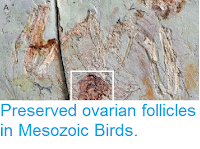
Preserved ovarian follicles in Mesozoic Birds.

The two surviving groups of Archosaurs, Crocodilians and Birds, show very different reproductive strategies.  Crocodilians have paired ovaries and produce large clutches of small eggs, which mature slowly prior to being laid, and make a relatively small investment in parental care. Birds have only a single ovary, a modification not seen in any other Amniote (Reptile or Mammal) with eggs that mature rapidly prior to being laid, smaller clutch sizes and larger eggs, and make a higher level of investment in parental care (these traits are highly variable within Birds, but there is a clear separation between the situation in Birds and the situation in Crocodilians).

In a paper published in the journal Nature on 17 March 2013, a team of scientists led by Xiaoting Zheng of the Institute of Geology and Palaeontology at Linyi University and the Shandong Tianyu Museum of Nature, reported the presence of ovarian follicles (developing eggs) in a specimen of the Early Cretaceous Bird Jeholornis. This met with some scepticism from the palaeontological community but no alternative explanation for the structures has been suggested.

In a paper published in the National Science Review on 12 December 2013, Jingmai O’Connor of the Institute of Vertebrate Palaeontology and Paleoanthropology of the Chinese Academy of Sciences, Xiaoting Zheng of the Institute of Geology and Palaeontology at Linyi University and the Shandong Tianyu Museum of Nature, Xiaoli Wang and Yan Wang, also of the Geology and Palaeontology at Linyi University and Zhonghe Zhou, also of the Institute of Vertebrate Palaeontology and Paleoanthropology of the Chinese Academy of Sciences, describe the presence of ovarian follicles in five further birds from the Johol Biota, all Enantiornithines (an extinct group of toothed Birds that dominated the Cretaceous Avian Fauna, and which are more closely related to modern Birds than Jeholornis) from the Shandong Tianyu Museum of Nature and discuss the implications of these findings for our understanding of the evolution of egg development in early Birds.

New specimen of an unnamed Enantiornithine Bird from the Jehol Biota, preserving ovarian follicles, note the specimen is preserved in dorsal view and the follicles are preserved on the left side of the body, scale bar equals 20 mm. (B) Close-up of the follicles (enlarged from white box in A), scale bar equals 5 mm. O’Connor et al (2013).

Because of the large clutch sizes and slow development of eggs in Crocodilians, a female Crocodilian, prior to laying eggs, will contain a large number of ovarian follicles of identical size. A female Bird on the other hand, will contain a smaller number of follicles, and these will be of different sizes, due to the rapid development of eggs in modern Birds. This raises questions as to when this situation developed, in the earliest birds or earlier in the Dinosaur group from which Birds evolved, or even the earliest Dinosaurs.

The presence of ovarian follicles has been reported once previously in a non-Avian Dinosaur, in a specimen of Compsognathus longipes  from the Late Jurassic of Germany. Compsognathus longipes is a Jurassic Coelurosaur placed outside (but closely related to) the Maniraptoriformes, the group of Dinosaurs from which Birds evolved, and therefore a useful species from which to make judgements about the evolution of egg development in Birds. Unfortunately the angle at which Compsognathus longipes is preserved does not allow the determination of the number of ovaries it had, however it is clear that it had a large number of follicles, and that they were similar in size, suggesting that they developed in a similar way to the eggs of modern Crocodilians.

In addition an Oviraptorosaurian Maniraptoran has previously been described from the Late Cretaceous of China, with two eggs between the pubes (i.e. in the process of being laid). This has been interpreted as evidence that the Dinosaur had two oviducts, and therefore two ovaries.

Jeholornis contains a large number of small ovarian follicles, all apparently at the same stage of development, however these follicles are all found on the left side of the body, the side where the sole ovary of modern Birds is found, suggesting that this early Bird had already lost its second ovary.

The new Entornithine specimens all appear to show a range of clutch sizes, but none appear to possess ovarian follicles at different stages of development, suggesting that this arose in the Neornithine Birds (the group that includes all living Birds), after its split from the Entornithine Birds.

From this O’Connor et al. develop the following theory on the evolution of egg development in early Birds: The Coelurosaur and Maniraptoriformes, and therefore most likely all Dinosaurs, had paired ovaries and produced large numbers of small eggs, which matured slowly inside the mother in a way similar to that seen in modern Crocodilians. The early Bird, Jeholornis, which is only slightly more advanced than Archaeopteryx, and which is thought to have been a week flier with a slow metabolism, had already lost one ovary, presumably an adaptation to weight-reduction associated with flying, but otherwise shows a similar pattern of egg development. The  more derived Entornithine Birds, a successful and diverse Cretaceous group, show a variety of reproductive strategies, as reflected in clutch sizes, but still have not developed the hierarchical development of eggs seen in modern Birds, which enables the female to hold eggs at different stages of development. Finally the Neornithine Birds show hierarchical development of eggs, a feature thought to be closely associated with having a high metabolism.

Preserved data regarding ovarian anatomy mapped over a simplified cladogram of Theropoda, with a focus on Maniraptora, the derived clade that includes Aves. Crocodylia are placed as the outgroup, and this clade and crown group birds define an extant phylogenetic bracket for interpreting the reproductive traits of Mesozoic birds and other extinct Theropods. O’Connor et al (2013).

See also….


Birds derived from small Theropod Dinosaur ancestors in the Middle Jurassic, and appear to have reached similar levels of diversity in the Cretaceous to that seen today. However the dominant group of Birds in the Cretaceous were the Enatiornithines, a group of toothed Birds related to but not ancestral to modern Birds (Ornithuromorpha), which died...


Discovered in the 1860s, Archaeopteryx had a unique combination of features, including a long, feathery tail, that marked it out as distinctive, intermediate between a Dinosaur and a Bird, which sealed Archaeopteryx's status as the First Bird. While it remained unique in this way for a


...


For a hundred and fifty years Archaeopteryx lithographica has been the earliest known bird. The first specimen (actually a single feather)...


Follow Sciency Thoughts on Facebook.

Friday, 25 April 2014

An Enatiornithine Bird from the Early Cretaceous Jehol Biota.

Birds derived from small Theropod Dinosaur ancestors in the Middle Jurassic, and appear to have reached similar levels of diversity in the Cretaceous to that seen today. However the dominant group of Birds in the Cretaceous were the Enatiornithines, a group of toothed Birds related to but not ancestral to modern Birds (Ornithuromorpha), which died out in the end Cretaceous extinction event.

In a paper published in the Journal of Vertebrate Paleontology on 8 January 2013, a team of scientists led by Jingmai O’Connor of the Dinosaur Institute of the Natural History Museum of Los Angeles County and the Key Laboratory of Evolutionary Systematics of Vertebrates of the Institute of Vertebrate Paleontology and Paleoanthroplogy of the Chinese Academy of Sciences, describe a new species of Enatiornithine Bird from the Early Cretaceous Yixian Formation in Jianchang County in Liaoning Province, China. The Yixian Formation is one of the deposits that makes up the Jehol Biota, a fossil lagerstätte in which numerous Vertebrate, Invertebrate and Plant fossils are preserved in exquisite detail in lithographic limestones, providing one of the best preserved examples of a Mesozoic ecosystem known.

The new species is named Sulcavis geeorum, where ‘Sulcavis’ is a combination of ‘sulcus’, meaning ‘groove’ and ‘avis’, meaning ‘bird’, and ‘geeorum’ honours the Gee family of La Cañada, California, ‘for their generous contributions in support of Mesozoic bird research’. Sulcavis geeorum is a ~20 cm Enatiornithine Bird preserved in ventral view on a single slab. The skeleton is almost complete and there are poorly preserved feathers around the head and upper part of the body.

(Top) Photograph of the single known specimen of Sulcavis geeorum. (Bottom) Camera lucida drawing of the single known specimen of Sulcavis geeorum. Light gray indicates areas of poor preservation; dark gray indicates matrix. Abbreviations: ce, cervical vertebrae; co, coracoid; fe, femur; fi, fibula; fu, furcula; h, humerus; il, ilium; mc, metacarpal; mc I, alular digit; mc II, major digit; mc III, minor digit; mt, metatarsals; py, pygostyle; r, radius; s, synsacrum; sc, scapula; ti, tibiotarsus; u, ulna; ul, ulnare. O’Connor et al. (2013).

Sulcavis geeorum has notably large and robust teeth, with distinctive grooves on them that give the Bird its generic name. These suggest that it was adapted to a durophagous diet (diet of tough food that needed to be broken up, such as bones, nuts or shellfish). Modern Birds rely on gastroliths (swallowed stones) to break up hard foods in a muscular organ called the gizzard before it reaches their stomach, but no Enatiornithine Bird has ever been found to have had such structures. Gastroliths have been found in Ornithuromorph Birds from the Cretaceous, as well as Sapeornithiform Birds (another extinct Mesozoic group) and several types of Dinosaur, so their absence in Enatiornithine Birds is unlikely to be preservational, particularly given the large number of these Birds known from the Jehol Biota, where feathers and soft tissues are often preserved.

Detail of skull of Sulcavis geeorum. (A) Proximal half of rostrum; (B) entire skull, right lateral view; (C), interpretative drawing. Light gray indicates areas of poor preservation; dark gray indicates matrix. Abbreviations: ang?, angular?; bo?, basioccipital; d, dentary; eo, exoccipital; fr, frontal; fm, foramen magnum; ju, postorbital process of the jugal; max, maxilla; n, nasal; oc, occipital condyle; pa, parietal; pao, paraoccipital process; pm, premaxilla; po, postorbital; scl, scleral ossicle; so, supraoccipital; sp?, splenial; sur?, surangular. O’Connor et al. (2013).

This lack of gastroliths in Enatiornithine Birds suggests that they were obliged to retain their teeth in order to work food, despite the fact that teeth are both heavy (a problem for a small flying animal) and metabolically expensive. Teeth appear to have been lost rapidly among the earliest Ornithuromorph Birds, suggesting that they no longer suffered this constraint. This may have given the Ornithuromorph Birds an evolutionary advantage over the Enatiornithine Birds, explaining while the one group was able to survive into the Cenozoic while the other perished.

See also…


Follow Sciency Thoughts on Facebook.

Wednesday, 8 January 2014

Avian footprints from the Early Cretaceous of Victoria State, Australia.

Dinosaur footprints are well documented from a number of sites around the world, and a whole branch of palaeontology (Dinosaur ichnology) is dedicated to their study. This can provide a whole range of data about these animals that would not otherwise be available, particularly with regard to their behavior and environment (finding out where something ended up after it died is not the same as finding out where it lived when it was alive). The preserved footprints of Birds (which are a form of Dinosaur), are much rarer, as Birds are smaller and lighter than other forms of Dinosaur, and in many cases move by flying or swimming rather than walking.

In a paper published in the journal Palaeontology on 25 October 2013, Anthony Martin of the Department of Environmental Studies at Emory University in Atlanta and the School of Geosciences at Monash University in Clayton, Victoria, Patricia Vickers-Rich, also of the School of Geosciences at Monash University, Thomas Rich of Museum Victoria and Michael Hall, again of the School of Geosciences at Monash University, describe three footprints from a slab eroded from a cliff at Dinosaur Cove, to the west of Cape Otway in Victoria State, Australia.

Overall view of slab recovered from Dinosaur Cove, Victoria, with circles around Track 1 (T1), Track 2 (T2) and Track 3 (T3). Arrow indicates where sample was cut and examined for sedimentological content.  Scale bar is 10 cm. Martin et al. (2013).


The three footprints are referred to as Track 1, Track 2 and Track 3. They do not appear to represent a record of movement, but rather three prints made by separate feet, two of which may come from the right and left foot of the same animal. The prints are preserved in a fine grained fluvial (river) sandstone.

Tracks one and two appear to have been made by the right and left foot of a Bird (or two Birds). They are 10.8-11.4 cm across and 10.6-10.7 cm in length, and appear to represent a narrow foot with three forward pointing claws and a reduced, backward pointing, hind claw. The prints could have been produced by a Enantiornithine (an extinct group of Mesozoic Birds with wing claws and teeth) or Ornithurine Bird (the group that comprises modern Birds and their ancestors), potentially a shorebird with a lifestyle similar to that of a Heron or Crane.

Avian track (Track 1) from Eumeralla Formation, Dinosaur Cove, Victoria. (A) Overall view of track. (B) Line drawing of track and associated pressure-release structures, with digits labelled from I to IV. Grey silhouette indicates inferred foot morphology, not the outline of the track. Thick arrow (below right) points in direction of initial foot movement before abrupt stop, and thin arrow (upper left) points in direction of movement after stop. Missing part of surface denoted by black area between digits III and IV, but fracture omitted. Scale bars are 5 cm. Martin et al. (2013).

Avian track (Track 2) 
from Eumeralla 
Formation, Dinosaur Cove, Victoria. (
A) Overall view of track. (B) Line 
drawing of track and associated 
pressure-release structures, with digits 
labelled from I to IV. Grey silhouette 
indicates inferred foot 
morphology, not of outline of the 
track. Ta = Taenidium isp., crosssection 
of invertebrate burrow. Scale 
bars are 5 cm. 
Martin et al. (2013).


The third print (Track 3) does not appear to come from a Bird. It is another right footprint, but thicker, apparently from a heavier animal and lacking a backward pointing hind toe. Martin et al. suggest that this comes from a small non-avian Theropod Dinosaur, possibly a Coelurosaur.

Theropod track (Track 3) from Eumeralla Formation, Dinosaur Cove, Victoria. (A) Overall view of track. (B) Line drawing of track and associated pressure-release structures, with digits labelled from II to IV. Grey silhouette indicates inferred foot morphology and not the outline of the track. Scale bars are 5 cm. 
Martin et al. (2013).


If the interpretation of these tracks is correct, then they represent the oldest known avian tracks in Australia, and possibly in the southern hemisphere (potential older Bird tracks in Argentina are now thought to be considerably younger, while the avian origin of others in South Africa is disputed).

See also Early Cretaceous Dinosaur footprints from Sichuan Province, China, A fossil Vulture from the Miocene of Nebraska, A new Long-tailed Bird from the Early Cretaceous of China, A fossil Bird from the Eocene of Guangdong Province China and Dinosaur footprints from the Early Cretaceous of Ganzu Province, China.

Follow Sciency Thoughts on Facebook.