Showing posts with label Dromaeosaurs. Show all posts

Saturday, 24 June 2023

Shri devi: The (previously unknown) skull of a Dromaeosaurid Dinosaur from the Late Cretaceous Baruungoyot strata of Mongolia.

The Dromaeosaurs were a group of small-to-medium sized Theropod Dinosaurs, closely related to the earliest Birds. They are noted for the presence of an enlarged and highly curved claw on their second toe, a long, straight tail formed from tightly interlocked caudal vertebrae, and the presence of feathers. The group were widespread, with numerous fossils from the Cretaceous of Asia, North and South America, and Europe, although their Bird-like, often delicate skeletons did not usually preserve well, so most species are known only from fragmentary remains. One area where more complete Dromaeosaur skeletons are more frequently found is the Djadokhta strata of the Gobi Desert, Mongolia, an area which has produced several fairly complete skeletons of the Late Cretaceous Dromaeosaur, Velociraptor mongoliensis. 

These Upper Cretaceous deposits of the Gobi desert have produced a range of other Velociraptorine Dromaeosaurs, including Adasaurus mongoliensis, Tsaagan mangas, 'Velociraptor' osmolskae, Linheraptor exquisitus, Shri devi, and Kuru kulla, although most of these are known only from a single specimen.

In a paper published in the journal Acta Paleontologica Polonica on 21 June 2023, Łukasz Czepiński of the  Institute of Palaeobiology of the Polish Academy of Sciences, describes a new Dromaeosaur specimen from the Late Cretaceous Baruungoyot strata  of the Gobi Desert, which he assigns to the species Shri devi.

The new specimen, ZPAL MgD-I/97, was collected in 1970 by a Polish-Mongolian Palaeontological Expedition, and initially described and illustrated as Velociraptor sp., then later redescribed as a specimen of Velociraptor mongoliensis. However, upon re-examination of the specimen, Czepiński disagrees with this diagnosis, noting that the skull is much less elongated than in that species.

(A) Map of Mongolia and Inner Mongolia of China with the Upper Cretaceous sites yielding remains of dromaeosaurid dinosaurs. (B) Photograph of Khulsan locality, from where the specimen described in this paper was collected, photographed in the 1970 during the Polish-Mongolian Paleontological Expeditions (from the Collections of the Institute of Palaeobiology of the Polish Academy of Sciences). Czepiński (2023).

Specimen ZPAL MgD-I/97 comprises a partial skull, including the left jugal, left lacrimal, left maxilla, fragment of the right maxilla, palatine elements, both dentaries lacking the anteriormost portions, both splenials, surangulars, and angulars, in close association with a distal portion of the left hindlimb, containing the distal parts of the left fibula and tibia, astragalus and complete pes, with four metatarsals and all phalanges. The holotype specimen of Shri devi, MPC-D 100/980, is a partial articulated skeleton including cervical, dorsal, and proximal caudal vertebrae, the right femur, the right and left tibiotarsa, and the right pes but lacking a skull, There is almost no overlap in the bones of the two specimens, with ZPAL MgD-I/97 being about 20% smaller than MPC-D 100/980, but both specimens preserve a single hind foot (left in ZPAL MgD-I/97 and right in MPC-D 100/980), and Czepiński is confident that these are similar enough to assign the two specimens to the same species.

Reconstruction of the Dromaeosaurid Dinosaur Shri devi, based on ZPAL MgD-I/97 and MPC-D 100/980. (A) Skull; missing elements reconstructed on the base of Velociraptor mongoliensis (MPC-D 100/25 and MPC-D 100/54). (B) Whole body silhouette with known remains of the holotype and referred material. Czepiński (2023).

The skull of Shri devi is apparently much shorter than in other Mongolian Dromaeosaurids, based upon the shape of the antorbital fenestra (opening in the skull in front of the eye), which is almost round in Shri devi, but elongated in most Mongolian Dromaeosaurids, despite Shri devi otherwise being very similar, and presumably closely related to, Velociraptor mongoliensis. A similar short-snouted condition is seen in many North American Dromaeosaurids, though these are not thought to be closely related to Shri devi, suggesting that this is an ecological adaptation, rather than an indicator of relatedness.

Dromaeosaurid Dinosaur Shri devi (ZPAL MgD-I/97) from the Upper Cretaceous, Khulsan, Ömnögovi, Gobi Desert, Mongolia. Photographs (A₁), (A₂), (A₄), and (A₅) and 3D model (A₃), (A₆), and (A₇) obtained from the CT scan of the left side of the skull in dorsal (A₁), medial (A₂, A₃), anterior (A₆), and lateral (A₇) views. Elements of the left palate in dorsal (A₄) and ventral (A₅) views. Right maxilla in the lateral (A₈, A₉) and anterior (A₁₀) views, with the margin of the antorbital fenestra indicated by dashed lines, and the close up of the fifth (A₁₁) and the second (A₁₂) preserved tooth in labial views showing very weakly developed denticles on the mesial carina. Right mandible in the lateral (A₁₃) and (A₁₄) and medial (A₁₅) and (A₁₆) views. (B) Explanatory drawings of the skull in left (B₁) and right (B₂) lateral views with the preserved bones (in grey). Czepiński (2023).

Most of the Dromaeosaurid Dinosaurs from Mongolia, particularly those with very long snouts, are found in palaeodesert environments, covered by aeolian sands. Both specimens of Shri devi, on the other hand, comes from a more mixed environment, with a mixture of aeolian and fluvial deposits, suggesting a wetter (though still fairly arid) environment. The available prey to a small predatory Dinosaur would appear to have been similar in both environments, including Lizards, Mammals, Protoceratopsids, Oviraptorosaurs, and Birds (larger Ankylosaurids were also present, but unlikely to have been hunted by small Dromaeosaurs), suggesting that the variation in snout length is unlikely to be related to feeding. Instead, Czepiński suggests that an elongated snout may have been related to an elongated sinus, something which would have improved thermoregulation in Dromaeosaurs living in exposed, arid environments.

See also...

Online courses in Palaeontology. 

Follow Sciency Thoughts on Facebook.

Follow Sciency Thoughts on Twitter.


Friday, 16 June 2023

Wulong bohaiensis: Iridescent plumage in a juvenile Dromaeosaur from the Jehol Biota.

Melanosomes are organelles within the cells of Vertebrates within which the pigment melanin is stored. The first fossil melanosomes were described in 2008, since when they have been recorded in a range of fossil taxa, with the different shape of different melanosomes being used to make inferences about the colour of a variety of extinct Animals. One notable group to which this methodology has been applied is Mesozoic Birds, enabling palaeontologists to determine that some of the remarkable colouration, and therefore presumably colour-related behaviour, seen in modern Birds was already present in the Mesozoic. 

One notable feature found in the plumage of a variety of Bird groups today is iridescence, a visual effect achieved by the coherent scattering of light at certain frequencies as it passes through the barbules of feathers, where layers of specially modified melanosomes are present. This works because melanin and keratin have different refractive indexes to both one-another and to air, enabling the bending of light at certain wavelengths in consistent ways. This is sometimes used to aid the camouflaging effect of the Bird's plumage, as in the case of the iridescent green plumage on the backs of Hummingbirds, it is more commonly used in displays and signalling between Birds.

Iridescence and plumage colour has been determined for a number of ancient Bird species, but feathers are also known in non-Avian Dinosaurs, with the most famous examples being the Jehol Biota from the Early Cretaceous of northeastern China, where a very large number of feathered Dinosaurs have been found. The feathers of these Jehol Dinosaurs are generally considered to be too modified by burial compression and thermal alteration, as well as oxidation after exposure, which has largely removed the kerogen matrix from which the fossils are made, leaving the majority of the fossils as (very detailed) rock impressions. This might seem to be an obstacle to the reconstruction of colour and iridescence in these fossils, but much of the work that has been done with fossil melanosomes has been based upon the shape of these structures, rather than their chemistry, which has allowed for the reconstruction of both non-iridescent structural colouration and iridescence in the plumage of Enatornithine Birds and non-Avian Paravian Dinosaurs (the Paravia is the group that includes Birds, Dromaeosaurs, and Troodontids).

All known iridescent nanostructures within feathers are found within the barbules (filaments projecting from the barbs of feathers), structures which appeared in early Maniraptorans (the group which includes Alvarezsaurs, Therizinosaurs, Oviraptosaurs, and Paravians), and to have been refined within the Paravians, and the presence of iridescence in a variety of Paravians could imply that the appearance of barbules may have been linked to iridescence.

It is highly likely that colouration has played an important role in the evolution of Birds and their ecology, and that the accumulating body of data on melanosomes in early Birds might provide insight into this. However, if non-Avian Paravians also had pigmented and iridescent plumage, then their evolution and ecology is equally likely to have been influenced by this. At the moment we have very little information on the colouration of these Dinosaurs, but potentially, if it can be collected, it may be possible to tell how their colouration changed as they reached maturity, and if their colouration was sexually dimorphic. To do this for any species of Dinosaur, a large dataset would be necessary, with numerous specimens with preserved feathers, reflecting both sexes and a range of ages. 

In a paper published in the journal Acta Palaeontologica Polonica on 13 June 2023, Angus Croudace of the School of Geosciences at the University of Edinburgh, Caizhi Shen of the Dalian Natural History Museum, Junchang Lü of the Institute of Geology of the Chinese Academy of Geological Sciences, Stephen Brusatte, also of the School of Geosciences at the University of Edinburgh, and Jakob Vinther of the School of Earth Sciences at the University of Bristol, reconstruct the plumage colouration of a specimen, DNHM D2933, of Wulong bohaiensis, an Early Cretaceous feathered Microraptorine Dromaeosaurid from the Jehol Biota of Liaoning, China.

Previous studies of the skeleton of DNHM D2933 have determined that it was a juvenile, about one year old when it died and still growing, making it the first juvenile non-Avian Dinosaur to have the colour of its plumage determined, as far as Croudace et al. are aware.  In order to determine the colouration, and iridescence, of the specimen, Croudace et al. used a statistical approach to the determining of the purpose of preserved melanosomes from different parts of the body. This works because different coloured melanosomes are known to be different in shape. Eumelanin-rich melanosomes are large and oblate and produce black colours, while pheomelanin-rich melanosomes are smaller and more ovoid, producing ginger or brown colours. Iridescent melanosomes are typically hollow or flat.

Dromaeosaurid Dinosaur Wulong bohaiensis (DNHM D2933), from Shangheshou, Chaoyang, Liaoning, China, Early Cretaceous Jiufotang Formation with a minimum age of 120.3 million years (A₁). Samples 1–16 were labelled by Stephen Brusatte while taking samples at the museum. Illustration by Jakob Vinther (A₂) to show distinct plumage groupings on Wulong bohaiensis (DNHM D2933). For clarity, in this illustration only the samples with successful melanosome preservation are labelled. Preservation on each of the excluded samples was not sufficient for study. Croudace et al. (2023).

Samples from DNHM D2933 were examined under a scanning electron microscope from several angles in order to establish the measurements of individual melanosomes. Since these 'melanosomes' are impressions rather than the original structures, it is impossible to determine whether-or-not they were hollow in life. However, the majority of the melanosomes observed appear to be to narrow to have been hollow. The density with which the melanosomes were packed, which has an effect on colour intensity, was not assessed.

Preserved melanosome imprints characteristic of each sample from the Dromaeosaurid Dinosaur Wulong bohaiensis (DNHM D9233) from Shangheshou, Chaoyang, Liaoning, China, Early Cretaceous Jiufotang Formation with a minimum age of 120.3 million years. All melanosome imprints are from solid and cylindrical melanosomes. Preservation on samples 7 and 14 is less clear. Three distinctive types of melanosome morphology were found on sample 15. Each was measured separately and treated as different samples for analysis (15a/15b/15c). Croudace et al. (2023).

Different types of melanosomes were observed on different parts of the body of the Dinosaur, enabling Croudace et al. to build up a picture of the distribution of colours its plumage, by comparison to a database of melanosomes from the plumage of modern Birds. Based upon this, Wulong bohaiensis is presumed to have been largely grey in colour, with patches of highly iridescent feathers on its forelimb and hindlimb remiges. 

Reconstruction of the Dromaeosaurid Dinosaur Wulong bohaiensis (DNHM D2933), from Shangheshou, Chaoyang, Liaoning, China, Early Cretaceous Jiufotang Formation with a minimum age of 120.3 million years. This illustration broadly depicts iridescent plumage on the limbs and grey feathers on the body. It should be noted that the full extent of the iridescence has been extrapolated in the creation of this illustration, based on the evidence provided by a small but significant distribution of iridescent samples across several limbs of the fossil. Robert Nicholls in Croudace et al. (2023).

Wulong bohaiensis is the fifth non-avian Paravian Dinosaur in which iridescence has been described (the others being Microraptor, Caihong, Bohaiornis, and Eoconfuciusornis) and the first juvenile. Two previously described species, Microraptor and Caihong, have also had the colour of their plumage determined, with both thought to be predominantly black.

The presence of iridescence in the feathers of non-Avian Dinosaurs lends support to the proposal that feathers evolved before flight, and originally had a quite different purpose, such as signalling, being later co-opted as flying aids. However, it is possible that the common ancestor of the Paravians was at least partially airborne, and that feathers were later co-opted for signalling in different groups. 

Feathers in modern Birds play a variety of roles, with signalling to other members of their species being important. In many modern Birds, iridescence plays an important part of such behaviour, often playing a role in courtship rituals. However, in such species, iridescence is typically only present in adults of reproductive age, not juveniles or subadults. DNHM D2933 is assessed to be a juvenile Dromaeosaur, about a year old, but still with some growing to do. In some Animals, reproduction can occur before the maximum size is reached, though in modern Birds of comparable size to Wulong bohaiensis, the best available analogue for reproductive behaviour, reproduction does typically occur until the individual is several years old, despite the fact that modern Birds typically reach their full size during their first year of life. This makes it unlikely that DNHM D2933 was reproductively active, and therefore unlikely that its iridescence was linked to mating behaviour. Some modern Birds, notably Corvids, develop iridescent feathers before reaching reproductive age. In these Birds, iridescence appears to be linked to the ability to recognise members of their own species, often as individuals (Corvids typically have quite complex social lives).

See also...


Online courses in Palaeontology. 

Follow Sciency Thoughts on Facebook.

Follow Sciency Thoughts on Twitter.


Thursday, 22 December 2022

Microraptor zhaoianus: The stomach contents of a small Dromaeosaurid Dinosaur, and the implications for this on its diet and ecology.

Determining the diets of extinct Animals is remarkably problematic, and can generally only be accomplished where clearly identifiable feeding traces or stomach contents can be found. Even where Animals thought likely to be predatory are found in close proximity to those thought likely to be their prey, it is impossible to state with any confidence that this reflects the behaviour of the living Animals, and is not a postmortem association. Stomach contents are only very rarely preserved, and then only at sites with exceptional fossil preservation, meaning that most known examples come from a very small number of locations. Furthermore, the stomach contents of an Animal can usually only tell us what it has consumed, and provides little information about its wider behaviour. We cannot, for example assume that an Animal directly hunted another species based upon its stomach contents, as almost all carnivorous Animals will consume carrion given the opportunity.

Theropod Dinosaurs are generally assumed to have hunted prey smaller than themselves. This is true of most modern Mammals, Birds and Crocodilians. Other than Mustelids, which regularly hunt prey larger than themselves, predatory Mammals generally hunt large prey only when in packs, so that the total mass of the predators outstrips that of the prey, even if the individuals do not. Large Theropods are likely to have mostly hunted other Dinosaurs, as these would have represented most of the large prey available in their environments. Small Theropods, on the other hand, are likely to have had a much wider range of suitably sized prey, including even smaller Dinosaurs, Lizards, small Amphibians, small Mammals, Arthropods, and Molluscs, and are likely to have fed on all of these. 

Very few Dinosaurs have more than one specimen known with preserved stomach contents, giving us a very limited conception of their diet. However, the small Early Cretaceous Dromaeosaurid Microraptor has four known individuals with preserved stomach contents, providing the opportunity for an analysis of its diet not really possible for any other Dinosaur. Individuals of Microraptor have previously been shown to have consumed a Bird, a Lizard, and a Fish.

In a paper published in the Journal of Vertebrate Paleontology on 20 December 2022, David Hone of the School of Biological and Behavioural Sciences at Queen Mary University of London, Alexander Decechhi of the Division of Natural Sciences at Mount Marty College, Corwin Sullivan of the Department of Biological Sciences at the University of Alberta, and the Philip J. Currie Dinosaur Museum, Xu Xing of the Key Laboratory of Vertebrate Evolution and Human Origins at the Institute of Vertebrate Paleontology and Paleoanthropology of the Chinese Academy of Sciences, and Hans Larsson of the Redpath Museum at McGill University, describe the stomach contents of the fourth specimen of Microraptor in which this is known, the holotype of Microraptor zhaoianus, and discuss the implications of this for our understanding of the diet of the species.

The specimen, IVPP V 12330, is a compression fossil broken into a number of fragments, with most of the part and counterpart present, showing the incomplete but articulated skeleton of the small Dinosaur. The abdominal and thoracic cavities show no signs of having been ruptured, and, visible within the rib-cage of the Animal, is the articulated pes (foot) of a small Mammal. This visibly overlies the ribs of the left side of the thoracic cavity, and is in turn overlain by the ribs of the right side. The visible part of the foot includes ll tarsals and metatarsals and most phalanges,including unguals of digits I and probably III. A number of long bones are also present, beneath and beside the pes, which hint that more of the Mammal might be present but obscured.

Holotype specimen of Microraptor zhaoianus (IVPP V12330) with Mammal foot gut contents. (A) Entire specimen. Box inset indicates the location of (B) and (C). (B) Close-up view of Mammal foot. (C) Illustration of visible bones: dark gray elements are Microtaptor ribs, yellow bones are the articulated Mammalian foot and light gray are unidentified bones. Note the juxtaposition of the foot over the inside of the left ribs and the overlap of the right ribs over the foot, particularly over digits II and III. Abbreviations: ast, astragalus; cal, calcaneum; mtI, metatarsal 1; nav, navicular; lr, left rib; rr, right rib. Scale bar in (A) equals 100 mm and in (B) and (C) equals 5 mm. Hone et al. (2022).
The phalanges of the foot are slender, resembling those of the Early Cretaceous Mammals Eomaia and Sinodelphys, both of which come from the same deposits as Microraptor. However, they are neither as elongate nor as curved as seen in these species, suggesting that this is another, unknown, Mammal, and that it was a primarily ground dwelling species (Eomaia and Sinodelphys are both thought to have been arboreal in nature).

The first digit is 8.1 mm in length excluding the ungual (claw), or 9 mm in length if the ungual is included. This is roughly equivalent to those of Sinodelphys, Yanoconodon, and Eomaia, and may therefore indicate an Animal of similar size, although if this Mammal did have a different ecological role, then the possible size bracket can be expanded somewhat. Nevertheless, Hone et al. estimate a size in the range 13-43 g (the range that includes most modern Mice, Voles, and Shrews).

Numerous examples of Microraptor have been recovered from the beds which make up the Jehol Biota, and many studies have been done on this Dinosaur's ecology. Nevertheless, considerable controversy remains about the lifestyle of Microraptor, with different researchers having suggested that it might be nocturnal, diurnal, capable of gliding flight, capable of powered flight, arboreal in habit, and terrestrial in habit. What is generally accepted is that Microraptor was capable of some-sort of areal locomotion, and probably able to climb reasonably well (although there is considerable doubt as to whether it was capable of living in arboreal environments with small-diameter branches, an environment which the only non-Avian Theropods thought likely to have colonised are the Scansoriopterygians. 

Over 300 specimens of Microraptor are known, which have been divided into three separate species, of different sizes and with slightly different anatomical traits, although it is still possible that this represents different growth stages and variability within a single species. Whatever the taxonomic implications, this physical variation probably represents a degree of ecological difference between the morphotypes, which may indicate differences in diet. The four specimens of Microraptor for which stomach contents are known belong to two different species, Microraptor zhaoianus, of which a previous specimen was shown to have consumed a Lizard, while Hone et al.'s study shows consumption of a small, terrestrial, Mammal, and Microraptor gui, in which two specimens have been shown to have consumed a Fish, and a small Bird, respectively. This may, therefore, represent two different species with slightly different dietary habits, but is also likely just to represent a degree of flexibility in feeding habits.

Most modern predators take food items considerably smaller than themselves, and this is unlikely to have been different in the Early Cretaceous. With the exception of Mustelids, modern Mammals of 21 kg or less typically target prey no more than 40% of their own size. This rule appears to be applicable to Microraptor, with all four specimens with stomach contents having consumed Animals significantly smaller themselves. The Bird known from the stomach contents of a specimen of Microraptor gui had an ulna length of 10.5 mm, while the ulna of the Dinosaur that had eaten it was 80 mm long. The Lizard eaten by a specimen of Microraptor zhaoianus had femur 13.4 mm long, while its consumer's was 75 mm in length. The Fish appears to have been of a similar proportion to the Dinosaur which ate it, based upon rib size, while Hone et al. estimate that the small Mammal from their study was about 10% of the size of the Microraptor.

Any consideration of the diet of an Animal should also take into account its jaw morphology. Typically, Vertebrates with shorter, more robust jaws tend to consume larger prey, which needs to be subdued and processed before consumption, whereas those with longer jaws tend to consume smaller prey, with an emphasis on shovelling down as many prey items as quickly as possible. 

This principle has previously been applied to the Eudromaeosauria, with the group found to split conveniently into three clusters, species with short deep jaws, such as Deinonychus and Atrociraptor, species with intermediate-lengthed jaws, such as Achillobator, Saurornitholestes, Bambiraptor, and Acheroraptor, and long-snouted forms such as Linheraptor, Tsaagan, and Velociraptor. Interestingly, all of the species known to have short jaws are from North America, as are most of those with intermediate jaws, while most of the long-jawed species are Asian, although, with the jaws of many species unknown or known only from fragmentary remains, it is unclear how significant this is.

While many specimens of Microraptor are known, it has proven hard to fit it into this matrix, as in the majority of specimens both maxillae are absent, unexposed, damaged, or difficult to fully demarcate from adjacent bones. However, two specimens, BMNHC PH881 and IVPP V 13475, both identified as Microraptor sp., have maxillae which appear to fit into the intermediate group, possible suggesting prey fairly easy to seize, but requiring some force to subdue. Since Microraptor is itself a small Animal, probably massing under 1 kg, Mouse-sized Mammals and similar small Vertebrates would seem to fit into this category, while most Insects would be too small.

The Mammal consumed by Microraptor IVPP V 12330 is thought to have been ground dwelling, and about the right size for the presumed prey of Microraptor, which is itself also thought to have been ground dwelling. This would seem, at first sight, to be fairly good evidence for Microraptor having predated this Mammal. However, Hone et al. caution against making such an assumption, observing that almost all carnivorous Animals will consume carrion if it is available, rather than hunting, and that, therefore, an Animal having consumed another Animal cannot be taken as direct evidence of a predator-prey relationship.

Hone et al. also not that, while Dromaeosaurs are generally assumed to have been capable of swallowing quite large items, all of the known stomach contents of Microraptor have been quite small, in this case the foot only of a Mammal, which is a low-nutrition part of the body, and generally among the last parts consumed. This makes it quite conceivable that the majority of the Mammal might have been consumed by another Animal, with the Microraptor, subsequently consuming an overlooked portion of the carcass. 

It has previously been suggested that Microraptor might have been capable of actively hunting small Birds in the treetops, based upon the presence of a partial wing and both feet of an Enantiornithine Bird within the body cavity of another specimen. However, these are again low nutrition parts of the body, likely to have been left by another Animal eating the majority of the Bird. What remains of the wing, and the feet, are themselves articulated, appears to suggest that Microraptor was incapable of any further processing of its food; either tearing these pieces of a carcass then swallowing them, or finding them left behind after the majority of the Bird has been eaten by something else. Whichever is the case, the specimen does not seem to be, in itself, sufficient evidence to claim Microraptor was able to hunt small Birds. Even if the Bird could be assumed to have been killed and then consumed by the Dinosaur, this does not indicate that the predation event took place above the ground. Even the most arboreal of modern Birds spends a considerable amount of time on the ground, and many modern predators, such as Hyenas, Cheetahs, and Foxes, hunt them there.

The presence of a Fish in within the body cavity of Microraptor specimen has also been taken as evidence of direct predation on Fish, within an aquatic environment, although in that case scavenging was not ruled out. 

Hone et al. note that the suggestion that Microraptor was capable of hunting both in the treetops and in the water as highly dubious, noting that modern Animals which can do this tend to be very specialist predators, something that there is no evidence for in the case of Microraptor. They caution that such stories are attractive, but are not supported by the evidence, and that the presence of a wide range of consumed Animals within the stomach contents of a species is probably more indicative of it being a generalist scavenger that a specialist hunter.

The range of Animals now known to have been consumed by Microraptor is wider than for any other known non-Avian Theropod, although this is clearly related to the fact that more specimens with stomach contents are known than for any other Dinosaur. However, the assumption that Microraptor, whilst probably capable of hunting, would consume a wide range of Animals opportunistically, is probably also true for most Theropods. Furthermore, most Theropods are thought likely to have changed the Animals they consumed quite significantly over their long growth-cycles, and it is likely that members of the same species in different regions would have consumed different food items, and that individuals would have consumed different items at different times of year, all of which would have favoured a more generalist approach to feeding. Insects and other Invertebrates are likely to have made up a proportion of the diet of the smallest Theropods. These have never been found in any stomach contents, but this is probably reflective of their low preservation potential rather than their not being consumed.

Specimen IVPP V 12330, the holotype of Microraptor zhaoianus, provides direct evidence of the direct consumption of a Mammal by Microraptor, only the second time this has been demonstrated for a non-Avian Dinosaur. However, this does not provide evidence of a direct predation event, but rather adds to the mounting evidence that Microraptor was a generalist carnivore, largely eating small Vertebrates, but not necessarily hunting them.

See also...

Online courses in Palaeontology. 

Follow Sciency Thoughts on Facebook.

Follow Sciency Thoughts on Twitter.


Sunday, 29 March 2020

Dineobellator notohesperus: A new species of Dromaeosaurid Dinosaur from the Latest Cretaceous of New Mexico.

Dromaeosaurids have been found in North America from the Early to Late Cretaceous, from as far west as Alaska to as far east as Maryland. However, their fossil record is very poor near the time of their extinction prior to the Cretaceous-Palaeogene boundary in North America. Several taxa are known from the Late Cretaceous, but almost all are from the Campanian (83.6-72.1 million years ago). Recently, two taxa, Acheroraptor temertyorum and Dakotaraptor steini, were named from the Maastrichtian (Latest Cretaceous, 72.1-66.0 million years ago) Hell Creek Formation, but, aside from these two skeletal fossil specimens, non-tooth material of Maastrichtian taxa is rare. Although isolated Dromaeosaurid teeth are somewhat common in Late Cretaceous strata of North America, these teeth reveal little ecological information about this group.

In a paper published in the journal Scientific Reports on 26 March 2020, Steven Jasinski of the Department of Earth and Environmental Science at the University of Pennsylvania, the Section of Paleontology and Geology at the State Museum of Pennsylvania, and the Don Sundquist Center of Excellence in Paleontology, Robert Sullivan of the New Mexico Museum of Natural History and Science, and Peter Dodson of the School of Veterinary Science, University of Pennsylvania, describe a new species of Dromaeosaurid from the Maastrichtian Ojo Alamo Formation of the San Juan Basin in New Mexico.

The new species is named Dineobellator notohesperus, where 'Dineobellator' is derived from 'Diné', the Navajo word in reference to the people of the Navajo Nation, and the Latin suffix '-bellator', meaning warrior, and 'notohesperus' comes from 'noto-' from the Greek, meaning southern, or south; and the '-hesper' meaning western, in reference to the American Southwest. The species is described from a partial disarticulated skeleton, comprising of a rostromedial portion of right premaxilla, a left maxilla fragment, a ?maxillary tooth, the dorsolateral process of the left lacrimal, the a ?nasal fragment, an incomplete right jugal, an incomplete right basipterygoid, an incomplete occipital condyle, some isolated prezygopophyses, some isolated vertebral processes, caudal vertebra 1, a middle caudal vertebra, four fused distal caudal vertebrae, several vertebral fragments, a nearly complete rib and some rib fragments, a nearly complete right humerus, a nearly complete right ulna, an incomplete right metacarpal III, a nearly complete right manual ungual II, an incomplete right femur, incomplete right metatarsals I, II and III, an incomplete left ?astragalus, a nearly complete right pedal ungual III, and various other cranial and post-cranial bone fragments.

Selected elements and features of the holotype of Dineobellator notohesperus (SMP VP-2430), including: right humerus, posterior (A) view; right ulna, medial (B) view; close up of ulna showing feathers where ulnar papillae are located along the ulnar ridge, feathers used are from a Western Screach Owl, Megascops kennicottii (C); middle caudal vertebra (D), (E), distal (D) and (E) lateroventral (E) views, with red highlighting circular indent on centrum surface; tooth, lateral (F) view; magnification of distal basal denticles (G); anterior caudal vertebra 1, right lateral (H) view; right manual ungual II (I–L), lateral (I) view, silhouette of transverse plane of right manual ungual II near distal end (J), medial (K) view, and with area shown in dashed box in (K) highlighting abnormal oblong concavity in red (L); right pedal ungual III, partially reconstructed, lateral (M) view. Abbreviations: cc, central concavity; dc, deltopectoral crest; eg, digital extensor groove; ft, flexor tubercle; ld, latissimus dorsi scar; lg, lateral groove; mc, medial crest; mg, medial groove; na, neural arch; ns, neural spine; op, olecranon process; tp, transverse process. Scale bars, 1 cm for (A)–(E) and (H)–(M), 1 mm for (F), (G). (L) not to scale. Jasinski et al. (2020).

The type specimen of Dineobellator notohesperus (SMP VP-2430) is an animal similar in size to Velociraptor and Saurornitholestes, based on the similar sizes of comparable elements. A few small fragments of SMP VP-2430 are from the skull of Dineobellator notohesperus. A rostromedial portion of the right premaxilla is preserved without teeth, but with portions of two alveoli. The alveoli are relatively inconspicuous and closely spaced. A subrectangular fragment of the left maxilla is preserved with two partial alveoli. The dorsolateral process of the left lacrimal is subtriangular with a rounded point laterally, a conspicuous lacrimal fenestra, and is similar to those in other Dromaeosaurids. Another subrectangular fragment, this one of the left nasal, has an enlarged medial sutural surface and a flat dorsal surface. A flat, trapezoidal portion of the right jugal is slightly curved laterally toward its rostral and caudal ends, suggesting a relatively deep jugal. The braincase is incomplete with only the condylar portion of the basioccipital preserved. The caudal portion of the braincase is subcircular and obliquely twisted. The right basipterygoid process of the basisphenoid is prominent medially and externally, directed caudodorsally, and possesses a thin canal internally, inferred to represent a neurovascular groove, as for the palatine ramus of the facial nerve amd palatine artery. The right basal tuber is robust but incomplete medially. Its rostral edge is directed rostrolaterally with a deep U-shaped notch between the processes. Portions of the carotid canal are present on the medial edge of the basipterygoid recess and run rostrocaudally. Ventrally, the ovoid opening for the carotid canal is 6.5 mm long.

Skeletal reconstruction of Dineobellator notohesperus, SMP VP-2430, with known elements colored in white. Figured bones are as follows: fused distal caudal vertebra (A); middle caudal vertebra (B); caudal vertebra 1 (C); right femur (D); rib (E); right basipterygoid (F); left lacrimal (reversed) (G); right jugal (H); right humerus (I); right ulna (J); right metacarpal III (K); right manual ungual II (L); right metatarsal II (M); right metatarsal III. (N) Individual scale bars are 2 cm. Jasinski et al. (2020).

The distinct offset nature of the longitudinal grooves of the manual ungual are often found on the pedal unguals of several Dromaeosaurid taxa and are barely offset in the manual ungual in one other taxon (Boreonykus certekorum), but not in other Dromaeosaurids. The distinct dorsomedial groove proximally near the articulation surface is not seen in other Dromaeosaurid taxa. The flattened proximal edge of the humerus of Dineobellator is distinct from the sigmoidal shape in other Dromaeosaurids (e.g., Saurornitholestes, Bambiraptor, Deinonychus). The sharp, acutely angled curvature of the distal portion of the deltopectoral crest is unique among Dromaeosaurids, although it is less smooth in Deinonychus. The deltopectoral crest is relatively larger in Dineobellator (estimated 31% of total humeral length in Dineobellator compared to other Dromaeosaurids with preserved humeri; e.g., 20.5% in Bambiraptor feinborgorum, 23.5% in Dakotaraptor steini, 25% in Saurornitholestes langstoni, and 28% in Deinonychus antirrhopus). In other Dromaeosaurids, proximal caudal vertebrae are acoelous or amphiplatyan.

The opisthocoelous proximal caudal vertebrae of Dineobellator are unknown in other Dromaeosaurids, although they have been found in the Caenagnathid Theropod Gigantoraptor erlianensis. The ventral surface of the proximal caudal is curved ventrally, while those of other Dromaeosaurids (e.g., Deinonychus) are angled, but not curved, in lateral view. The transverse processes of the proximal caudal vertebra I is subrectangular, distinct from Deinonychus where they are subtriangular and Velociraptor where they are enlarged and fan out distally. The centrum surfaces, particularly on the posterior (caudal) end, are distinctly oval to subrectangular in Dineobellator rather than rounded as in other Dromaeosaurids. The subcircular concavities on the cranial and caudal surfaces of the centra of the mid-caudal vertebrae are symmetrical and not seen in other Dromaeosaurid caudal vertebrae. While the flexor tubercle is smaller in the pedal ungual than in the manual ungual, it is still enlarged compared to those of other Dromaeosaurid taxa (e.g., Bambiraptor, Deinonychus, Utahraptor), and most similar in relative size to Dakotaraptor pedal unguals. Additionally, the smaller secondary grooves ventral to the main lateral grooves on the pedal ungual are unique among dromaeosaurids. While the late Campanian Saurornitholestes sullivani is from the older Kirtland Formation (De-na-zin Member) of the San Juan Basin, it lacks corresponding elements that would permit comparison. However, isolated Dromaeosaurid teeth from the De-na-zin Member have been collected, and these differ from those of Dineobellator. Teeth of Saurornitholestes sullivani are gently curved, have slightly apically hooked denticles, less dense denticles (14–15 denticles per 5 mm compared to 18–20 in Dineobellator), and possess mesial denticles. It is also noted that one of the diagnostic features of Saurornitholestes langstoni are distal denticles that are strongly hooked apically. Additionally, the maxillary and dentary teeth of Saurornitholestes langstoni are vertical and perpendicular to the alveolar margin and possess mesial carinae (although these tend to be mainly or completely proximal on the teeth) that are distinctly smaller than distal carinae.

Dineobellator notohesperus represents the most complete Theropod skeleton recovered from the late Maastrichtian Naashoibito Member and one of the most complete Dromaeosaurids from the Maastrichtian of North America. Dineobellator co-existed with numerous other theropods, including Caenagnathids, Ornithomimids, Troodontids, and Tyrannosaurids. The presence of Dineobellator suggests that Dromaeosaurid Dinosaurs continued to diversify into the late Maastrichtian. Because these taxa do not form a monophyletic clade, multiple lineages of Dromaeosaurids are inferred to have been present during Campanian and Maastrichtian time, including at least two in the northern and one in the southern reaches of Laramidia. These lineages followed distinct evolutionary paths, while presumably filling similar ecological niches in their respective ecosystems. Jasinski et al.'s phylogenetic analysis suggests potentially at least four lineages during the Campanian, and at least two to three remaining into the Maastrichtian in North America. The recovery of Dineobellator as a second Maastrichtian North American Velociraptorine further suggests vicariance in this group after a dispersal from Asian ancestors. 

Time-calibrated phylogeny of Dromaeosaurid relationships illustrating the major relationships within the family including their paleobiogeography. Strict consensus phylogenetic tree resulting in 32 most parsimonious trees, each with a tree length of 416 steps, a Consistency Index of 0.466, and a Retention Index of 0.640. Archaeopteryx is the outgroup. Temporal positions and biogeographic locations of dromaeosaurid taxa are provided. Silhouettes are taken from phylopic.org. Jasinski et al. (2020).

For nearly a century, since the recognition of the early late Campanian Dromaeosaurus albertensis, only indeterminate teeth and fragmentary Dromaeosaurid remains had been recovered from Maastrichtian age strata in North America. However, recently, the first diagnostic late Maastrichtian North American Dromaeosaurid, Acheroraptor temertyorum, consisting of a nearly complete right maxilla and potentially associated, nearly complete left dentary, was described from the from the Hell Creek Formation of Montana. Soon after, a second Dromaeosaurid, Dakotaraptor steini, was named from the Hell Creek Formation of South Dakota based on material from a larger individual and represented by portions of the fore- and hindlimbs and axial skeleton. It is noted that Dakotaraptor is likely a chimera and portions of the described skeleton have already been shown to not represent a Dromaeosaurid, namely with the 'furcula' reidentified as part of a Turtle plastron. Dineobellator notohesperus represents the first diagnostic Dromaeosaurid known from the Maastrichtian of southern North America, and only the third late Maastrichtian Dromaeosaurid known from North America.

Some aspects of the palaeobiology of Dineobellator, including its inferred behavior, can be hypothesized based on morphological evidence. The deltopectoral crest of the humerus is the attachment site for several muscles in the forelimb. The brachialis muscle, which originates on the distal edge of the deltopectoral crest, would aid in the flexion of the forearm in Dineobellator. Enlarging the distal portion of the crest would result in the enlargement of the origin of this muscle. The change in the angle of the distal portion of the deltopectoral crest may have also allowed for the origin of the m. brachialis to shift, creating a more parallel orientation for the muscle in relation to the long axis of the radius and ulna. This orientation could have resulted in lower muscular forces necessary for flexion of the forearm, and similar or larger muscle sizes based on the enlarged deltopectoral crest could have provided greater strength capabilities of this movement. The enlarged dorsomedial groove on the manual ungual suggests larger digital extensors (the extensor digitorum brevis muscle). This could be counteracted by tighter grip strength of the manus, as evidenced by the enlarged flexor tubercle on the manual ungual relative to other Dromaeosaurids (the flexor tubercle is approximately 93% of the height of the articular surface in Dineobellator), including those of Microraptor (56%), Bambiraptor (55%), Deinonychus (55%), Boreonykus (60%), and Velociraptor mongoliensis (77%). This tighter grip strength is also seen in the hindfeet relative to other Eudromaeosaurs (67% in Dineobellator, 50% in Dakotaraptor, 40% in Utahraptor, 36% in Deinonychus, 30% in Dromaeosaurus, 22% in Boreonykus, 20% in Velociraptor mongoliensis, and 17% in Bambiraptor). 

The possession of opisthocoelous proximal caudal vertebrae may have allowed more mobility and range of movement near the base, while keeping the rest of the tail stiff could allow it to act as a rudder or counterweight. This may have increased the agility of Dineobellator and thus may have implications for its predatory behavior, particularly with respect to the pursuit of prey.

A gouge and depression on the manual ungual are inferred to be the result of an external force from a single event. These features are only present on the medial side of the ungual suggesting it is not due to postmortem deformation. They do not appear to be the result of an infection or disease causing a pathology. The absence of remodeling or retexturing of the bone suggests external trauma caused these features, and that the inflicted trauma that resulted in these marks occurred close to, or at, the time of death. The size of this groove is consistent with the morphology of the ungual of an animal of similar size to SMP VP-2430. Jasinski et al. speculate an altercation with another Dineobellator or other predatory Theropod resulted in these marks. Additionally, there is a deformed and remodeled rib, suggesting a break that healed, indicating that the animal survived for a while after suffering the injury. More evidence is needed to confirm or refute these features as pathologic features.

Several Dromaeosaurid taxa have been found to possess feathers, or feather-like structures, such as the Barremian–early Aptian Changyuraptor, the Aptian Sinornithosaurus, Zhenyuanlong, and Wulong, and the Albian Microraptor. Some of these also possess feathers on their hindlimbs and most are confined to smaller body sizes and classified within Microraptorinae, although Zhenyuanlong is larger than the others and has recently been recovered as the sister taxon to Microraptorinae plus Eudromaeosauria. In addition to exceptional preservation leading to the discovery of feathers in Theropods, some taxa have been found with structures similar to the quill knobs (or ulnar papillae) in extant Birds. Among these taxa are the Campanian Asian Velociraptorine Velociraptor mongoliensis and the Maastrichtian North American Dromaeosaurine Dakotaraptor. The discovery of ulnar papillae in Dineobellator adds a third member of Eudromaeosauria to this group. With approximately 12–14 secondary feathers, based on the number of quill knobs, Dineobellator is similar to that of Velociraptor mongoliensis having 14 secondaries and lies between the estimates for the Maastrichtian Rahonavis (10 secondaries), the Tithonian Archaeopteryx (12 or more secondaries) and the Albian Microraptor (18 secondaries). The presence of quill knobs in Dineobellator provides further evidence for feathers throughout Dromaeosauridae, which have been documented in the three major clades, and from the Barremian through the Maastrichtian. It seems likely that feathers were present in the earliest Dromaeosaurids, and potentially all members thereafter, based on the widespread occurrence of quill knobs and feathers in Microraptorines. Their presence in non-volant Dromaeosaurids of varying sizes further supports the notion that these feathers did not evolve exclusively for flight. While there have been suggestions of the winged forelimbs being used for stabilization during predatory attack, this would have been less important for larger-bodied taxa such as Dakotaraptor. It has been shown that coloration and patterns highly discernible within taxa may not have the same effect on prey. This implies that feathers can act as bright markers, species-recognition markers, and/or sexual display features without being visual signals that call attention of predators or prey. Modern Raptorial Birds show that colour patterns can still be intricate and serve to both camouflage the predator and be part of the sexual selection process, and similar feather styles may have been present in Dromaeosaurids.

While North American Dromaeosaurids are known from the Barremian by multiple taxa (Yurgovuchia and Utahraptor), following Deinonychus in the early Albian there is a significant hiatus in their fossil record. This hiatus (or gap) lasts until the middle to late Campanian with the appearance of Dromaeosaurus. This approximately 30-million-year hiatus may be due, in part, to bias (e.g., preservational, collecting, sampling) against small and rarer taxa, making it difficult to determine if their absence is real or an artefact of the fossil record. Any Dromaeosaurids from this hiatus would be of extreme importance in understanding their evolution.

See also...

https://sciencythoughts.blogspot.com/2016/02/boreonykus-certekorum-new-species-of.htmlhttps://sciencythoughts.blogspot.com/2015/12/partial-dromaeosaur-remains-from-early.html
https://sciencythoughts.blogspot.com/2015/10/dakotaraptor-steini-giant-feathered.htmlhttps://sciencythoughts.blogspot.com/2015/07/zhenyuanlong-suni-large-feathered.html
https://sciencythoughts.blogspot.com/2015/05/saurornitholestes-sullivani-new-species.htmlhttps://sciencythoughts.blogspot.com/2015/01/a-new-specimen-of-microraptor-from.html
Follow Sciency Thoughts on Facebook.

Wednesday, 24 February 2016

Boreonykus certekorum: A new species of Velociraptorine Dromaeosaur from the Late Cretaceous of west-cemtral Alberta.

Dromaeosaurs are thought to have been the group of Theropod Dinosaurs most closely related to birds, making them of great interest to palaeontologists. They were smal-to-medium sized predatory Dinosaurs, which all appear to have had extensive featheres plumage, and some forms are believed to have evolved flight independently of the Birds. However most species appear to have been fast running ground predators likely to have brought down prey with the enlarged claws on their second toes,claws which give the group their popular name 'Raptors' ('Raptor' means claw in Latin, and also serves to highlight their similarity to Birds, as Birds of Prey are also known as 'Raptors', while 'Dromaeosaur' derives from Greek and means 'Running Lizard'). Dromaeosaurs appear to have been present on every continent rom the Middle Jurassic to the end of the Cretaceous, and as mostly small animals are thought likely to have had high rates of species turnover, howver their small size and fragile skeletons mean that specimens are rare, and generally cosist of either fragmentary bones or isolated teeth or claws, making studies of the groups true diversity and range difficult.

In a paper published in the Journal of Vertebrate Paleontology on  18 December 2015, Phil Bell of the School of Environmental and Rural Science at the University of New England and Philip Currie of the Department of Biological Sciences at the University of Alberta describe a new species of Dromaeosuaur from the Late Cretaceous Pipestone Creek Bonebed (part of the Wapati Formation) near Grand Prairie in west-central Alberta.

The new species is named Boreonykus certekorum, where 'Boreonykus' means 'Boreal Claw' in reference to the Boreal Forests that cover the area where it was found ('onykus' is Greek for 'claw') and 'certekorum' honours Certek Heating Solutions and the Barendregt family for their support of palaeontology in the Peace region of western Canada.

The species is described from fragmentary material found in a bonebed comprising largely bones of the Ceratopsid Pachyrhinosaurus lakustai, but with material from other species present. The material, which is nt thought to come from a single individual, comprises a right frontal bone (i.e. the bone that would form the right half of the forehead in a Human), two claws, one from the right hand and one from the left foot, a caudal (tail) vertebra and a number of fragmentary teeth.

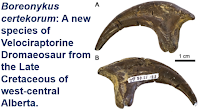
Boreonykus certekorum, left pedal ungual II-3. (A) Lateral and (B) medial views. Bell & Currie (2015).

Boreonykus certekorum is considered to be a member of the Velociraptorinae, a group of Dromaeosuars largely know from Asia, expanding our knowledge of North American members of this group. The identification of this material as represnting a new and distinct species also adds to the emerging picture of a distictive fauna being present in west-central Alberta in the Late Cretaceous, distinct from the faunas of southern Alberta and Montana to the south or Alaska to the west, but forming a conection between them.

See also...

http://sciencythoughts.blogspot.co.uk/2015/12/partial-dromaeosaur-remains-from-early.htmlPartial Dromaeosaur remains from the Early Cretaceous of Inner Mongolia.          Dromaeosaurs are thought to have been the Dinosaur group most closely related to the earliest Birds, making them of great interest to palaeontologists...
http://sciencythoughts.blogspot.co.uk/2015/10/dakotaraptor-steini-giant-feathered.htmlDakotaraptor steini: A giant, feathered Dromaeosaurid from the End Cretaceous Hell Creek Formation of South Dakota. Dromaeosaurids were first described in the 1920s, but received relatively little attention from palaeontologists until the late 1960s. However in recent years it has been realized that the group were...
http://sciencythoughts.blogspot.co.uk/2015/07/zhenyuanlong-suni-large-feathered.htmlZhenyuanlong suni: A large feathered Dromaeosaur from the Jehol Biota. Dromaeosaurid Dinosaurs are among the closest non-Avian relatives of the Birds and show many similarities to the earliest members of that group, making understanding Dromaeosaurs important for understanding the origin of Birds. In particular...

Follow Sciency Thoughts on Facebook.

Saturday, 12 December 2015

Partial Dromaeosaur remains from the Early Cretaceous of Inner Mongolia.

Dromaeosaurs are thought to have been the Dinosaur group most closely related to the earliest Birds, making them of great interest to palaeontologists.. Unfortunately this also means that for the most part they were small and rather fragile animals, which limited their preservational potential. Thus Dromaeosaur fossils are both highly sought after and extremely rare. That said the group is known from across the Northern Hemisphere, with Dromaeosaurs having been found in Europe, Asia and North America, as well as Africa and South America in the southern hemisphere. All currently known Dromaeosaur fossils date from the Cretaceous, though the group are inferred to have arisen in the Jurassic by their close relationship to Birds.

In a paper published in the journal PeerJ on 7 December 2015, Michael Pittman and Rui Pei of the Department of Earth Sciences at the University of Hong Kong, Qingwei Tan of the Long Hao Institute of Geology and Paleontology and Xing Xu of the Institute of Vertebrate Paleontology & Paleoanthropology of the Chinese Academy of Sciences describe a set of partial Dromaeosaur remains from the Early Cretaceous Bayan Gobi Formation of Inner Mongolia.

The specimen comprises a partial left hindleg preserved on a split slab and its counterpart, with the distal portion of the femur, tibia and fibula preserved along with most of the bones of the foot. This is not considered to be sufficient to describe the remains to species level, but appears to have come from a Microraptor-like Dromaeosaur with a mass of less than 1 kg.

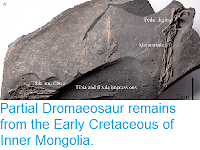
An incomplete, partially-articulated left Dromaeosaurid leg from the Early Cretaceous Bayan Gobi Formation of Inner Mongolia. (A) main slab; (B) counterslab. Pittman et al. (2015).

The slab also contained an isolated manual ungual (claw from a forelimb) about 16 mm in length and strongly arched. This clearly comes from a Theropod, and almost certainly from a Dromaeosaur about the same size as the one that produced the leg, though it cannot be said with absolute certainty that it came from the same individual. In addition a portion of a right rib, again almost certainly from a small Dromaeosaur was found on the slab, as well as a bone mass comprising numerous small fragments of unidentified bone.

An isolated Theropod manual ungual is associated with the incomplete partially-articulated left Dromaeosaurid leg. Pittman et al. (2015).

The Bayan Gobi Formation is interpreted as having formed in an inland basin far from the sea, with a cool climate and a system of lakes. ponds and rivers. It has previously produced a diverse assemblage of fossils including Flowering Plants, Conifers, Podocarps, Ostracods, Bivalves, Osracods, Mammals, Champsosaurs (semi-aquatic Diapsids of uncertain affinities), and three previously described Dinosaurs, the Psittacosaurid Ornithischian Psittacosaurus gobiensis, the Hadrosauroid Ornithischian Penelopognathus weishampeli, and the Therizinosauroid Theropod Alxasaurus elesitaiensis. The Dromaeosaur remains are not sufficient to identify the specimen to species level, but they do indicate that Dromaeosaurs were present, increasing both the known diversity of the Bayan Gobi fauna and the known range of Dromaeosaurs as a group, and leaving the hope of finding more complete specimens of the group in the formation in the future,

See also...

http://sciencythoughts.blogspot.co.uk/2015/07/zhenyuanlong-suni-large-feathered.htmlZhenyuanlong suni: A large feathered Dromaeosaur from the Jehol Biota.  Dromaeosaurid Dinosaurs are among the closest non-Avian relatives of the Birds and show many similarities to the earliest members of that group, making understanding Dromaeosaurs important for understanding the origin of Birds. In particular...
In December 2000 Xing Xu, Zonghe Zhou and Xioalin Wang of the Institute of Vertebrate Paleontologyand Paleoanthropology of the Chinese Academy of...
 
http://sciencythoughts.blogspot.co.uk/2012/03/dinosaur-footprints-from-early.htmlDinosaur footprints from the Early Cretaceous of Ganzu Province, China.        The Deinonychosaurs are the group of dinosaurs most closely related to the birds. They are divided into two groups, the Dromaeosaurs (popularly known as 'Raptors') and the Troodontids, which share a...
Follow Sciency Thoughts on Facebook.