Showing posts with label Jehol Biota. Show all posts

Tuesday, 1 August 2023

Phytoliths from the stomach contents of Jeholornis prima, and their implications for the diet of early Birds.

Angiosperms, or Flowering Plants, are dominant members of almost all terrestrial (and some marine) ecosystems today. For a long time their origin was considered mysterious, but in the past two decades a wealth of new fossil material has gone a long way to unravelling this mystery. However, while these fossils can help us understand the phylogeny of the early Angiosperms, the way in which they came to dominate modern food webs through interactions with other organisms is harder to unravel. Modern Birds have a complicated relationship with Angiosperms, often being herbivores, but also pollinators and seed dispersers, but, as with Angiosperms, the fossils of early Birds tell us a limited amount about their ecological roles. 

The Early Cretaceous Jehol Biota of northeastern China is an important resource for our understanding of the early evolution of both Angiosperms and Birds, preserving some of the earliest known Angiosperm fossils as well as a wide diversity of Birds. The Jehol Birds show a wide variation in skull shape, dentition, and general morphology, suggesting a range of ecological and dietary specializations, although it is believed that the majority of these Birds were arboreal (tree-dwelling), and had a diet not dissimilar to modern arboreal Birds, including Insects, small Vertebrates, and some plant matter. These dietry assumptions have been supported by some direct fossil evidence, from the preserved stomach contents of Jehol Birds, as well as the presence of what are believed to have been gastroliths in the gizzards of some specimens. Nevertheless, this falls a long way short of the dietary variation seen in modern Birds, and leaves questions about the extent to which the rise of the Angiosperms and that of the Birds might be connected.

In a paper published in the journal Nature Communications on 28 July 2023, Yan Wu of the Key Laboratory of Vertebrate Evolution and Human Origins at the  Institute of Vertebrate Paleontology and Paleoanthropology of the Chinese Academy of Sciences, Yong Ge, also of the Key Laboratory of Vertebrate Evolution and Human Origins, and of the Department of Archaeology and Anthropology at the University of the Chinese Academy of Sciences, Han Hu of the Department of Earth Sciences at the University of Oxford, Thomas Stidham, again of the Key Laboratory of Vertebrate Evolution and Human Origins, and of the College of Earth and Planetary Sciences at the University of Chinese Academy of Sciences, Zhiheng Li and Alida Bailleul, again of the Key Laboratory of Vertebrate Evolution and Human Origins, and Zhonghe Zhou, once again of the ey Laboratory of Vertebrate Evolution and Human Origins and College of Earth and Planetary Sciences at the University of Chinese Academy of Sciences, present the results of a study in which they attempted to gain a deeper understanding of the relationship between early Birds and Angiosperms by examining the stomach contents of a Bird from the Jehhol Biota for phytoliths.

The specimen examined, IVPP V14978, is a subadult Jeholornis prima, one of the earliest branching Birds other than Archaeopteryx, and known from over a hundred well-preserved specimens. Jeholornis prima retains the long bony tail and akinetic skull of non-Avian Theropod Dinosaurs, but is starting to show the reduced dentition and other derived Bird-like features. A morphometric analysis of mandible and alimentary tract has suggested that it was at least partially frugivorous.

Phytoliths are opaline silica crystals which build up in the leaves of Plants as dissolved monosillicic acid taken up with groundwater is precipitated out as water is lost from the leaves via transpiration. Phytoloths have a long fossil record, are known to be resilient to dissolution, and, importantly, are taxonomically significant, with different groups of plants producing different shaped phytoliths. Previous studies have been able to reconstruct the diets of Dinosaurs by examination of phytoliths recovered from their teeth and faeces. 

Line-drawing, photography, and computed laminography scans of the specimen of Jeholornis prima (IVPP V14978). The stomach area from which the phytoliths were extracted is shaded gray in (a) and shown in the computed laminography scan in (d). (c) & (d) Are focused views of the skull and thoracic region from the computed laminography scans. Black arrows in (d) indicate the gastroliths preserved associated with the residue (black arrows in (b)) sampled from the digestive tract, and the parallel white arrows indicate thoracic and sternal ribs. Abbreviations: c, coracoid; cav, caudal vertebrate; cb, ceratobranchial; che, chevron; cv, cervical vertebrate; de, dentary; ep, epibranchial; fe, femur; fr, frontal; gst, gastroliths; hu, humerus; II-2, manual digit phalanx II-2; III-3, manual digit phalanx III-3; isc, ischium; jp, jugal process; ju, jugal; lc, lacrimal; na, nasal; pa, parietal; pd, postdentary; pl, palatine; pm, premaxilla; pob, postorbital; pu, pedal ungual; pub, pubis; pzg; pre- and post-zygapophyses; qu, quadrate; rec, rectri;, res, residue; sc, scapula; sk, skull; stc, stomach content; sq, squamosal; syn, synsacrum; tib, tibiotarsus; tmt, tarsometatarsus; to, tooth; ul, ulnae; w, wing feathers. Wu et al. (2023).

Specimen IVPP V14978 s one of the smallest known Birds assigned to the Jeholornithidae, and is considered to be a subadult Jeholornis prima, based on the presence of a long bony tail, a strut-like coracoid, and a largely edentulous jaw. About two grams of carbonized material, interpreted as potential food residue within the gastric region of the Bird, was scraped from this specimen with a clean razor blade for analysis. Processing of this sample produced 418 phytoliths, from the gastric region of the Bird, but none from the surrounding sediment, supporting the hypothesis that these were derived from the Bird's stomach contents, not the contamination from the surrounding environment. 

The majority of these phytoliths (68%) have a blocky body with wavy ridge ornamentations and a size of ranging between about 45 and 90 μm. A blocky form and wavy ridgeline is consistent with several types of Plants, including Ferns, Conifers, Grasses, Broad-leaved Trees, and members of the Magnoliales.  While Grasses, Ferns, and Conifers do produce blocky phytoliths with wavy ridgelines, these are rectangular, while those from the sample are polyhedral. Furthermore, the phytoliths of most Broad-leafed Trees have very weak ridgelines, while those of the sample are well developed, making it probable that the phytoliths from the sample came from a Magnoliid. Comparison of the phytoliths to a large selection (over 4000 samples) of modern phytoliths from known plants found that they were most similar in form to those of the Coconut Magnolia, Lirianthe coco, and Machilus nanmu, a type of Laurel found in south China, both members of the Magnoliales. 

Comparison between fossil phytoliths extracted from the digestive tract of Jeholornis prima (IVPP V14978) and modern phytoliths. (a), (b) Fossil blocky phytoliths with wavy ridgelines from the stomach content of Jeholornis prima (IVPP V14978), consistent with the blocky phytoliths in modern Magnoliid leaves; (c) blocky phytoliths with wavy ridgelines, extracted from Lirianthe coco leaves (an extant species of Magnoliales) collected from Guangxi Province, China; (d), (e) fossil phytoliths with radiate lines and a conical projection in the centre, which is similar to the hair base phytoliths in modern plants; (f) hair base phytoliths extracted from extant Ficus tikoua leaves collected from Gongga Mountain, Sichuan, China. Scale bar is equal across all panels. Wu et al. (2023).

Also present in the sample are two phytoliths with a round shape and a protuberant centre, resembling the phytoliths of modern Eudicots, and 132 phytoliths which could not be identified. While these phytoliths cannot be identified, they do provide evidence that the living Bird was consuming foliage from more than one sort of Plant. 

The Magnoliales and Laurales are currently thought to have diverged about 130 million years ago, based on molecular clock dating, with comprehensive adjustments derived from fossil calibrations. Other estimates for this divergence are 117 million years, based on a mega-phylogeny of plastid genomes, and o a reconstructed time frame derived from transcriptomes and nuclear genomes. None of these estimates is at odds with the age of the Jiufotang Formation, from which specimen IVPP V14978 was obtained, which has been dated to about 120 million years before the present, on the basis of radioisotope dating of a volcanic ash layer. The palynological record also suggests that the Jehol Biota included members Angiosperms such as Magnoliapollis, Liliacidites, Asteropollis, Knemapollis, and Chloranthus. Wu et al.'s data suggests that Magnoliids were present and that their leaves formed part of the diet of Jeholornis prima.

The fossils of the Jehol Biota were laid down in lake environments, within an ecosystem with a mixture of Gymnosperm and Angiosperm Plants, as well as a wide variety of Vertebrate and Invertebrate Animals. Many modern Birds are arboreal specialists, and Birds such as Jeholornis prima appear to have been early pioneers of this environment, showing adaptations to an arboreal environment, and having a diet which included fruits, seeds, and leaves. An ecological shift to living in the treetops combined with a dietary shift away from carnivory to include a range of Plant foods could have been a significant driver of Avian evolution away from the ecological niche occupied by their closest relatives, the Dromaeosaurs and Troodontids.

Artist’s reconstruction of Jeholornis prima with potential angiosperm arboreal herbivorous feeding ecology proposed by Wu et al.. The leaf of Cretaceous Angiosperm was reconstructed as the diet of Jeholornis. Wu et al. (2023).

An ecological shift to living in trees combined with an ecological shift to a largely herbivorous diet in forests increasingly becoming dominated by Angiosperms could potentially have had a significant impact on the evolution of the early Birds, during their Cretaceous radiation. Such a transition appears to have been marked by the adoption of gastroliths, as well as a reduction in dentition, a thinning of the enamel on the remaining teeth, and changes in the shape of the skull. A prior morphometric analysis of the mandible of Jeholornis found that it was a generalist herbivore, possibly with a diet similar to that of modern Anserform or Galliform Birds, although it also showed a strong similarity to the Hoatzin, Opisthocomus hoazin, a modern specialist leaf-eater. Wu et al.'s study supports the idea that Jeholornis was a herbivore, with leaves forming at least part of its diet. Leaves are generally considered to be a poor diet for Birds, due to the low amounts of energy they provide, which is not sufficient to support the energy requirements of sustained flight. Jeholornis appears to have had a diet which included seasonally available fruits, and to have used gastroliths during an alternative season to help it process other foods. It is quite possible that it consumed some leaves as part of a wider herbivorous diet, as it the case with modern groups such as Mousebirds. 

See also...

Online courses in Palaeontology

Follow Sciency Thoughts on Facebook.

Follow Sciency Thoughts on Twitter.


Friday, 16 June 2023

Wulong bohaiensis: Iridescent plumage in a juvenile Dromaeosaur from the Jehol Biota.

Melanosomes are organelles within the cells of Vertebrates within which the pigment melanin is stored. The first fossil melanosomes were described in 2008, since when they have been recorded in a range of fossil taxa, with the different shape of different melanosomes being used to make inferences about the colour of a variety of extinct Animals. One notable group to which this methodology has been applied is Mesozoic Birds, enabling palaeontologists to determine that some of the remarkable colouration, and therefore presumably colour-related behaviour, seen in modern Birds was already present in the Mesozoic. 

One notable feature found in the plumage of a variety of Bird groups today is iridescence, a visual effect achieved by the coherent scattering of light at certain frequencies as it passes through the barbules of feathers, where layers of specially modified melanosomes are present. This works because melanin and keratin have different refractive indexes to both one-another and to air, enabling the bending of light at certain wavelengths in consistent ways. This is sometimes used to aid the camouflaging effect of the Bird's plumage, as in the case of the iridescent green plumage on the backs of Hummingbirds, it is more commonly used in displays and signalling between Birds.

Iridescence and plumage colour has been determined for a number of ancient Bird species, but feathers are also known in non-Avian Dinosaurs, with the most famous examples being the Jehol Biota from the Early Cretaceous of northeastern China, where a very large number of feathered Dinosaurs have been found. The feathers of these Jehol Dinosaurs are generally considered to be too modified by burial compression and thermal alteration, as well as oxidation after exposure, which has largely removed the kerogen matrix from which the fossils are made, leaving the majority of the fossils as (very detailed) rock impressions. This might seem to be an obstacle to the reconstruction of colour and iridescence in these fossils, but much of the work that has been done with fossil melanosomes has been based upon the shape of these structures, rather than their chemistry, which has allowed for the reconstruction of both non-iridescent structural colouration and iridescence in the plumage of Enatornithine Birds and non-Avian Paravian Dinosaurs (the Paravia is the group that includes Birds, Dromaeosaurs, and Troodontids).

All known iridescent nanostructures within feathers are found within the barbules (filaments projecting from the barbs of feathers), structures which appeared in early Maniraptorans (the group which includes Alvarezsaurs, Therizinosaurs, Oviraptosaurs, and Paravians), and to have been refined within the Paravians, and the presence of iridescence in a variety of Paravians could imply that the appearance of barbules may have been linked to iridescence.

It is highly likely that colouration has played an important role in the evolution of Birds and their ecology, and that the accumulating body of data on melanosomes in early Birds might provide insight into this. However, if non-Avian Paravians also had pigmented and iridescent plumage, then their evolution and ecology is equally likely to have been influenced by this. At the moment we have very little information on the colouration of these Dinosaurs, but potentially, if it can be collected, it may be possible to tell how their colouration changed as they reached maturity, and if their colouration was sexually dimorphic. To do this for any species of Dinosaur, a large dataset would be necessary, with numerous specimens with preserved feathers, reflecting both sexes and a range of ages. 

In a paper published in the journal Acta Palaeontologica Polonica on 13 June 2023, Angus Croudace of the School of Geosciences at the University of Edinburgh, Caizhi Shen of the Dalian Natural History Museum, Junchang Lü of the Institute of Geology of the Chinese Academy of Geological SciencesStephen Brusatte, also of the School of Geosciences at the University of Edinburgh, and Jakob Vinther of the School of Earth Sciences at the University of Bristol, reconstruct the plumage colouration of a specimen, DNHM D2933, of Wulong bohaiensis, an Early Cretaceous feathered Microraptorine Dromaeosaurid from the Jehol Biota of Liaoning, China.

Previous studies of the skeleton of DNHM D2933 have determined that it was a juvenile, about one year old when it died and still growing, making it the first juvenile non-Avian Dinosaur to have the colour of its plumage determined, as far as Croudace et al. are aware.  In order to determine the colouration, and iridescence, of the specimen, Croudace et al. used a statistical approach to the determining of the purpose of preserved melanosomes from different parts of the body. This works because different coloured melanosomes are known to be different in shape. Eumelanin-rich melanosomes are large and oblate and produce black colours, while pheomelanin-rich melanosomes are smaller and more ovoid, producing ginger or brown colours. Iridescent melanosomes are typically hollow or flat.

Dromaeosaurid Dinosaur Wulong bohaiensis (DNHM D2933), from Shangheshou, Chaoyang, Liaoning, China, Early Cretaceous Jiufotang Formation with a minimum age of 120.3 million years (A₁). Samples 1–16 were labelled by Stephen Brusatte while taking samples at the museum. Illustration by Jakob Vinther (A₂) to show distinct plumage groupings on Wulong bohaiensis (DNHM D2933). For clarity, in this illustration only the samples with successful melanosome preservation are labelled. Preservation on each of the excluded samples was not sufficient for study. Croudace et al. (2023).

Samples from DNHM D2933 were examined under a scanning electron microscope from several angles in order to establish the measurements of individual melanosomes. Since these 'melanosomes' are impressions rather than the original structures, it is impossible to determine whether-or-not they were hollow in life. However, the majority of the melanosomes observed appear to be to narrow to have been hollow. The density with which the melanosomes were packed, which has an effect on colour intensity, was not assessed.

Preserved melanosome imprints characteristic of each sample from the Dromaeosaurid Dinosaur Wulong bohaiensis (DNHM D9233) from Shangheshou, Chaoyang, Liaoning, China, Early Cretaceous Jiufotang Formation with a minimum age of 120.3 million years. All melanosome imprints are from solid and cylindrical melanosomes. Preservation on samples 7 and 14 is less clear. Three distinctive types of melanosome morphology were found on sample 15. Each was measured separately and treated as different samples for analysis (15a/15b/15c). Croudace et al. (2023).

Different types of melanosomes were observed on different parts of the body of the Dinosaur, enabling Croudace et al. to build up a picture of the distribution of colours its plumage, by comparison to a database of melanosomes from the plumage of modern Birds. Based upon this, Wulong bohaiensis is presumed to have been largely grey in colour, with patches of highly iridescent feathers on its forelimb and hindlimb remiges. 

Reconstruction of the Dromaeosaurid Dinosaur Wulong bohaiensis (DNHM D2933), from Shangheshou, Chaoyang, Liaoning, China, Early Cretaceous Jiufotang Formation with a minimum age of 120.3 million years. This illustration broadly depicts iridescent plumage on the limbs and grey feathers on the body. It should be noted that the full extent of the iridescence has been extrapolated in the creation of this illustration, based on the evidence provided by a small but significant distribution of iridescent samples across several limbs of the fossil. Robert Nicholls in Croudace et al. (2023).

Wulong bohaiensis is the fifth non-avian Paravian Dinosaur in which iridescence has been described (the others being MicroraptorCaihongBohaiornis, and Eoconfuciusornis) and the first juvenile. Two previously described species, Microraptor and Caihong, have also had the colour of their plumage determined, with both thought to be predominantly black.

The presence of iridescence in the feathers of non-Avian Dinosaurs lends support to the proposal that feathers evolved before flight, and originally had a quite different purpose, such as signalling, being later co-opted as flying aids. However, it is possible that the common ancestor of the Paravians was at least partially airborne, and that feathers were later co-opted for signalling in different groups. 

Feathers in modern Birds play a variety of roles, with signalling to other members of their species being important. In many modern Birds, iridescence plays an important part of such behaviour, often playing a role in courtship rituals. However, in such species, iridescence is typically only present in adults of reproductive age, not juveniles or subadults. DNHM D2933 is assessed to be a juvenile Dromaeosaur, about a year old, but still with some growing to do. In some Animals, reproduction can occur before the maximum size is reached, though in modern Birds of comparable size to Wulong bohaiensis, the best available analogue for reproductive behaviour, reproduction does typically occur until the individual is several years old, despite the fact that modern Birds typically reach their full size during their first year of life. This makes it unlikely that DNHM D2933 was reproductively active, and therefore unlikely that its iridescence was linked to mating behaviour. Some modern Birds, notably Corvids, develop iridescent feathers before reaching reproductive age. In these Birds, iridescence appears to be linked to the ability to recognise members of their own species, often as individuals (Corvids typically have quite complex social lives).

See also...


Online courses in Palaeontology

Follow Sciency Thoughts on Facebook.

Follow Sciency Thoughts on Twitter.


Tuesday, 3 January 2023

Confuciusornis shifan: A new species of Confuciusornithid Bird from the Early Cretaceous Jehol Biota.

The Confuciusornithids are a group of Birds known from the Early Cretaceous Jehol Biota. Unlike earlier Jurassic Birds, they have both a pygostyle (short tail made from fused bones) and a beak, key features we associate with modern Birds, although they are not closely related, being considered to be the sister group to the Ornithothoraces, the group which comprises both the Euornithes ('True Birds'; the group to which all modern Birds belong) and the Enatiornithes ('Opposite Birds'; the most commonly preserved group of fossil Birds from the Cretaceous, which were generally toothed rather than beaked). Although these Birds are only known from a single fossil lagerstatten, thousands of individual specimens with a temporal range of about 15 million years (the Jehol Biota comprises three succeeding formations, the Dabeigou, Yixian and Jiufotan), which have been assigned to five genera and eleven species (although some of these assignments are debatable), giving us a degree of understanding of the group.

In a paper published in the journal Communications Biology on 21 December 2022, Renfei Wang of the College of Earth Sciences at Jilin University, and the Key Laboratory for Evolution of Past Life in Northeast Asia at the Paleontological Museum of Liaoning, Dongyu Hu, also of the Key Laboratory for Evolution of Past Life in Northeast Asia at the Paleontological Museum of Liaoning, Meisheng Zhang, also of the College of Earth Sciences at Jilin University, Shiying Wang, again of the Key Laboratory for Evolution of Past Life in Northeast Asia at the Paleontological Museum of Liaoning, Qi Zhao of the Key Laboratory of Vertebrate Evolution and Human Origins at the Institute of Vertebrate Paleontology and Paleoanthropology of the Chinese Academy of SciencesCorwin Sullivan of the Department of Biological Sciences at the University of Alberta, and the Philip J. Currie Dinosaur Museum, and Xing Xu, once again of the Key Laboratory for Evolution of Past Life in Northeast Asia at the Paleontological Museum of Liaoning, and the Key Laboratory of Vertebrate Evolution and Human Origins at the Institute of Vertebrate Paleontology and Paleoanthropology, and of the Center for Vertebrate Evolutionary Biology at Yunnan University, describe a new species of Confuciusornithid Bird from the Xiaotaizi Village exposure of the Jiufotang Formation in  Jianchang County, Liaoning Province.

The new species is placed in the genus Confuciusornis, and given the specific name shifan, which means 'paragon of all teachers', and is an honorific applied to Confucius, and also refers to the 70th anniversary of the opening of Shenyang Normal University (瀋陽師範大學 or Shenyang Shifan Daxue). The species is described from a single specimen, PMoL-AB00178, which is a nearly complete and mostly articulated skeleton, preserved on a single slab.

Confuciusornis shifan holotype (PMoL-AB00178). (a) Photograph. (b) Schematic line drawing. cav caudal vertebra, cev cervical vertebra, fu furcula, ga gastralia, lc left coracoid, ldIII left manual digit III, lfe left femur, lh left humerus, lil left ilium, lis left ischium, lm left manus, lp left pes, lra left radiale, lr left radius, ls left scapula, lt left tibiotarsus, lu left ulna, lul left ulnare, ma mandible, pu pubis, py pygostyle, r rib, rc right coracoid, rdcIII claw of right manual digit III, rfe right femur, rfi right fibula, rh right humerus, ris right ischium, rm right manus, rp right pes, rra right radiale, rr right radius, rs right scapula, rt right tibiotarsus, ru right ulna, rul right ulnare, sk skull, sy synsacrum, tv thoracic vertebra. Arrow indicates the position from which the histological section of the right femur was taken. Scale bars is 2 cm. Wang et al. (2022).

Examination of the skeleton of Confuciusornis shifan indicates that it is an adult specimen, with all neurocentral sutures are closed without any trace, the sacral vertebrae are completely fused together to form a synsacrum, and nearly all of the compound bones (e.g., the metacarpus, tibiotarsus, and metatarsus) are fully formed. Examination of a cross section of the right femur revealed four lines of arrested growth (indicative of seasonal pauses in growth, similar to tree rings), which is considered indicative of having reached the final adult size in a Confuciusornithid.

Osteohistological section of Confuciusornis shifan holotype (PMoL-AB00178). Sample was taken from the midshaft of the right femur. ICL inner circumferential layer, OCL outer circumferential layer. Arrows indicate lines of arrested growth. Scale bar is 100 μm. Wang et al. (2022).

Despite this, Confuciusornis shifan is small for a Confuciusornithid Bird, with an estimated body mass of 174 g (around the size of a large Thrush or small Dove), with only one species, Changchengornis hengdaoziensis, having a smaller adult specimen (with an estimated body mass of 138 g).

The pygostyle is one of the defining features of modern Birds, but was absent in the long-tailed Birds of the Jurassic, with the Cretaceous-Recent Birds which share this characteristic being considered to comprise a single clade, the Pygostylians. In more advanced members of the group, such as the Sapeornithids, Pengornithid Enantiornithines, and Ornithuromorphs, this is a short, plough-shaped structure, but in earlier members of the group, including the Confuciusornithids, Jinguofortisids, and the majority of Enantiornithines, the pygostyle was longer and rod-shaped. It has generally been assumed that this longer pygostyle comprises a larger number of bones than the pygostyle of modern Birds, although the structure is seldom preserved well enough to be able to count the co-ossified bones which make it up. However, the pygostyle of Confuciusornis shifan is perforated (thought to be the result of incomplete fusion between adjacent neural arches), which leaves the intervertebral foramina (gaps between vertebrae) visible. The specimen has ten intervertebral foramina, implying a minimum of eleven vertebrae are fused, more than has previously been recorded in any Confuciusornithid Bird (the previous record-holder was a juvenile specimen of Confuciusornis sanctus with eight), and significantly more than is known from any non-Confuciusornithid Pygostylian Bird, with 5-6 being typical in even early members of the group.

Selected axial elements of Confuciusornis shifan holotype (PMoL-AB00178). (a) Cervical vertebrae. (b) Synsacrum. (c) Pygostyle. sy synsacrum. Arrows in (b) and (c) indicate the longitudinal ridge on the ventral surface of the synsacrum and the positions of foramina along the pygostyle, respectively. Scale bars are 0.5 cm in (a) and (c) and 1 cm in (b). Wang et al. (2022).

This has interesting implications for the evolution of the Avian tail. Both Confuciusornis shifan and Confuciusornis sanctus have seven free caudal (tail) vertebrae in addition to the fused vertebrae of the pygostyle, giving Confuciusornis shifan a total caudal vertebrae count of eighteen. Five to eight free caudal vertebrae seems to be typical of early Pygostylian Birds, with 5–6 in Jinguofortisids, 6–8 in Enantiornithines, and 5–7 in early Ornithuromorphs (modern Birds have 5-6). The exception appears to be the Sapeornithids, which are thought to have about 12. Since the pygostyle typically comprises another 5-6 vertebrae, this means that most Pygostylian Birds have a total of no more than 14 caudal vertebrae, with the exception of the Confuciusornithids and Sapeornithids, which have about 18. This is still less than in the non-Pygostylian Birds, with Archaeopteryx having 21-23 free caudal vertebrae, and Jeholornis having 27. This implies a general tendency towards a reduction of the number of caudal vertebrae in Pygostylian Birds, with exceptions in groups such as the Confuciusornithids and Sapeornithids, and possibly the Enantiornithines (which had a long pygostyle, presumably made up of a higher number of fused vertebrae, although no actual data is available). It is known that at least some of the long-pygostyled Birds used this structure to support large, ornamental tail feathers, whereas the shorter plough shaped pygostyles of more advanced groups are used to support retractable tail fans, which greatly increase aerodynamic lift and maneuverability. 

Typical Confuciusornithids have long wings with strongly asymmetrical flight feathers, strut-like coracoids, a keeled sternum, and enlarged major manual digits, all features which have been used to argue that they were strong flyers, although some functional analyses have suggested that their capabilities would have been more limited, and it is generally accepted that their flight capacity would have been weaker than modern Birds, or even Early Cretaceous Ornithothoracines.

Although clearly closely related to Confuciusornis sanctusConfuciusornis shifan shows some flight adaptations dissimilar to those seen in other Confuciusornithids. Typical Confuciusornithids have an elongated forearm, giving an increased wing-area, a useful adaptation to long-distance flight. Confuciusornis shifan is significantly smaller than most Confuciusornithids, and shows enlargement of many of the skeletal processes to which muscles would have attached. This would have given greater control over the tips of the wings during flight, increasing maneuverability during flight.

Selected limb elements of Confuciusornis shifan holotype (PMoL-AB00178). (a) Left carpometacarpus. (b) Right carpometacarpus. (c) left alular metacarpal of the confuciusornithid specimen PMoL-AB00150. (d) Right tarsometatarsus. Carpometacarpi are in palmar view, and tarsometatarsus is in cranial view. cb cushion-like bone, ep extensor process, pp pisiform process. Roman numerals in (d) identify metatarsals. Black arrow in (c) indicates the cranial distal condyle of the alular metacarpal; black and white arrows in (d) indicate the ridge-like process on metatarsal IV and the dorsal tubercle on metatarsal III, respectively. Scale bars are 0.25 cm. Wang et al. (2022).

See also...

Online courses in Palaeontology

Follow Sciency Thoughts on Facebook.

Follow Sciency Thoughts on Twitter.


Thursday, 22 December 2022

Microraptor zhaoianus: The stomach contents of a small Dromaeosaurid Dinosaur, and the implications for this on its diet and ecology.

Determining the diets of extinct Animals is remarkably problematic, and can generally only be accomplished where clearly identifiable feeding traces or stomach contents can be found. Even where Animals thought likely to be predatory are found in close proximity to those thought likely to be their prey, it is impossible to state with any confidence that this reflects the behaviour of the living Animals, and is not a postmortem association. Stomach contents are only very rarely preserved, and then only at sites with exceptional fossil preservation, meaning that most known examples come from a very small number of locations. Furthermore, the stomach contents of an Animal can usually only tell us what it has consumed, and provides little information about its wider behaviour. We cannot, for example assume that an Animal directly hunted another species based upon its stomach contents, as almost all carnivorous Animals will consume carrion given the opportunity.

Theropod Dinosaurs are generally assumed to have hunted prey smaller than themselves. This is true of most modern Mammals, Birds and Crocodilians. Other than Mustelids, which regularly hunt prey larger than themselves, predatory Mammals generally hunt large prey only when in packs, so that the total mass of the predators outstrips that of the prey, even if the individuals do not. Large Theropods are likely to have mostly hunted other Dinosaurs, as these would have represented most of the large prey available in their environments. Small Theropods, on the other hand, are likely to have had a much wider range of suitably sized prey, including even smaller Dinosaurs, Lizards, small Amphibians, small Mammals, Arthropods, and Molluscs, and are likely to have fed on all of these. 

Very few Dinosaurs have more than one specimen known with preserved stomach contents, giving us a very limited conception of their diet. However, the small Early Cretaceous Dromaeosaurid Microraptor has four known individuals with preserved stomach contents, providing the opportunity for an analysis of its diet not really possible for any other Dinosaur. Individuals of Microraptor have previously been shown to have consumed a Bird, a Lizard, and a Fish.

In a paper published in the Journal of Vertebrate Paleontology on 20 December 2022, David Hone of the School of Biological and Behavioural Sciences at Queen Mary University of London, Alexander Decechhi of the Division of Natural Sciences at Mount Marty College, Corwin Sullivan of the Department of Biological Sciences at the University of Alberta, and the Philip J. Currie Dinosaur Museum, Xu Xing of the Key Laboratory of Vertebrate Evolution and Human Origins at the Institute of Vertebrate Paleontology and Paleoanthropology of the Chinese Academy of Sciences, and Hans Larsson of the Redpath Museum at McGill University, describe the stomach contents of the fourth specimen of Microraptor in which this is known, the holotype of Microraptor zhaoianus, and discuss the implications of this for our understanding of the diet of the species.

The specimen, IVPP V 12330, is a compression fossil broken into a number of fragments, with most of the part and counterpart present, showing the incomplete but articulated skeleton of the small Dinosaur. The abdominal and thoracic cavities show no signs of having been ruptured, and, visible within the rib-cage of the Animal, is the articulated pes (foot) of a small Mammal. This visibly overlies the ribs of the left side of the thoracic cavity, and is in turn overlain by the ribs of the right side. The visible part of the foot includes ll tarsals and metatarsals and most phalanges,including unguals of digits I and probably III. A number of long bones are also present, beneath and beside the pes, which hint that more of the Mammal might be present but obscured.

Holotype specimen of Microraptor zhaoianus (IVPP V12330) with Mammal foot gut contents. (A) Entire specimen. Box inset indicates the location of (B) and (C). (B) Close-up view of Mammal foot. (C) Illustration of visible bones: dark gray elements are Microtaptor ribs, yellow bones are the articulated Mammalian foot and light gray are unidentified bones. Note the juxtaposition of the foot over the inside of the left ribs and the overlap of the right ribs over the foot, particularly over digits II and III. Abbreviations: ast, astragalus; cal, calcaneum; mtI, metatarsal 1; nav, navicular; lr, left rib; rr, right rib. Scale bar in (A) equals 100 mm and in (B) and (C) equals 5 mm. Hone et al. (2022).
The phalanges of the foot are slender, resembling those of the Early Cretaceous Mammals Eomaia and Sinodelphys, both of which come from the same deposits as Microraptor. However, they are neither as elongate nor as curved as seen in these species, suggesting that this is another, unknown, Mammal, and that it was a primarily ground dwelling species (Eomaia and Sinodelphys are both thought to have been arboreal in nature).

The first digit is 8.1 mm in length excluding the ungual (claw), or 9 mm in length if the ungual is included. This is roughly equivalent to those of Sinodelphys, Yanoconodon, and Eomaia, and may therefore indicate an Animal of similar size, although if this Mammal did have a different ecological role, then the possible size bracket can be expanded somewhat. Nevertheless, Hone et al. estimate a size in the range 13-43 g (the range that includes most modern Mice, Voles, and Shrews).

Numerous examples of Microraptor have been recovered from the beds which make up the Jehol Biota, and many studies have been done on this Dinosaur's ecology. Nevertheless, considerable controversy remains about the lifestyle of Microraptor, with different researchers having suggested that it might be nocturnal, diurnal, capable of gliding flight, capable of powered flight, arboreal in habit, and terrestrial in habit. What is generally accepted is that Microraptor was capable of some-sort of areal locomotion, and probably able to climb reasonably well (although there is considerable doubt as to whether it was capable of living in arboreal environments with small-diameter branches, an environment which the only non-Avian Theropods thought likely to have colonised are the Scansoriopterygians. 

Over 300 specimens of Microraptor are known, which have been divided into three separate species, of different sizes and with slightly different anatomical traits, although it is still possible that this represents different growth stages and variability within a single species. Whatever the taxonomic implications, this physical variation probably represents a degree of ecological difference between the morphotypes, which may indicate differences in diet. The four specimens of Microraptor for which stomach contents are known belong to two different species, Microraptor zhaoianus, of which a previous specimen was shown to have consumed a Lizard, while Hone et al.'s study shows consumption of a small, terrestrial, Mammal, and Microraptor gui, in which two specimens have been shown to have consumed a Fish, and a small Bird, respectively. This may, therefore, represent two different species with slightly different dietary habits, but is also likely just to represent a degree of flexibility in feeding habits.

Most modern predators take food items considerably smaller than themselves, and this is unlikely to have been different in the Early Cretaceous. With the exception of Mustelids, modern Mammals of 21 kg or less typically target prey no more than 40% of their own size. This rule appears to be applicable to Microraptor, with all four specimens with stomach contents having consumed Animals significantly smaller themselves. The Bird known from the stomach contents of a specimen of Microraptor gui had an ulna length of 10.5 mm, while the ulna of the Dinosaur that had eaten it was 80 mm long. The Lizard eaten by a specimen of Microraptor zhaoianus had femur 13.4 mm long, while its consumer's was 75 mm in length. The Fish appears to have been of a similar proportion to the Dinosaur which ate it, based upon rib size, while Hone et al. estimate that the small Mammal from their study was about 10% of the size of the Microraptor.

Any consideration of the diet of an Animal should also take into account its jaw morphology. Typically, Vertebrates with shorter, more robust jaws tend to consume larger prey, which needs to be subdued and processed before consumption, whereas those with longer jaws tend to consume smaller prey, with an emphasis on shovelling down as many prey items as quickly as possible. 

This principle has previously been applied to the Eudromaeosauria, with the group found to split conveniently into three clusters, species with short deep jaws, such as Deinonychus and Atrociraptor, species with intermediate-lengthed jaws, such as AchillobatorSaurornitholestes, Bambiraptor, and Acheroraptor, and long-snouted forms such as Linheraptor, Tsaagan, and Velociraptor. Interestingly, all of the species known to have short jaws are from North America, as are most of those with intermediate jaws, while most of the long-jawed species are Asian, although, with the jaws of many species unknown or known only from fragmentary remains, it is unclear how significant this is.

While many specimens of Microraptor are known, it has proven hard to fit it into this matrix, as in the majority of specimens both maxillae are absent, unexposed, damaged, or difficult to fully demarcate from adjacent bones. However, two specimens, BMNHC PH881 and IVPP V 13475, both identified as Microraptor sp., have maxillae which appear to fit into the intermediate group, possible suggesting prey fairly easy to seize, but requiring some force to subdue. Since Microraptor is itself a small Animal, probably massing under 1 kg, Mouse-sized Mammals and similar small Vertebrates would seem to fit into this category, while most Insects would be too small.

The Mammal consumed by Microraptor IVPP V 12330 is thought to have been ground dwelling, and about the right size for the presumed prey of Microraptor, which is itself also thought to have been ground dwelling. This would seem, at first sight, to be fairly good evidence for Microraptor having predated this Mammal. However, Hone et al. caution against making such an assumption, observing that almost all carnivorous Animals will consume carrion if it is available, rather than hunting, and that, therefore, an Animal having consumed another Animal cannot be taken as direct evidence of a predator-prey relationship.

Hone et al. also not that, while Dromaeosaurs are generally assumed to have been capable of swallowing quite large items, all of the known stomach contents of Microraptor have been quite small, in this case the foot only of a Mammal, which is a low-nutrition part of the body, and generally among the last parts consumed. This makes it quite conceivable that the majority of the Mammal might have been consumed by another Animal, with the Microraptor, subsequently consuming an overlooked portion of the carcass. 

It has previously been suggested that Microraptor might have been capable of actively hunting small Birds in the treetops, based upon the presence of a partial wing and both feet of an Enantiornithine Bird within the body cavity of another specimen. However, these are again low nutrition parts of the body, likely to have been left by another Animal eating the majority of the Bird. What remains of the wing, and the feet, are themselves articulated, appears to suggest that Microraptor was incapable of any further processing of its food; either tearing these pieces of a carcass then swallowing them, or finding them left behind after the majority of the Bird has been eaten by something else. Whichever is the case, the specimen does not seem to be, in itself, sufficient evidence to claim Microraptor was able to hunt small Birds. Even if the Bird could be assumed to have been killed and then consumed by the Dinosaur, this does not indicate that the predation event took place above the ground. Even the most arboreal of modern Birds spends a considerable amount of time on the ground, and many modern predators, such as Hyenas, Cheetahs, and Foxes, hunt them there.

The presence of a Fish in within the body cavity of Microraptor specimen has also been taken as evidence of direct predation on Fish, within an aquatic environment, although in that case scavenging was not ruled out. 

Hone et al. note that the suggestion that Microraptor was capable of hunting both in the treetops and in the water as highly dubious, noting that modern Animals which can do this tend to be very specialist predators, something that there is no evidence for in the case of Microraptor. They caution that such stories are attractive, but are not supported by the evidence, and that the presence of a wide range of consumed Animals within the stomach contents of a species is probably more indicative of it being a generalist scavenger that a specialist hunter.

The range of Animals now known to have been consumed by Microraptor is wider than for any other known non-Avian Theropod, although this is clearly related to the fact that more specimens with stomach contents are known than for any other Dinosaur. However, the assumption that Microraptor, whilst probably capable of hunting, would consume a wide range of Animals opportunistically, is probably also true for most Theropods. Furthermore, most Theropods are thought likely to have changed the Animals they consumed quite significantly over their long growth-cycles, and it is likely that members of the same species in different regions would have consumed different food items, and that individuals would have consumed different items at different times of year, all of which would have favoured a more generalist approach to feeding. Insects and other Invertebrates are likely to have made up a proportion of the diet of the smallest Theropods. These have never been found in any stomach contents, but this is probably reflective of their low preservation potential rather than their not being consumed.

Specimen IVPP V 12330, the holotype of Microraptor zhaoianus, provides direct evidence of the direct consumption of a Mammal by Microraptor, only the second time this has been demonstrated for a non-Avian Dinosaur. However, this does not provide evidence of a direct predation event, but rather adds to the mounting evidence that Microraptor was a generalist carnivore, largely eating small Vertebrates, but not necessarily hunting them.

See also...

Online courses in Palaeontology

Follow Sciency Thoughts on Facebook.

Follow Sciency Thoughts on Twitter.


Tuesday, 2 August 2022

Three-dimensionally preserved Dinosaur remains from a new Jehol Biota outcrop in Inner Mongolia.

The Jehol Biota produces a wide range of exquisitely preserved Early Cretaceous fossils from locations across Liaoning, Inner Mongolia, and Hebei provinces in northeastern China. However, in almost all cases these are two-dimensionally preserved (i.e. flattened), with only a single site, an outcrop of the the Lujiatun Unit of the Yixian Formation in western Liaoning, producing fossils in three dimensions. The fossils from this location are predominantly Dinosaurs, with some Lizards and Mammals, and show signs of representing an area with an area with a different faunal composition and ecology to the rest of the Jehol Biota, as well as having a different taphonomy (mode of preservation).

In a paper published in the journal Acta Palaeontologica Polonica on 20 June 2022, Honggang Zhang of the College of Earth Science and Engineering, and Paleontological Institute at Shandong University of Science & Technology, Dongxiang Yu, also of the College of Earth Science and Engineering at Shandong University of Science & Technology, Yuhui Feng, also of the Paleontological Institute at Shandong University of Science & Technology, Rui Pei of the Key Laboratory of Evolutionary Systematics of Vertebrates at the Institute of Vertebrate Paleontology and Paleoanthropology of the Chinese Academy of Sciences, and Chang-Fu Zhou, again of the College of Earth Science and Engineering at Shandong University of Science & Technology, describe a second outcrop producing three-dimensionally preserved fossils from the Jehol Biota, this time located in the Ningcheng Basin of Inner Mongolia.

The new outcrop, at a site called Xidayingzi in Ningcheng County, comprises an outcrop of interbedded volcanic and sedimentary rocks about 80 m thick. The volcanic rocks here are predominantly basaltic andesites, rhyolitic breccia lavas and andesitic tuffs, while the sedimentary units are gravel-rich siltstones, sandstones, and conglomerates, all containing volcanically derived material.

Map of the Inner Mongolia, Liaoning and Hebei (A) showing location of the Xidayingzi site and the outcrops of the Lujiatun Unit of the Yixian Formation of the Jehol Biota in Beipiao, western Liaoning Province. Stratigraphic column (B) and corresponding photographic image (C) of the Early Cretaceous Xidayingzi site. Zhang et al. (2022).

Initial investigations at this site uncovered the remains of Dinosaurs from four different groups, plus Lizard and Mammal remains, all preserved in three dimensions and many in a semi-articulated state, although most material is individual bones.

Fossils found in the Xidayingzi site from the Early Cretaceous Ningcheng Basin, Inner Mongolia. (A) Sinovenator-like Troodontid Dinosaur (SDUST-V1062), the left pes is exposed in medial view. (B) Ceratopsian Dinosaur Psittacosaurus sp. (PMOL-AD00163), the maxilary teeth are loosely arranged and exposed in lateral view. (C) Neornithischian Dinosaur Jeholosaurus sp. (SDUST-V1063), the scapulocoracoid, humerus, ulna, and radius in lateral view. (D) Euhelopus-like Sauropod (SDUST-V1064), digital image of the tooth crown in medial view. (E) Indeterminated Lizard (PMOLAR00268), digital image of the fragmentary mandible in lingual view. (F) Symmetrodont-like Mammal (PMOL-AM00036), digital image of the mandible in lingual view. Zhang et al. (2022).

The most notable specimen from the site (SDUST-V1062) is the articulated post-cranial skeleton of a Troodontid Dinosaur, possibly a specimen of Sinovenator; the specimen resembles Sinovenator changii in most regards, but differs in having having a round anterior margin of the preacetabular process of the ilium and a moderately developed ambiens process of the pubis, and may therefore represent a second species in the genus.

Three Sauropod teeth were found at the site, two of them well preserved and similar to those of Euhelopus, a Titanosauriform of similar age to the Jehol Biota, but not previously reported from there.

Eight Neornithischian Dinosaur fossils were found at the site, with four being semi-articulated partial postcranial skeletons. These all resemble  Jeholosaurus shangyuanensis, a small Neornithischian previously only known from the Lujiatun Unit of the Jehol Biota.

Six specimens of Ceratopsian Dinosaurs were found, although these were rather fragmentary in nature. All appear similar to the early-diverging Psittacosaurus, often used as an index fossil for the Lower Cretaceous in East Asia, and common in the Jehol Biota. Curiously, the maxillary teeth of the new specimens appear to be spaced apart rather than being imbricated as in all other known Psittacosaurs, which may again indicate they belong to a new species.

A single fragment of a Lizard mandible (PMOL-AR00268) was found. This has pleurodont, conical, single-cusped, and closely packed teeth, which, are features common in a range of Mesozoic Lizards, and not helpful diagnostically.

Mammals are also represented by a single mandible (PMOL-AM00036), which has one premolar, five molars, and eight empty alveoli; the molars have acutely-triangulated molar cusps, which allows the specimen to be referred to the Symetrodonts, although this is a polyphyletic assemblage of Mammals, made up of members of different groups which converged on a similar morphology, possibly as a response to some Mesozoic ecological condition.

See also...

Online courses in Palaeontology

Follow Sciency Thoughts on Facebook.

Follow Sciency Thoughts on Twitter.


Tuesday, 5 July 2022

Cokotherium jiufotangensis: A new species of Eutherian Mammal from the Early Cretaceous Jehol Biota of China.

Eutherian Mammals (or Placental Mammals) represent the largest Mammal group alive today. Molecular clock analysis suggests that thy diverged from the Marsupials during the Jurassic, which is supported by the oldest known Eutherian Mammal fossil, Juramaia sinensis, coming from the Late Jurassic Tiaojishan Formation of Liaoning Province in China. However, the fossil record of early Eutherians is sparse, with only Juramaia sinensis known from the Jurassic, and a only a few examples, such as Eomaia, Acristatherium, Ambolestes, Sasayamamylos, Sinodelphys, and Prokennalestes coming from the Early Cretaceous. This makes it hard to make solid predictions about the relationships between these early Eutherian species, with the discovery of new species often leading to the reassessment of the importance of features used to define the group (for example Sinodelphys was considered the earliest known Marsupial until 2018, when a re-evaluation of the group following the discovery of Ambolestes zhoui lead to it being classified as a Eutherian.

In a paper published in the Philosophical Transactions of the Royal Society Series B: Biological Sciences on 7 February 2022, Hai-Bing Wang of the Key Laboratory of Vertebrate Evolution at the  Institute ofVertebrate Paleontology and Paleoanthropology, the Centre for Excellence in Life and Paleoenvironment of the Chinese Academy of Sciences, and the Key Laboratory of Palaeobiology and Stratigraphy at the Nanjing Institute of Geology and PalaeontologySimone Hoffmann of the  Department of Anatomy at the New York Institute of TechnologyDian-Can Wang of the Department of Oral and Maxillofacial Surgery at Peking University, and Yuan-Qing Wang, also of the Key Laboratory of Vertebrate Evolution at the  Institute of Vertebrate Paleontology and Paleoanthropology, and the Centre for Excellence in Life and Paleoenvironment of the Chinese Academy of Sciences, and of the College of Earth and Planetary Sciences at the University of Chinese Academy of Sciences, describe a new species of Eutherian Mammal from the Early Cretaceous Jehol Biota of Liaoning Province, China.

The new species is described from a single specimen collected from the Jiufotang Formation at the Sihedang Site in Lingyuan City, and has an estimated age of 120 million years. It is named Cokotherium jiufotangensis, where 'Cokotherium' is intended to honour the late Chuan-Kui Li for his  contributions to our understanding of the evolution of early Mammals, and 'jiufotangensis' means 'from Jiufotang'.

Holotype specimen of Cokotherium jiufotangensis (IVPP V23387). (a) Skeleton of Cokotherium jiufotangensis; (b) skull in ventrolateral view; (c) forelimb mainly in lateral view; (d) virtual reconstruction of the skull in dorsolateral view; (e) virtual reconstruction of the skull in ventrolateral view. Right side indicated by (r), left side indicated by (l). (d) and (e) at same scale. ap, angular process; as, alisphenoid; bh, basihyal; c, lower canine; C, upper canine; C2, axis (cervical vertebra 2); ca, capitate; ci, crista interfenestralis; cl, clavicle; cot, coronoid tubercle; cp, coronoid process; ct, centrale; cv, cervical vertebrae; d, dentary; eh, epihyal; fc, fenestra cochleae; fr, frontal; fv, fenestra vestibuli; gf, glenoid fossa; h, humerus; ha, hamate; if, infraorbital foramen; ju, jugual; lc, lacrimal; lcf, lacrimal foramen; lu, lunate; mac, mandibular condyle; maf, masseteric fossa; max, maxilla; mc, metacarpals; na, nasal; oc, occipital condyle; omc, ossified Meckelian cartilage; pa, parietal; pgf, postglenoid fossa; pgp, postglenoid process; ph, phalanges; pi, pisiform; pmx, premaxilla; po, postorbital process; pr, promontorium; ptf, posttemporal foramen; r, radius; s, scapular; sc, scaphoid; sh, stylohyal; sf, stapedius fossa; sq, squamosal; st, sternum; T, thoracic vertebrae; td, trapezoid; th, thyrohyal; tm, trapezium; tq, triquetrum; u, ulnar. Wang et al. (2022).

The specimen is a partial skeleton with a complete skull, forelimbs and part of the trunk and hindlimbs, which is preserved on a single slab of material. The dorsal and right lateral portions of the skull are obscured by the rock-matrix, but could be observed by computerised tomographic imaging.

Cokotherium jiufotangensis has an ossified Meckelian cartilage, something seen in modern Eutherians, but not previous Early Cretaceous examples such as Eomaia, Prokennalestes, Hovurlestes or Ambolestes. This had led to speculation that early members of the group retained a cartilaginous Meckelian sulcus into adult life, as was the case in the contemporary Eutriconodontan and Zhangheotheriid Mammals. 

Furthermore, this cartilage is reduced in size, which likely indicates that the middle ear bones have become detached from it, a key development of the ear in modern Mammals, which is not seen in the Eutriconodontans. The ear bones are separated from the Mecklian cartilage in some Zhangheotheriids, although only by a small gap, and this may also be the case in Cokotherium jiufotangensis.

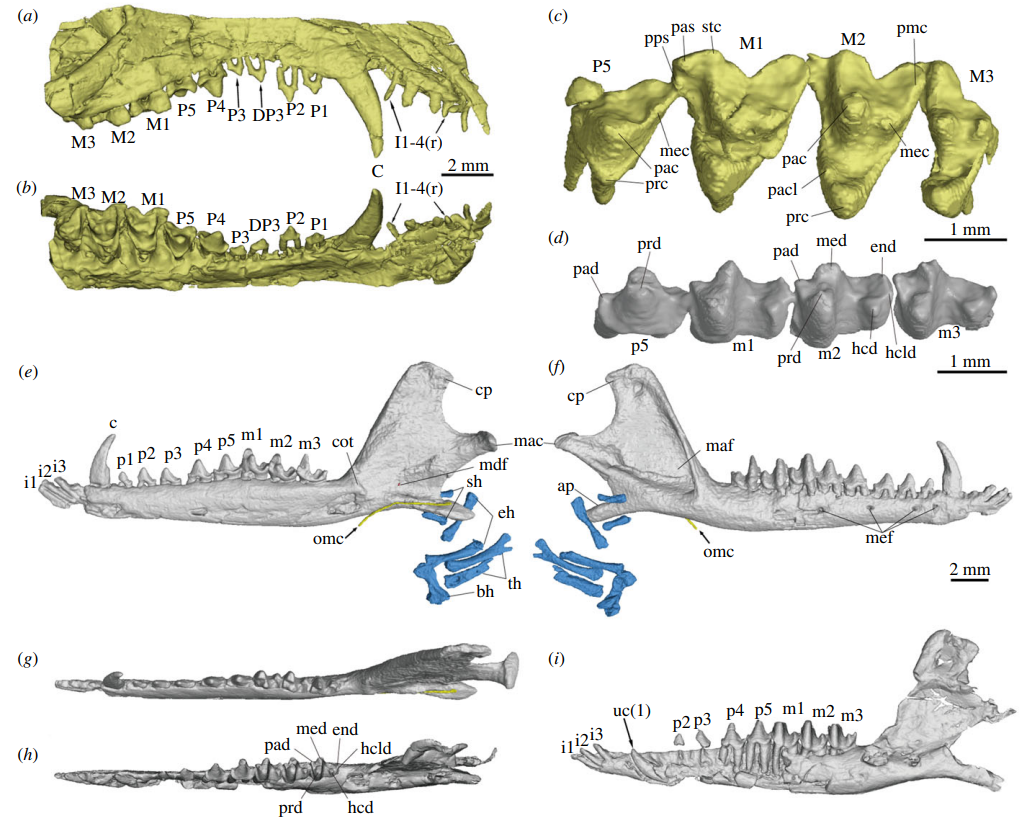
Jaws and dentition of Cokotherium jiufotangensis (IVPP V23387). (a) Right upper jaw in lateral view; (b) right upper jaw in occlusal view; (c) left P5-M3 in occlusal view; (d) left p5-m3 in occlusal view; (e) right mandible with the ossified Meckelian cartilage (yellow) and hyoid bones (blue) in medial view; (f) right mandible with the ossified Meckelian cartilage (yellow) and hyoid bones (blue) in lateral view; (g) right mandible in dorsal view; (h) left mandible in dorsal view; (i) left mandible in lateral view showing unerupted canine. Right side indicated by (r), left side indicated by (l). (e)-(i) at same scale. ap, angular process; bh, basihyal; c, lower canine; C, upper canine; cot, coronoid tubercle; cp, coronoid process; DP, deciduous upper premolar; eh, epihyal; end, entoconid; hcd, hypoconid; hcld, hypoconulid; i, lower incisor; I, upper incisor; m, lower molar; M, upper molar; mac, mandibular condyle; maf, masseteric fossa; mdf, mandibular foramen; mec, metacone; med, metaconid; mef, mental foramen; omc, ossified Meckelian cartilage; p, lower premolar; P, upper premolar; pac, paracone; pacl, paraconule; pad, paraconid; pas, parastyle; pmc, post-metacrista cusp; pps, preparastyle; prc, protocone; prd, protoconid; sh, stylohyal; stc, stylocone; th, thyrohyal; uc, unerupted lower left canine. Wang et al. (2022).

Wang et al. were also able to reconstruct the inner ear of Cokotherium jiufotangensis in three dimensions using computerised tomographic scanning, the first time this has been done for an Early Cretaceous Eutherian Mammal (although the morphology of part of the inner ear has been described in Prokennalestes, a Eutherian from the Early Cretaceous of Inner Mongolia).

The  cochlear canal of Cokotherium jiufotangensis comprises a single coil (i.e. 360°). This is similar to the state in most later Cretaceous Eutherian Mammals, with greater coiling seen in most modern Mammals as well as some Cretaceous Zhelestids. Many other features of the ear, including  a secondary crus commune, the base of a secondary osseous lamina, the primary osseous lamina and a bony cribriform plate, are similar to those in both later Cretaceous and modern Eutherian Mammals, confirming these arose early in the history of the group.

Inner ear of Cokotherium jiufotangensis (IVPP V23387). (a) Position of inner ear (green), veins (blue), and nerves (yellow) in ventral view of cranium; (b) endocast of right and left inner ear (green), veins (blue), and nerves (yellow) in same ventral view; (c) cross section through left inner ear showing internal structures of cochlear canal; (a-c) at same scale. Endocast of inner ear (grey), cochlear and vestibular nerves (yellow) in (d) ventral, (e) dorsal, (f) medial and (g) lateral views, anterior is down, all at same scale. am, ampulla; asc, anterior semicircular canal; ca, cochlear aqueduct; cc, crus commune; ci, crista interfenestralis; cn, cochlear nerve; co, cochlear canal; cp, cribriform plate; crp, crista parotica; fc, fenestra cochleae; fn, facial nerve; fv, fenestra vestibuli; gf, glenoid fossa; gg, geniculate ganglion; hf, hiatus Fallopii; ips, inferior petrosal sinus; jf, jugular fossa; lhv, lateral head vein; lsc, lateral semicircular canal; pl, primary osseous lamina; pr, promontorium; psc, posterior semicircular canal; scc, secondary crus commune; sff, secondary facial foramen; slhv, sulcus for lateral head vein; vca, vein of cochlear aqueduct; vn, vestibular nerve. Wang et al. (2022).

The earliest Eutherian Mammals generally have a larger number of teeth than modern members of the group, and consequently these teeth are closely packed together. Cokotherium jiufotangensis has a reduced number of both incisors and molars, and consequently a less densely packed dentition, a trait otherwise recorded in Eutherian Mammals from the Late Cretaceous onwards. It still has four premolars on each side of both the upper and lower jaws, but the hindmost premolars are starting to show signs of molarisation, another trait previously known only from later Eutherian species.

Despite these apparently derived traits, a phylogenetic analysis carried out by Wang et al. suggests that Cokotherium jiufotangensis is one of the most basal Eutherians known, and possibly outside the Theria (Eutherians plus Marsupials) altogether. However, it is possible that this placement is an artefact of the small number of early Eutherians known, and our subsequent poor understanding of the relationships between these early Mammals.
See also...

Online courses in Palaeontology

Follow Sciency Thoughts on Facebook.

Follow Sciency Thoughts on Twitter.