Showing posts with label Khyber Pakhtoon Khawa Province. Show all posts

Tuesday, 5 September 2017

Gymnopilus swaticus: A new species of Mushroom from Khyber Pakhtunkhwa Province, Pakistan.

Members of the genus Gymnopilus are wood-decomposing Basidiomycote Fungi found across Europe, North Africa and parts of North America. They produce yellow, orange, red or purple Mushrooms which often cloesly resemble poisonous species found in the same area, though they are not poisonous themselves.

In a paper published in the journal Phytotaxa on 4 July 2017, Junaid Khan of the Center for Plant Sciences and Biodiversity at the University of Swat, Munazza Kiran of the Department of Botany at the University of the Punjab, Sana Jabeen of the Faisalabad Campus of the University of Education, Hassan Sher, also of the Center for Plant Sciences and Biodiversity at the University of Swat, and Abdul Nasir Khalid, also of the Department of Botany at the University of the Punjab, describe a new species of Gymnopilus from the Sawt District of Khyber Pakhtunkhwa Province in Pakistan.

The new species is named Gymnopilus swaticus, in reference to the area where it was found. It was found growing on wood from the West Himalayan Spruce, Piceae smithiana, in the Gabin Jabba Marshes of the Lalkoo Valley. It produces convex to hemispherical Mushrooms, 40-70 mm across and sulphur yellow to rust brown in colour.

Gymnopilus swaticus, basidiomes in natural habitat. Junaid Khan in Khan et al. (2017).

See also...

http://sciencythoughts.blogspot.co.uk/2017/08/coprinopsis-rugosomagnispora-new.htmlhttp://sciencythoughts.blogspot.co.uk/2017/06/gondwanagaricites-magnificus-new.html
http://sciencythoughts.blogspot.co.uk/2016/07/unravelling-diversity-of-podaxis-fungi.htmlhttp://sciencythoughts.blogspot.co.uk/2016/05/truncospora-wisconsinensis-new-species.html
https://blogger.googleusercontent.com/img/b/R29vZ2xl/AVvXsEiaPwZjAkDvU8oVPZhtzzBAs8Hyo0V6pEPrES5PBwyvEHQ-7mqXVc5xaYK4laAVRJnzkScUXVKaWZjvAWG-8EzFGyP8YwRN0mq5UP7TVQE7QVegPg4lqmpZlIODFb_K4mivKMYOJivsxuU/s200/Helvella+sublactea+A+new+species+of+Mushroom+from+Yunnan+Province%252C+China..pnghttp://sciencythoughts.blogspot.co.uk/2015/02/four-new-species-of-mushroom-from.html
Follow Sciency Thoughts on Facebook.

Monday, 3 October 2016

Magnitude 5.4 Earthquake in Khyber Pakhtunkhwa Province, Pakistan.

The United States Geological Survey recorded a Magnitude 5.4 Earthquake at a depth of 43.4 km, roughly 48 km to the north of the town of Athmuqam in Khyber Pakhtunkhwa Province, Pakistan, slightly after 1.00 pm local time (slightly after 8.00 am) on Saturday 1 October 2016. There are no reports of any damage or casualties associated with this event, but people have reported feeling it across northern Pakistan.

 The approximate location of the 1 October 2016 Khyber Pakhtunkhwa Earthquake. Google.

Northern Pakistan lies close to the boundary between the Indian and Eurasian tectonic plates, which runs through northern Afghanistan. The Indian Plate is moving northward relative to the Eurasian Plate, causing folding and uplift along this boundary, which has led to the formation of the Hindu Kush Mountains of Afghanistan, the Himalayas and the other mountain ranges of Central Asia., and which makes the nations in this boundary zone prone to Earthquakes.

Plate boundaries and movements beneath southern Pakistan, Iran and the Arabian Sea. University of Southampton.

Witness accounts of Earthquakes can help geologists to understand these events, and the structures that cause them. The international non-profit organization Earthquake Report is interested in hearing from people who may have felt this event; if you felt this quake then you can report it to Earthquake Report here.
See also...
http://sciencythoughts.blogspot.co.uk/2016/04/flash-floods-and-landslides-kill-at.htmlFlash floods and landslides kill at least 65 in northern Pakistan.                                          At least sixty five people have died folowing a series of flash floods and landslides in Khyber Pakhtunkhwa, Azad Kashmir and Gilgit Baltistan Provinces in northern Pakistan on Sunday 3 April 2016...
http://sciencythoughts.blogspot.co.uk/2016/03/flooding-and-landslides-kill-over-30.htmlFlooding and landslides kill over 30 people in northern Pakistan.                                     Thirty four people have been confirmed dead and many more are still missing as heavy rain falls across northern Pakistan. The rainfall has led to flooding which has affected many communities, as well...
http://sciencythoughts.blogspot.co.uk/2015/10/hundreds-known-to-have-died-following.htmlHundreds known to have died following massive deep Earthquake in northeast Afghanistan.                                                Four hundred and forty people are known to have died and thousands more are missing or injured following...
Follow Sciency Thoughts on Facebook. 

Sunday, 3 April 2016

Flash floods and landslides kill at least 65 in northern Pakistan.

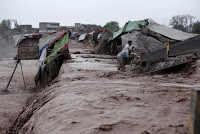
At least sixty five people have died folowing a series of flash floods and landslides in Khyber Pakhtunkhwa, Azad Kashmir and Gilgit Baltistan Provinces in northern Pakistan on Sunday 3 April 2016. Forty Eight deaths have been confirmed in Azad Kashmir, including twelve in Kohistan District, largely due to landslides and house collapses. Landslides are a common problem after severe weather events, as excess pore water pressure can overcome cohesion in soil and sediments, allowing them to flow like liquids. Approximately 90% of all landslides are caused by heavy rainfall. House collapses are also common following heavy rainfall in the region, largely due to the use of mud-bricks as a building material. Such bricks are a cheap and easily obtainable building material for poorer communities in Pakistan, but fare very badly in wet conditions. Another eight people have been reported dead following a landslide in Sharda District

 Flood waters sweeping through a market in Peshawar, Khyber Pakhtunkhwa, Pakistan. Fayaz Aziz/Reuters.

In Khyber Pakhtunkhwa Province ten people are reported to have died in landslides in Shangla District, two women have been confirmed dead after they were caught in a flash flood in Swat District, and Malakand, Mansehra, Upper Dir, Charsadda, and Chitral Districts have each recorded single deaths. In Peshawar Lake Bara Khowar overflowed leading to flooding in that washed away around seventy shops and commercial properties. Nine deaths have been reported in the town of Chilas in Gilgit Baltistan Province, four of them in a single house-collapse incident.

Flooding in Gilgit Baltistan Province, Pakistan, on 4 April 2016. Dawn.

Flooding and landslices are common at this time of year in northern Pakistan, where rising temperatues at the start of summer lead to thawing snow and ice in the mountains of the region. However the area does not typically recieve large amounts of rainfall at this time of year, and the heavy rainfall which has arrived in 2016 has both caught people by surprise and worsened the usual seasonal problems. 
 
The Himalayan provinces of Pakistan are extremely prone to landslides, due to a number of active faults in the area, these being driven by the northward movement of the Indian Plate, which is pushing into Eurasia at a rate of 40 mm a year. This causes earthquakes on both plates, as well as the folding and uplift that has created the Himalayas and the Tibetan Plateau.
 
See also...
 
http://sciencythoughts.blogspot.co.uk/2016/03/flooding-and-landslides-kill-over-30.htmlFlooding and landslides kill over 30 people in northern Pakistan.                                       Thirty four people have been confirmed dead and many more are still missing as heavy rain falls across northern Pakistan. The rainfall has led to flooding which has affected many communities, as well as blocking...

At least thirteen people have died following a landslide in the Gulistan Johar District of Karachi, the capital of Sindh Province in Pakistan, early on Tuesday 13...

http://sciencythoughts.blogspot.co.uk/2015/06/death-toll-thought-to-have-exceeded-800.htmlDeath toll thought to have exceeded 800 as heat wave hits Sindh Province, Pakistan.      The death toll from a heat wave hitting Sindh Province in Pakistan is thought to have exceeded 800. A total of 775 deaths had been...
 
 
Follow Sciency Thoughts on Facebook. 
 

Sunday, 1 March 2015

Fifteen people injured following Magnitude 5.4 Earthquake in Khyber Pakhtunkhwa Province, Pakistan.

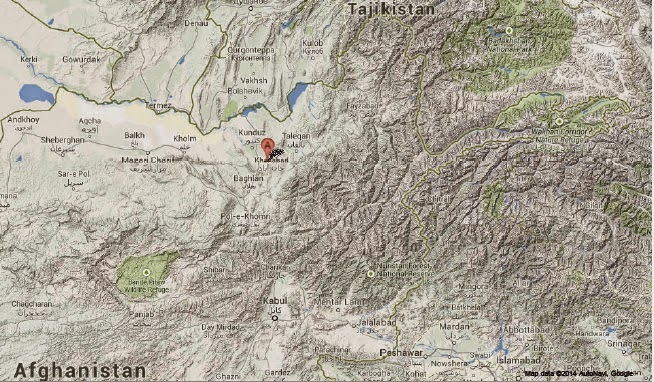
The United States Geological Survey recorded a Magnitude 5.4 Earthquake at a depth of 28 km to the north of the town of Balakot in Khyber Pakhtunkhwa Province, Pakistan, slightly before 3.00 am local time on Friday 27 February 2015 (slightly before 10.00 pm on Thursday 26 February GMT). Earthquakes of this size are large enough to be dangerous, and this one is reported to have led to about twenty houses to collapse, with fifteen people sufficiently injured to require hospital treatment. The quake was felt across much of northern Pakistan.

The approximate location of the 27 February 2015 Khyber Pakhtunkhwa Province Earthquake. Google Maps.

Northern Pakistan lies on to the boundary between the Indian and Eurasian tectonic plates, which runs through northern Afghanistan, Pakistan and India. The Indian Plate is moving northward relative to the Eurasian Plate, causing folding and uplift along this boundary, which has led to the formation of the Hindu Kush Mountains of Afghanistan, the Himalayas and the other mountain ranges of Central Asia., and which makes the nations in this boundary zone prone to Earthquakes.

See also...

The United States Geological Survey recorded a Magnitude 5.8 Earthquake at a depth of 97.2 km in southern Badakshan Province, Afghanistan...


The United States Geological Survey recorded a Magnitude 4.0 Earthquake at a depth of 52.4 km in southeastern Kunduz Province, Afghanistan...


A report in the Times of India on 6 June 2014 has documented a possible volcanic eruption in the Kangra District of Himachal Pradesh State, India. The...


Follow Sciency Thoughts on Facebook.

Sunday, 31 August 2014

Two new species of Scorpion from Pakistan.

There are thought to be about 50 described species of Scorpion from Pakistan, although these have not been systematically reviewed since 1900. Since 1995 there have been sixteen published studies on specific Scorpions in Pakistan, and seven wider studies that have mentioned Scorpions within the country. Given this state of knowledge there are likely to be many undiscovered species within the country, and there is considerable room for expanding our knowledge of the known species.

In a paper published in the American Museum Novitates on 24 June 2014, Muhammed Tahir of the Scorpion Systematics Research Group at the American Museum of Natural History and the Department of Biological Sciences at the University of Sargodha, Sharokh Navidpour of the Razi Reference Laboratory of Scorpion Research at the Razi Vaccine and Serum Research Institute and Lorenzo Prendini, also of the Scorpion Systematics Research Group at the American Museum of Natural History, describe two new species of Scorpion from Pakistan. 

Both new species are placed within the genus Razianus, which currently contains only a single species, Razianus zarudnyi. Razianus zarudnyi has previously only been recorded from Iran, though Tahir et al. also record its occurrence in Iraq for the first time, from a specimen collected at Bazair in Baghdad Province in 1934 and found in the collection of the American Museum of Natural History.

The first new species is named Razianus birulai, in honour of A.A. Byalynitskii-Birulya, who described the first species assigned to the genus Razianus under the name Hemibuthus zarudnyi in 1903 (it was not assigned to the genus Razianus until 1987). Razianus birulai is a 26.0-28.9 slender yellow Scorpion with red markings, described from three specimens (two male and one female) found under rocks in rocky, mountainous desert at altitudes of 1090-1458 m, in the Loralai District of Balochistan Province, Pakistan. 

Razianus birulai, male (top) and female (bottom), both in dorsal view. Scale bars are 5 mm. Tahir et al. (2014).

The second new species described is named Razianus farzanpayi, in honour of R. Farzanpay, who first described the genus Razianus. Razianus farzanpayi is a slender dark brown Scorpion with reddish-brown markings, 20-23 mm in length. The species is described from two male and four female specimens collected from under rocks in rocky, mountainous deserts in the Miranshah District of Khyber Pakhtoon Khawa Province and the Barkhan District of Balochistan, at altitudes of 931-1104 m. 

Razianus farzanpayi male (top) and female (bottom), both in dorsal view. Scale bars are 5 mm. Tahir et al. (2014).

See also…


Wood Scorpions of the genus Euscorpius are found in Europe from Iberia to Russia, as well as North Africa and southwest Asia, and is therefore one of the best studied Scorpion genuses, with eighteen described species grouped into four subgenera, and numerous subspecies. Despite this it is thought that there is still...


Scorpions are thought to have been among the earliest...


Scorpions are distinctive predatory Arachnids, with an instantly recognizable bodyform. They have eight walking legs plus a pair of grasping claws and a long, flexible tail ending in a venomous stinger; some species are capable of killing a human being with their sting...


Follow Sciency Thoughts on Facebook.