Showing posts with label Scorpions. Show all posts

Monday, 11 March 2024

Scorpiops (Euscorpiops) krachan: A new species of Scorpion from Thailand.

The Scorpion genus Scorpiops comprises medium-sized, generally brown Scorpions found across South,  Southeast, and  East Asia.  The genus is generally split into several subgenera, although not all of these are accepted by all experts in the field, while some  Scorpion  specialists elevate some or all of the subgenera to genus level.

In a paper published in the journal Zootaxa on 6 March 2024, Wasin Nawanetiwong of the Department of Biology at Chulalongkorn UniversityOndřej Košulič of the Department of Forest Protection and Wildlife Management at Mendel University in Brno, Natapot Warrit, also of Chulalongkorn University, Wilson Lourenço of the Muséum national d’Histoire naturelle, and Eric Ythier of BYG Taxa, describe a new species of Scorpiops from the Kaeng Krachan National Park in Phetchaburi Province, Thailand.

The new species is described on the basis of three male and one female specimens, all collected within the park. It is placed within the subgenus Euscorpiops, and given the specific name krachan, in reference to the national park.

Scorpiops (Euscorpiops) krachan. (A), (B) Male holotype, habitus, dorsal (A) and ventral (B) aspects. (C), (D) Female paratype, habitus, dorsal (C) and ventral (D) aspects. Scale bar is 1 cm. Nawanetiwong et al. (2024).

Male specimens of Scorpiops (Euscorpiops) krachan ranged from 21.7mm to 26.9 mm in length, while the female specimen measured 25.9 mm, small for the subgenus. These Scorpions are brownish yellow in colour, with the females being darker than the males. Males have notably longer pedipalps and chelae than the females. The carapace has a weakly granular texture.

Scorpiops (Euscorpiops) krachan, female with pre-juveniles (instar I). Nawanetiwong et al. (2024).

Members of the genus Scorpiops have been described from a wide range of forest types at altitudes of between 40 m and 1800 m above sealevel. Scorpiops (Euscorpiops) krachan is the second member of the genus to be reported in Phetchaburi Province, and is found in the Tenasserim Mountain Range, which is covered by rainforests. Specimens were found under rocks in a transitional zone between secondary and primary rainforest. Members of the genus Scorpiops are ambush predators, giving them a rather sedentary lifestyle, and therefore limited distribution potential, which leads to a high rate of  endemism within the genus.

Natural habitat of Scorpiops (Euscorpiops) krachan in Kaeng Krachan National Park, Phetchaburi Province, Thailand. Nawanetiwong et al. (2024).

See also...

Friday, 23 December 2022

Hottentotta pooyani: A new species of Scorpion from Khuzestan Province, Iran.

Iran has a large and diverse Scorpion fauna, influenced by its position at the crossroads of Anatolia, the Middle East, and South and Central Asia. The genus Hottentotta is thought to be of African origin, but has spread to the Middle East, Anatolia, and South Asia. Of the 68 species of Scorpions recorded from Iran, ten belong to the genus Hottentotta, including eight of the 41 species entirely endemic to the country.

In a paper published in the Bulletin of the Iraq Natural History Museum on 20 December 2022, Mohammed Moradi of the Department of Biology at the University of Zanjan, Ersan Aydın Yağmur of the Alaşehir Vocational School at Manisa Celal Bayar University, and Abolfazl Akbari of the Razi Vaccine and Serum Research Institute, describe a new species of Hottentotta from Khuzestan Province, Iran.

The new species is named Hottentotta pooyani, in honour of Pooyan Moradi, the son of Mohammed Moradi. It is described from two female specimens, both collected in Khuzestan Province; the males are unknown.

Hottentotta pooyani, female holotype; (A) Dorsal view, (B) Ventral view. Scale bar is 10 mm. Moradi et al. (2022).

Hottentotta pooyani is a medium sized Scorpion, with the two known specimens measuring 61.43 and 64.71 mm in length; this is fairly typical for members of the genus Hottentotta, but smaller than most Iranian members of the group. It is pale yellow in colour, with darker yellow markings around the eyes, and has a smooth carapace with sparse hairs. The pedipalps (pincers) are long and slender,

Hottentotta pooyani appears to be more similar, and therefore is probably more closely related to members of the genus found in Arabia than to those of the Iranian interior, something observed in several other Scorpions found in Khuzestan Province. Moradi et al. suggest that this endemism may be shared with the neighbouring Basra Province in Iraq, with the two provinces being isolated from the rest of their countries by climatic differences and the broad lower reaches of the rivers Tigris and Euphrates.

See also...

Follow Sciency Thoughts on Facebook.

Follow Sciency Thoughts on Twitter


Wednesday, 25 March 2020

Parioscorpio venator: A new species of Scorpion from the Early Silurian Waukesha Biota of Wisconsin, USA.

Scorpions include some of the earliest animals to have become fully terrestrial. The earliest forms are Silurian in age, but because most Palaeozoic species are represented by only rare, fragmentary material, much of their early evolutionary history is speculative. Divergent views regarding the habitat of Palaeozoic Scorpions have been published. Some have argued that the earliest scorpions were marine, whereas others have claimed a terrestrial origin. It has also been argued that some Paleozoic Scorpions were secondarily aquatic. Arguments concerning whether early Scorpions were terrestrial or marine have been based principally on stratigraphic context nd preserved anatomical features. Anatomical evidence used to interpret habitat include the presence or absence of feeding structures used to liquify prey (coxapophyses or stomathecae), chemosensory organs (pectines), mechanosensory organs (trichobothria), and respiratory structures (book gills or book lungs). In some Palaeozoic species, inferred locomotory stance, deduced from limb morphology, also has been applied as evidence of habitat. All Silurian Scorpion fossils, and indeed most from the Palaeozoic, have been recovered from nearshore to marginal-marine strata. Such deposits provide ambiguous evidence of habitat, as bodily remains of arthropods are easily transported after death. Likewise, inferring locomotory stance and habitat from limb morphology in a fossil Scorpion can yield equivocal results. Pectines, stomathecae, trichobothria, and respiratory structures are rarely preserved as fossils, and in many examples the non-preservation of such structures likely has a taphonomic origin.

In a paper published in the journal Scientific Reports on 16 January 2020, Andrew Wendruff of the Department of Biology and Earth Science at Otterbein University, Loren Babcock of the School of Earth Sciences at Ohio State University, Christian Wirkner of Allgemeine & Spezielle Zoologie at Universität Rostock, and Joanne Kluessendorf and Donald Mikulic of the Weis Earth Science Museum at the University of Wisconsin-Fox Valley, describe the exceptionally preserved remains of a new Early Silurian Scorpion from the Waukesha Biota of Wisconsin, USA.

The Waukesha Biota is a fossil lagerstätte producing exceptionally well preserved fossils from outcrops of the Brandon Bridge Formation in Waukesha and Milwaukee counties, Wisconsin. The Biota includes biomineralised and non-biomineralising or lightly skeletonised taxa, of which macrofossils are assigned to at least 12 Metazoan phyla. Articulated Trilobites, Ostracodes, Conulariids, Graptolites, non-biomineralised Arthropods and ‘Worms’ dominate the biota. Atypical marine conditions are suggested by the near lack of Echinoderm, Brachiopod, Mollusc and Coral remains. Fossils are preserved in a 12 cm layer of thinly laminated, fine-grained dolostone deposited during a transgressive episode over the eroded dolostones of the Schoolcraft and Burnt Bluff formations Recent biostratigraphic assessment of the Waukesha Lagerstätte shows that conodonts present include Pterospathodus eopennatus, the eponymous indicator of the Pterospathodus eopennatus Superzone, indicating an age of between 437.5 and 436.5 million years. Sedimentary traps which formed along the base of the scarp in the intertidal or supratidal zones received remains of organisms washed in from nearby areas. These sedimentary traps have so far not yielded remains of unambiguous, fully terrestrialised animals or plants. Organisms were preserved through replication
in microbial mats which coated and cemented bodily remains in place. Microbial processes are implicated in the precipitation of thin phosphatic coatings on non-biomineralised or lightly skeletonised remains leading to exceptional preservation.

The new Scorpion is named Parioscorpio venator, where 'Parioscorpio' means 'progenitor-Scorpion' and 'venator' means 'hunter'. It is described from two substantially complete specimens. are preserved as a combination of thin organic film and replication by thin calcium phosphate coating. Parioscorpio venator is now the earliest known scorpion

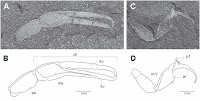
Parioscorpio venator, Brandon Bridge Formation (Silurian), Wisconsin, USA. (a) Holotype, UWGM 2162, photographed under low-angle lighting and revealing internal anatomy; (b) interpretive drawing of holotype; (c) Paratype, UWGM 2163, photographed under low-angle lighting; (d) interpretive drawing of paratype. Abbreviations: cx, coxa; fe, femur; fr, free finger; fx, fixed finger; gt, gut; le, lateral eye; me, median eyes; mt, metasomal segment; pa, patella; pc, pericardium; pfm, pedipalp femur; pm, pedipalp manus; pm.c, pedipalp manus carina; ppt, pedipalp patella; pr, pedipalp ramus; ps, pulmo-pericardial sinus; ptr, pedipalp trochanter; pv, poison vesicle; st, sternum; stn, sternite; tr, trochanter; wl, walking leg. Scale bar equals 5 mm. Wendruff et al. (2020).

Parioscorpio venator is characterised by a small exoskeleton showing a unique array of characters. Based on earlier studies some of these characters, such as compound eyes, are primitive (plesiomorphic) for Arachnids. Other characters, such as clawed pedipalps (the second pair of appendages attached to the cephalothorax of most Arachnids) and a narrow metasoma (tail) terminating in a stinger, are derived (apomorphic). A mesosoma comprised of seven segments, which is observed uniquely in Parioscorpio venator, is interpreted as a primitive characteristic. Palaeozoic Scorpions show a trend toward reducing the number of tail segments through time. Six tail segments are present in two Silurian species that are younger, Proscorpius osborni and Eramoscorpius brucensis. Most extant and extinct Scorpions have five tail sternites, a condition that had evolved by at least the Carboniferous Period. The large, anterolateral eyes, and anteromedial position of the small medial eyes, also are regarded as plesiomorphic features, as they are present in younger Silurian species such as Allopalaeophonus caledonicus, Palaeophonus nuncius, and Proscorpius osborni. Pectines, which are chemosensory structures present in all extant scorpions, are unknown in most Palaeozoic forms including Parioscorpio venator. This is probably a taphonomic artefact, as pectines are easily lost after death or moulting. In other aspects of external morphology Parioscorpio venator fits within the range of morphological features exhibited among other, more derived, Scorpion taxa. A telson bearing an expanded area for a poison vesicle and a stinger is an apomorphous condition for Scorpions. The holotype of Parioscorpio venator preserves an incomplete telson, which is folded under the fifth metasomal segment. The proximal portion shows a swelling close to the articulation with the metasoma, inferred to be a poison vesicle, but the more terminal stinger is not evident.

Additional images of the holotype of Parioscorpio venator  (UWGM 2162), Brandon Bridge Formation (Silurian), Wisconsin, USA. (a) Entire specimen photographed under low-angle lighting and revealing internal anatomy; (b) closeup of left pedipalp; (c) closeup of prosoma showing the large, anterolateral eyes; (d) closeup of the strut-like pulmo-pericardial sinuses that project from the pericardium; (e) closeup of medial hourglassshaped pericardium; (f)  closeup of end of the metasoma showing a bulbous vesicle folded over the previously metasomal segment, terminal stinger missing; (g) entire specimen photographed with diffuse lighting. Scale bars equal 5 mm for (a) and (g); scale bar equals 1 mm for (b)–(f). Wendruff et al. (2020).

Both specimens of Parioscorpio venator show details of internal anatomy. In the paratype, parting of the rock through the fossil reveals a medial structure interpreted as the gut tract, and it resembles that of extant Scorpions. It is a narrow, simple tube extending from the prosoma to the metasoma. It originates in the anterior prosoma, slightly forward of the inferred position of the mouth.

In the holotype of Parioscorpio venator, internal structures of the mesosoma and metasoma have been impressed on the thin dorsal cuticle during sediment compaction. They consist of a series of narrow, hourglass-shaped medial structures extending much of the length of the mesosoma. Extending laterally from each of the medial structures is a pair of curved, strut-like elements. The hourglass-shaped structures of the mesosoma continue into the metasoma as a simple, narrow tube. Neither book lungs nor book gills are evident on the fossil.

Detailed studies of the central architecture of the circulatory and respiratory systems in present-day Scorpions reveal a strikingly similar arrangement to the preserved structures in Parioscorpio venator. The pericardium, which surrounds and houses the heart, comprises a series of narrow, medial hourglass-shaped structures in the mesosoma. Strut-like pulmo-pericardial sinuses project laterally from the pericardium. In some extant Scorpions, these internal medial structures are reflected externally on the dorsal cuticle along with the tergite boundaries. This is evident on P. venator as well. In extant scorpions, the pulmo-pericardial sinuses connect the book lungs with the circulatory system. The book lungs oxygenate the hemolymph (‘blood’) and deliver the oxygenated hemolymph to the pericardium. Wendruff et al. infer that the organs of the respiratory-cardiovascular architecture were evolutionarily conservative.

Medial structures associated with the pulmonary-cardiovascular system in Silurian (a) and Holocene (b), (c) scorpions. (a) Parioscorpio venator, holotype, detail of medial region showing pulmo-cardiovascular structures; (b) Scanning Electron Microscope image of Centruroides exilicauda, corrosion cast of pericardium and associated pulmo-pericardial sinuses; (c) Hadogenes troglodytes, male, dorsal surface, showing medial structures externally reflecting the position of the internal pericardium (compare with (b)). Abbreviations: bl, book lungs; pc, pericardium; ps, pulmo-pericardial sinus. Scale bars equal 1 mm for (a,b); scale bar equals 1 cm for (c). Wendruff et al. (2020).

Among extant Chelicerates, terrestrial forms such as Scorpions tend to be restricted to processing oxygen from air (e.g., by means of book lungs). However, marine Xiphosurans (Horseshoe Crabs), which normally extract oxygen from water by means of external book gills, are nevertheless capable of respiration when they journey onto land to spawn. The circulatory and respiratory organs of Xiphosurans are equally complex to those of Scorpions and this may contribute to their ability to respire in air and survive on land. Presumably, ancient Xiphosurans and Arachnid ancestors had a similar capability to venture onto land.

Anatomical details preserved in Parioscorpio venator suggest that the physiological changes necessary to accommodate a marine-to-terrestrial transition in Arachnids occurred early in their evolutionary history. Whether Parioscorpio venator was a fully terrestrial Arthropod is uncertain. The close similarity of its preserved pulmonary-cardiovascular structures with those of extant Scorpions and Horseshoe Crabs hint at the possibility of extended stays on land.

See also...

https://sciencythoughts.blogspot.com/2020/01/chinese-national-arrested-trying-to.htmlhttps://sciencythoughts.blogspot.com/2018/08/alloscorpiops-viktoriae-new-species-of.html
https://sciencythoughts.blogspot.com/2018/02/physoctonus-amazonicus-new-species-of.htmlhttps://sciencythoughts.blogspot.com/2016/04/opsieobuthus-tungeri-scorpion-from.html
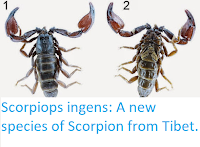
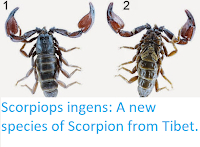
https://sciencythoughts.blogspot.com/2015/08/tityus-apozonalli-new-species-of.htmlhttps://sciencythoughts.blogspot.com/2015/05/scorpiops-ingens-new-species-of.html
Follow Sciency Thoughts on Facebook.

Wednesday, 15 January 2020

Chinese national arrested trying to smuggle Scorpions through Bandaranaike International Airport, Sri Lanka.

A 30-year-old Chinese man was arrested at Bandaranaike International Airport in Colombo, Sri Lanka when he was found to be carrying about 200 live Scorpions in plastic containers in his luggage. The man admitted to having collected the animals from the wild himself, and stated that he was taking them back to China for breeding and to sell. He was eventually allowed to continue his journey, without the Scorpions, after paying a 100 000 rupee fine (about US$550).

Scorpions found in the luggage of a Chinese man detained at Colombo Airport, Sri Lamka. Colombo Gazette.

Sri Lanka has a high biodiversity level, with many endemic species (species not found anywhere else), as might be expected from a large island in a tropical location, It has in theory had legislation to protect its wildlife for decades, but a lengthy civil conflict has made this less of a priority than it might have been, and the country became a centre for wildlife crime, with criminals both targeting the island's own flora and fauna, and using the island as a rout through which to smuggle wildlife and wildlife products from elsewhere in Asia and Africa. The country has stated that it now intends to make tackling wildlife crime a priority, though with a large, and growing population, high poverty levels, and a weak national infrastructure, it remains to be seen how this will be implemented.

See also...

https://sciencythoughts.blogspot.com/2018/08/alloscorpiops-viktoriae-new-species-of.htmlhttps://sciencythoughts.blogspot.com/2018/02/physoctonus-amazonicus-new-species-of.html
http://sciencythoughts.blogspot.co.uk/2016/04/opsieobuthus-tungeri-scorpion-from.htmlhttp://sciencythoughts.blogspot.co.uk/2015/08/tityus-apozonalli-new-species-of.html
http://sciencythoughts.blogspot.co.uk/2015/05/scorpiops-ingens-new-species-of.htmlhttp://sciencythoughts.blogspot.co.uk/2014/08/two-new-species-of-scorpion-from.html
Follow Sciency Thoughts on Facebook.

Tuesday, 28 August 2018

Alloscorpiops viktoriae: A new species of Burrowing Scorpion from the Magway Region of Myanmar.

Burrowing Scorpions of the genus Alloscorpiops are found across southern and central Thailand, as well as in parts of neighbouring Vietnam and Laos, where they are found in both dry and humid tropical forests. 

In a paper published in the journal ZooKeys on 17 July 2018, Wilson Lourenço of the Muséum national d’Histoire naturelle, and Ondřej Košulič of the Department of Forest Protection and Wildlife Management at the Mendel University in Brno, describe a new species of Alloscorpiops from the Magway Region of central Myanmar.

The new species is named Alloscorpiops viktoriae, in honour of Viktorie Košuličová, the daughter of Ondřej Košulič, and the proximity of the site where the species was discovered to Mount Victoria, 'the most impressive peak of Central Myanmar'. It is described from three specimens, two adult females and a juvenile male, found on a sandy riverbank. The species is reddish to dark brown in colour and small for a member of the genus Alloscorpiops, with one of the adult females measuring 50.9 mm.

Alloscorpiops viktoriae, female. Dorsal and ventral aspects. Lourenço & Košulič (2018).

See also...

https://sciencythoughts.blogspot.com/2018/02/physoctonus-amazonicus-new-species-of.htmlhttp://sciencythoughts.blogspot.co.uk/2016/04/opsieobuthus-tungeri-scorpion-from.html
http://sciencythoughts.blogspot.co.uk/2015/08/tityus-apozonalli-new-species-of.htmlhttp://sciencythoughts.blogspot.co.uk/2015/05/scorpiops-ingens-new-species-of.html
http://sciencythoughts.blogspot.co.uk/2014/08/two-new-species-of-scorpion-from.htmlhttp://sciencythoughts.blogspot.co.uk/2014/05/a-new-species-of-wood-scorpion-from.html
Follow Sciency Thoughts on Facebook.

Saturday, 10 February 2018

Physoctonus amazonicus: A new species of Far-tailed Scorpion from Pará State in Brazil.

Fat-tailed Scorpions, Buthidae, are the largest group of Scorpions, with over 800 described species. They get their name from the fact that many species have thick tails and slender claws, primarily relying on their venom for both offence and defence, with a handful of species being capable of killing a Human with their sting. The genus Physoctonus currently contains two species, both from the caatingas thornscrub of northeastern Brazil.

In a paper published in the journal ZooKeys on 23 October 2017, Wilson Lourenço of the Muséum national d’Histoire naturelle at the Sorbonne Universités describes a new species of Physoctonus from Pará State in Brazil, based upon material collected by French zoologist Jean Vellard in 1929, and stored since then in the collection of the Muséum national d’Histoire naturelle.

The Vellard made two trips to the Amazon region of Brazil in the 1920s, during which time he studied the Scorpions and Venomous Fish of the area. He subsequently described four new species of Scorpion from Brazil, all of which are still considered valid today. Vallard also left a number of undescribed specimens in museum collections, though these have largely been overlooked to date.

The new species is named Physoctonus amazonicus, in reference to the area where it was found, in the Campos do Pará region between rivers Xingu and Araguaya, part of the Amazon drainage system. The species is a small-to-medium sized Scorpion, reaching a size of at least 28.4 mm (based upon the size of the single known female specimen – the males are unknown) and yellow in colour with brown spots. The only known specimen was found under a Termite mound in cerrado (savanna) grassland.

Physoctonus amazonicus, female specimen in dorsal and ventral views. Lourenço (2017).

See also...

http://sciencythoughts.blogspot.co.uk/2016/04/opsieobuthus-tungeri-scorpion-from.htmlhttp://sciencythoughts.blogspot.co.uk/2015/08/tityus-apozonalli-new-species-of.html
http://sciencythoughts.blogspot.co.uk/2015/05/scorpiops-ingens-new-species-of.htmlhttp://sciencythoughts.blogspot.co.uk/2014/08/two-new-species-of-scorpion-from.html
http://sciencythoughts.blogspot.co.uk/2014/05/a-new-species-of-wood-scorpion-from.htmlhttp://sciencythoughts.blogspot.co.uk/2013/12/a-scorpion-from-late-devonian-of-south.html
Follow Sciency Thoughts on Facebook.

Sunday, 10 April 2016

?Opsieobuthus tungeri: A Scorpion from the Permian Petrified Forest of Chemnitz in eastern Germany

Scorpions are a highly successful group of predatory Arachnids, with over 1750 described living species and a fossil record dating back to the Silurian. There are currently 131 described fossil Scorpion species, however these are not distributed evenly through the fossil record, with over sixty described species from the Carboniferous and less than ten from most other geological periods. To date Permian Scorpions are known only from some fragmentary remains from Isady in the Vologda Region of Russia and a trace fossil interpreted as a Scorpion track from Arizona.

In a paper published in the journal BMC Evolutionary Biology on 7 April 2016 Jason Dunlop of the Museum für Naturkunde at the Leibniz Institute for Research on Evolution and Biodiversity at the Humboldt University Berlin, David Legg of the Oxford University Museum of Natural History, Paul Selden of the Paleontological Institute at the University of Kansas and the Natural History Museum in London, Victor Fet of the Department of Biological Sciences at Marshall University, Joerg Schneider of the Geological Institute at TU Bergakademie Freiberg and the Kazan Federal University and Ronny Rößler also of the Geological Institute at TU Bergakademie Freiberg and of the Museum für Naturkunde in Chemnitz, describe a new species of Scorpion from the Early Permian Petrified Forest of Chemnitz in Saxony in eastern Germany.

The Chemnitz Petrified Forest is a preserved forest ecosystem buried by a pyroclastic flow, which contains one of the most complete known Permian ecosystems. As well as 53 upright tree stumps the system contains palaeosols (fossil soils) which an extensive root network and numerous chunks of detached wood. Animal fossils include Myriapods, Trigonotarbids, numerous Gastropods and some Vertebrate material

The new Scorpions are tentatively assigned to the Carboniferous genus Opsieobuthus and given the specific name tungeri in honour of the geologist Bernd Tunger for his work on the Chemnitz Petrified Forest. The species is described from two specimens, a tentatively identified as a male and a female, and is distinguished from other members of its genus on the basis of exceptionally large pectines (comb-shaped scent organs on the underside of a Scorpion), which protrude beyond the body.

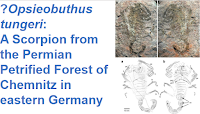
Top: ?Opsieobuthus tungeri, female specimen (?), part and counterpart from the palaeosol beneath the Zeisigwald Tuff Horizon, Leukersdorf Formation (lower Permian, Sakmarian) of the Chemnitz Petrified Forest, Saxony, Germany. Bottom: Interpretative drawings of the specimens. Abbreviations: ac, aculeus; ca, carinae; ch ?, possible chelicera; cx, coxa; cxa, coxapophysis; le, lateral eyes; op, operculum; ot, ocular tubercle; pe, pedipalp; pec, pectines; ps, pedal spur; su, superimposed coxa and pectines; tc, tarsal claws; ts, tibial spur; ves, vesicle; wi, wing-like structure; ?, disarticulated cuticle fragment of uncertain affinity. Legs numbered from I–IV. Dunlop et al. (2016).

The tentative sexual differentiation of the specimens is based upon the pectines, which in modern Scorpions tend to be larger and have more teeth in males. The female specimen is 120 mm in length and preserved within what appears to be a burrow, along with some fragments of what may be a recently shed skin. The male specimen is 130 mm in length, although it appears to have been compressed in a way that shortened it when buried.

Top: ?Opsieobuthus tungeri, male specimen (?), part and counterpart from the palaeosol beneath the Zeisigwald Tuff Horizon, Leukersdorf Formation (lower Permian, Sakmarian) of the Chemnitz Petrified Forest, Saxony, Germany. Scale bar is 10 mm. Bottom: Interpretative drawings of the specimens. Abbreviations: ac, aculeus; ca, carinae; ch ?, possible chelicera; cx, coxa; cxa, coxapophysis; le, lateral eyes; op, operculum; ot, ocular tubercle; pe, pedipalp; pec, pectines; ps, pedal spur; su, superimposed coxa and pectines; tc, tarsal claws; ts, tibial spur; ves, vesicle; wi, wing-like structure; ?, disarticulated cuticle fragment of uncertain affinity. Legs numbered from I–IV. Dunlop et al. (2016).

Dunlop et al. note that the close proximity of the male to a recently ecdysed female (female that has recently shed its skin) is interesting, as many modern male Scorpions will find and guard female subadults close to maturity, mating with them once they moult and become sexually responsive, and suggest that the proximity of the two specimens may indicate similar behaviour in these Permian Scorpions.

See also...

http://sciencythoughts.blogspot.co.uk/2015/08/tityus-apozonalli-new-species-of.htmlTityus apozonalli: A new species of Scorpion from Miocene Chiapas Amber.                    The ambers of Chiapas State, Mexico, were laid down in the Miocene (and possibly Oligocene) in shallow marine environments. The amber is thought to be derived from resin secreted from a Leguminous tree of the genus Hymenaea, which lived in mangrove...
http://sciencythoughts.blogspot.co.uk/2013/12/a-scorpion-from-late-devonian-of-south.htmlA Scorpion from the Late Devonian of South Africa.                                                             Scorpions are thought to have been among the earliest Animals to colonize the land, with specimens...

Follow Sciency Thoughts on Facebook.