Showing posts with label Klyuchevskoi Volcano Group. Show all posts

Thursday, 29 October 2020

Eruption on Mount Bezymianny in the Russian Far East.

The Tokyo Volcanic Ash Advisory Center and Kamtchatka Volcanic Eruption Response Team reported a major eruption on Mount Bezymianny, a 2882 m stratovolcano (cone shaped volcano made up of layers of ash and lava) on the central part of the Kamchatka Peninsula, which started slightly after 8.20 am local time on Thursday 22 October 2020, which produced an ash column about 9 km high, and formed a cloud roughly 100 km x 200 km in extent. This split into two parts, one of which drifted to the northwest and the other the southeast, travelling over 800 km before dispersing. The following day a satellite passing over the volcano detected a thermal anomaly which is thought likely to be the result of a lava dome forming, but there have been no further eruptions.

 
An ash column over Mount Bezymianny on the Kamchatka Peninsula on 22 October 2020. Siberian Times.

Mount Bezymianny was thought to be extinct until 1955, when it began a volcanic cycle that ended in 1956 with an explosive eruption caused the summit to collapse and created a large horseshoe-shaped crater. This has subsequently been filled in by further eruptive episodes on Bezymianny. The current summit is 2882 m high, but it is overshadowed by the nearby Kamen and Kluchevskaya volcanoes at 4579 m and 4750 m respectively. Bezymianny is thought to have formed about 4700 years ago, on the remains on an older, Pleistocene, volcano active between 11 000 and 7000 years ago. It has undergone three periods of intense activity since its formation, but was apparently inactive for about a thousand years prior to its 1955 reactivation.

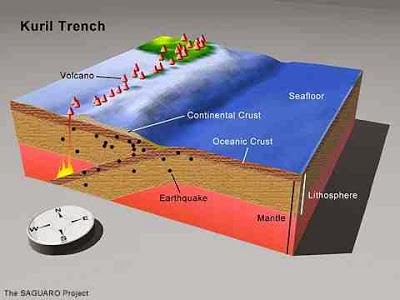
Mount Bezymianny is part of the Klyuchevskoi Volcano Group in the Ust-Kamchatka (East Kamchatka) District, along with mounts Klyuchevskoi and Kamen. The Kamchatka Peninsula lies on the eastern edge of the Okhotsk Plate, close to its margin with the Pacific and North American Plates. The Pacific Plate is being subducted along the margin, and as it does so it passes under the southern part of the Kamchatka Peninsula, and as it does so is partially melted by the friction and the heat of the Earth's interior. Some of the melted material then rises through the overlying Okhotsk Plate as magma and fuelling the volcanoes of southern Kamchatka.
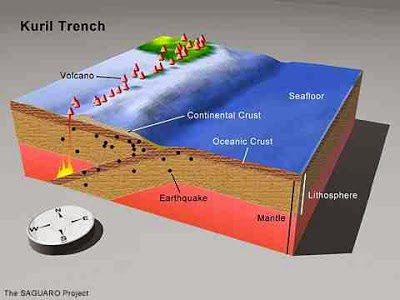
 
Simple diagram showing the subduction of the Pacific Plate beneath the Okhotsk Plate along the Kuril Kamchatka Trench. The Kamchatka Peninsula is at the top of the diagram. Auburn University.

See also...


Follow Sciency Thoughts on Facebook.

Follow Sciency Thoughts on Twitter.


Wednesday, 15 April 2020

Aviation alart issued after eruption on Mount Klyuchevskoi.

The Kamtchatka Volcanic Eruption Response Team has issued a warning to aviation following an eruption on Mount Klyuchevskoi, a 4750, stratovolcano (cone-shaped volcano made up of successive layers of ash and lava), on the central Kamchatka Peninsula, at about 0.40 am local time on Wednesday 15 April 2020. The eruption produced an ash column that rose to a height of about 6000 meters above sealevel, and drifted about 65 km to the northeast. Smaller explosive eruptions continue on the volcano, which has been more-or-less constantly active since April 2019. 

An ash cloud above Mount Klyuchevskoi on 13 April 2020. Volcano Discovery/Kamtchatka Volcanic Eruption Response Team.

Mount Klyuchevskoi is part of the Klyuchevskoi Volcano Group in the Ust-Kamchatka (East Kamchatka) District, along with mounts Bezymianny and Kamen. The Kamchatka Peninsula lies on the eastern edge of the Okhotsk Plate, close to its margin with the Pacific and North American Plates. The Pacific Plate is being subducted along the margin, and as it does so it passes under the southern part of the Kamchatka Peninsula, and as it does so is partially melted by the friction and the heat of the Earth's interior. Some of the melted material then rises through the overlying Okhotsk Plate as magma and fuelling the volcanoes of southern Kamchatka.

Simple diagram showing the subduction of the Pacific Plate beneath the Okhotsk Plate along the Kuril Kamchatka Trench. The Kamchatka Peninsula is at the top of the diagram. Auburn University.

See also...

https://sciencythoughts.blogspot.com/2020/03/magnitude-75-earthquake-to-southeast-of.htmlhttps://sciencythoughts.blogspot.com/2019/06/raikoke-volcano-erupts-for-first-time.html
https://sciencythoughts.blogspot.com/2019/03/eruptions-on-mount-bezymianny.htmlhttps://sciencythoughts.blogspot.com/2018/11/eruption-on-mount-ebeko-produces-35-km.html
Follow Sciency Thoughts on Facebook.

Saturday, 23 March 2019

Eruptions on Mount Bezymianny.

The Kamtchatka Volcanic Eruption Response Team reported a thermal anomaly beneath Mount Bezymianny, a 2882 m stratovolcano (cone shaped volcano made up of layers of ash and lava) on the central part of the Kamchatka Peninsula, seen in satellite images between 12 and 15 March 2019, accompanied by intense gas-end-steam emissions from the volcano's crater and avalanches of hot ash on its flanks observed by webcams located around the site. This was followed by a series of eruptions on 15-16 March, which produced ash columns up to 15 km high and drifted to the east and northeast, with ashfalls being reported by communities up to 120 km away.

Thermal image of an eruption on Mount Bezymianny on 15 March 2019. Bright white area represents fragments of hot rock collapsed onto the lava dome and flanks of the volcano. KVERT.

Mount Bezymianny was thought to be extinct until 1955, when it began a volcanic cycle that ended in 1956 with an explosive eruption caused the summit to collapse and created a large horseshoe-shaped crater. This has subsequently been filled in by further eruptive episodes on Bezymianny. The current summit is 2882 m high, but it is overshadowed by the nearby Kamen and Kluchevskaya volcanoes at 4579 m and 4750 m respectively. Bezymianny is thought to have formed about 4700 years ago, on the remains on an older, Pleistocene, volcano active between 11 000 and 7000 years ago. It has undergone three periods of intense activity since its formation, but was apparently inactive for about a thousand years prior to its 1955 reactivation.

 Infrared satellite images of a spreading ash plume from an eruption on Mount Bezymianny starting at 4.10 pm GMT on 16 March 2019. KVERT/VolSatView.

Mount Bezymianny is part of the Klyuchevskoi Volcano Group in the Ust-Kamchatka (East Kamchatka) District, along with mounts Klyuchevskoi and Kamen. The Kamchatka Peninsula lies on the eastern edge of the Okhotsk Plate, close to its margin with the Pacific and North American Plates. The Pacific Plate is being subducted along the margin, and as it does so it passes under the southern part of the Kamchatka Peninsula, and as it does so is partially melted by the friction and the heat of the Earth's interior. Some of the melted material then rises through the overlying Okhotsk Plate as magma and fuelling the volcanoes of southern Kamchatka.

 Simple diagram showing the subduction of the Pacific Plate beneath the Okhotsk Plate along the Kuril Kamchatka Trench. The Kamchatka Peninsula is at the top of the diagram. Auburn University.

See also...

https://sciencythoughts.blogspot.com/2018/01/eruption-on-mount-klyuchevskoi-russian.htmlhttps://sciencythoughts.blogspot.com/2017/12/eruption-on-mount-bezymianny-kamchatka.html
https://sciencythoughts.blogspot.com/2017/12/eruption-on-mount-klyuchevskoi.htmlhttps://sciencythoughts.blogspot.com/2017/12/eruptive-emissions-from-mount.html
https://sciencythoughts.blogspot.com/2017/09/eruption-on-mount-zhupanovsky-kamchatka.htmlhttps://sciencythoughts.blogspot.com/2017/03/eruption-on-mount-kambalny-kamchatka.html
Follow Sciency Thoughts on Facebook.

Friday, 5 January 2018

Eruption on Mount Klyuchevskoi, Russian Far East.

The Kamtchatka Volcanic Eruption Response Team reported an eruption on Mount Klyuchevskoi, a 4750, stratovolcano (cone-shaped volcano made up of successive layers of ash and lava), on the central Kamchatka Peninsula, on Wednesday 3 January 2017, which produced a column of ash and steam that rose to 5.5 km above sealevel and drifted 92 km to the northeast. The volcano had been inactive for most of this year, but began to produce emissions on 2 December, and underwent  eruptions on the fifth, seventh, thirteenth, and twenty-first of the month.

Column of ash over Mount Klyuchevskoi. Igor Buymistrov/TASS.

Mount Klyuchevskoi is part of the Klyuchevskoi Volcano Group in the Ust-Kamchatka (East Kamchatka) District, along with mounts Bezymianny and Kamen. The Kamchatka Peninsula lies on the eastern edge of the Okhotsk Plate, close to its margin with the Pacific and North American Plates. The Pacific Plate is being subducted along the margin, and as it does so it passes under the southern part of the Kamchatka Peninsula, and as it does so is partially melted by the friction and the heat of the Earth's interior. Some of the melted material then rises through the overlying Okhotsk Plate as magma and fuelling the volcanoes of southern Kamchatka.

Simple diagram showing the subduction of the Pacific Plate beneath the Okhotsk Plate along the Kuril Kamchatka Trench. The Kamchatka Peninsula is at the top of the diagram. Auburn University.

See also...

http://sciencythoughts.blogspot.co.uk/2017/12/eruption-on-mount-bezymianny-kamchatka.htmlhttp://sciencythoughts.blogspot.co.uk/2017/12/eruption-on-mount-klyuchevskoi.html
http://sciencythoughts.blogspot.co.uk/2017/12/eruptive-emissions-from-mount.htmlhttp://sciencythoughts.blogspot.co.uk/2017/09/eruption-on-mount-zhupanovsky-kamchatka.html
http://sciencythoughts.blogspot.co.uk/2017/03/eruption-on-mount-kambalny-kamchatka.htmlhttps://blogger.googleusercontent.com/img/b/R29vZ2xl/AVvXsEi_KEon7muzpRJKjS31wYRIJVIgd_YFOf-MIgnQiLNCSEnFD1GHE-wFM15TxEKbA9rp40CeAkVzf2LFR2h9ymxwaNMvi_JUr1BTOXG6q6D7p85l63nev7VOV-GvizO4djpSkqXbjfYGC3E/s200/Eruption+on+Mount+Klyuchevskoi..png
Follow Sciency Thoughts on Facebook.

Thursday, 21 December 2017

Eruption on Mount Klyuchevskoi.

The Kamtchatka Volcanic Eruption Response Team reported an eruption on Mount Klyuchevskoi, a 4750, stratovolcano (cone-shaped volcano made up of successive layers of ash and lava), on the central Kamchatka Peninsula, on Thursday 21 December 2017, which produced a column of ash and steam that rose to 7 km above sealevel and drifted 68 km to the east. The volcano had been inactive for most of this year, but began to produce emissions on 2 December, and underwent smaller eruptions on the fifth, seventh and thirteenth of the month.

Satelite image showing a plume of ash over Mount Klyuchevskoi on 21 December 2017. Suomi National Polar-orbiting Partnership/Visible Infrared Imaging Radiometer Suite/NASA/Volcano Discovery.

Mount Klyuchevskoi is part of the Klyuchevskoi Volcano Group in the Ust-Kamchatka (East Kamchatka) District, along with mounts Bezymianny and Kamen. The Kamchatka Peninsula lies on the eastern edge of the Okhotsk Plate, close to its margin with the Pacific and North American Plates. The Pacific Plate is being subducted along the margin, and as it does so it passes under the southern part of the Kamchatka Peninsula, and as it does so is partially melted by the friction and the heat of the Earth's interior. Some of the melted material then rises through the overlying Okhotsk Plate as magma and fuelling the volcanoes of southern Kamchatka.

Simple diagram showing the subduction of the Pacific Plate beneath the Okhotsk Plate along the Kuril Kamchatka Trench. The Kamchatka Peninsula is at the top of the diagram. Auburn University.

See also...

http://sciencythoughts.blogspot.co.uk/2017/12/eruptive-emissions-from-mount.htmlhttp://sciencythoughts.blogspot.co.uk/2017/09/eruption-on-mount-zhupanovsky-kamchatka.html
http://sciencythoughts.blogspot.co.uk/2017/03/eruption-on-mount-kambalny-kamchatka.htmlhttps://blogger.googleusercontent.com/img/b/R29vZ2xl/AVvXsEi_KEon7muzpRJKjS31wYRIJVIgd_YFOf-MIgnQiLNCSEnFD1GHE-wFM15TxEKbA9rp40CeAkVzf2LFR2h9ymxwaNMvi_JUr1BTOXG6q6D7p85l63nev7VOV-GvizO4djpSkqXbjfYGC3E/s200/Eruption+on+Mount+Klyuchevskoi..png
http://sciencythoughts.blogspot.co.uk/2015/12/eruptions-on-mount-zhupanovsky.htmlhttp://sciencythoughts.blogspot.co.uk/2014/08/two-dead-and-one-missing-after.html
Follow Sciency Thoughts on Facebook.

Monday, 18 July 2016

Eruption on Mount Klyuchevskoi.

The Kamtchatka Volcanic Eruption Response Team reported an explosive eruption on Mount Klyuchevskoi slightly before 9.45 am local time on Monday 18 July 2016 (slightly before 9.45 pm on Sunday 17 July 2016 GMT), with an ash column reaching 6 km above the summit of the volcano and  drifted about 30 km to the southeast.

 Ash cloud over Mount Klyuchevskoi on 18 July 2016. МЕТЕОВЕСТИ.

4750 m high Mount Klyuchevskoi is part of the Klyuchevskoi Volcano Group in the Ust-Kamchatka (East Kamchatka) District, along with mounts Bezymianny and Kamen. The Kamchatka Peninsula lies on the eastern edge of the Okhotsk Plate, close to its margin with the Pacific and North American Plates. The Pacific Plate is being subducted along the margin, and as it does so it passes under the southern part of the Kamchatka Peninsula, and as it does so is partially melted by the friction and the heat of the Earth's interior. Some of the melted material then rises through the overlying Okhotsk Plate as magma and fueling the volcanoes of southern Kamchatka.

 See also...

http://sciencythoughts.blogspot.co.uk/2015/12/eruptions-on-mount-zhupanovsky.htmlEruptions on Mount Zhupanovsky.                  The Kamtchatka Volcanic Eruption Response Team reported explosive eruptions on Mount Zhupanovsky on Friday 27 and Monday 30 November 2015, with ash columns reaching 6-7 km above the summit of the volcano and  drifted about 300 km to the east and southeast, as well as a pyroclastic flow (avalanche...
http://sciencythoughts.blogspot.co.uk/2014/08/two-dead-and-one-missing-after.htmlTwo dead and one missing after avalanche on Russian volcano.                                    Two people are known to have died and a third is missing after an avalanche on Mount Kamen on the Kamchatka Peninsula on...
http://sciencythoughts.blogspot.co.uk/2014/05/eruption-on-shivaluch-produces-10-km.htmlEruption on Shivaluch produces a 10 km high ash column.                                                 Mount Shivluch, a 3.283 km high volcano on the eastern Kamchatka Peninsula, underwent a major eruption on Tuesday 27 May 2014, producing...
Follow Sciency Thoughts on Facebook.