Baikal is the most ancient and deepest lake on the Earth. It is thought to be 25–30 million years old, its maximum depth is 1641 m, and the volume of water body exceeds 23 000 km³. The family Lubomirskiidae represents a spectacular example of endemic radiation of Freshwater Sponges under the specific conditions of the great lake. Genetic studies have shown this family to be monophyletic (all descended from a single common ancestor, all of the descendants of which are placed within the family), having derived from the more widespread Freshwater Demosponge family Spongillidae. Members of the Lubomirskiidae no longer undergo gemmulation (asexual reproduction), which is thought to be a responce to a long residence in the stable and relatively benign conditions of the lake.
At present, 14 species are allocated to the family Lubomirskiidae, although this number is most likely underestimated. Comprehensive morphological study of the Baikal Sponges has revealed at least five forms that showed a constant set of morphological characteristics but could not be related to any known species, forms which have been suggested to be new species. Additionally, some specimens with uncommon morphology have been described, as well as several Sponge specimens having unusual or transitional traits.
The gaps in our knowledge of Lubomirskiidae morphology and taxonomy concern some aspects in the biology of the Baikal Sponges. The absence of gemmules, gemmuloscleres, and parenchymal microscleres, which often contribute to taxonomy, complicates species identification. Moreover, the majority of the Lubomirskiidae species were described in the late nineteenth and early twentieth centuries. The descriptions were limited to the classical taxonomy based on diagnostic morphological
characters and were often very brief.
The genus Swartschewskia is clearly segregated from other Lubomirskiidae genera. Only Swartschewskia is characterised by cortex: an ectosomal skeleton, tangential arrangement of primary tracts and stout bent strongyles as megascleres. The genus includes two species: Swartschewskia papyracea and Swartschewskia irregularis. Swartschewskia papyracea is widely distributed in the depth range of 1–80 m in Baikal. In contrast Swartschewskia irregularis is extremely rare, inhabiting sublittoral zone of Baikal (70–150 m). The species was described in 1902, based upon a single specimen that was not preserved. During the next 120 years only one Sponge specimen with a similar morphology has been found but no data on its morphology were published.
Molecular approach is also limited for phylogenetic studies of the Baikal sponges due to low variability of markers usually applied for this purpose throughout the world. Recently the protein coding sequences of mitochondrial DNA were used to study the phylogenetic relationship of Baikal sponges only at the genera taxonomic level. This study showed that the nucleotide substitution rate of intergenic regions of the Baikal Sponge mtDNA is significantly higher than coding sequences, which makes them very promising for phylogenetic reconstructions of closely related species. However, only concatenated nuclear regions and mitochondrial data allowed taxonomists to separate closely related species of the family Lubomirskiidae. Therefore Bukshuk and Maikova used concatenated nuclear regions and mitochondrial sequences to investigate the phylogenetic position of a new species within the family Lubomirskiidae.
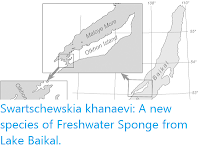
During a seried of expeditions in 2016, unusual Sponges were sampled in Olkhonskiye Vorota Strait. These Sponges were identified as a separate species based on their morphological and molecular phylogenetic data.
The Olkhonskiye Vorota is a narrow strait that connects the Maloye More Strait with the main part of Baikal. The bottom of the Maloye More and the Olkhonskiye Vorota straits consists of different types of ground: rock debris, boulders, pebbles, various sand fractions, and silt. The samples were collected at the three study sites. At study sites (1) and (2), an extensive multi-layered bank of rock debris is located along the shore from the shoreline to the depth of 4–10 m. Stone fragments have rather large interstices between each other. The interstices are not filled with smaller fractions of ground (such as gravel, sand or silt); hence, unhampered water movements can take place there. Below 10 m, the bottom is sandy with rare boulders submerged in the sand with their lower side. At the study site 3, the bottom mainly consists of sand with detached boulders and rocks, which can be partially submerged in sand.
Sampling sites in Lake Baikal. Bukshuk & Maikova (2020).
The new species is named Swartschewskia khanaevi, in honour of Igor Khanaev, the scientist and diver who organised the dive program and collected type material. It is a thin encrusting Sponge, reaching its maximal thickness in the centre of the body, at 0.5-1.0 mm, and its thinest at the edges, where it is 0.05–0.3 mm thick, and is yellowish beige in colour. Usually, these Sponges have from one to three oscula (large openings to the outside through which the current of water exits after passing through the spongocoel, having been absorbed through much smaller dermal pores), although one specimen was found that had six. Oscula are almost round, deepened, edged with well-developed spicular vallum. Oscula size is 146–978 × 235–1148 μm. Dermal pores are non-uniformly distributed on sponge surface. They are mostly aggregated in pore fields. Those are not deepened relatively to sponge surface, diverse in shape and can join to each other. Round or ovoid inhalant apertures of 7–(106 × 7–140 μm in size perforate dermal membrane. The apertures are located in meshes of ectosomal skeleton network. Pore fields size varies significantly: 0.07–1.5 × 0.09–2 mm. One field usually contains 4–40 pores; the maximum number of pores is 78. There are also isolated pores.
Up to 70–80 % of sponge surface is lacking in both oscula and pores and covered with dense accumulations of Cocconeis placentula and sporadic exemplars of other Diatoms. Additionally, some Ciliated Protozoa of genus Lagenophry were observed on all specimen of Swartschewskia khanaevi.
Swartschewskia khanaevi, external view. Abbreviations: osc, oscula; pf, pore fields. Scale bar is 5 mm. Bukshuk & Maikova (2020).
The Sponge surface is a hard but fragile crust, i.e., ectosomal skeleton; the inner part of the body is soft and can be easily detached from the crust. The ectosomal skeleton has a form of a cortical layer of tangentially arranged tracts forming an alveolar network. Meshes are disordered; size and shape vary. In some parts of the cortex, meshes are indistinguishable; tracts cross irregularly. Megascleres in tracts are arranged in loose bundles, 2–8 megascleres in every bundle. The thickness of the cortex varies significantly from 44 to 307 μm. The thickest cortex is observed near oscula, the thinnest in the areas of pore fields. The choanosomal skeleton is weak; it consists of separated spicules and thin disordered fibres.
Megascleres (structural skeletal elements) are exclusively strongyles (spicules with blunted or rounded ends) of 99–149 × 9–21 µm with different sorts of spines: simple spines, rosette spines, and a peculiar sort of spine, secondarily microspined tuberculated spines. The latter look like tubercles (4–9 µm in diameter and 1–5 µm in height) densely ornamented with simple spines (number 13–58) and these are the most abundant sort of spines. Rosette spines are comparatively rare (0.83.2 × 1–3.6 μm in size, contain 3–9 simple spines). The length of isolated simple spines and simple spines in both kinds of complex spines is similar: 0.1–0.9 µm. Microscleres (smaller skeletal elements) are absent.

Swartschewskia khanaevi. (A) Sponge surface, (B) ectosomal skeleton, (C) cross section of skeleton, (D), (E) secondarily microspined tuberculated spines on strongyles, (F) strongyles. Abbreviations: chs, choanosomal skeleton; Cp, Cocconeis placentula; dm, dermal membrane; es, ectosomal skeleton; ia, inhalant apertures; Lsp, Lagenophrys sp.; st, spicular tracts. Scale bars: 10 μm (D), (E), 100 μm (F), 500 μm (A), 1 mm (B). Bukshuk & Maikova (2020).
See also...