Showing posts with label Porifera. Show all posts

Saturday, 20 May 2023

Freshwater Sponges from the Deccan Traps of India.

Freshwater Sponges of the Order Spongillida have a long fossil record, with isolated spicules known from the Permo-Carboniferous of the Massif Central of France and the Saar-Nahe Basin of southwest Germany, and the oldest identifiable species, Spongilla purbeckensis, coming from the Jurassic of England. Despite this, fossils of Freshwater Sponges are extremely rare, due to the fragile nature of their siliceous skeletons. Most fossils assignable to the Spongillida are simple spicules, which cannot be placed within a family, genus, or species, with more detailed classification requiring the discovery of gemmuloscleres, spicules which produce gemmules, an asexual reproductive stage. The oldest known fossil gemmule attributable to the Spongillida is Palaeospongilla chubutensis from the Lower Cretaceous of Patagonia.

Spicules of Freshwater Sponges have been recorded from several sites within the Cretaceous-Palaeocene Deccan Traps deposits of India, although most of these have been impossible to identify, although in 2021 a new species of Freshwater Sponge, Palaeocorvospongilla cretacea, was described from the Terminal Cretaceous Deccan intertrappean lacustrine deposits of the Malwa Group of Madhya Pradesh.

In a paper published in the journal Acta Palaeontologica Polonica on 8 March 2023, Bandana Samant of the Department of Geology at Rashtrasant Tukadoji Maharaj Nagpur UniversityRoberto Pronzato of the Dipartimento di Scienze della Terra, dell’Ambiente e della Vita at the Università di Genova, Dhananjay Mahendrakumar Mohabey of the Geological Survey of IndiaTiziana Cubeddu and Giacinta Angela Stocchino of the Dipartimento di Medicina Veterinaria at the Università di Sassari, Krutika Jangale, Pranay Thalal, and Anup Dhobale, also of the Department of Geology at Rashtrasant Tukadoji Maharaj Nagpur University, and Renata Manconi, also of the Dipartimento di Medicina Veterinaria at the Università di Sassari, describe a new species of Freshwater Sponge from the Deccan infratrappean deposits of Naskal in Telangana State, India.

The Deccan Traps are a series of Late Cretaceous-Early Palaeocene volcanogenic sediments covering an area of 500 000 km² across southern, western, and central India. As well as the numerous lava flows of these deposits, the sequence also includes infratrappean and intertrappean sediments (that is to say sediments covered over by lava flows, or between lava flows), which provide a fossil record of many organisms across the Cretaceous-Palaeocene boundary. The Naskal site is located in the Ranga Reddy District of Telangana State, in south-central India. This sequence is less than 3 m deep, and has a lateral extent of less than 15 m, and exposes sediments laid down between flows 3 and 4 of the Deccan Traps sequence, which have been dated to between 66.136 and 66.056 million years before the present, slightly below the Cretaceous-Palaeocene Boundary, at 66.043 million years ago.

Within the total Naskal exposure, Sponge spicules were found only at one site, Naskal GSI Quarry, within a portion of the exposure 120 mm thick. The spicule-yielding section includes exposures of (bottom-to-top) black to grey cherty limestone, hard yellowish shaly mudstone, loose shaly to carbonate mudstone to marlstone, white mudstone, and dark clay with sandy lenses. No spicules were recovered from the Naskal B exposure, which is only 7 m from the Naskal GSI Quarry exposure.

Map of India showing Deccan volcanic province (green area). (A) Location of Naskal intertrappean, Naskal B (white star) and Naskal GSI Quarry sections (red star). (B) Sponge spicule and Diatom bearing horizon in Naskal GSI Quarry section. (C) Palynomorph bearing Naskal B section. Samant et al. (2023).

The Naskal exposure is noted for its Mammal fauna, but also includes Fish, Anurans, Squamates, a Sphenodontian, Turtles, and Crocodilians. Pollen recovered from Naskal contain a mixture of forms which are known in both Cretaceous and Palaeocene deposits, as well as forms that are otherwise exclusively Cretaceous or exclusively Palaeocene.

Samples were obtained by acid-washing bulk sediment samples that sieving the remnants, and examining the filtered samples under light and scanning electron microscopes.

The specimens are placed in a new genus and genus, and given the name Longibirotula antiqua, where 'Longibirotula' refers to the long shaft of the birotules (a type of spicule with wheel-shaped ends), assumed to be gemmuloscleres, which would have produced gemmules, which in turn would have acted as a resting stage for these Sponges, and 'antiqua'  means 'old'. The distinctive birotules of this species and long and slender, reaching 47-76 μm in length, straight or slightly curved, and have scattered spines, which very in their density and number. 

Gemmuloscleres of the Palaeospongillid Sponge Longibirotula antiqua from the Upper Cretaceous–Lower Paleocene of Naskal GSI Quarry (India). (A)–(O) Birotules (slides PGNU/NSKQ/SL-1–13) slender, spiny, with long shaft. Diagenetic processes affect all spicules to various degree. Scale bars 20 µm. Samant et al. (2023).

Longibirotula antiqua also has two types of monaxial megascleres (large unbranching spicules), slim long, microspiny to smooth oxeas (needle shaped spicules) reaching 142-425 μm in length, and shorter, stouter acanthoxeas (spiny spicules) measuring 71-105 μm in length.

Megascleres of the Palaeospongillid Sponge Longibirotula antiqua from the Upper Cretaceous–Lower Paleocene of Naskal GSI Quarry (India). (A)–(I). Oxeas (slides PGNU/NSKQ/SL-1–13) slim to stout with variably pointed tips. Diagenetic processes affect all spicules to various degree. Scale bars 20 µm. Samant et al. (2023).

The spicules of the Sponge are associated with diatoms of the genus Aulacoseira, which implies a eutrophic (nutrient rich) environment, possibly caused by volcanic material entering the lake. The presence of gemmuloscleres birotules suggests that the lake was only sporadically a suitable environment for the Sponges, possibly due to seasonal variations in water level. Gemmulation, timed to match seasonal conditions, is considered to be a key evolutionary strategy for Freshwater Sponges, the the gemmules forming asexual propagative agents which can survive periods of adverse conditions and disperse to colonize new environments.

Megascleres of the Palaeospongillid Sponge Longibirotula antiqua from the Upper Cretaceous–Lower Paleocene of Naskal GSI Quarry (India). (A)–(H) Acanthoxeas (slides PGNU/NSKQ/SL-1–13) with large spines. Diagenetic processes affect all spicules to various degree. Scale bars 20 µm. Samant et al. (2023).

Gemmules (often used as the diagnostic feature for Freshwater Sponge species) for Longibirotula antiqua have not been found in the Naskal deposits, but the distinctive combination of long slim oxeas, shorter acanthoxeas and long gemmuloscleres birotules, and an absence of microscleres (a smaller class of Sponge spicules), leads Samant et al. to conclude that the material is sufficiently unique to be described as a new species. 

Fossil Freshwater Sponges of the Eocene-Miocene genus Ephydatia have gemmuloscleres birotules, as do members of the modern genera AnheteromeyeniaCorvoheteromeyeniaCorvomeyeniaHeteromeyeniaRacekiela, and Umborotula. The birotules of Longibirotula antiqua most closely resemble those of Ephydatia and Heteromeyenia, giving Samant et al. confidence that these are in fact gemmuloscleres. 

Spicular complement of skeleton and gemmules of the Palaeospongillid Sponge Longibirotula antiqua from Upper Cretaceous–Lower Paleocene of Naskal GSI Quarry (India) (slides PGNU/NSKQ/ST-1, 2). (A), (B) Acanthoxeas short with dense spines. (C), (D) Oxeas fusiform, long and with acute tips. (E), (F) Birotules with long shaft. Diagenetic processes affect all spicules to various degree. Scale bars 20 µm. Samant et al. (2023).

The smooth to microspiny long oxeas of Longibirotula antiqua resemble those of the extant genus Heterorotula. The short acanthoxeas are less similar, but still close enough that Samant et al. suspect that like HeterorotulaLongibirotula antiqua may have used these shorter spicules to form a gemmular cage, protecting its resting stage. The genus Heterorotula has a broadly Gondwanan distribution, with living species known from Australia, New Zealand, New Caledonia, and the Americas, as well as a fossil record in subequatorial Brazil (although it is absent from the Afrotropical Region), which likely suggests that Longibirotula antiqua was derived from Freshwater Sponges from India rather than Eurasia.  The similarity of Longibirotula antiqua to modern members of the group underlines the structurally conservative nature of Freshwater Sponges, as well as the success of a morphology and lifestyle which has apparently been able to persist with little change for tens of millions of years.

See also....

Follow Sciency Thoughts on Facebook.

Follow Sciency Thoughts on Twitter.


Wednesday, 17 August 2022

Assessing the authenticity of Acheulean Porosphaera beads.

The appearance of symbolic thinking is considered to be one of the most important steps in the development of modern Human cognition, giving Humans the ability to pass on information by means of objects rather than direct communication, and thereby helping to build communities bound by common cultural traits rather than simple kinship. Evidence of this, however, is difficult to detect in the archaeological record, leading to intense debates as to when and where such behaviour first appeared.

The first shell beads appear over a hundred thousand years ago in Africa and the near east, at sites such as Skhul Cave in Israel, where beads have been dated to 135-100 000 years before the present, Qafzeh Cave, also in Israel, dated to 100-92 000 years ago, Blombos Cave in South Africa, 100-70 000 years ago, Sibudu Cave in South Africa, older than 70 000 to about 60 000 years ago, Border Cave, again in South Africa, 125-35 000 years ago,  Grotte des Pigeons in Morocco, 80 000 years ago, Bizmoune Cave in Morocco, at least 142 000 years old, Rhafas Cave, also in Morocco, 82 000 years ago, Contrabandiers Cave, once again in Morocco, 120-90 000 years ago, and Oued Djebbana in Algeria, 100-90 000 years ago. All of these sites are associated with early anatomically modern Humans, apparently confirming that beads were an innovation novel to this group. It has been suggested that symbolic thinking appeared in anatomically modern Humans, providing them with a cultural edge that enabled them to replace all other Hominins. However, recent evidence has suggested that some other Hominin species also used symbolism, which would indicate a far earlier origin within the genus Homo. This analysis has largely revolved around the use of personal ornaments, such as beads, pendants, bracelets and diadems, which are taken as evidence of symbolic thought.

One group particularly associated with bead-making are Neanderthals, something which ties into deeper questions about this group's abilities, and relationship to modern Humans. 

Neanderthals were for a long time (and often still are) classified as a separate Hominin species, Homo neanderthalensis, possibly the most advanced Human species other than ourselves, but nevertheless separate and inferior. However, more recent genetic studies have shown that many modern Humans, and probably all non-African Humans, carry some Neanderthal DNA, which challenges this view of separateness. 

This has led to differing views on the taxonomic status of Neanderthals; possibly they were still a separate species, Homo neandethalensis, but only recently diverged and still capable of interbreeding with us (which is tricky, because in biology populations are generally defined as different species when they are incapable of interbreeding). Alternatively, maybe they should be seen as a modern Humans, but belonging to a different subspecies, Homo sapiens neandethalensis (with all living Humans being classified as Homo sapiens sapiens), which acknowledges that they were different from us, but not that different. Finally, maybe they should be seen as completely modern Humans, but belonging to an ethnic group which has disappeared; making them no more different from living Humans than modern Europeans are from modern Africans.

Much of this debate revolves around the cognitive abilities of Neanderthals. As a group, Neanderthals are strongly associated with the Acheulean Palaeolithic technology. This technology first appeared in Africa about 1.76 million years ago (long before the appearance of Neanderthals), and spread across much of Africa and Eurasia, being used by a variety of Hominin groups. Neanderthals first appeared somewhere between 800 000 and 315 000 years ago, and used Acheulen technology throughout almost all of their history, although some later groups appear to have adopted different technologies learned from Modern Human neighbours. Thus, while Neaderthals are strongly associated with the Acheulean technology, particularly in Europe, not all Acheuleans were Neanderthals, and not all Neanderthals were Acheuleans. 

This long use of a single tool-making technology, apparently without any innovation, has been used to suggest that Neanderthals lacked the capacity for abstract imaginative thought; they were capable of copying what they had seen others make, but were quite incapable of coming up with new ideas for themselves. However, despite this apparent lack of innovation in tool-making, Neanderthals are also thought to have been capable of considerable artistic output, with material attributed to their output including pendants made from the claws of Birds of Prey, a bone flute, cave paintings, and numerous beads, some made from shells, but many of them made from fossils of the Cretaceous Sponge, Porosphaera globularis.

In a paper published in the journal Archaeological and Anthropological Sciences on 1 August 2022, Gabriele Luigi Francesco Berruti of the University of Ferrara, and of the Association 'P-Project Prehistory Piedmont', Dario Sigari, also of the University of Ferrara, and of the Geoscience Center of Coimbra University and the Archaeological Cooperative Society, Cristiana Zanasi of the Civic Museum of Modena,  Stefano Bertola and  Allison Ceresa, again of the University of Ferrara, and Marta Arzarello, once again of the University of Ferrara, and the Association 'P-Project Prehistory Piedmont', assess the authenticity of the Porosphaera globularis beads, and assess whether they were genuinely made by our Neanderthal forebears. 

Berruti et al.'s study concentrates on a collection of Porosphaera beads in the collection of the Civic Museums of Modena, which were obtained in 1891 from the French police commissioner and antiquarian  Charles Le Beuf, who collected them from Saint-Acheul in the Somme, the type locality for the Acheulian culture (i.e. the site from which that culture was named, and to which material from other locations is compared when deciding if it can be classified as 'Acheulian'.

Porosphaera beads were collected from Acheulian sites across northwest France and Southern England in the nineteenth century. They are clearly made from fossils of the Cretaceous calcareous Sponge Porosphaera globularis, which was naturally rounded, but have holes bored through them, which nineteenth century archaeologists interpreted as evidence of their use as beads. The problems with this are that the Sponge fossils are found in the same chalk layers that Acheuleans (and later people) excavated for flints from which to make tools (meaning that Acheuleans would have been digging them out whether they subsequently used them or not), and that about 9% of these fossils have 'natural' boreholes in them, made by Cretaceous Sipunculid Worms. 

Thus there could be three possible explanations for the 'beads' found by nineteenth century archaeologists. Firstly, they could be exactly what they were assumed to be; beads made by Acheuleans as personal ornamentation. Secondly, they could be Sponges with boreholes made by Cretaceous Worms, which were then collected and used as beads by the Acheuleans. Finally, it is possible that these Sponges were bored by Cretaceous Worms and overlooked by the Acheuleans, but collected by nineteenth century archaeologists, who had preconceived ideas about what beads looked like which the Acheuleans lacked.

Archaeological sites where Porosphaera globularis beads have been recovered. Berruti et al. (2022).

Whereas a modern site used as the type for an archaeological culture (or palaeontological species) would be recorded very precisely. The Saint Acheul 'site' actually refers to an entire region in the suburbs of Amiens, with several different locations producing material, some of them from several different layers. The earliest of these contains material dated to 670-650 000 years before the present, and marks the earliest spread of the Acheulian culture into northern Europe. Accurate recording of the level from which the Porosphaera beads  were obtained is lacking, but it is thought that they came from the same layers as flint tools recorded from the site.

In 1891 the then director of the Civic Museum of Modena, Carlo Boni, purchased a collection of beads and stone tools from Le Beuf for 400 Francs. The Porosphaera beads were assembled by Boni into four necklaces, three using raffia threads and one using metal wire, with each necklace having between 112 and 156 individual beads. These were then mounted on a cardboard panel for display purposes, using some red ribbon. The beads have remained on this mount to this day, with both the beads and the panel having gained a coating of dust and an organic crust derived from the breakdown of the cardboard.

One of the four Porosphaera globularis necklaces of the Modena collection assembled on the original twentieth-century support. Paolo Terzi in Berruti et al. (2022).

Berruti et al. disassembled Boni's necklaces, in order to obtain a specimen of 520 beads, which were then individually examined. The perforations in these beads were found to be larger than the 'natural' holes caused by Cretaceous Worm-borings, and the beads themselves were, on average more uniform in size and more rounded than a selection of random Porosphaera globularis fossils. This implies strongly that the beads in the Moderna collection have been subjected to Human selection, although whether this was by Acheuleans or nineteenth century archaeologists is unclear.

Next Berruti et al. examined wear traces on the beads, finding that they showed wear around their perforations (as would be caused by a string, whether ancient of modern), and on the surfaces where the perforations were found (i.e. on the surfaces where the beads would rub-together while suspended on a string), but not on other surfaces of the beads. Furthermore, many of the beads had developed a patina, which was not seen on the surfaces adjacent to the holes. All of these have been recorded on Porosphaera beads used in other studies, and taken as evidence of the beads having been worn on a string of some description, and having rubbed against one-another while being worn.

However, Berruti et al. consider that while these traces could have been made by the actions of fashion-conscious Acheuleans, it is also possible that they could have been caused by the actions of nineteenth century antiquarians, either intentionally, to increase the value of their finds, or inadvertently, while mounting the beads onto strings for display purposes.

Since this matter cannot be resolved by looking at wear on the beads caused by them rubbing against one-another on a string, or the friction of the string itself, Berruti et al. consider an alternative source of information, namely to what extent would the beads by modified by rubbing against the skin of their wearers? (Clothing has never been found in association with Acheulean archaeological sites, and these people are therefore assumed not to have worn clothing). If the beads had never been worn by Acheuleans, but rather collected and strung by antiquarians for the first time, then any markings left by such rubbing against skin should be absent.

To this end Berruti et al. obtained five non-perforated specimens of Porosphaera globularis (which, lacking perforations, could never have been worn as beads), and tested these by rubbing them against Pig skin (considered similar enough to Human skin to be used in a variety of trials) for a total of ten minutes each; three of the beads were rubbed against clean skin and two against dirty skin.

All of the beads showed signs of abrasion and rounding after ten minutes, suggesting that they would be unlikely to survive long-term wear as items of jewellery work against the skin. The beads rubbed against dirty skin developed distinctive striations within the ten minutes, a phenomenon absent in the Moderna beads.

(a) Photomicrographs of the specimen K126 from Hannover before and after the experimentation (rubbing for 10 min on dirty pig skin); (b) Photomicrographs of the specimen L844 from Logstor before and after the experimentation (rubbing for 10 min on pig skin); in the lower part of the image, two photomicrographs of the surfaces of two different specimens of the Modena collections. The surfaces of the samples K126 and L844 before the experimentation are similar to the surfaces of the samples from the Museum collection; after the experimentation, the surfaces are strongly smoothed. Berruti et al. (2022).

Close examination of the Moderna beads enabled them to be divided into three groups, based upon their geology. The first of these show signs of having been rolled on the seafloor before being buried, producing a unique set of scratches and markings. The second group have been partially or wholly remineralized after being buried. The third set show no signs of either mechanical abrasion or remineralization. 
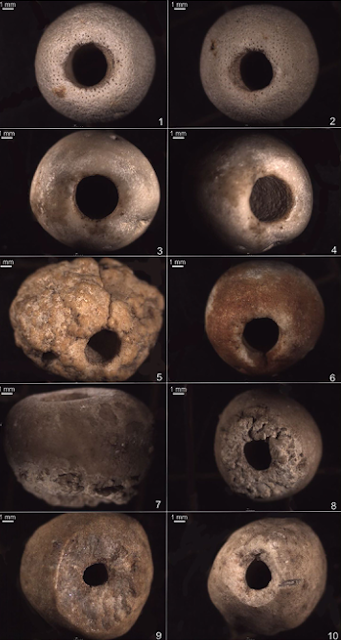
Specimens of the Modena collection. Specimens with microstructure very well preserved, the pattern of the cells forming the sponge skeleton is clearly readable (1)–(2); specimens with surfaces showing marked rounding, smoothing and erosion surfaces, caused by their rolling in water environments (3)–(4); specimens with almost uniform surface concretions, mainly yellowish (goethite, limonite) or reddish (haematite), due to the stay of the fossils into soils or karst wells with a clayish matrix rich in iron minerals (5)–(6); specimens with marked dissolution and recrystallization phenomena having an irregular distribution and due to rainwater circulation (vadose meteoric environment) (7)–(8). Indeed, there are clear phenomena of calcite mineralization, macrocrystalline as well, located only on lower fossil surface, the pending one. Berruti et al. (2022).

Berruti et al. looked for signs of intentional modification of the wholes through the beads, from which it might be possible to determine the nature of the tool being used, and therefore whether the person carrying out this action lived in the Palaeolithic or the nineteenth century. Several of the beads show signs of mechanical action around the hole, though it cannot safely be said whether this was a result of drilling by bead-maker, or abrasion by the string. In two cases the hole through the bead was hourglass shaped, which was most likely caused by drilling from each end, but is was not possible to tell what tool was used, not when this action occurred.

Specimens of the Modena collection. Specimens with preserved marl residuals in the through-hole (1)–(4); specimens with two opposite conical holes that converge in the shape of an hourglass towards the centre of the hole (5)–(10). Looking in detail at the through-hole surface, concentric striae can be identified (9)–(10); they affect the internal calcite wall of the sponge and they seemingly confirm the use of a bow drill. Berruti et al. (2022).

In the late nineteenth century the concept of symbolic thought, and its importance as a step in the development of achieving the cognitive abilities of modern Humans, was barely (if at all) understood. Even today, there are those who believe that this is a unique trait in anatomically modern Humans, and that any evidence for this in Europe prior to the arrival of anatomically modern Humans, about 40 000 years ago, must be erroneous. Many scholars in the field, however, support the idea that this, like other traits, must have evolved gradually, and therefore it is not unreasonable to expect to find evidence for some sort of symbolic thought in earlier groups.

The apparent use of personal ornamentation by Neanderthals has been seen as a clear piece of evidence in support of this idea, and the presence of beads in the classical Acheulean deposits as fairly strong evidence of the creative abilities of Neanderthals. However, the Saint Acheul beds are significantly older than any other deposits thought to have yielded material associated with personal ornamentation (made by Neanderthals, anatomically modern Humans, or anybody else), which should automatically raise questions about the reliability of these items.

Based upon this analysis, Berruti et al. conclude that the Acheulean  Porosphaera beads are entirely natural in their origin; possibly with a little bit of help by over-enthusiastic nineteenth century antiquarians, but definitely not produced by early Acheuleans.

Berruti et al. do not, however, extrapolate from this data to assume that all evidence of symbolic thought attributed to Neanderthals are false. There is a considerable body of evidence which suggests that Neandethals were capable of artistic representation, albeit later in their history than the Saint Acheul deposits. Even if this evidence is all erroneous, and our current ideas about Neanderthals are completely wrong, this will only be overturned by looking at the validity of each individual piece of evidence, with no single source of data being able to tell the whole story.

See also...


Follow Sciency Thoughts on Facebook.

Follow Sciency Thoughts on Twitter.


Tuesday, 16 June 2020

Astrolirus patricki: A new species of Sponge-associated Starfish, from the seamounts of the northwest Pacific.

Seamounts are deep-sea biomes in the global ocean which harbor diverse habitats and benthic communities. Sponges are one of the dominant benthic groups in seamount ecosystems, playing important ecological roles by providing habitat and settlement substrate for other seamount invertebrates, such as Molluscs, Hydrozoans and Echinoderms. Suspension-feeding Brittle Stars and Crinoids with long and flexible arms are often observed perching on or wrapped around Sponges. 

In a paper published in the journal PeerJ on 27 May 2020, Ruiyan Zhang of the School of Oceanography at Shanghai Jiao Tong University and the Key Laboratory of Marine Ecosystem Dynamics at the Second Institute of Oceanography of the Ministry of Natural Resources, Yadong Zhou, also of the Key Laboratory of Marine Ecosystem Dynamics at the Second Institute of Oceanography of the Ministry of Natural Resources, Ning Xiao of the Laboratory of Marine Organism Taxonomy and Phylogeny of the Institute of Oceanology and the Center for Ocean Mega-Science of the Chinese Academy of Sciences, and Chunsheng Wang, also of the School of Oceanography at Shanghai Jiao Tong University, the Key Laboratory of Marine Ecosystem Dynamics and the State Key Laboratory of Satellite Ocean Environment Dynamics at the Second Institute of Oceanography of the Ministry of Natural Resources, describe a new Starfish species, which was found attaching to deep-sea Sponges, based upon five specimens from northwestern Pacific seamounts.

Species of the family Brisingidae possess 7 20 spiny arms that are up to about 40 times the length of the disk radius. As exclusive deep-sea inhabitants, their long arms and spines potentially equip them to be excellent suspension feeders, stretching out and gathering food particles in the water column in the resource-diluted deep ocean. The Brisingidae is composed of 62 extant species designated into 10 genera. The genus Astrolirus currently contains only one species, Astrolirus panamensis, and is differentiated from the other genera based on the presence of intercostal plates on arms and a pair of marginal plates between the first adambulacral plates. Astrolirus panamensis was discovered in the eastern Pacific Ocean at 1820- 2418 m depth, with 1 eight-armed specimen and 27 nine-armed specimens of varying size (disc diameter 6- 26 mm) reported. Thereafter, Astrolirus has seldomly been reported or investigated. 

The new species is named Astrolirus patricki, in honour of the character `Patrick Star' in the famous cartoon `SpongeBob Squarepants', who always spends time with his best friend `SpongeBob', a benthic Sponge. Since all specimens of the new species were observed in situ living on Sponges, it was name by Patrick to reflect this curious relationship.

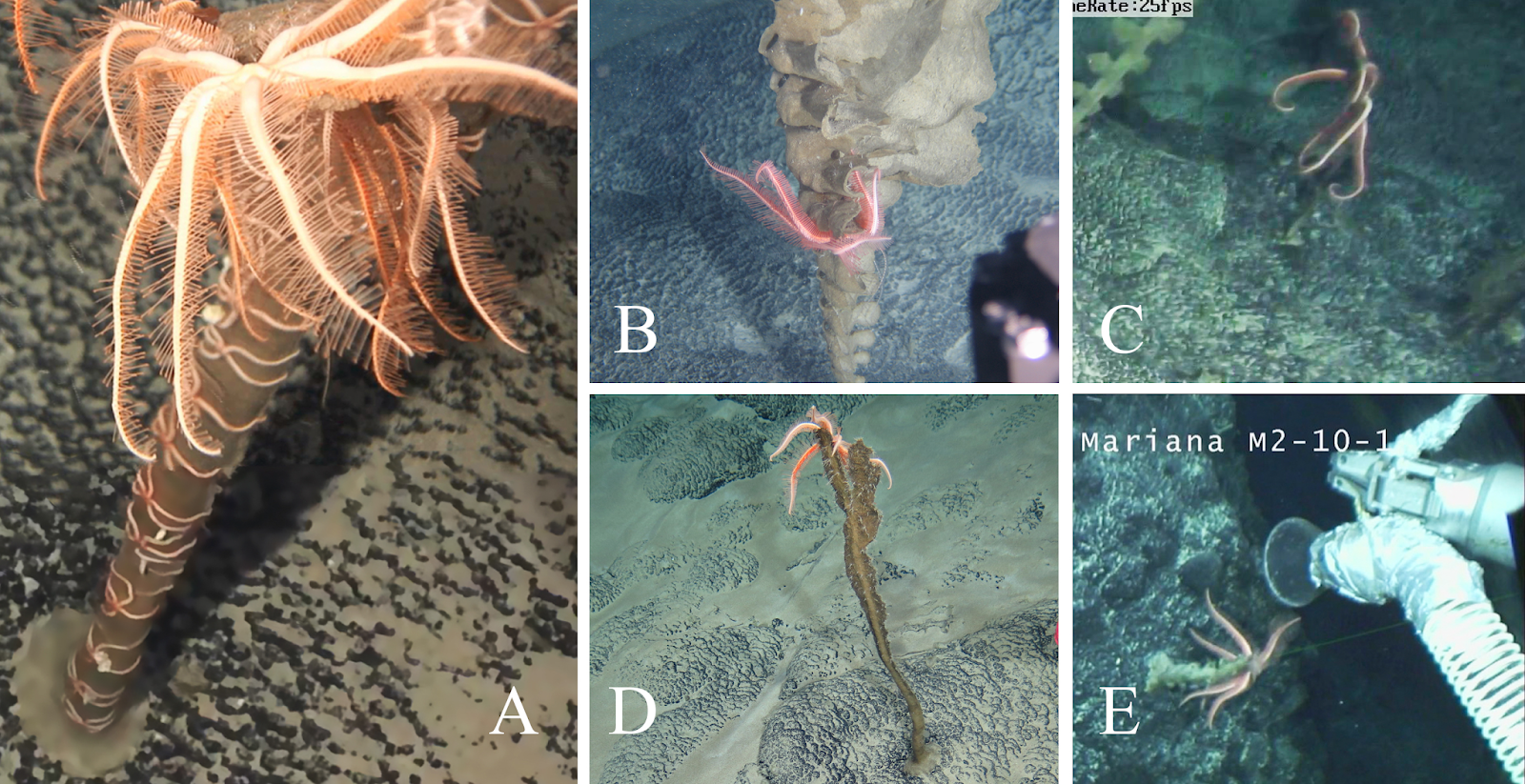
In situ photographs of Astrolirus patricki. Zhang et al. (2020).

All five specimens of the new species are seven-armed and were captured from Hexactinellid Sponges. Occasionally 2- 3 individuals were spotted on the same Sponge along with numbers of Ophiuroids and Crinoids. The new species differs greatly from Astrolirus panamensis in morphological characters and living habitat.

During the COMRA (China Ocean Mineral Resources R & D Association) cruises DY31, DY37, DY41, DY56 and a seamount cruise in the northwestern Pacific Ocean seamounts from 2013 to 2019, five specimens of the new species were collected by mechanical arms or siphon-pumps equipped on Human operated vehicles and remote operated vehicles. Specimens were photographed in situ and on board by digital cameras. Tube feet tissues were extracted from each specimen and frozen in -80°C refrigerator or liquid nitrogen for later molecular experiments, while other parts of specimens were preserved in 100% ethanol for morphological examinations. Morphological identification was conducted under a stereoscopic microscope. 

Astrolirus patricki has seven robust arms. The tntercostal integument is densely covered by irregular, abutting plates. There is no conection between proximal arm plates. The first pair of adambulacral plates is separated by a pair of marginal plates. A large interradial plate above the first marginal plates, is visible from the abactinal side, covered by scattered spinelets. The mouth spines and proximal adambulacral spines are robust, and densely distributed. There are 3-4 uboral spines and 1-2 subambulacral spines, the proximal ones of which are truncate and capitate. There is one lateral spine to each adambulacral plate, starting from about the 8th. There is a pair of gonads to each arm.

Astrolirus patricki, abactinal view. (A) Paratype RSIOAS028. (B) Paratype RSIOAS003. (C), (D), (H), holotype RSIOAS044, (C) Abactinal surface of disk and proximal part of arms, with red arrow pointing at the madreporite body, white arrow at the interradial plate and yellow arrows at the marginal plates. The red frame indicates the proximal region of arm connecting the disk and genital region, where pedicellariae do no form regular costae. (D) Abactinal surface of arm genital area with mosaic plating, red arrows show the costae bands. (E) Paratype RSIOAS003, abactinal surface of arm genital area, red arrows show the costae bands. (F) Paratype RSIOAS052, zoom in view of the abactinal disk, showing the multiple sharp spinelets on disk plates. (G) Paratype RSIOAS052, a piece of dissected skin from abactinal disk, shot from the inner side of the skin, showing the small round disk plates. (H) Abactinal surface at the middle of arm, black arrows indicate the pedicellariae bands. Zhang et ai. (2020).

See also...

https://sciencythoughts.blogspot.com/2019/08/asterodiscides-fourmanoiri-starfish.htmlhttps://sciencythoughts.blogspot.com/2019/01/acanthaster-solaris-using-environmental.html
https://sciencythoughts.blogspot.com/2019/01/sertulaster-keslingi-and-delicaster.htmlhttps://sciencythoughts.blogspot.com/2018/03/thousands-of-starfish-wash-up-on.html
https://sciencythoughts.blogspot.com/2016/02/estimating-role-of-temperature-in-sea.htmlhttps://sciencythoughts.blogspot.com/2013/12/a-mass-death-of-starfish-in-late.html
Follow Sciency Thoughts on Facebook.

Wednesday, 27 May 2020

Haliclona (Flagellia) xenomorpha: A new species of Heteroscleromorph Demosponge from the Gulf of St. Lawrence, Canada.

Demosponges are the most abundant class of Poriferans in modern waters, with 72% of living Sponge species being Demosponges. They are characterised by a soft body covering a skeleton made up of spicules of calcite or aragonite. Members of the subclass Heteroscleromorpha also have silica spicules, but these are morphologically distinct from those of Glass Sponges, taking the form of monaxons (needle shaped spicules) and/or tetraxons (four-pointed spicules), as well as microscleres (small skeletal elements which are often highly distinctive at species level). The order Haplosclerida consists of Heteroscleromorph Sponges with skeletons comprised largely of oxeas monaxons pointed at both ends) and strongyles (monaxons with blunt ends), plus distinctive microscleres. The family Chalinidae are common marine encrusting Haplosclerid Sponges, found in protected environments as undersides of rocks and crevices, both in intertidal and subtidal habitats. The largest genus in the family Chalinidae is Haliclona, which contains over 350 species, and has been divided into numerous subgenera. Haliclona (Flagellia) is a recently erected subgenus characterized by the presence of flagellosigma microscleres (small, horseshoe-shaped spicules), which are often distinctive between species. Members of the taxon also have normal sigmas within a confused skeleton formed by oxea megascleres. The subgenus has a global distribution and contains 10 species. 

In a paper published in the journal Zootaxa on 14 May 2020, Curtis Dinn of the Gulf Fisheries Centre of Fisheries and Oceans Canada, describes a large and abundant new species of Haliclona (Flagellia) collected throughout the southern Gulf of St. Lawrence, Canada.

The new species is named Haliclona (Flagellia) xenomorpha, where 'xenomorpha' means 'Alien-shaped' in reference to the thick and often irregular flagellosigmas. These spicules also resemble the derelict spacecraft from the 1979 film Alien directed by Ridley Scott, and the name pays homage to the titular antagonist of the series. This species is massively encrusting with raised oscula (large openings to the outside through which the current of water exits after passing through the spongocoel, having been absorbed through much smaller dermal pores). The Sponge is very friable and is thus often broken into pieces upon collection. The largest specimens are over 10 cm in diameter, but no consistent growth form is apparent. Larger specimens are often seen fully encrusting small pebbles and may have shell fragments incorporated into the tissue. The surface is generally smooth in more intact specimens, while fragments are more irregular and porous. In less damaged specimens, a fine transparent mesh covers the surface, but this often collapses after collection. Oscula are less than 0.5 cm wide and are raised above the surrounding tissue. Below the surface, the Sponge tissue is irregularly punctate. The consistency of large pieces is firm, compressible, but very brittle if pressure is applied, resulting in small crumbled pieces. The colour is pale yellow to light brown, with some specimens appearing pinkish.

Haliclona (Flagellia) xenomorpha. (A). Holotype ARC 81426. (B) Paratype ARC 81428 showing portions of smooth surface. (C) Specimen with smooth surface along an inner portion. (D) Large multispecies catch with Haliclona (Flagellia) xenomorpha (white arrows) and Mycale lingua (black arrows). (E), (F) Skeleton. Dinn (2020).

The skeleton of Haliclona (Flagellia) xenomorpha is confused, with a loose reticulation of paucispicular tracts which are irregularly connected by single spicules. Thick and thin oxeas do not appear to be localized in the skeleton. There is no surface specialization of spicules, but a layer of thick spongin is present at the surface in undamaged specimens. Flagellosigmas and sigmas are found throughout the choanosome, with regular sigmas often occurring in groups, especially evident near canal openings.

Megascleres (large spicules) are oxeas in two size categories. Thick oxeas are often slightly bent and have sharp tapered points, 250-298 × 12-17 μm. Thin oxeas are similarly shaped but with sharper ends which taper further along the shaft, 183-245 × 3.6-9.0 μm. Microscleres are flagellosigmas in two size categories and abundant normal sigmas. The distinctive thick category of flagellosigmas consists of spicules with curved ends that may be steeply curved, branched into two or more points, or not curved at all with endings pointing outwards, length of long endings 56-108 μm, of short endings 46-73 μm, width 58-98 μm, thickness 6.5-13 μm. Normal flagellosigmas are ovoid with widely curved ends, but are variable in size and overall shape, length of long endings 32-95 μm, of short endings 26-56 μm, width 40-77 μm, thickness 2.7-5.6 μm. Regular sigmas are variable in size, and have incurved apices, 39-82 μm in length and 3.2-7.1 μm thick. In some specimens thick flagellosigmas may appear more sigma-like with ends of similar lengths and a crescent shape, but these spicules may also have irregular ends.

Haliclona (Flagellia) xenomorpha, spicules. (A)–(B). Oxeas. (C)–(F) Thick flagellosigmas showing various degrees of irregularity. (G)–(H) Regular flagellosigmas. (I)–(J) Regular sigmas. Dinn (2020).

Several specimens of Haliclona (Flagellia) xenomorpha were collected along the American Bank near the Gaspé Peninsula and southern fringe of the Laurentian Channel. The holotype (when describing a new species one specimen is designated the holotype; all future specimens determined to belong to the same species as this holotype therefore bellong to the species) was collected north of Brion Island, in the Magdalen Island Archipelago, near the shelf edge and was encrusting a rock. The species was collected at depths ranging from 41–89 m. Multiple specimens were collected in single trawls, but only single individuals from trawls were retained for taxonomic analysis.

The unique features of Haliclona (Flagellia) xenomorpha are the presence of thick flagellosigmas and two categories of oxeas. The thickness of the flagellosigma spicules exceed, and in most cases more than double the maximum thickness of spicules from other members of the genus. The flagellosigmas in Haliclona (Flagellia) xenomorpha reach a maximum thickness 13 μm, while flagellosigmas of Haliclona (Flagellia) porosa (also present in the Gulf of St. Lawrence) reach a maximum thickness of 6.3 μm. Thick flagellosigmas are common in the skeleton, and are thus considered as a second size category, though there may be intermediately sized flagellosigmas which are difficult to place in either size category. The consistently irregular endings of the thick flagellosigmas are also a defining character of the species.

See also...

https://sciencythoughts.blogspot.com/2020/05/chalinula-qatari-suberites-luna-two-new.htmlhttps://sciencythoughts.blogspot.com/2020/05/heteromeyenia-cristalina-radiospongilla.html
https://sciencythoughts.blogspot.com/2020/05/reticulosa-sp-reticulosan-sponge-from.htmlhttps://sciencythoughts.blogspot.com/2020/05/looking-for-origin-of-caspian-sponges.html
https://sciencythoughts.blogspot.com/2020/05/determining-ranges-of-stalked-fan.htmlhttps://sciencythoughts.blogspot.com/2020/05/leucosolenia-qingdaoensis-new-species.html
Follow Sciency Thoughts on Facebook.

Monday, 25 May 2020

Chalinula qatari & Suberites luna: Two new species of Demosponge from the hyperarid Mangroves of Qatar.

The Persian Gulf is considered an extreme marine environment due to its hyperthermic and hypersaline conditions. The environment in the southwestern coast of the Persian Gulf is particularly extreme. This shallow-water region and the associated mangrove settings has hyperarid conditions with temperature and salinity reaching values as high as 49˚C and 75 parts per thousand, levels much higher than the East coast of the Gulf. The southwestern coast forms an isolated marine province with a high rate of marine endemism and lower species richness than the eastern coast of Persian Gulf, the latter receives an influx of waters from the Indian Ocean which results in a higher diversity of species. The high rate of endemism found in the western coast of Persian Gulf, and the as yet, low number of taxonomic descriptions for the region, indicate potential for the discovery of species new-to-science.

In a paper published in the journal PLoS One on 13 May 2020, Bruno Welter Giraldes of the Environmental Science Centre at Qatar University, Claire Goodwin of the Huntsman Marine Science Centre and the University of New Brunswick, Noora Al-Fardi, Amanda Engmann, and Alexandra Leitão, also of the Environmental Science Centre at Qatar University, Asma Ahmed, Kamelia Ahmed, Hadil Abdulkader, and Halah Al-Korbi of the Biomedical Science Department at Qatar University, Hala Sultan Saif Al Easa of the Department of Chemistry and Earth Sciences at Qatar University, Nahla Ahmed Eltai of the Biomedical Research Centre at Qatar University, and Pejman Hanifi-Moghaddam, also of the Biomedical Science Department at Qatar University, describe two new species of Demosponge from the Mangroves of Qatar.

Marine ecosystems have considerable potential for bioprospecting, and several new drugs are described and isolated every year, yet these natural resources, which can produce economic and societal benefits, remain largely unexplored. A significant majority of new marine natural products have come from Sponges (Phylum Porifera). Chemical compounds isolated from Sponges have been found to have anti-inflammatory, antibiotic, anticancer and anticoagulant properties. Sponges are multicellular invertebrates that have evolved as filter feeders in aquatic environments. Sponges naturally process a huge volume of water daily and as a consequence, may concentrate a wide variety of pathogens. Due to this, Sponges have developed effective defence systems based on bioactive secondary metabolites including antibacterial substances.

Despite their economic importance, virtually nothing is known about Sponge diversity in the coastal areas in the Gulf, with only a few Sponge records from the Arabian Sea and adjacent area. Environmental stress has been shown to concentrate toxins in Sponges, and higher temperatures to be related with the bioactivity. Therefore, the study of marine Sponges in the extreme, hyperarid conditions found in the Southwest of Persian Gulf has potential for both the discovery of potential bioactive metabolites and species new to science.

Shallow-water hyperarid Mangrove ecosystems were studied at Al-Khor and Al-Dhakira, Qatar. These areas do not experience any input of fresh water, but saline tidal channels are present. Areas of Seagrass and Oyster beds, interspersed with rocky substrate, surround and extend out from the Mangroves in the shallow subtidal zone (less than 1 m). The coastal zones of Qatar are characteristic by gently sloping shores and a large tidal range which result in large intertidal and shallow subtidal zones.

Collection localities in Qatar: (A) the location of Qatar within the Persian Gulf; (B) the location of the studied Mangrove settings and the other locations around Qatar that were searched for Sponge species; (C) the studied Mangrove settings in Al-Khor and Al-Dhakira highlighting the large area with shallow depth around the Mangrove; (D) schematic profile of the Mangrove ecosystem in the coastal intertidal zone with the forest area and the shallow subtidal zone with patches of Seagrass and Oyster-beds (rocks). Giraldes et al. (2020).

Sponges were collected in the intertidal and subtidal zones in the studied arid Mangrove ecosystem. Most specimens were collected by snorkelling and freediving at the edge of tidal mangrove channels. Field studies did not involve endangered or protected species and there is no specific permission required for collection of Porifera in these locations. Specimens were photographed in situ using underwater cameras. Large pieces of each species were transported to the laboratory and preserved in 70% ethanol. Methods for identification followed standard taxonomic procedures.

After the first taxonomic identification, more than 50 freediving and snorkelling expeditions were performed in the tidal channels surrounding Mangroves, and Seagrasses, to identify zonation and distribution of the described species. In addition several dives were undertaken in shallow subtidal zones around Qatar, including Um-Bab, Dukhan and Janan Island in the west Coast, Shamal, Al-Ruwais and Fuwarit in the North coast and Al-Khor, Al-Dhakira, Doha, Al-Alyia Island, Al-Wakrah and Sea-Line in the east coast. Visual identification of Sponges was performed based on the general shape, texture and colour of the described new species.

The first new species described is placed in the genus Chalinula, and given the specific name qatari, for the general type locality, Qatar, and its colouration, which is similar to that of the Qatari flag. Chalinula qatari is a thinly encrusting Sponge with a thickness of around 4 mm and a maximum observed diameter of 40 cm. Oscular chimneys  (raised oscula, large openings to the outside through which the current of water exits after passing through the spongocoel, having been absorbed through much smaller dermal pores) were present on some specimens. These had the form of small cones around 6 mm in diameter with an elevation of around 8 mm. Oscules were 2–5 mm in diameter. Oscular chimneys were observed mainly in the specimens in the Mangrove roots. Most living specimens are a vivid maroon colour, however, those living in stressful situations, such as intertidal specimens in summer conditions, may bleach to a pale yellow. The choanosomal skeleton (supporting skeleton of spicules) is an anisotropic reticulation with paucispicular primary tracts, 1–3 spicules in diameter. The secondary tracts are unispicular, usually about two spicules long. There is no ectosomal skeleton, the ends of the primary tracts of the choanosome project beyond the surface, rendering it slightly hispid.
Chalinula qatari, morphology, skeleton and spiculation. Morphology: Living specimens (A) attached to Mangrove pneumatophores in the riparian zone, (B), (C) in the intertidal zone, (D) under limestone in the channels between the Mangroves. Skeleton and spicules: (E) choanosomal skeleton; (F) embryos; (G) ascending spicule tracts; (H) oxeas, showing immature thinner forms; (I) choanosomal skeleton showing thickness of encrustation on a Mangrove root; (J) embryo; (K) Cross section of ectosome (specialised ectosomal skeleton absent); (L) choanosomal skeleton showing length of secondary spicule tracts; (M) close up of ascending primary spicule tract. Electronic microscopy of (N) large, thick oxea (O) thinner oxea. Giraldes et al. (2020).

Chalinula qatari is currently only known from the holotype and paratype localities in the Mangroves at Al-Dhakira and Al-khor, planted Mangrove in the Al-Wakrah in the south of Doha, and in the Mangroves at Shamal in the north-east of Qatar. All locations are on the east coast of Qatar, south-western coast of the Arabian/Persian Gulf. 

Chalinula qatari is described from a holotype (when describing a new species one specimen is designated the holotype; all future specimens determined to belong to the same species as this holotype therefore bellong to the species) collected from a pneumatophore (breathing root) of a Mangrove in a tidal-channel at Al-Khor, Qatar, at a depth of 30 cm, as well as two paratypes from the intertidal zone at Al-Dhakira, also found encrusting pneumatophores.

Extracts from Chalinula qatari did not show any antibacterial bioactivity against the test pathogens. No significant differences in skeletal morphology or spiculation were observed between the paratypes. The proportion of smaller young oxeas did vary amongst the paratypes; with each specimens presenting a different ratio of large and thin spicules. Embryos with young spicules were visible in some individuals. these were always concentrated in the basal layer. The skeleton of Chalinula qatari comprises oxeas (spicules pointed at both ends) 69.2-96.2 μm in length by 1.1-4.0 μm in width.

The species was found growing on the pneumatophores of the Mangrove Avicennia marina in the intertidal and subtidal zones along tidal channels, and on the underside of limestone rocks in tidal channels. It was also found in Seagrass and Algal beds connected directly with the Mangrove habitat. Chalinula qatari is currently only known from the holotype and paratype localities in the Mangroves at Al-Dhakira and Al-khor, as well as planted Mangroves in the Al-Wakrah in the south of Doha, and in the Mangroves at Shamal in the north-east of Qatar. All locations are on the east coast of Qatar, south-western coast of the Persian Gulf.

The possession of an isodictyal skeleton of diactinal megascleres, and a regular anisotropic reticulation with recognisable ascending primary tracts, places this species in Order Haplosclerida. The presence of a choanosomal skeleton with unispicular secondary lines assigns this species to Family Chalinidae. Within the Chalinidae, Giraldes et al. assign this species to genus Chalinula on the basis that the secondary tracts of the choanosomal skeleton are mostly two spicules long and multispicular fibre tracts are not present throughout the Sponge. 

The second new species is placed in the genus Suberites, and given the specific name luna; the species was nicknamed the ‘Moon-surface Sponge’ by the collectors due to its appearance. The name reflects both this and the importance of the Moon in the Muslim culture.

Suberites luna, morphology, skeleton and spiculation: (A), (B) growing on Mangrove pneumatophores in the riparian zone; (C) just collected and cut; (D) large compound oscule; (E) large specimens close to Seagrass; (F) specimen just collected. Slides of fresh specimens, (G) cross section of choanosomal skeleton; (H) plumose choanosomal skeleton in cross section, (I) palisade of subtylostyles in the ectosome. Slide in cross section of dried specimen showing plumose choanosomal skeleton (J). Electronic Microscopy, (K), (L), (M) showing different head shapes of the subtylostyles; (N) the subtylostyles types (I), (II) and (III). Giraldes et al. (2020).

Suberites luna is a massive globular-lobate sponge, with some large specimens 20–60 cm diameter and 10–20 cm high. The sponge exterior is dense and compact. The interior choanosomal tissue has many pores and is cavernous. Oscules are infrequent, the largest observed was around 8 mm in diameter and was on the apex of a lobe. These Sponges have a velvety surface with macroscopically smooth appearance; they are cmpact, firm, slightly compressible and elastic, and hard to tear. A slime is produced when torn.  The live colour is greenish-black and internally a yellowish orange.

The skeleton is plumose (made of primary fibres or spicule tracts from which skeletal elements obliquely radiate) with ascending tracts of large subtylostyles (slender accessory spicules). An ectosomal skeleton is formed of a palisade of smaller subtylostyles. Subtylostyles are 10-843 μm by 2.9-13.1 μm. A multimodal pattern of spicule length was observed, with three main sizes of tylostyles (subtylostyles): (I) smaller spicules 110-196 long by 2.9-5.9 μm wide, most likely ectosomal in distribution; (II) robust subtylostyles 400–500 long by 5-13.1 μm wide, found in the sub-ectosomal choanosomal skeleton; (III) long subtylostyles, over 600 μm in length by 5.6-10.4 μm wide, part of the deep choanosomal skeleton forming the ascending tracts in the plumose skeleton.

Suberites luna has been recorded from Mangrove ecosystems on the east coast of Qatar from Shamal to Al-Wakrah, in the south-western coast of the Persian Gulf. The species is described from a holotype collected from the pneumatophore of a Mangrove in a tidal channel at Al-Khor, Qatar, and four paratypes, one collected from a rock/sand substrate in the hyperarid Mangrove bay at Al-Khor, and three collected from shells and soft rock on sand substrate in the Seagrass peripheral to the hyperarid Mangrove at Al-Dhakira, Qatar. 

Suberites luna is found on hard substrates in Mangrove and Seagrass habitats in the subtidal zone. Observed on the pneumatophores of Avicennia marina in the channels of the riparian zone of the arid Mangrove ecosystems. Often found close to Chalinula qatari. Very abundant with large specimens (more than 50 cm diameter) in the subtidal zone around the Mangroves, and at the edges of the seagrass habitat. Found in soft sediment, but mostly attached to small pieces of hard substrate within the sediment, such as small soft-rocks and shells. There was a higher abundance of this species at sites with low current.

Significant differences in skeleton and spiculation of the paratypes was not observed. However, there was some variation in external form with some specimens being much larger and more lobate than others. This species is included within the Family Suberitidae and Genus Suberites, due to its massively globular-lobate shape, possession of a spicule complement consisting only of tylostyles, and the presence of an ectosomal palisade formed of bouquets of smaller tylostyles than those of the choanosome.

Extracts taken from some specimens of Suberites luna showed antibiotic activity against three species of bacteria (Staphylococcus epidermidis, Staphylococcus aureus, Enterococcus faecalis), others were effective against only one species (Enterococcus faecalis) of the bacteria tested in Giraldes et al.'s study, while others showed no antibacterial activity against any of the bacterial strains.

The discovery of Suberites luna and Chalinula qatari on Mangroves on the west coast of the Persian Gulf highlights the lack of taxonomic study of Sponge species in the Gulf but also the biogeographic isolation of the studied hyperarid mangrove habitats. These two species new to science, together with the other endemic species that have been found in this habitat support the concept that the west coast of the Persian Gulf is an isolated marine province. Theoretically, the intense hyperarid conditions found in the west coast of Persian Gulf create a biogeographic barrier that isolates an endemic biodiversity adapted to the intense temperature and salinity conditions. The deeper waters and constant water input from the Indian Ocean result in less extreme arid conditions on the eastern coast of the Persian Gulf, and this area shares several species with tropical Indian Ocean areas (e.g. Gastropods and Decapods). The high temperatures and salinities found on the western Persian Gulf coast might kill non-adapted Sponge species, as has been demonstrated for tropical Sponge species reaching 33˚C, preventing colonisation by Sponges from neighbouring provinces. Recent studies on the biodiversity of bioturbating Crabs, based in the same arid Mangrove setting, support the theory that the southwest coast of the Persian Gulf is an isolated marine province. A Mangrove setting in an isolated marine province that houses an abundant endemic Shrimp Palaemon khori, that occurs only in this Mangrove setting in Qatar and remains absent in the entire Arabian Gulf. It is possible the two new Sponge species are also endemic to this Mangrove setting in the type locality. If they are it would bring the number of endemic species known to three. This highlights the conservation importance of this forest ecosystem in a desert region. Further study of the western Persian Gulf sponge fauna is needed to fully understand its biodiversity and biogeographic affinities with neighbouring regions.

Suberites luna exhibited antibacterial activity against three common pathogenic Gram-positive Bacterial species, Staphylococcus aureus, Staphylococcus epidermidis and Enterococcus faecalis. Although this is a preliminary study it highlights the potential of the toxins produced by Suberites luna for the development of a new antibacterial drugs, including drugs for resistant Bacteria. Future studies are required to chemically isolate the toxin of Suberites luna  and evaluate its uses in treatment of Bacteraemia and other Bacterial infections. Despite the negative antibiotic effect of Chalinula qatari the fact other studies on the family Chalinidae have found metabolites indicate that it might merit future research. The sulphated sterol Chalinulasterol, has been isolated from the family Chalinidae.

See also...

https://sciencythoughts.blogspot.com/2020/05/heteromeyenia-cristalina-radiospongilla.htmlhttps://sciencythoughts.blogspot.com/2020/05/reticulosa-sp-reticulosan-sponge-from.html
https://sciencythoughts.blogspot.com/2020/05/looking-for-origin-of-caspian-sponges.htmlhttps://sciencythoughts.blogspot.com/2020/05/determining-ranges-of-stalked-fan.html
https://sciencythoughts.blogspot.com/2020/05/leucosolenia-qingdaoensis-new-species.htmlhttps://sciencythoughts.blogspot.com/2020/05/swartschewskia-khanaevi-new-species-of.html
Follow Sciency Thoughts on Facebook.