Showing posts with label Maharashtra State. Show all posts

Thursday, 20 July 2023

Sixteen confirmed deaths following landslide in Maharashtra State, India.

Sixteen people have been confirmed dead and dozens more are feared to be buried beneath debris following a landslide in Maharashtra State, India, on Thursday 20 July 2023. The landslide hit the village of Irshalwadi in Raigad District, about 15 km to the east of Pune, burying seventeen of about fifty houses, in as much as nine metres of debris. The incident happened after 400 mm of rain fell within 24 hours in the area. Landslides are a common problem after severe weather events, as excess pore water pressure can overcome cohesion in soil and sediments, allowing them to flow like liquids. Approximately 90% of all landslides are caused by heavy rainfall.  

Debris left by a landslide in the village of Irshalwadi in Raigad District, Maharashtra State, on 20 July 2023. Francis Mascarenhas/Reuters.

Landslides, flooding and other rainfall-related events are common during the annual monsoon, which starts around the beginning of June, but this year the rains have been particularly severe, particularly in the northern part of the country, with over a hundred people having lost their lives since the onset of the season.

Flooding in New Delhi on 14 July 2023. Adnan Abidi/Reuters.

Monsoons are tropical sea breezes triggered by heating of the land during the warmer part of the year (summer). Both the land and sea are warmed by the Sun, but the land has a lower ability to absorb heat, radiating it back so that the air above landmasses becomes significantly warmer than that over the sea, causing the air above the land to rise and drawing in water from over the sea; since this has also been warmed it carries a high evaporated water content, and brings with it heavy rainfall. In the tropical dry season, the situation is reversed, as the air over the land cools more rapidly with the seasons, leading to warmer air over the sea, and thus breezes moving from the shore to the sea (where air is rising more rapidly) and a drying of the climate. This situation is particularly intense in South Asia, due to the presence of the Himalayas. High mountain ranges tend to force winds hitting them upwards, which amplifies the South Asian Summer Monsoon, with higher winds leading to more upward air movement, thus drawing in further air from the sea.

Diagrammatic representation of wind and rainfall patterns in a tropical monsoon climate. Geosciences/University of Arizona.

See also...


Follow Sciency Thoughts on Facebook.

Follow Sciency Thoughts on Twitter


Wednesday, 7 October 2020

Pensioner killed by Tiger in Maharashtra State, India.

Authorities in Maharashtra State, India, are trying to locate a Tiger which killed a pensioner on Monday 5 October 2020. Meroti Pendor, 70, from the village of Khambada in Chandrapur District was attacked in the evening while collecting firewood. The Tiger is believed to be the same Animal responsible for another seven fatal attacks over the past two years, and which forest department officials had attempted to shoot with a tranquiliser dart earlier in the same day.

 
A Tiger in the Umred Karhandla Wildlife Sanctuary in Maharashtra State, India. Wildlife Institute of India.


Bengal Tigers, Panthera tigris tigris, are considered to be Endangered under the terms of the International Union for the Conservation of Nature's Red List of Threatened Species, with the Indian subspecies, Panthera tigris tigris, threatened by poaching, loss and fragmentation of habitat, with the result that the total adult Tiger population in India is currently thought to be about 3890 (up from about 1400 in 2006). As such Tigers are heavily protected in India, and the Indian Forest Service usually try to relocate Tigers that come into conflict with Humans to more remote areas, preferably within national parks, though the extent to which local people co-operate is variable, and where conflict occurs within national parks there is limited action that can be taken.

See also...


Follow Sciency Thoughts on Facebook.

Follow Sciency Thoughts on Twitter.


Friday, 12 June 2020

Water in Indian meteor crater changes colour over night.

The water in Lonar Lake, a flooded meteor crater in Maharashtra State, India, roughly 500 km to the east of Mumbai, turned from green to pink overnight this week, much to the surprise of local residents. The usually gets its colour from the Cyanobacterium Arthrospira spp., living in its upper layers, but apparently exceptionally warm weather in the area has caused both the temperature and the salinity of the lake to rise (the water level has gone down due to evaporation during the sustained warm spell, but the amount of salt in the lake has remained constant; the same amount of salt in a lower amount of water raises the salinity), until it eventually passed outside the tolerance level of Arthrospira spp., which died en masse. This enabled other organisms, notably the halophile (salt loving) Green Alga Dunaliella salina, which turns pink under stressful conditions, but has a higher environmental tolerance, to take over as the dominant group, blooming with the extra available resources; both an increased access to sunlight due to the the absence of Cyanobacteria, and nutrients released by the Cyanobacteria as they died.

Lake Lonar in pink (above) and green (below) colours. Deccan Herald/Twitter.

Conditions of high salinity are harmful to most organisms, due to the osmotic stress they induce. Put simply, the membranes of most micro-organisms are impervious to salt but allow water to pass through. Under most circumstances this is not a problem, but when the outside environment becomes too salty the water moves so that it is at the same concentration on either side of the membrane, flowing out of the organism and causing it to contract and die. Dunaliella salina is able to counteract this by producing glycerol and β-carotene in response to osmotic stress, which equalises the water concentration on either side of the cell membrane without changing the internal salinity, and incidentally turns it pink, and thus can take over as the dominant micro-organism when the salinity in a body of water exceeds the tolerance of other organisms.

 
Dunaliella salina cells in different culture conditions. (A) Green cell from a non-stressed culture. (B) Stressed cell turning orange. (C) Orange cell from a culture exposed to nutrient stress due to β-carotene accumulation. Scale bar represents 10 μm. Munevver Aksoy in Ramos et al. (2011).

Lake Lonar has an average diameter of 1.2 km, and sits within an impact crater with an average diameter of 1.8 km. It is slightly elliptical in shape, which has led to the estimation that it was formed by an object coming from the east, which struck at an angle of 35-40°. The crater was formerly thought to be about 50 000 years old, but recent estimates based upon argon-argon dating have suggested it may be as much as 570 000 years old.

Satellite image of Lonar Lake, showing the ejecta blanket surrounding it which identifies it as an impact crater. The smaller feature to the right is Lake Ambar, which is thought to have been caused by a fragment of the same object. Jesse Allen/Earth Observatory/NASA/Wikimedia Commons.

Argon-Argon dating relies on determining the ratio of radioactive Argon⁴⁰ to non-radioactive Argon³⁹ within minerals from igneous or metamorphic rock (in this case volcanic ash) to determine how long ago the mineral cooled sufficiently to crystallise. The ratio of Argon⁴⁰ to Argon³⁹ is constant in the atmosphere, and this ratio will be preserved in a mineral at the time of crystallisation. No further Argon³⁹ will enter the mineral from this point, but Argon⁴⁰ is produced by the decay of radioactive Potassium⁴⁰, and increases in the mineral at a steady rate, providing a clock which can be used to date the mineral.

 The approximate location of Lake Lonar. Google Maps,

The waters of Lake Lonar are both highly alkaline and highly saline, due to the chemistry of the rock on which it sits (basalt, from the Deccan Traps Flood Basalts) and the evaporitic nature of the lake; water does not flow out of Lake Loner, but is lost entirely by evaporation. The lake is fed by two small streams and the seasonal monsoon rains.

Monsoons are tropical sea breezes triggered by heating of the land during the warmer part of the year (summer). Both the land and sea are warmed by the Sun, but the land has a lower ability to absorb heat, radiating it back so that the air above landmasses becomes significantly warmer than that over the sea, causing the air above the land to rise and drawing in water from over the sea; since this has also been warmed it carries a high evaporated water content, and brings with it heavy rainfall. In the tropical dry season the situation is reversed, as the air over the land cools more rapidly with the seasons, leading to warmer air over the sea, and thus breezes moving from the shore to the sea (where air is rising more rapidly) and a drying of the climate.

Diagrammatic representation of wind and rainfall patterns in a tropical monsoon climate. Geosciences/University of Arizona.

The unique chemistry of Lonar Lake gives it a distinctive microbial community, typically dominated by Cyanobacteria, but with a broad range of Bacteria and Archaea, as well as Eukaryotic groups such as Alveolates, Fungi, Stramenopiles, Choanoflagellates, Amoebozoans and Cercozoans. Many of these Eukaryotic groups are thought to contain species endemic to the lake (i.e. not found elsewhere).

See also...

https://sciencythoughts.blogspot.com/2020/05/assessing-how-blooms-of-dinoflagellate.htmlhttps://sciencythoughts.blogspot.com/2020/04/emiliania-huxleyi-modelling-how.html
https://sciencythoughts.blogspot.com/2020/04/looking-for-causes-of-recurring.htmlhttps://sciencythoughts.blogspot.com/2020/04/identifying-worlds-oldest-impact.html
https://sciencythoughts.blogspot.com/2020/04/microbial-life-in-post-impact-chicxulub.htmlhttps://sciencythoughts.blogspot.com/2020/04/using-high-throughput-sequencing-to.html
Follow Sciency Thoughts on Facebook.

Wednesday, 31 July 2019

Landslide kills father and son in Maharashtra State, India.

Two people have died after a landslide destroyed their home in Thane in northern Maharashtra State, India, on Tuesday 30 July 2019. Birendra Jaswal, 40 and his son Sunny Jaswar, 10, were sleeping in the building when part of a hillslope collapsed onto it. They were rushed to the Chatrapati Shivaji Hospital in Kalwa for treatment, but both died of their injuries. Jaswar’s wife Neelam, 35, was also injured and is being treated in the hospital, where her condition is described as 'stable'/ Local authorities have evacuated another nineteen families from fifteen nearby homes, which they describe as having been built illegally by unscrupulous landlords on the flanks of Parsik Hill, which is notoriously unstable following years of illegal quarrying and deforestation. The evacuated families are being housed temporarily at a nearby school while the properties are demolished. What long term plans the authorities have for rehousing them are unclear.

The aftermath of a landslide on the side of Parsik Hill in Thane that killed two people. Hindustan Times.

The area where the incident occurred is known to suffer a high risk of landslides, particularly during the  monsoon season when high rainfall frequently triggers such events. Landslides are a common problem after severe weather events, as excess pore water pressure can overcome cohesion in soil and sediments, allowing them to flow like liquids. Approximately 90% of all landslides are caused by heavy rainfall. To this end the slopes above the expressway had been re-enforced against such events. However local press sources are reporting that these defences are largely iron in construction, and in places are showing signs of severe corrosion.

Maharashtra State has a monsoon climate, with the rains typically arriving around the start of June and peaking in July. The area where the 19 July 2015 landslip occurred typically receives over 500 mm of rain in June and over 1300 mm in July, and the area suffers frequent landslip and flooding events. This situation is made worse by widespread deforestation and quarrying for construction materials (much of it illegal) which tends to destabilise hill slopes.

Monsoons are tropical sea breezes triggered by heating of the land during the warmer part of the year (summer). Both the land and sea are warmed by the Sun, but the land has a lower ability to absorb heat, radiating it back so that the air above landmasses becomes significantly warmer than that over the sea, causing the air above the land to rise and drawing in water from over the sea; since this has also been warmed it carries a high evaporated water content, and brings with it heavy rainfall. In the tropical dry season the situation is reversed, as the air over the land cools more rapidly with the seasons, leading to warmer air over the sea, and thus breezes moving from the shore to the sea (where air is rising more rapidly) and a drying of the climate. This situation is particularly intense in South Asia, due to the presence of the Himalayas. High mountain ranges tend to force winds hitting them upwards, which amplifies the South Asian Summer Monsoon, with higher winds leading to more upward air movement, thus drawing in further air from the sea. 

 Diagrammatic representation of wind and rainfall patterns in a tropical monsoon climate. Geosciences/University of Arizona.
  
See also...

https://sciencythoughts.blogspot.com/2019/06/infant-consumed-by-leopard-in.htmlhttps://sciencythoughts.blogspot.com/2019/05/crocodile-kills-boy-in-maharashtra.html
https://sciencythoughts.blogspot.com/2018/12/leopard-captured-after-attacks-on.htmlhttps://sciencythoughts.blogspot.com/2018/12/atractosteus-spatula-alligator-gar.html
https://sciencythoughts.blogspot.com/2018/08/portuguese-man-o-war-sting-more-than-50.htmlhttps://sciencythoughts.blogspot.com/2018/03/lepidochelys-olivacea-olive-ridley.html
Follow Sciency Thoughts on Facebook.

Monday, 3 June 2019

Infant consumed by Leopard in Maharashtra State, India.

A nine-month-old infant has died after being snatched from his home in Chandrapur District, Maharashtra, on Sunday 2 June 2019. Swaraj Gurnule went missing while sleeping in a house with his parents, who informed Forestry Department officials as soon as the realised he was missing. The partially consumed remains of the child were found about 2 km from his home. Forest officials are now setting camera traps up in the area, with a view to capturing and relocating the animal.

A Leopard on the Nagzira Wildlife Sanctuary in Maharashtra State, India. Hrishikesh Burkule/Trover.

Leopards are considered to be Vulnerable under the terms of the International Union for the Conservation of Nature's Red List of Threatened Species, with the Indian subspecies, Panthera pardus fusca, considered to be particularly vulnerable due to India's rapidly rising Human population, which has resulted in agriculture and other Human activities expanding into many former wilderness areas. For this reason the Indian Forest Service usually try to relocate Leopards that come into conflict with Humans to more remote areas, preferably within national parks, though the extent to which local people co-operate is variable.

See also...

https://sciencythoughts.blogspot.com/2019/05/gujarat-woman-killed-by-leopard.htmlhttps://sciencythoughts.blogspot.com/2019/05/crocodile-kills-boy-in-maharashtra.html
https://sciencythoughts.blogspot.com/2019/05/himachal-pradesh-man-arrested-with-two.htmlhttps://sciencythoughts.blogspot.com/2019/05/rajasthan-man-killed-by-leopard.html
https://sciencythoughts.blogspot.com/2019/03/kashmir-farmer-injured-by-leopard.htmlhttps://sciencythoughts.blogspot.com/2018/12/leopard-captured-after-attacks-on.html
Follow Sciency Thoughts on Facebook.

Saturday, 18 May 2019

Crocodile kills boy in Maharashtra State, India.

A boy has died following a Crocodile attack in the Sangli District of Maharashtra State, India, on Thursday 16 May 2019. Akash Jadhav, 12, of Mauje Digraj village, was playing by the bank of the River Krishna while his mother and sister washed cloths nearby, when he was seized by the animal, thought to have been a female Mugger Crocodile, Crocodylus palustris, which dragged him into the river and held him for 30-45 minutes before being driven off by local fishermen. The boy's body sank after being released, and was not recovered until the next day.

Akash Jadhav, 12, killed by a Crocodile in the Sangli District of Maharishtra State on 16 May 2019. Zee News.

Mugger Crocodiles were formerly found across South Asia from Iran to Myanmar and Nepal to Sri Lanka, but they are thought to be extinct in Myanmar, Bhutan, and Bangladesh, and is considered to be Vulnerable under the terms of the International Union for the Conservation of Nature’s Red List of  Threatened Species. Muggers are smaller that Saltwater and Nile Crocodiles, with males reaching about 3.5 m and females about 2.5 m, and are generally less considered less dangerous, as their preferred prey is animals smaller than Humans. However, as with other Crocodylians, the females can be highly aggressive during the nesting season (April to June), and people are occasionally killed by these animals.

The River Krishna in Sangli District is home to a large population of Mugger Crocodiles, with attacks in May and June becoming a regular problem; there were two such incidents reported in 2018, one of which resulted in a fatality, and several more fatalities over the past few years. These attacks have led to reciprocal actions by local villagers, with regular reports of Crocodiles being killed (illegally) in the area. This conflict appears to have been driven by rising Human populations in the area, which means that there are more Humans living close to the Crocodiles, and that there is more water being taken from the river for domestic and industrial use, reducing the available habitat for Crocodiles and their main food source (Fish).

See also...

https://sciencythoughts.blogspot.com/2018/12/leopard-captured-after-attacks-on.htmlhttps://sciencythoughts.blogspot.com/2019/02/fisherman-killed-by-crocodile-on-kenyan.html
https://sciencythoughts.blogspot.com/2019/02/schoolgirl-feareddead-after-crocodile.htmlhttps://sciencythoughts.blogspot.com/2019/01/pregnant-woman-killed-by-crocodile-in.html
https://sciencythoughts.blogspot.com/2018/12/leopard-captured-after-attacks-on.htmlhttps://sciencythoughts.blogspot.com/2018/12/crocodile-kills-girl-on-lake-bangweulu.html
Follow Sciency Thoughts on Facebook.

Sunday, 16 December 2018

Leopard captured after attacks on livestock in Maharashtra State, India.

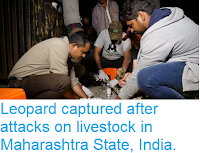
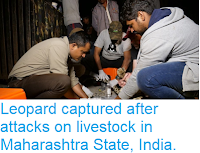
A Leopard has been captured by the Indian Forest Service following a series of attacks on livestock in the village of Pimpri Budruk in the Pune District of Maharashtra State, India. The village has suffered a series of attacks on Goats, Calves, and Dogs over the past month, but until now the culprit was unidentified. Then at about 5.30 pm local time on Friday 14 December 2018 a local woman spotted the Leopard drinking from a stream near the village, and the Forest Service was called in to deal with the animal. After some discussion with the local population it was decided that capturing the Leopard was the best option, and the animal, a female estimated to be about five years old, was shot with a tranquiliser dart and taken to a rescue centre in Manikdoh.

Veterinarians from the Indian Forest Service and Wildlife SOS examine a Leopard captured near a village in Pune District, Maharashtra on 14 December 2018. Asian News International/Twitter.

Leopards are considered to be Vulnerable under the terms of the International Union for the Conservation of Nature's Red List of Threatened Species, with the Indian subspecies, Panthera pardus fusca, considered to be particularly vulnerable due to India's rapidly rising Human population, which has resulted in agriculture and other Human activities expanding into many former wilderness areas. For this reason the Indian Forest Service usually try to relocate Leopards that come into conflict with Humans to more remote areas, preferably within national parks, though the extent to which local people co-operate is variable.

See also...

https://sciencythoughts.blogspot.com/2018/12/crocodile-attacks-man-in-karnataka.htmlhttps://sciencythoughts.blogspot.com/2018/12/atractosteus-spatula-alligator-gar.html
https://sciencythoughts.blogspot.com/2018/10/woman-attacked-by-crocodile-in-odisha.htmlhttps://sciencythoughts.blogspot.com/2018/04/crocodile-kills-fourteen-year-old-boy.html
https://sciencythoughts.blogspot.com/2018/04/woman-attacked-by-leopard-in-rajasthan.htmlhttps://sciencythoughts.blogspot.com/2018/03/lepidochelys-olivacea-olive-ridley.html
Follow Sciency Thoughts on Facebook.