Showing posts with label Martinique. Show all posts

Saturday, 21 December 2019

Cerrorchestia taboukeli: A new species of Terrestrial Amphipod from Martinique Island.

Amphipods are (mostly) small, laterally compressed Crustaceans with differentiated legs (i.e. not all their legs are the same). Female Amphipods carry their eggs in brood pouches till they hatch; the young resemble the adults and typically reach maturity after about six molts. Amphipods are extremely widespread and numerous, but often overlooked due to their small size, most species being under 10 mm, though giant species exceeding 30 cm are known from the deep oceans. Amphipods are found in almost all modern marine ecosystems, as well as many freshwater environments; most freshwater 'Shrimps' are Amphipods, as are the terrestrial  and semi-terrestrial Taltrids, known variously as Sandhoppers, Beachhoppers, Fieldhoppers, and Foresthoppers.

In a paper published in the European Journal of Taxonomy on 12 December 2019, Christophe Piscart of Université de Rennes, Khaoula Ayati of the Faculté des Sciences de Bizerte at the Université de Carthage, and Mathieu Coulis of Le Lamentin on Martinique, describe a new species of Foresthopper from Martinique.

The Caribbean Region is inhabited by 21 terrestrial or semi-terrestrial species of Talitrids. These species belong to ten genera (Cariborchestia, Caribitroides, Cerrorchestia, Chelorchestia, Floreorchestia, Mexitroides, Platorchestia, Talitroides, and Talorchestia) and can be pooled into three different ecological groups (Beachhoppers, Fieldhoppers and Foresthoppers) according to their environmental distribution and morphological adaptations. Almost half of the Caribbean species belong to the Beachhopper and Fieldhopper groups, with 11 species that could be considered as Foresthoppers, known from the rain and cloud forests of the Greater Antilles islands and Central America. In the Lesser Antilles, six Amphipod species are known (Floresorchestia guadalupensis, Hyalella caribbeana, Platorchestia platensis, Amphiatlantica sulensoni, Tethorchestia antillensis,  and Tethorchestia karukarae), all from sandy beaches, lakes and ponds on Guadeloupe. No terrestrial species are known to date. Moreover, there is no knowledge on the distribution of Amphipods on Martinique Island, prior to the exploration of Pitons du Carbet mountain range carried out in 2017 and 2018, when a new species of Foresthopper was found during samplings of the soil Arthropods of the tropical sub-mountain rainforest.

Amphipods were sampled in the mountain range of Pitons du Carbet on Martinique Island where they
occur above 1000 m in small forest patches distributed around the summits and high plateaus. The vegetation has the characteristic of a cloud forest, i.e., it is subjected to high precipitation (mean annual rainfall above 6000 mm), high nebulosity (mistiness) and epiphytic plants are very abundant. The species was found in the litter layer of the Mountain Mangrove, Clusia mangle, and Umbrella Plant, Schefflera attenuata, which are the two dominant tree species of the area. Amphipods were found at two localities, the pass between the Piton Alma and Piton Dumauzé, at an altitude of 1045 m, and on the top of the Piton Boucher, at an altitude of 1059 m.

The new species is placed in the Foresthopper genus Cerrorchestia, which is otherwise known from similar environments in Panama to Costa Rica, and given the specific name taboukeli, which derives from ‘Taboukéli oüébo’, meaning ‘summit of the mountain’ in the in the Kalinago language of the the pre-Colombian inhabitants of Martinique Island. The species is sexually dimorphic (i.e. the sexes are different in size and shape), with the males having a greatly enlarged second claw, and being slightly larger, with the described male specimen being 11.3 mm in length, while the described female specimen is 9.6 mm. 

Cerrorchestia taboukeli, male specimen in lateral view. Piscart et al. (2019).

Cerrorchestia taboukeli was found in very wet conditions of the Pitons du Carbet Mountain Range (annual precipitation higher than 6000 mm per year) always at an altitude higher than 1000 m. At this altitude, the cloud forest is sparse, alternating with mountain grassland. Cerrorchestia taboukeli was found only under tree patches in a shaded environment where leaves of Mountain Mangroves and Umbrella Plants create a thick litter layer on the soil. During daylight, the animals rest almost motionless under the leaf litter unless disturbed, in which cases they actively jump in search for shelter.

Cerrorchestia taboukeli, live specimen. Piscart et al. (2019).

Using a quadrat of 25 × 25 cm, the population density was estimated to be, on average, 196 individuals per square meter. The sex ratio of adults was biased toward females, and juveniles represented more than 75% of the population during the sampling period. The species live in leaf litter of cloud forest with an andosol developed on volcanic rocks (andesite).

See also...

https://sciencythoughts.blogspot.com/2017/02/persistent-organic-pollutants-in.htmlhttps://sciencythoughts.blogspot.com/2016/12/epimeria-abyssalis-new-species-of.html
https://sciencythoughts.blogspot.com/2016/10/rosagammarus-minichiellus-not-amphipod.htmlhttps://sciencythoughts.blogspot.com/2015/12/phoxocephalus-tiomanensis-new-species.html
https://sciencythoughts.blogspot.com/2014/11/a-new-species-of-wormshrimp-from-gura.htmlhttps://sciencythoughts.blogspot.com/2014/11/a-new-species-of-wormshrimp-from.html
Follow Sciency Thoughts on Facebook.

Saturday, 29 September 2018

Magnitude 5.4 Earthquake to the northeast of Martinique Island, Lesser Antilles.

The United States Geological Survey recorded a Magnitude 5.4 Earthquake at a depth of 74.6 km roughly 67 km northeast Martinique in the Lesser Antilles, slightly after 8.300 am local time slightly after 12.30 pm GMT) on Friday 28 September 2018. This was a moderate quake, and at some depth as well as some way offshore, and there are no reports of any casualties or serious damage, though the quake was felt on Guadeloupe, Dominica, Martinique, St Lucya and St Vincent and the Grenadines.

The approximate location of the 28 September 2018 Lesser Antilles Earthquake. USGS.

The Lesser Antilles are located at the eastern fringe of the Caribbean Tectonic Plate. The Atlantic Plate (strictly speaking, an extension of the South American Plate which runs to the northeast of the Caribbean) is being subducted beneath this, and as it sinks into the Earth, is melted by the heat of the planets interior. Some of the melted material then rises up through the overlying Caribbean Plate as magma, fuelling the volcanoes of the Lesser Antilles Volcanic Arc. The subduction of the Atlantic Plate beneath the Caribbean Plate is not a smooth process, with the two plates constantly sticking together then breaking apart as the tectonic pressure builds up, causing Earthquakes in the process, though since the boundary between the two plates is some way to the east of the islands, Earthquakes in the Lesser Antilles tend to be both deep and offshore, which lessens their destructive potential.

 The subduction of the Atlantic Plate beneath the Caribbean Plate fuels the volcanoes of the Lesser Antilles Volcanic Arc. George Pararas-Carayannis.

Witness accounts of Earthquakes can help geologists to understand these events, and the structures that cause them. The international non-profit organisation Earthquake Report is interested in hearing from people who may have felt this event; if you felt this quake then you can report it to Earthquake Report here. 

See also...

https://sciencythoughts.blogspot.com/2018/09/magnitude-52-earthquake-in-monte-cristi.htmlhttps://sciencythoughts.blogspot.com/2018/09/tropical-storm-gordon-makes-landfall-on.html
https://sciencythoughts.blogspot.com/2018/08/sternula-antillarum-hundreds-of-least.htmlhttps://sciencythoughts.blogspot.com/2018/08/evacuations-as-city-of-lynchburg.html
https://sciencythoughts.blogspot.com/2018/07/hundreds-of-sea-turtles-washing-up-dead.htmlhttps://sciencythoughts.blogspot.com/2018/06/aurelia-sp-over-800-bathers-stung-by.html
Follow Sciency Thoughts on Facebook.

Saturday, 16 September 2017

Magnitude 4.6 Earthquake to the northeast of Martinique Island.

The United States Geological Survey recorded a Magnitude 4.6 Earthquake at a depth of 55.3 km roughly 49 km northeast of the town of Petite Riviere Salee on the French island of Martinique in the Lesser Antilles, at about 4.15 am local time (about 10.15 am GMT) on Friday 15 September 2017. This was a moderate quake, and at some depth as well as some way offshore, and there are no reports of any casualties or serious damage, though the quake was felt on Martinique and St Lucia.

The approximate location of the 15 September 2017 Martinique Earthquake. USGS.

The Lesser Antilles are located at the eastern fringe of the Caribbean Tectonic Plate. The Atlantic Plate (strictly speaking, an extension of the South American Plate which runs to the northeast of the Caribbean) is being subducted beneath this, and as it sinks into the Earth, is melted by the heat of the planets interior. Some of the melted material then rises up through the overlying Caribbean Plate as magma, fuelling the volcanoes of the Lesser Antilles Volcanic Arc. The subduction of the Atlantic Plate beneath the Caribbean Plate is not a smooth process, with the two plates constantly sticking together then breaking apart as the tectonic pressure builds up, causing Earthquakes in the process, though since the boundary between the two plates is some way to the east of the islands, Earthquakes in the Lesser Antilles tend to be both deep and offshore, which lessens their destructive potential.

 The subduction of the Atlantic Plate beneath the Caribbean Plate fuels the volcanoes of the Lesser Antilles Volcanic Arc. George Pararas-Carayannis.

Witness accounts of Earthquakes can help geologists to understand these events, and the structures that cause them. The international non-profit organisation Earthquake Report is interested in hearing from people who may have felt this event; if you felt this quake then you can report it to Earthquake Report here.
 
See also...
 
http://sciencythoughts.blogspot.co.uk/2017/05/shipping-warning-issued-after-eruption.htmlhttp://sciencythoughts.blogspot.co.uk/2017/03/magnitude-45-earthquake-to-north-of-st.html
http://sciencythoughts.blogspot.co.uk/2017/02/magnitude-56-earthquake-to-northeast-of.htmlhttp://sciencythoughts.blogspot.co.uk/2016/12/magnitude-59-earthquake-off-coast-of.html
http://sciencythoughts.blogspot.co.uk/2015/10/magnitude-45-earthquake-in-lesser.htmlhttp://sciencythoughts.blogspot.co.uk/2013/12/five-people-killed-by-landslide-in-st.html
Follow Sciency Thoughts on Facebook. 

Friday, 3 February 2017

Magnitude 5.6 Earthquake to the northeast of Martinique.

The United States Geological Survey recorded a Magnitude 5.6 Earthquake at a depth of 35.1 km roughly 62 km northeast of the town of Sainte-Marie on the French island of Martinique in the Lesser Antilles, slightly before 3.55 pm local time (slightly before 7.55 pm GMT) on Friday 3 February 2017. This was a large quake, but at some depth as well as some way offshore, and there are no reports of any casualties or serious damage, though the quake was felt over a large area, with people reporting feeling it across Guadeloupe, Dominica, Martinique, Saint Lucya, and Saint Vincent and the Grenadines.

The approximate location of the 3 February 2017 Martinique Earthquake. USGS.

The Lesser Antilles are located at the eastern fringe of the Caribbean Tectonic Plate. The Atlantic Plate (strictly speaking, an extension of the South American Plate which runs to the northeast of the Caribbean) is being subducted beneath this, and as it sinks into the Earth, is melted by the heat of the planets interior. Some of the melted material then rises up through the overlying Caribbean Plate as magma, fuelling the volcanoes of the Lesser Antilles Volcanic Arc. The subduction of the Atlantic Plate beneath the Caribbean Plate is not a smooth process, with the two plates constantly sticking together then breaking apart as the tectonic pressure builds up, causing Earthquakes in the process, though since the boundary between the two plates is some way to the east of the islands, Earthquakes in the Lesser Antilles tend to be both deep and offshore, which lessens their destructive potential.

 The subduction of the Atlantic Plate beneath the Caribbean Plate fuels the volcanoes of the Lesser Antilles Volcanic Arc. George Pararas-Carayannis.

Witness accounts of Earthquakes can help geologists to understand these events, and the structures that cause them. The international non-profit organisation Earthquake Report is interested in hearing from people who may have felt this event; if you felt this quake then you can report it to Earthquake Report here.

See also...

https://blogger.googleusercontent.com/img/b/R29vZ2xl/AVvXsEiOVrnH9LxYv_0xqompotqs_lQdAZWC0gwHUIVve6Pc7WpR1ebYKnxa89V9Oa-HwdKDVnJuGWIXRX8QII6OX-r7nT7lcLBxt6mAKJ7MDws1veJirwMDhyphenhyphengyeM9VkJ_Ydx8gIkQ5_tgrVi4/s200/Magnitude+4.5+Earthquake+in+the+Lesser+Antilles..png
http://sciencythoughts.blogspot.co.uk/2016/12/magnitude-59-earthquake-off-coast-of.html
 
http://sciencythoughts.blogspot.co.uk/2013/12/five-people-killed-by-landslide-in-st.html

http://sciencythoughts.blogspot.co.uk/2012/03/volcanic-activity-on-soufriere-hills.html
http://sciencythoughts.blogspot.co.uk/2013/10/magnitude-61-earthquake-of-north-coast.html

Follow Sciency Thoughts on Facebook. 

Saturday, 26 March 2016

Jahnula purpurea: A new species of Ascomycote Fungo from Martinique.

Ascomycote Fungi of the order Jahnulales are aquatic wood decomposing Fungi found almost exclusively in freshwater environments (one species is known from Mangroves). Members of the genus Jahnula, from which the family gets its name, are primarily tropical in distribution, though some temperate species are known.

In a paper published in the journal MycoKeys on 9 March 2015, Jacques Fournier of Rimont in France, Huzefa Raja of the Department of Chemistry and Biochemistry at the University of North Carolina, and Carol Shearer of the Department of Plant Biology at the University of Illinois, Urbana, describe a new species of Jahnula from a river on Martinique Island in the Lesser Antilles.

The new species is named Jahnula purpurea, meaning 'purple', in reference to the colour which the Fungus stains the wood it lives on. This has never previously been seen in a member of the Jahnulales, and while other wood-decomposing Fungi are known to produce purple stains, these are not closely related to, and could not easily be confused with, the Jahnulales.

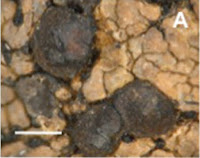
Jahnula purpurea, Ascomata on submerged wood. Note the purple stain. Scale bar is 500 μm. Fournier et al. (2015).

Jahnula purpurea has exceptionally small ascomata (fruiting bodies) for a member of the Jahnula. This has been seen only in one previous member of the genus, Jahnula marakotii, from peat swamps in Thailand, but this is quite dissimilar to Jahnula purpurea both in morphology and habitat.

Asci of Jahnula purpurea. Scale bars are 20 μm. Fournier et al. (2015).

See also...

http://sciencythoughts.blogspot.co.uk/2014/11/an-unusual-pucciniomycote-fungus-from.htmlAn unusual Pucciniomycote Fungus from Ecuador.                                                               Pucciniomycote Fungi (Rusts etc.) typically produce microscopic fruiting bodies, though a few do produce larger sporocarps, typically with a basal spore producing area, with spores being expelled through some sort of structure above this. However the production of such bodies seems to be scattered...
http://sciencythoughts.blogspot.co.uk/2014/11/a-new-species-of-lichen-infecting.htmlA new species of Lichen-infecting parasitic Fungus from Scandinavia.                                  Lichens are symbiotic organisms, each consisting of a Fungus and an Alga, the Fungus obtaining nutrients from the substrate (surface upon which the Lichen sits), while the Alga produces carbohydrates through photosynthesis. They the Fungi and Algae involved..
http://sciencythoughts.blogspot.co.uk/2014/10/the-cause-of-pink-spot-disease-on.htmlThe cause of Pink Spot Disease on Guavas in South Africa.                                                           Guavas, Psidium guajava, are fruit bearing trees in the Myrtle Family, Myrtaceae, closely related to Eucalyptus. They are native to Mexico, Central America and the Caribbean Islands, but have been introduced to many countries as a commercial fruit crop, the largest producers being Mexico, India and Brazil. Like most...
Follow Sciency Thoughts on Facebook.

Sunday, 4 October 2015

Magnitude 4.5 Earthquake in the Lesser Antilles.

The United States Geological Survey Recorded a Magnitude 4.5 Earthquake at a depth of 63 km iabout 50 km to the northeast of the island of Martinique in the Lesses Antilles, at about 1.30 pm local time (about 6.30 pm GMT) on Thursday 1 October 2015. This event was felt across much of the island, though there are no reports of any damage or casualties; which is roughly what would be expected from an Earthquake of this size at this depth; the quake is big enough to be felt over a wide area, but most of its energy has dissipated before the shock-waves reach the surface.

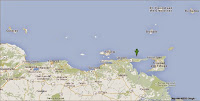
The approximate location of the 1 September 2015 Lesser Antilles Earthquake. Google Maps.

The Lesser Antilles are located at the eastern fringe of the Caribean Tectonic Plate. The Atlantic Plate is being subducted beneath this, and as it sinks into the Earth, is melted by the heat of the planets interior. Some of the melted material then rises up through the overlying Caribbean Plate as magma, fueling the volcanoes of the Lesser Antilles Volcanic Arc. The subduction of the Atlantic Plate beneath the Caribbean Plate is not a smooth process, with the two plates constantly sticking together then breaking apart as the tectonic pressure builds up, causing Earthquakes in the process, though since the boundary between the two plates is some way to the east of the islands, Earthquakes in the Lesser Antilles tend to be both deep and offshore, which lessens their destructive potential.

The subduction of the Atlantic Plate beneath the Caribbean Plate fuels the volcanos of the Lesser Antilles Volcanic Arc. George Pararas-Carayannis.

Witness accounts of Earthquakes can help geologists to understand these events, and the structures that cause them. The international non-profit organization Earthquake Report is interested in hearing from people who may have felt this event; if you felt this quake then you can report it to Earthquake Report here.

See also...

The United States Geological Survey recorded a Magnitude 5.2 Earthquake at a depth of 76.0 km roughly 15 km north of the the Paria Peninsula on the north...

The United States Geological Survey recorded a Magnitude 4.7 Earthquake at a depth of 20.8 km off the south coast of the Dominican Republic, slightly...


The United States Geological Survey recorded a Magnitude 4.8 Earthquake at a depth of 10 km in San Cristóbal Province in the southwest of the...


Follow Sciency Thoughts on Facebook.